Hut 8 has received a conditional Base Load classification in ERCOT’s Batch Zero Process for Beacon Point, a step forward in the energization process. We remain focused on working closely with our transmission and distribution service provider, ERCOT, regulators, and local stakeholders as the project advances.
I have spent money money on consultant calls with to TX power and political consultants than I care to admit.
My key takeaways for $HUT
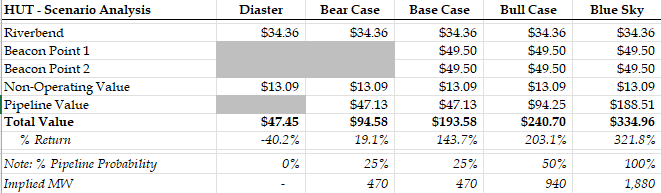
1) Extremely likely that Beacon Point will get energized before the end of 3Q27 (worse case) with a 1Q / early 2Q energization date more likely.
2) If they get power by early 2Q the company can still hit its target monetization date in 3Q.
3) If the monetization date is delayed by a few months it’s not a big deal - every month is $44m of EBITDA of one-time loss.
4) In the low probability scenario that Beacon Point is a complete zero the company has a lot of other shots on goal and the stock could be okay (it would go down a TON first!)
$HUT $WUFL $CIFR $APLD
Understand that the anti-data center movement is, at its core, a deindustrialization movement. So of course China is pushing it.
The US is manufacturing, at scale, the most valuable resource in the modern economy: artificial intelligence. But already, the NIMBY/anti-AI coalition wants to offshore the means of production.
How did that work out for us when we moved the manufacturing of steel, electronics, and other critical industries to East Asia?
Well, it worked out great for China, but decimated America's Heartland.
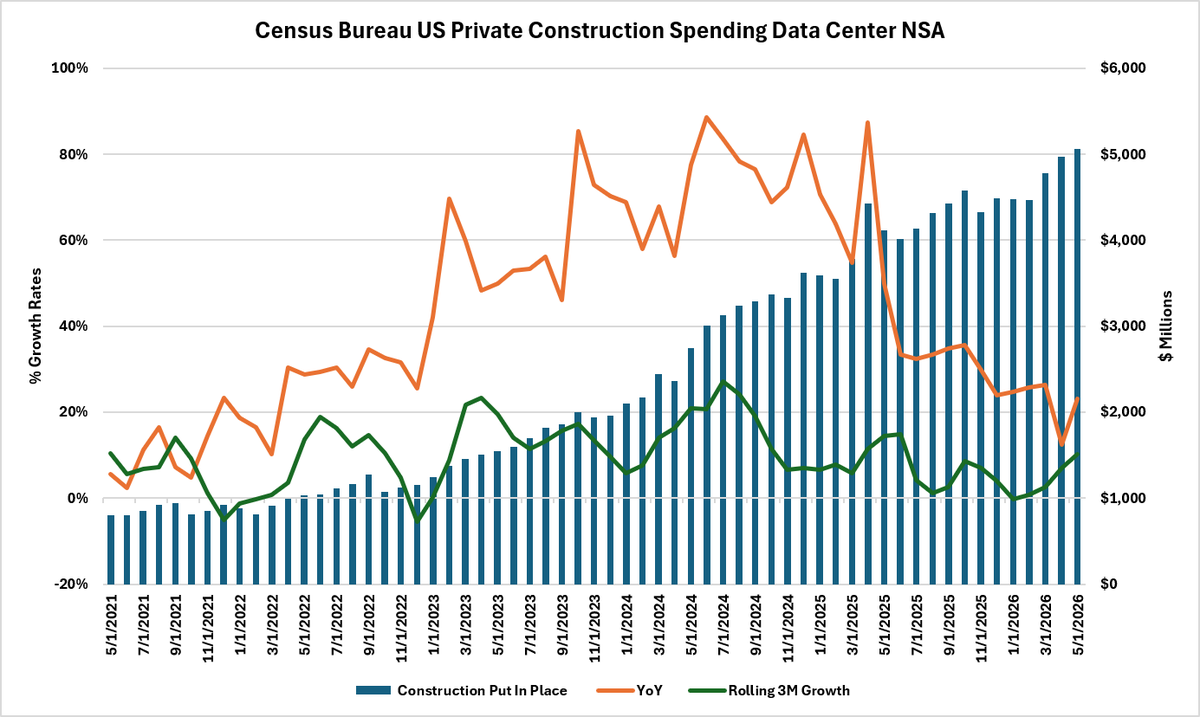
Now notice the overlap between the regions hit hardest by the China Shock (chart I) in the 2000s vs. the areas where the data center buildout is currently strongest (chart II).
This is a great American comeback story, the hour of the Rust Belt's industrial renaissance. For the first time in decades, we have a chance to reclaim industrial supremacy in the very sector that will determine the future of the global economy.
These are the stakes, and our enemy understands them better than most members of Congress.
The USA hates data centres, meanwhile they're becoming one of the best growth drivers in the country!
The mainstream media needs to report on THIS rather than the fake news they have been spreading (please share this!)
The data is CLEAR, counties with an OPERATING data centre crush the US avg. on home value, employment and job growth:
New housing units built: +50% vs +1%
Home values: +16% vs +7%
Unemployment: 3.4% vs 4.2%
Job growth: +3.8% vs +1%
And the tax side is fantastic too:
In Loudoun County, Virginia, data centers sit on about 4% of commercial parcels and throw off 38% of the county's entire general fund revenue. More than $100 million of NEW revenue/year!
Across northern Virginia data centers paid roughly $1.3 billion in local property taxes in 2024 alone (and this was as the boom was just getting started!)
The other states problems have no weight to them too. They use too much water?
US golf courses use roughly 2.08 billion gallons a day against data centers at about 449 million
Electricy costs are rising from Data Centres? Also not true. The opposite has been happening as Data Centers help to improve power generation within states or supply their own and sell the extra back to the grid.
And the last point to make here: Data Centers are what power AI.
The technology that is helping to treat cancer (as we saw with the recent Moderna announcement)
The technology that's increasing earnings across many companies in the USA and allowing them to hire more people
The technology that is allow anyone build a company cheaper and faster than ever before. AI is a net positive to the world and so are the data centres we need to power it
Don't let mainstream media continue to share bullshit fake news. Help share this content and spread the truth!
Don't forget to give me a follow @kylereidhead for more insights on AI and markets
@rev_cap Claude does not provide CYA (cover your ass). And if something gets f-ed up and you used Claude instead of lawyers and have no one to blame - you are f-ed!
In July alone, we've seen roughly $50B of data center co-location leases signed by former Bitcoin miners turned AI data center developers.. All on attractive terms, with investment-grade tenants (or IG backstops), and yields-on-cost ranging from 12%-15%:
- Core Scientific $CORZ with AMD $AMD: $14B TCV, 530MW IT load, 15 years (est. 12% YoC)
- Hut 8 $HUT with NVIDIA $NVDA: $9.8B TCV, 352MW, 15 years (est. 15% YoC)
- CleanSpark $CLSK (undisclosed high-IG tenant): $6.6B TCV, 175MW, 20 years (est. 13% YoC)
- TeraWulf $WULF with Anthropic: $19B TCV, 401MW, 20 years (est. 13% YoC)
These names (and others such as Cipher Digital $CIFR, Galaxy Digital $GLXY, Applied Digital $APLD) are often bucketed within the broader "AI Infrastructure" basket of various hardware and components manufacturers, neoclouds, etc.. But their business model is entirely different as their leases provide for 15-20 year streams of predictable, recurring cash flows. A few years ago, a 10%+ yield on cost for a 20-year, investment-grade hyperscaler lease would have been unheard of.. Now these new developers are earnings returns significantly above legacy data center developers.
Last month, valuations looked somewhat extended.. But a month later, with these names down 25%+ pretty much across the board, valuations as a whole look much more compelling as forward earnings are materially higher due to these recently announced deals. And by all accounts, more of these leases should be coming soon..
Well that escalated quickly!
$HUT announced another deal - 2nd phase of the Beacon Point deal with $NVDA. Same terms as phase 1 - 15 year initial term, triple net, $1.86 NOI/MW ($653 average annual), fully backed by NVDA. At 19x EV/EBITDA the equity value of this deal is worth $65 per share.
All in $HUT now has $1.75B of contracted NOI over 15 year terms with renewals, triple net fully backed by NVDA and GOOGL. Adjusted for future capex the stock now has an EV of $21B so trades at 12x stabilized NOI and 15x first year NOI (2028/2029 as these facilities ramp). So the stock is trading at half the multiple that private market DCs are trading at (27x)
Looking at my computer monitors and seeing a sea of red contrasted against a slew of positive fundamental data points I see opportunity. For a while, I have been a huge fan of the former BTC miners turned data center developers $HUT $WUFL $APLD $CIFR
These companies are signing multi-decade triple net leases with all payments fully backed by the full faith and creditworthiness of the hyperscalers. Relative to most other parts of the AI trade - investors are not taking on multiple and duration risk in these names. These are stable, long-term contracted cash flows. Eventually these companies will convert to REITs and be bought up by investors who have no idea what a GPU is!
Right now these companies are trading at a material discount to the deals that they have already signed. Per my math, on average the 4x names are trading at 18x EV/EBITDA, a massive discount to what data centers are transacting for in the private markets (25-27x EV/EBITDA). Even if we assume discounted multiples (low-20x) I see +35-40% upside in these names just from the DCs being built and these becoming "stabilized assets"
Furthermore, these companies have more power to sell and power is a very hot commodity these days! There has been $51B+ of total deal value announced YTD. An average size deal these days results in ~$8.5B of equity value created which works out to +70-80% upside in each name at current prices.
$HUT $WULF $APLD $CIFR
So much drama on here. Half my feed thinks that the hyperscalers are going to cut capex dramatically and crater AI stocks, the other half thinks that they are going to go deep into debt and spend way more than expected. My gut tells me its somewhere in between.
Hyperscaler EBITDA is expected to grow +25% over the next several years. Lets just say that capex grows inline with EBITDA growth going forward - so the hyperscalers run FCF breakeven with net cash on the balance sheet. Seems like a responsible way to run their businesses while continuing to invest aggressively.
In this world - the AI capex complex would grow revenue grows at 25% going forward (potentially more with incremental demand from enterprise + sovereign). Presumably earnings would grow faster due to operating leverage and capital returns (buybacks). So lets call it 25-30% EPS growth.
On average the AI stocks trade at ~27x P/E... so as a whole I would call them fairly priced. Obviously there will be some that out/under grow, product cycles within this, etc. But as a whole the trade seems fairly priced and still fast growing so decent returns to be made my holding multiples flat to downish while EPS compounds at 25-30%
Looking at my computer monitors and seeing a sea of red contrasted against a slew of positive fundamental data points I see opportunity. For a while, I have been a huge fan of the former BTC miners turned data center developers $HUT $WUFL $APLD $CIFR
These companies are signing multi-decade triple net leases with all payments fully backed by the full faith and creditworthiness of the hyperscalers. Relative to most other parts of the AI trade - investors are not taking on multiple and duration risk in these names. These are stable, long-term contracted cash flows. Eventually these companies will convert to REITs and be bought up by investors who have no idea what a GPU is!
Right now these companies are trading at a material discount to the deals that they have already signed. Per my math, on average the 4x names are trading at 18x EV/EBITDA, a massive discount to what data centers are transacting for in the private markets (25-27x EV/EBITDA). Even if we assume discounted multiples (low-20x) I see +35-40% upside in these names just from the DCs being built and these becoming "stabilized assets"
Furthermore, these companies have more power to sell and power is a very hot commodity these days! There has been $51B+ of total deal value announced YTD. An average size deal these days results in ~$8.5B of equity value created which works out to +70-80% upside in each name at current prices.
$HUT $WULF $APLD $CIFR
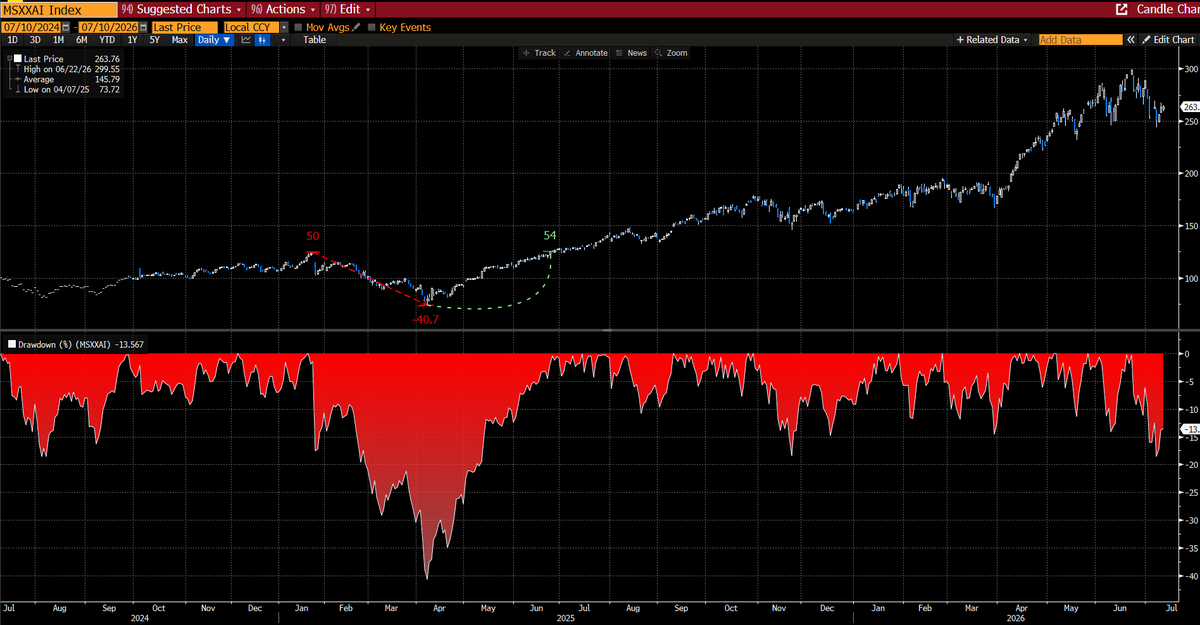
The AI trade has pulled back ~20% over the last few weeks - inline with the numerous pullbacks that the trade has had along the way (ex DeepSeek + Tariffs in early 2024).
This presents yet another compelling entry point. In the face of weak price action there have been a number of positive developments:
1/ Silicon Data showing contracted rental rates continuing to increase in July + their spot price indexes (B200) increasing +10% over the last week alone
2/ Anthropic ARR data (Yipit) hitting $69B and accelerating to +28% MoM growth!
3/ $META headlines saying that their compute will 2x in 2026 and 2027 and the street dramatically revising up capex estimates
4/ $META and $SPCX models coming out of nowhere and giving $OAI and $ANTH models a run for their money
@BigJohn043 Highly dependent on the family. Some are like that, but most that I have interacted with (and worked at) are more like institutional PE firms and very focused on deals and strategies where they have a unique edge.
The data points keep stacking up that the $META "excess compute" scare is a nothing burger.
Yesterday $WULF announced a record sized and priced (for a BTC miners) compute deal with Anthropic. NOI/MW $2.01 versus $HUT previous highwater mark of $1.86, total deal value record $19B, and unlevered yield on cost ~18% versus $HUT previous highwater mark of ~17%.
Today the same guys (Bloomberg) who created the scare wrote "Despite those efforts, Meta is still hungry for even more computing power, the spokesperson said. It is still moving forward with plans for expensive new data centers and recently inked major computing deals with CoreWeave Inc., Alphabet Inc.’s Google and Oracle Corp., among others."
Markets were jittery this week on news reports that Meta may be selling compute, raising concerns about excess supply. We thought we’d share some perspective using our rental term curves on why this news, if true, doesn’t have to be bearish for GPU rental prices.
Last year, ahead of the agentic AI boom, Meta aggressively locked in a large amount of compute capacity. It quite possibly secured more than it ultimately needed. It was a smart strategic bet to secure scarce supply early, with the flexibility to either deploy it internally or sell excess into a tight market. They acquired valuable real options at the time.
As recently as last November, the compute market looked very different. Spot and forward GPU rental rates were much lower, and the term curve was sharply backwardated. This is classic commodity behavior when the market anticipates new supply coming online and pressuring prices lower.
Since then, the picture has changed dramatically. As shown in our H100 term rate curves below, the entire curve has both risen sharply in level and flattened significantly, moving out of its steep backwardation.
In fact, rental rates have firmed further around the 1-year term over just the past week (Jun 25 – Jul 2), with multiple providers raising prices. For all the concern about a glut, the rental market is doing the opposite of pricing one in: rates are firming, not softening.
It now makes perfect financial sense for Meta to shed some of its older secured capacity while continuing to invest in newer, more powerful clusters. The real option they purchased has appreciated meaningfully. At the same time, demand for their specific models and use cases may not have materialized as strongly or as quickly as anticipated. This looks like firm-level rebalancing rather than a signal about the broader market.
Reallocating from legacy commitments toward frontier hardware is what a maturing market looks like: optimization, not weakness. Little in our data suggests the demand tailwinds from agentic AI and inference are softening. If anything, the term structure of GPU rental rates points to a market that’s tightening, not loosening.
Our forward and term curves are updated daily at https://t.co/STEPGF4ovj.
Happy Fourth! 🇺🇸🎆