Low IQ schizo Sudanese man somehow coordinates all this by himself.
Works out the loopholes in immigration law and everything.
Who helped him?
Every person and organisation involved should be held accountable.
@whiterabbiremix@bAnthonYsr On paper, we’ll be more likely to see a spike in the rate again. It’s basic math: the denominator is small, which is the black population. It doesn’t take that many offenders to cause a spike in the rate. You should have learned that in grade school.
June 8, 1940. Four days after Dunkirk, Britain lost 1,519 sailors in the Arctic Ocean. Almost no one talked about it. The government made sure of that.
Here's the full story, and it gets darker the deeper you go.
HMS Glorious was an aircraft carrier returning from Norway, where she had just pulled off something genuinely miraculous. RAF Hurricane pilots, flying planes never designed to land on a carrier, with no tail hooks and no training, somehow put their aircraft down on her deck anyway. It had never been done before. They saved the planes that would go on to fight in the Battle of Britain.
The ship should have been sailing home as a hero.
Instead, Captain Guy D'Oyly-Hughes had stripped her of her defenses.
D'Oyly-Hughes was a decorated WWI submarine legend, the kind of officer whose reputation had become a shield against criticism. But aboard Glorious, he had spent months feuding with his senior aviator, Commander Heath, who had refused to send his planes on a vague and suicidal attack run against German shore targets. D'Oyly-Hughes considered this insubordination. He had Heath arrested and thrown off the ship.
That decision had a consequence nobody predicted.
With Heath gone, Glorious had no combat air patrol flying. No planes in the sky watching for threats. And because D'Oyly-Hughes was in a hurry to get back to Scotland to personally oversee Heath's court martial, he requested permission to detach from the convoy and race home independently, with only two small destroyers for escort.
The Admiralty said yes.
On June 8, two German battlecruisers, Scharnhorst and Gneisenau, spotted a wisp of smoke on the Arctic horizon. They closed at full speed. Glorious had no radar. No aircraft up. No warning at all. By the time her crew understood what was happening, German shells were already tearing through the flight deck.
The battle lasted less than two hours. Glorious went down. Then Ardent. Then Acasta, though not before Acasta's crew, knowing they were dead, turned back toward the German fleet and fired their last torpedoes. One hit Scharnhorst. A final defiant act from men who had no chance.
1,519 men went into the Arctic water.
The sea temperature was just above freezing.
Norwegian vessels found survivors nearly three days later.
40 men were still alive.
The Admiralty convened a Board of Inquiry within days. Then they sealed the findings until 2041.
Not until the 1980s did naval historian Captain Stephen Roskill publish testimony suggesting the entire disaster traced back to one captain's personal vendetta against one officer, and to an institution too proud to question a war hero's judgment. The inquiry findings that could confirm or deny this remain classified for another 15 years.
1,519 people. A captain racing home for a court martial. A government that buried the story under Dunkirk's shadow.
We still don't know everything.
Teenagers trying to get summer jobs in 1985 didn't have to compete with illegals from Dorkistan, with student guest workers from Belarus, with Indians and Chinese with extended families, in-group clannish advantages, and cutthroat mentalities, with a greed-based society that values nothing except money, with the decay of the social fabric, and with many other factors to their detriment.
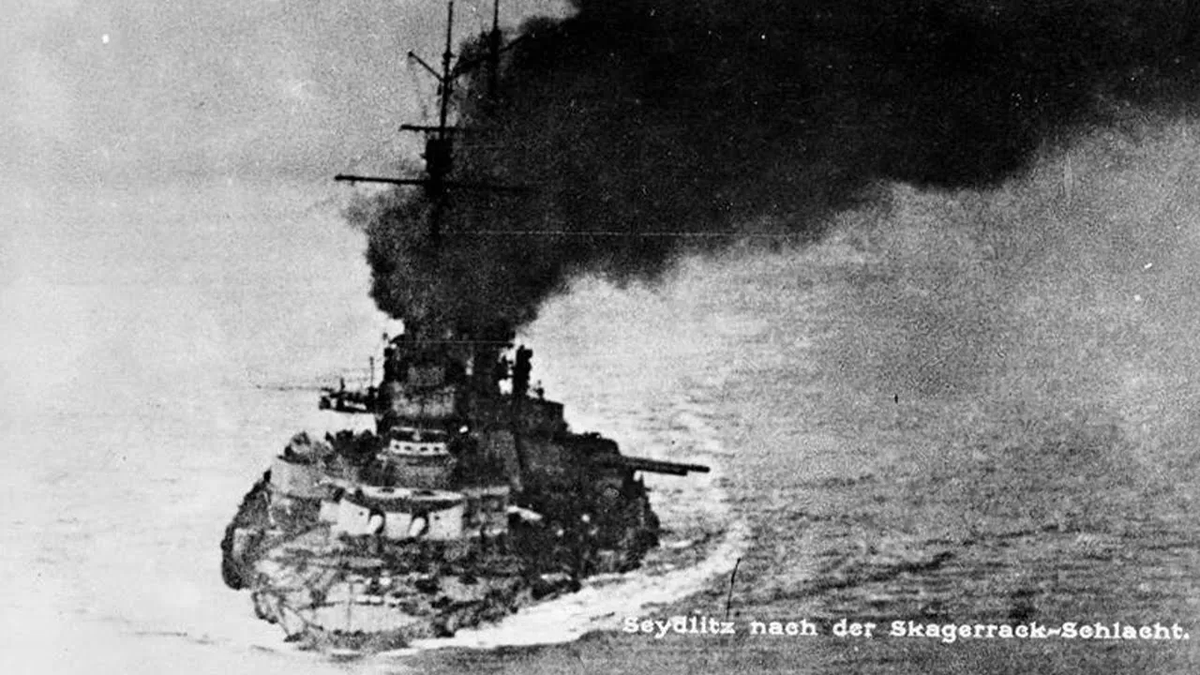
110 years ago today, the most battered warship in history limped home from the largest naval battle the world had ever seen. By every law of physics, she should have been dead. The reason she lived is one of the strangest stories of WW1.
This is the SMS Seydlitz.
To understand the miracle of June 1, 1916, you have to go back 16 months.
January 1915, the Battle of Dogger Bank. A British 13.5-inch shell from HMS Lion smashes into the rear of the Seydlitz and punches through the barbette of her aft turret. What happens next is every battleship sailor's nightmare. The blast ignites the cordite charges in the loading chamber, and a wall of fire flashes downward toward the magazines, where tons of high explosive sit waiting.
159 men die in seconds. Both aft turrets are gutted.
The ship is heartbeats away from being vaporized.
And then one man saves her. Pumpenmeister Wilhelm Heidkamp fights through the smoke to the flooding valves for the magazines. The valves are already glowing red hot from the fire. He turns them anyway, with his bare hands, flooding the magazines and drowning the explosion before it can reach the rest of the ship. He is horribly burned. The Seydlitz survives.
The Germans learn the lesson the British do not. They redesign their entire ammunition system: anti-flash doors in the hoists, tighter control of how much cordite sits exposed, ruthless discipline about propellant handling. The British shrug it off. That difference will get three British battlecruisers blown to pieces at Jutland a year later.
Now, June 1916.
At Jutland, the Seydlitz becomes the most shot-at ship in the battle. She is hit TWENTY-ONE times by heavy-caliber shells. A torpedo tears into her hull. A shell punches into the working chamber of a turret and sets it ablaze, and this time, because of the Dogger Bank reforms, the fire does NOT reach the magazines. The thing that should have killed her had already killed her once, and the Germans had built the cure.
But the damage is apocalyptic. She drinks in more than 5,300 tons of seawater. Her bow sinks so low that the only buoyancy left in the entire front half of the ship is one flooded torpedo room. Her freeboard drops to a couple of meters. She is, functionally, a submarine that hasn't finished sinking yet.
The journey home is a slow-motion nightmare. She lists 8 degrees with almost no stability left. She can barely make 3 knots. At times she has to travel STERN FIRST, sailing backwards across the North Sea, because her crushed bow can't take the waves head on. Pump steamers come alongside and breathe for her. A tug lays an oil slick to calm the sea. The crew prepares to abandon ship more than once.
And somehow, she makes it. She reaches the outer Jade river on June 2 and crawls into the Wilhelmshaven lock on June 3, so low and so flooded she has to be physically lightened just to clear the bar.
Sailors started calling her "the shell magnet." She had absorbed enough punishment to sink a small fleet, and she came home.
Here is the part that gives me chills.
Wilhelm Heidkamp, the burned pump master who saved her at Dogger Bank, was never forgotten. Decades later the German navy named a warship after him: the destroyer Z21 Wilhelm Heidkamp. In 1940 that destroyer led the German assault on Narvik, where it too was hit, exploded, and sank. The man who once drowned a magazine to stop an explosion gave his name to a ship that died by one.
Learn more here: https://t.co/eLFC0f5NCr