Thank you for adding your perspective, @hyderabaddoctor. Sharing a few references related to the points you raised:
Q1. Does gravity meaningfully reduce cerebral blood flow (CBF) in daily life?
A1. Across multiple CBF measurement modalities, studies consistently show that upright posture is associated with a lower CBF compared to the supine position. One recent example:
https://t.co/wmhxm5e6NR
Q2. Can cerebral autoregulation fully compensate for this reduction?
A2. Increasing evidence suggests autoregulation is not perfect:
Recent studies show that the effective autoregulatory range appears to be much narrower than previously assumed, closer to 80–100 mmHg MAP: https://t.co/CpTdTO6Jv5
CBF is not strictly constant even within the autoregulatory range: https://t.co/4yHdCZSQns
Q3. What can continuous measurement of CBF tell us?
A3. Even simple observations are informative. For example, prolonged sitting has been shown to reduce cerebral blood flow:
https://t.co/o4GQTzDjOQ
You’re right that a reduction in cerebral blood flow during upright idle posture may not be clinically relevant in isolation. The open question is whether this effect accumulates over decades. At present, we simply don’t know and that’s precisely what makes it worth studying.
You're welcome to read more here: https://t.co/W5UC7fjmns
Eager to hear your thoughts.
@aditya_gan3500, thanks for laying out the claims so clearly. Yes, humans do have sophisticated corrective systems like the baroreflex, muscle pump, autoregulation, and RAAS. But these mechanisms are not perfect, especially in the context of modern sedentary lifestyles where, as you mentioned, blood tends to pool in the lower extremities and we don’t engage the muscle pump enough to bring it back into circulation.
Evolution has always prioritized reproductive fitness, not lifelong maintenance. Antagonistic pleiotropy and the gradual decline of baroreflex and vascular reserve with age explain why orthostatic control deteriorates beyond our reproductive years. This idea is central to our work and we focus on the cumulative, lifetime load of gravity rather than just overt orthostatic hypotension.
There’s even a popular reference to this in the book Sitting Kills by the former Director of Life Sciences at NASA, which emphasises how chronic inactivity amplifies the effects of gravity on our physiology.
Orthostatic hypotension significantly increases all-cause mortality risk (RR ≈ 1.4) [PMID: 23878177]. It’s a clear example of how even moderate failures in orthostatic compensation can cascade into systemic health outcomes.
Eager to hear your perspective.
Yes, you're right @drgunjad. we've covered cerebral autoregulation in detail with the scientific evidence.
A few key points:
1. The effective autoregulation range is narrower than previously believed, closer to ~80–100 mmHg MAP: https://t.co/DL0Y6arsuB
2. It has also been shown that CBF is not constant even within the autoregulation range. https://t.co/4yHdCZSQns
More here: https://t.co/RRUIMmpm7p
Eager to hear your thoughts.
That's a very interesting observation @AbhiLenka11 @kavya9213140. You’re right, giraffes have extremely specialised baroreflex adaptations to handle the huge orthostatic load from the long vertical distance between the heart and brain.
Their arterial pressure is roughly 2–2.5× that of humans. In humans, the ANS, blood pressure regulation, baroreflexes, and even muscle pumps do a decent job through mid-life, but these systems gradually weaken with age, making it harder to maintain adequate upward perfusion.
The website doesn’t call gravity the primary driver but it could be an understated and poorly understood contributor.
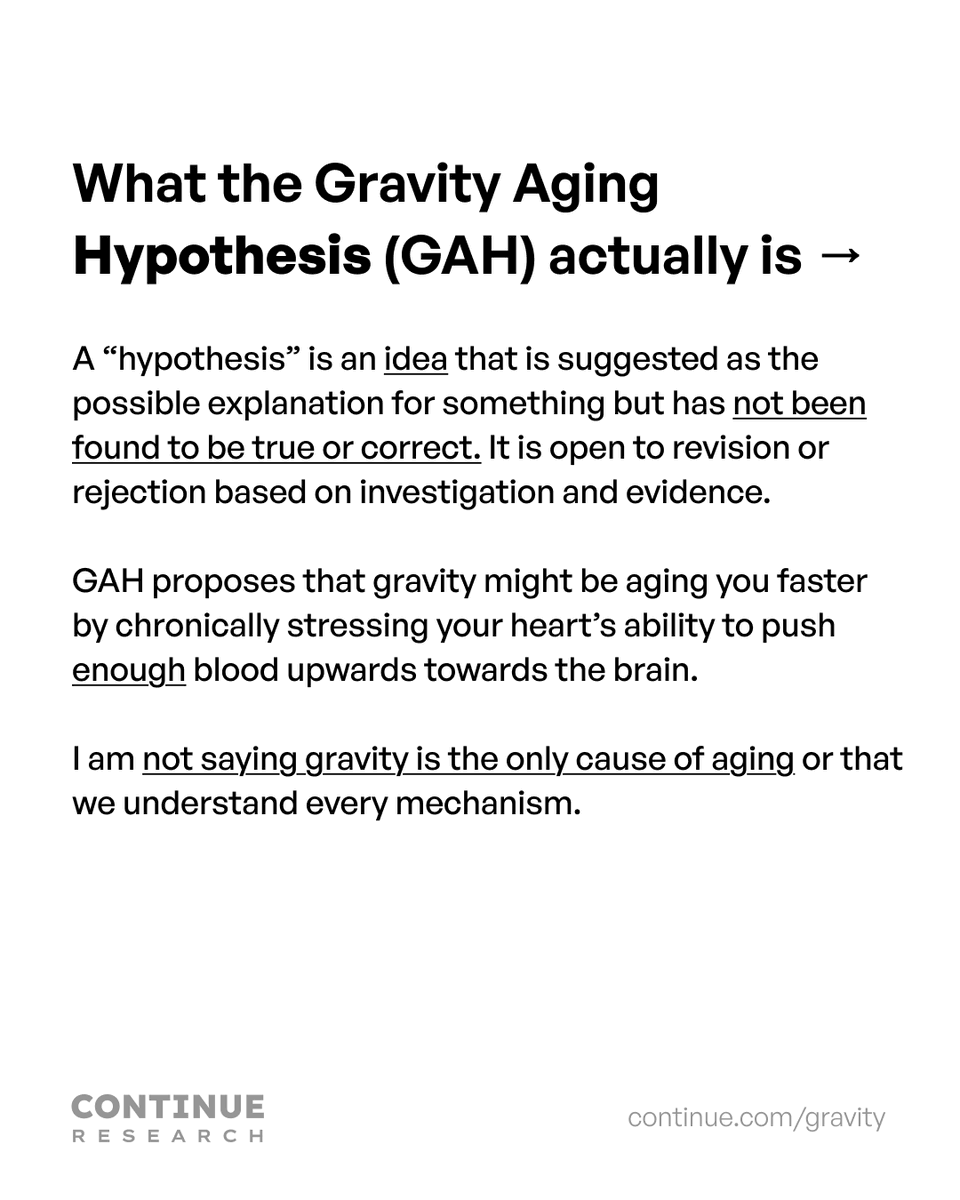
I did not explain the Gravity Aging Hypothesis (GAH) well, the first time.
I brought my consumer internet brain into a deep scientific field and I miscommunicated. I tried to compress years of research and thinking into a dramatic social media reveal.
That made the hypothesis sound absolute and commercial – while it’s really not.
I apologise.
This is me taking a slower, cleaner shot at explaining GAH, without oversimplifying it.
(1/7)
We don’t fully know why reptiles outlive similar-sized mammals – cold bloodedness and slower metabolism is one theory.
Gravity Aging Hypothesis is about how lifelong upright posture causes chronic hypoperfusion of the brain, especially in regulatory regions, which may accelerate human aging. If you’re curious, read more here: https://t.co/1Ihyf1AdZS
Eager to hear your thoughts.
Hello @theliverdoc
The table you've attached doesn't contradict the hypothesis because:
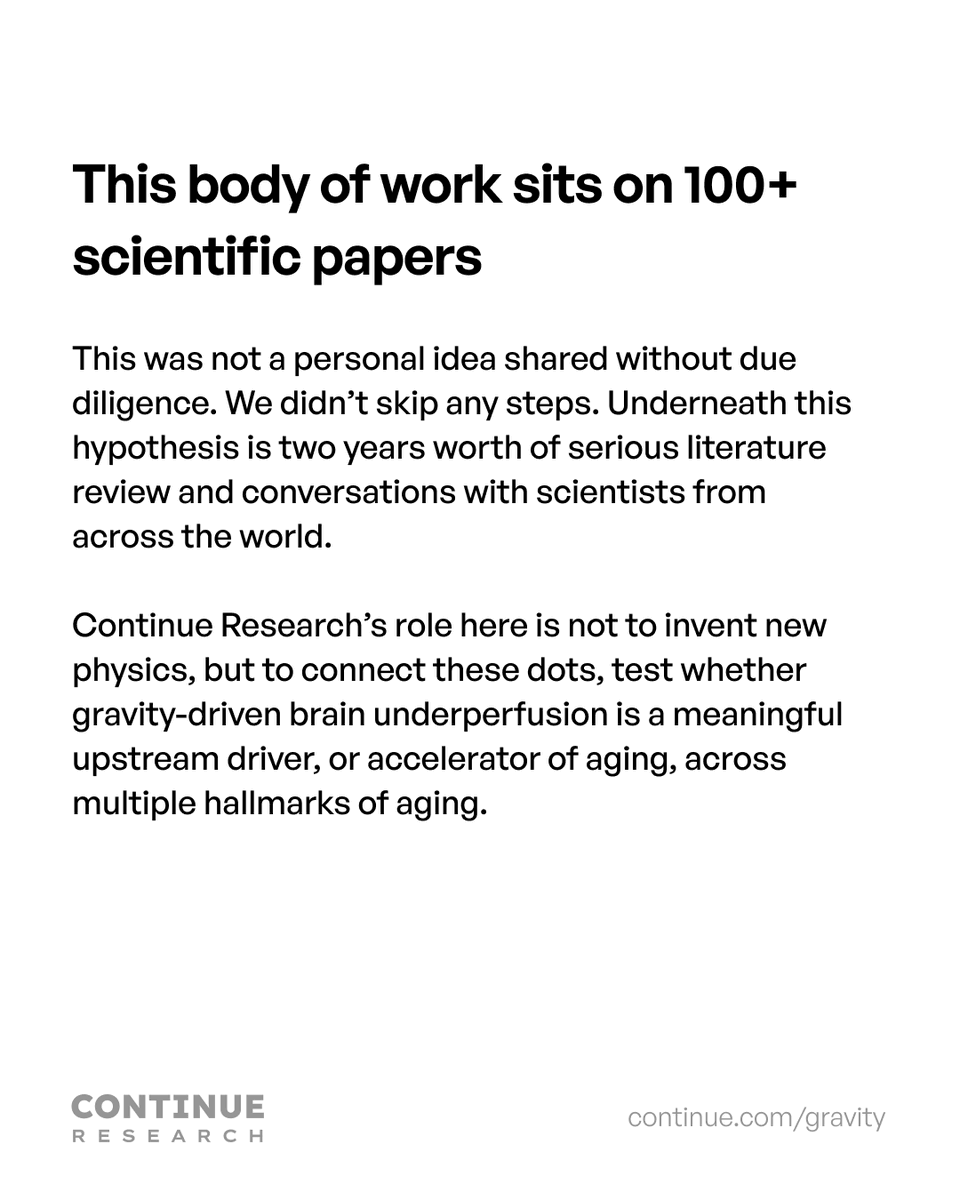
(a) Current science around neurovascular aging, neuroendocrine aging, and gravitational physiology is still evolving. We’re not claiming gravity to be the primary cause of aging. Only that it may be an accelerant for cellular entropy and several hallmarks of aging.
(b) Bats, height, yoga were always presented as clues, and never the only / decisive explanations to these common observations. The scientific evidence is outlined separately here (still directional): https://t.co/RRUIMmpm7p
(c) The points about Astronauts and Cerebral Autoregulation are something we have studied deeply and are already addressed here: https://t.co/QnfjT2Of9e
Would appreciate any direct questions by you on the published directional evidence. Our team of researchers will individually answer each one of them.
@abhisheKochhar@deepigoyal We are actively pursuing research to prove this hypothesis and promote research in this direction. You can read about it at https://t.co/KOWCSKhigf.
@varungrover@rahulalbussrk@varungrover
We invite you to read the scientific evidence behind the hypothesis here: https://t.co/05cMlOMNHC
Curious to hear what you think.
@gulaab_ali_@gulaab_ali_
We invite you to read the scientific evidence behind the hypothesis here: https://t.co/05cMlOMNHC
Curious to hear what you think.
@BetterSayAJ@theliverdoc We invite you to read the scientific evidence behind the hypothesis here: https://t.co/05cMlOMNHC
Curious to hear what you think.
@impactology
When you’re upright, CSF circulation is about 40–50% lower than when you’re lying supine. And the glymphatic system, as you said, depends directly on CSF circulation. https://t.co/TMWd87pVro
We invite you to read the scientific evidence behind the hypothesis here: https://t.co/W5UC7fjmns
Curious to hear what you think.
@follow_coloo
Interesting. We’re not saying that having the head above the heart automatically means a shorter lifespan. Giraffes, for example, have evolved with arterial pressure about 2.5× that of humans, which is enough to maintain stable brain perfusion.
https://t.co/lXz4i3F5n2
Bats are the longest-living mammals relative to their size. https://t.co/9W9xvOT0zz
Interesting clue about the role of gravity in longevity, but it's not evidence for the gravity-aging hypothesis and definitely not the only reason why bats live long.
You can read about the scientific evidence behind the hypothesis here: https://t.co/RRUIMmpm7p
@PandaShreyas@deepigoyal@PandaShreyas
Attaching a previous response here. Curious to hear what you think.
Read more at: https://t.co/Wr1loufVkA
https://t.co/QgNJSUCVZC
@anirudhmurali88
You’re right. Life evolved under 1G, and gravity is essential for cellular structure, division, and development. And yes, microgravity disrupts mechanotransduction, leading to cytoskeletal breakdown, altered signaling, and cellular stress. Astronauts quickly lose muscle, bone, and vascular tone because there’s no gravitational loading.
Similar to antagonistic pleiotropy, which is a trade-off where a mechanism that is beneficial early in life becomes harmful later, living under gravity might slowly age us. For optimal health, the goal isn’t zero gravity. It’s building resilience to gravity so the brain can maintain healthy blood flow for longer.
More at: https://t.co/RRUIMmpm7p