"The altar was the Cross. And as previous to the time when Christ suffered upon it, it was the sign of the greatest ignominy, so now has it become dignified and ennobled, and on the Last Day shall appear in the heaven more brilliant than the sun." - St. Bellarmine, Seven Words...
@CatholicPods@WalmartThomist@FrDylanSchrader I agree. Fr. Thomas Slater addresses this part of the Roman Catechism regarding perfect contrition in his "Questions of Moral Theology", he was very orthodox. p. 356~ https://t.co/2v81QD941c
@CatholicPods Probably thinking of this: "if he is not sure that the Church is from God, he does not believe it... he has begun, not ended, in unbelief..." Third paragraph: https://t.co/WfW8O5vwFf
@CTrefugees One thing I don't see here on a skim is government debt instruments (e.g. treasury bills). IIRC Zippy said it looks like usury but isn't since the sovereign can debase the currency (cf. stock dilution). Debasement could be a sin, but it wouldn't be usury.
@realDaveReilly@BishopBarron "...when a subject corrects his prelate, he ought to do so in a becoming manner, not with impudence and harshness, but with gentleness and respect." - St. Thomas, https://t.co/LBp2MmyZAz
@WalmartThomist The quote from ++Keeler seems spurious as I can only find it on a single Catholic blog (a blog which also says not to attend the Novus Ordo etc.). The official USCCB website for Jan 22 proposes several alternatives to abstinence.
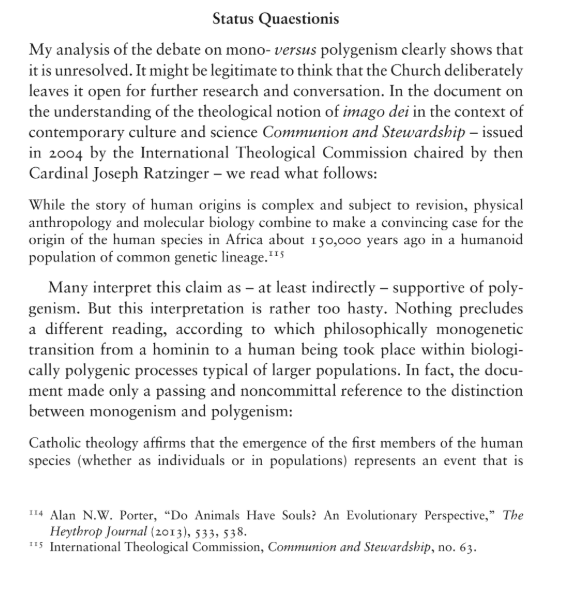
Your reading of C&S ("as saying that the first human beings may have arisen as a population") is not the only reading, and I find it the strained reading, all things considered.
First, what C&S doesn't say: "whether as individuals or as populations". If the text were intending to propose polygenism as in: "not all true men are descended from an individual Adam" (i.e. strict polygenism without theological monogenism, contrary to HG), why would it read: "in populations" instead of "as populations"?
As to what it does say: "whether as individuals or in populations". The former ("as individuals") likely refers to direct special creation (either the traditional account alone or one involving interbreeding with hominids). The preceding sentence reads: "The structures of the world can be seen as open to non-disruptive divine action in directly causing events in the world." It says "open to" i.e. not to the exclusion of "disruptive" divine action, i.e. special creation.
The latter ("in populations") likely refers to the ensoulment of humanoids (biological polygenism, theological monogenism--e.g. Flynn-Kemp) in a population, which does not entail polygenism as prohibited by Pius XII (not all true men descended from an individual Adam).
The context of paragraph 70 is the same as 69, i.e. divine causality. This is why, in passing, a distinction is drawn between "as individuals" and "in populations", because the cause is different: direct special creation ("disruptive") vs. evolution (biological polygenism, theological monogenism, "non-disruptive").
We're not talking here about two people of a population being ensouled vs. the whole population being ensouled. It doesn't fit the language or context, and it would strange for Card. Ratzinger to suddenly propose in passing the kind of polygenism clearly prohibited by Pius XII, as opposed to merely conceding a kind of polygenism HG would permit.
I wouldn't be the first to read this in a different way either, I found that Fr. Mariusz Tabaczek, O.P. makes a similar objection to your reading in "Theistic Evolution: A Contemporary Aristotelian-Thomistic Perspective" (p. 275, attached).
@topcenterkeys@cjscalia That actually seems plausible, lol: "My first name, an obvious palindrome, has been the burden of the eldest or only son for six generations."
If only someone had told him: Revile, O Oliver, your revilements, not your revilers.
Your reading of C&S ("as saying that the first human beings may have arisen as a population") is not the only reading, and I find it the strained reading, all things considered.
First, what C&S doesn't say: "whether as individuals or as populations". If the text were intending to propose polygenism as in: "not all true men are descended from an individual Adam" (i.e. strict polygenism without theological monogenism, contrary to HG), why would it read: "in populations" instead of "as populations"?
As to what it does say: "whether as individuals or in populations". The former ("as individuals") likely refers to direct special creation (either the traditional account alone or one involving interbreeding with hominids). The preceding sentence reads: "The structures of the world can be seen as open to non-disruptive divine action in directly causing events in the world." It says "open to" i.e. not to the exclusion of "disruptive" divine action, i.e. special creation.
The latter ("in populations") likely refers to the ensoulment of humanoids (biological polygenism, theological monogenism--e.g. Flynn-Kemp) in a population, which does not entail polygenism as prohibited by Pius XII (not all true men descended from an individual Adam).
The context of paragraph 70 is the same as 69, i.e. divine causality. This is why, in passing, a distinction is drawn between "as individuals" and "in populations", because the cause is different: direct special creation ("disruptive") vs. evolution (biological polygenism, theological monogenism, "non-disruptive").
We're not talking here about two people of a population being ensouled vs. the whole population being ensouled. It doesn't fit the language or context, and it would strange for Card. Ratzinger to suddenly propose in passing the kind of polygenism clearly prohibited by Pius XII, as opposed to merely conceding a kind of polygenism HG would permit.
I wouldn't be the first to read this in a different way either, I found that Fr. Mariusz Tabaczek, O.P. makes a similar objection to your reading in "Theistic Evolution: A Contemporary Aristotelian-Thomistic Perspective" (p. 275, attached).
What happened to covering the nakedness of your father? Should we simply cede the linguistic territory to the heterodox?
Whether Pius XII was imprudent (in hindsight, I suppose so) is immaterial to the point, which was to demonstrate that the way in which the body of theologians read HG, the way in which the Holy Office viewed Rahner's erroneous reading, and Pius' own comment on it precludes a "Trent is open to reinterpretation" reading of HG. The thread which I was responding to involved proposals that HG permitted multiple pairs of first parents or a communal Adam etc., hence my refutation and defense of our first father.
As to my brief expression of the Flynn-Kemp theory, it does not seem contrary to the faith, as it entails theological monogenism. I don't care for the theory either, but "horrifying"? God saw fit to flood the earth due to wickedness; that the descendants of Cain should engage in bestiality in a fallen world is not shocking.
@CatholicPods Right. Even if a proposition isn't prohibited, it can still be offensive to pious ears etc. The transition from minor theological censures to "propose whatever you want" was not an upgrade.
You're right to press this.
The whole impetus for addressing polygenism in Humani Generis was to protect the teaching that all men come from an individual Adam--in response to the latest French nonsense (many such cases). Initially the draft had a straight condemnation, but it was softened to allow for the possibility of pre-Adamites that had died out before Adam.
The grounds? 13/17 of the Holy Office consultors held that:
“denying that all men living on earth after Adam derive their origin from him” would “contradict (or be contrary to) what the Church has defined and proposes for belief about the origin and transfusion of original sin.”
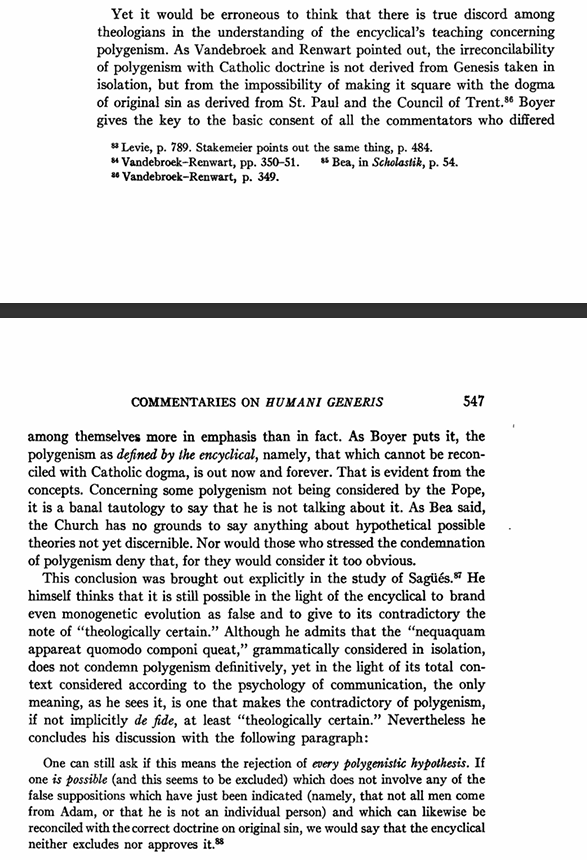
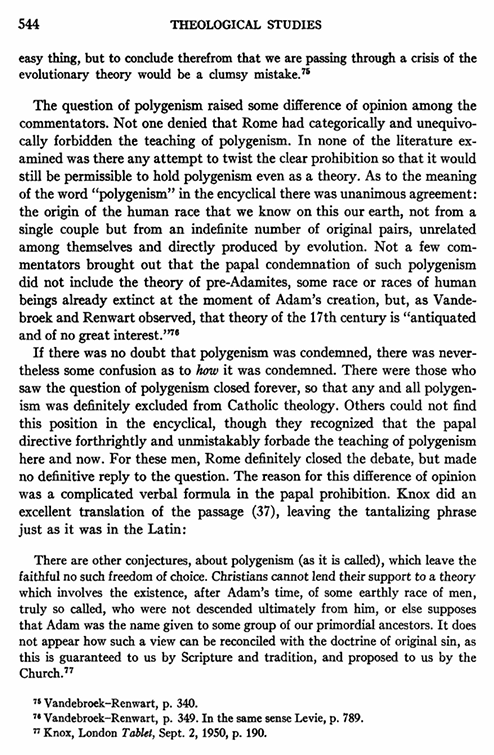
The modern reading of "nequaquam appareat" ("not apparent") as proposing that "polygenism is OK if original sin can be reinterpreted" is not how HG was drafted nor how the theologians received HG at its promulgation. They agreed that HG said that any polygenistic hypothesis which denied that all men come from an individual Adam was condemned. See Weigel's survey of the theologians eighteen months after HG, pp. 543-547, below.
What the theologians disagreed on was whether all polygenism was condemned or not. Some flatly said yes, others said that a polygenistic hypothesis which did NOT deny that all men descend from one individual Adam was still open (and this the minority faction). Again, no one was proposing that it was opening a door to reinterpreting original sin to fit polygenism.
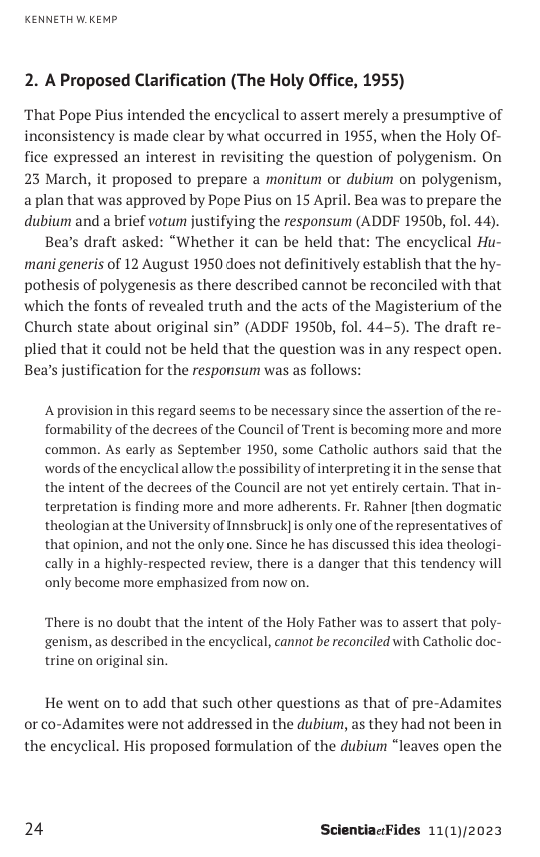
But by 1955, Rahner does speculate publicly that "nequaquam appareat" could mean the decrees of Trent are not certain, which spooked the Holy Office. They draw up a dubium and responsum to clarify but Pius XII ultimately declined to issue it on the grounds that HG was clear enough, saying:
"'there was no need for any clarification of the quoted passage from the encyclical, the formulation of which was deliberately cautious and it is good for it to remain as it is, without any further clarifications, except – of course – the absolute 'irreformability' of the dogma of original sin in the descendants of Adam. The two cardinals (Ciriaci and Ottaviani) rightly observed that “one needs to be very careful in the matter, as the words of the encyclical are.'"
As the years go on the problem gets worse and people started saying Pius XII meant to leave this "loophole" all along. The intent was clearly to leave room for polygenism to develop (which it did) while suppressing errors regarding our first parent, but it was commandeered as a means to "develop" Trent instead.
When HG was issued, interbreeding between hominids was not believed possible (this is a post-2000 development). Today, some propose that Adam and Eve were early hominids ensouled by God at conception whose ensouled descendants interbred with other hominids who were not ensouled etc. (biological polygenism, theological monogenism). This threads the needle and does not run afoul of HG's prohibition (or Trent's). If polygenism was condemned per se, this theory would be ruled out.
This seems like the kind of thing room was being left for, not "Trent really meant Adam was a group of people or whatever".
Weigel, Ccommentaries on Humani Generis
https://t.co/j5k72yLgWb
Kemp, Humani Generis & Evolution: A Report from the Archive
https://t.co/VHAyRDY00w
@CatholicPods Well, we know the zygote is not replaced with different kinds of organisms, but is rather a continuous, unified, self-directing organism. There is no substantial change, only accidental changes--it matures. There must be a human soul directing these human biological functions.
@AnthonyEsolen@Henricus2vB As to Paradise Lost, the indexed work is Rolli's 1730 Italian trans., which includes "Osservazioni sopra il libro del signor Voltaire che esamina l'epica poesia delle nazioni europee". Seems the Index often functioned as a kind of "Voltaire suppressor" (which was right and just).
@CatholicPods This is to say: modern embryology admits a zygote is a human being. If so, Thomas would say it has a soul by necessity. One must either reject modern embryology to appeal to Thomas as grounds for delayed ensoulment or admit that Thomas would not hold to delayed ensoulment today.
@CatholicPods St. Thomas would say there is no human being who is not also a human person because the soul is the form of the body. To posit delayed ensoulment on his terms, you must deny that a zygote is a human being (how?).
Section II.C is worthwhile: https://t.co/cvVGn9dvDa