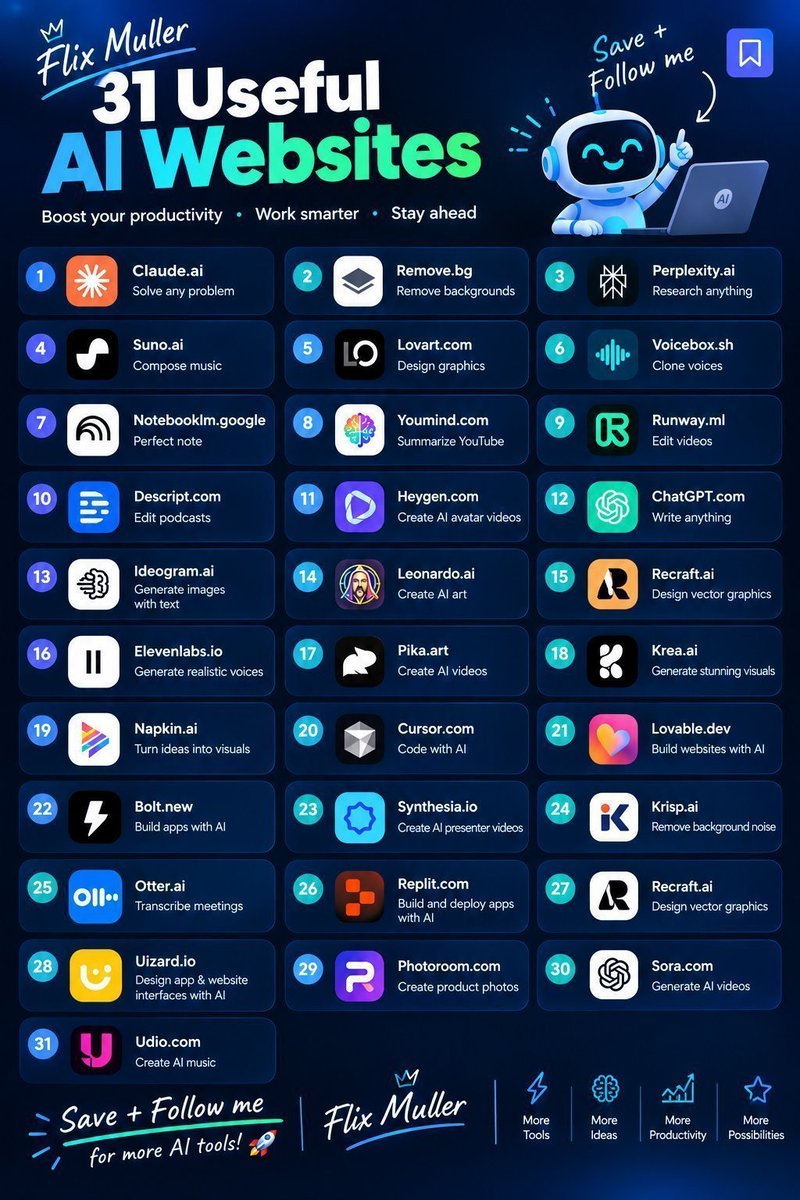
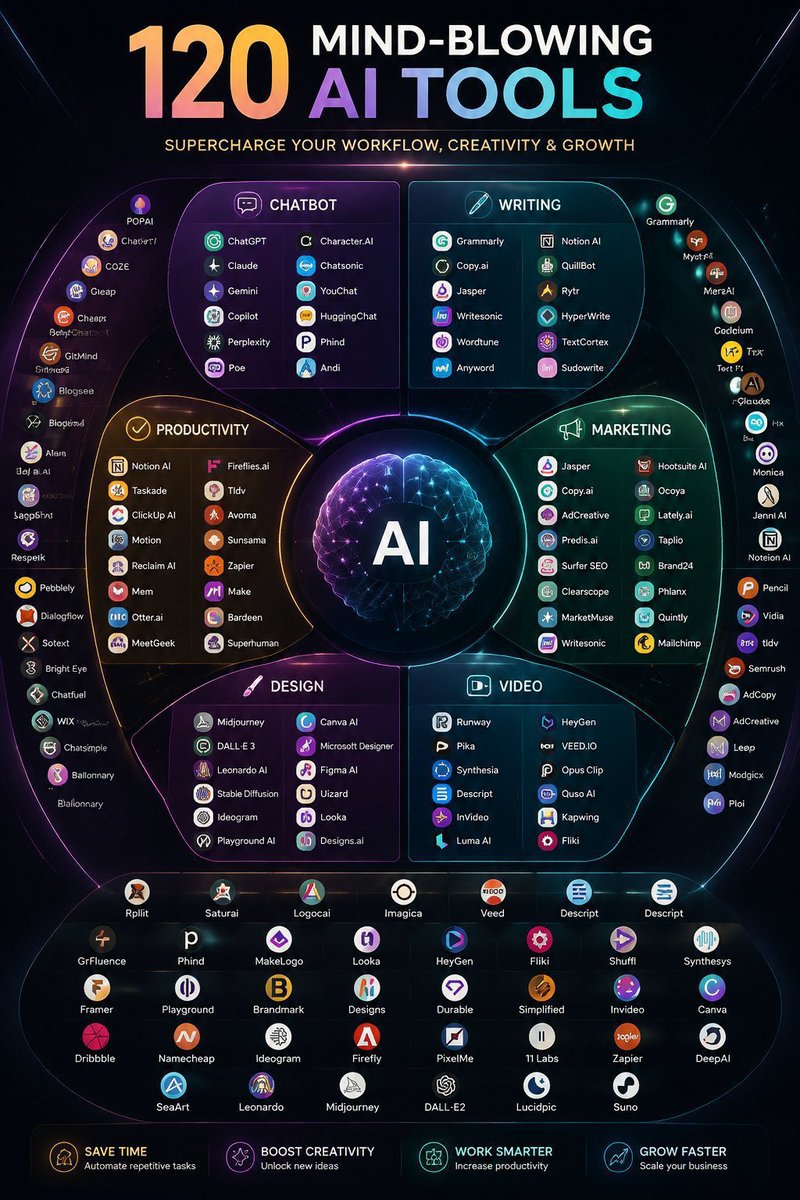
👀 Imagine saving 10+ hours every week with AI!
These 10 powerful AI websites can help you plan, learn, automate tasks, create content, and boost productivity — all for FREE! ⚡
🔖 Bookmark this list for later.
Which tool would you try first? 👇
👀 Imagine saving 10+ hours every week with AI!
These 10 powerful AI websites can help you plan, learn, automate tasks, create content, and boost productivity — all for FREE! ⚡
🔖 Bookmark this list for later.
Which tool would you try first? 👇
🚨 BREAKING: I asked Claude to improve my LinkedIn profile.
It didn’t just improve it. It made it a recruiter magnet.
Here are the 7 exact prompts I used:
Want to make someone smile when they see your name pop up?
Forget boring small talk.
Ask something unexpected, thoughtful, and fun.
The best conversations start with curiosity, not copy-paste messages. 😉
🚀 GOOGLE Free Courses With Certificates 🎓
Want to level up your skills without spending a single dollar?
Google is offering FREE courses with certificates in some of the most in-demand fields right now.
📚 Courses included:
🔹 Cybersecurity
🔗 https://t.co/cNcvpb2TWB…
🔹 Business Intelligence
🔗 https://t.co/DEJdEyBcRL…
🔹 Advanced Data Analytics
🔗 https://t.co/DEJdEyBcRL…
🔹 Digital Marketing
🔗 https://t.co/t9NzSDsRyz…
🔹 AI & Machine Learning
🔗 https://t.co/rX6KcV6tX1…
🔹 Data Analytics
🔗 https://t.co/e7BwSbU2F7…
🔹 Project Management
🔗 https://t.co/e7ui3ZIYEd…
🔹 UX Design
🔗 https://t.co/Cg7nR9AbSb…
🔹 IT Automation
🔗 https://t.co/DEJdEyBcRL…
🔹 IT Support
🔗 https://t.co/DEJdEyBcRL…
✅ Learn from Google
✅ Get certified
✅ Upgrade your skills
✅ Boost your career
No expensive degree. No complicated setup. Just your curiosity and an internet connection.
💾 Save this post so you can come back later.
🔁 Repost to help others.
❤️ Like if you found it useful.
Follow @trreo7 for more free courses, AI tools, and tech resources. 🚀
Ten million people have watched an MIT professor accidentally destroy the executive coaching industry.
He filmed the lecture once in January 2018 and died eighteen months later.
Executive coaches charge fifteen thousand dollars a session to teach a third of what he covered in one hour for free.
His name was Patrick Winston. He ran the MIT Artificial Intelligence Laboratory from 1972 to 1997 and wrote the AI textbook every computer science major in the world read for thirty years.
Every January for four decades, he gave a lecture called "How to Speak."
His entire framework fits on a napkin.
Do not read. Be in the image. Keep images simple. Eliminate clutter. Start with an empathetic connection. End with a punch line the audience can repeat over dinner. Never open with a joke. Never end with "thank you."
That last rule alone has probably cost the executive coaching industry a hundred million dollars.
"Your success in life will be determined largely by your ability to speak, your ability to write, and the quality of your ideas. In that order."
That is the actual opening line of the lecture. Winston believed it strongly enough to spend fifty years teaching computer scientists how to talk.
Founders spend $80,000 on an MBA and then hire a communications coach to teach them the same material Winston filmed once for free. Engineers write brilliant code and lose promotions to teammates who watched this lecture on the train.
The lecture is free on MIT OpenCourseWare. The textbook is free on his page.
Winston died in 2019. Almost none of the ten million viewers have actually implemented the four rules on the napkin.
The napkin is free. The willingness to actually use it in your next meeting is the entire edge.
Amazon Rep: "I have applied a $15 promotional credit to your Amazon balance."
Customer: "I will be sending this message for every late box."
Lesson for Prime Members:
Amazon does not just sell products. They sell your own laziness back to you. Their reps are trained to offer a weak $5 credit first because they know 95% of Americans will just complain to their spouse instead of demanding the full monthly fee they are legally owed.
Stop treating Prime like a charity. Claim your late credits, link a second adult under Amazon Household to split your $139 fee in half, and cancel your Subscribe & Save the exact minute the first discounted box ships.
Stop quietly subsidizing a trillion-dollar algorithm.
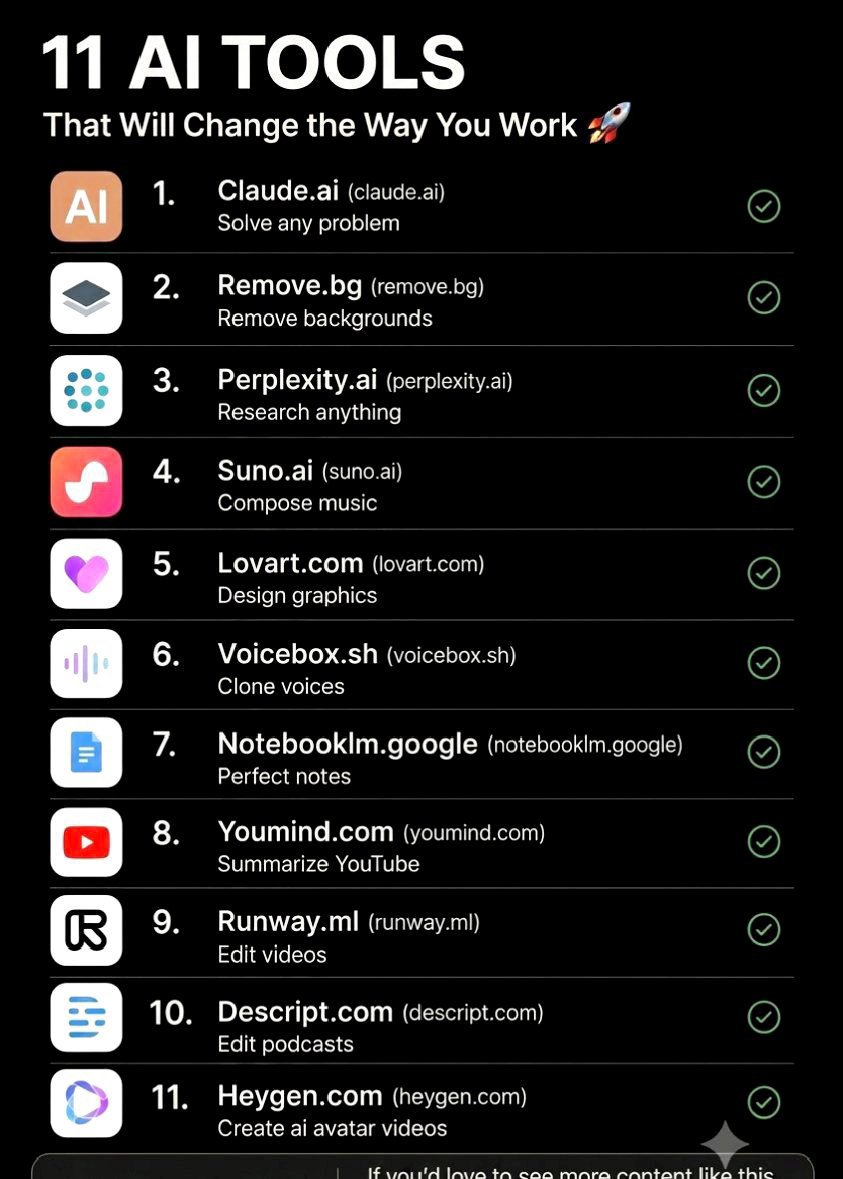
1. https://t.co/sXp1ZNNlqO (solve any problem)
2. https://t.co/1JZxLql3z1 (remove backgrounds)
3. https://t.co/Eow2eeJve0 (research anything)
4. https://t.co/bIt3AzZLss (compose music)
5. https://t.co/DnqqP1mQfq (design graphics)
6. https://t.co/Xs6Nd70Nyz (clone voices)
7. https://t.co/5km7MBHPzj (perfect notes)
8. https://t.co/dNuhLRisJG (summarize YouTube)
9. https://t.co/bEzSKA8j6Y (edit videos)
10. https://t.co/O2NM7uU9vQ (edit podcasts)
11. https://t.co/ELGeOEwdx1 (create AI avatar videos)
12. "Oxylabs Web API MCP" (https://t.co/RxVOgdAsYo…) (powerful web data extraction for AI agents)
Bookmark this post
If you’d love to see more content like this, don’t forget to follow @Arina_sharmi for more AI magic! 🚀
Make $950 Per Day with Copy & Paste Job.
EASIEST SIDE HUSTLE EVER!
You just need:
1. Internet
2. Mobile
3. 2 hour a day
I'll show you how. Grab the free guide now!
Like, Repost & reply " Money " and I'll DM it to you.
(Follow me to get it)
Millions of events. Thousands of services. Real-time data flowing continuously.
How do companies build systems that handle all of this without falling apart?
One answer is Apache Kafka.
But learning Kafka goes beyond knowing producers and consumers.
You need to understand how data moves, how failures are handled, and how systems scale.
Here are 12 Kafka concepts every engineer should master:
Kafka Fundamentals
→ Understand distributed event logs and asynchronous communication.
Core Components
→ Learn topics, brokers, partitions, producers, and consumers.
High-Level Architecture
→ Understand how Kafka clusters distribute and replicate data.
Event Flow
→ Follow events from producers to consumers.
Queue vs. Log
→ Learn why Kafka retains messages after consumption.
Partitions & Keys
→ Distribute events while preserving ordering within partitions.
Consumer Groups
→ Process events in parallel across multiple consumers.
Offsets
→ Track progress and replay previously stored events.
Replication
→ Maintain availability when brokers fail.
Delivery Guarantees
→ Understand at-most-once, at-least-once, and exactly-once processing.
Real-World Use Cases
→ Build event-driven microservices, CDC, and analytics pipelines.
Common Mistakes
→ Avoid ordering assumptions, premature commits, and poor partition planning.
Here's the important part:
Kafka isn't just a messaging tool.
It's the backbone of many real-time, event-driven architectures.
And understanding Kafka changes how you approach distributed systems.
Because building scalable systems isn't just about processing more data.
It's about handling failures, maintaining consistency, and keeping everything running when traffic increases.