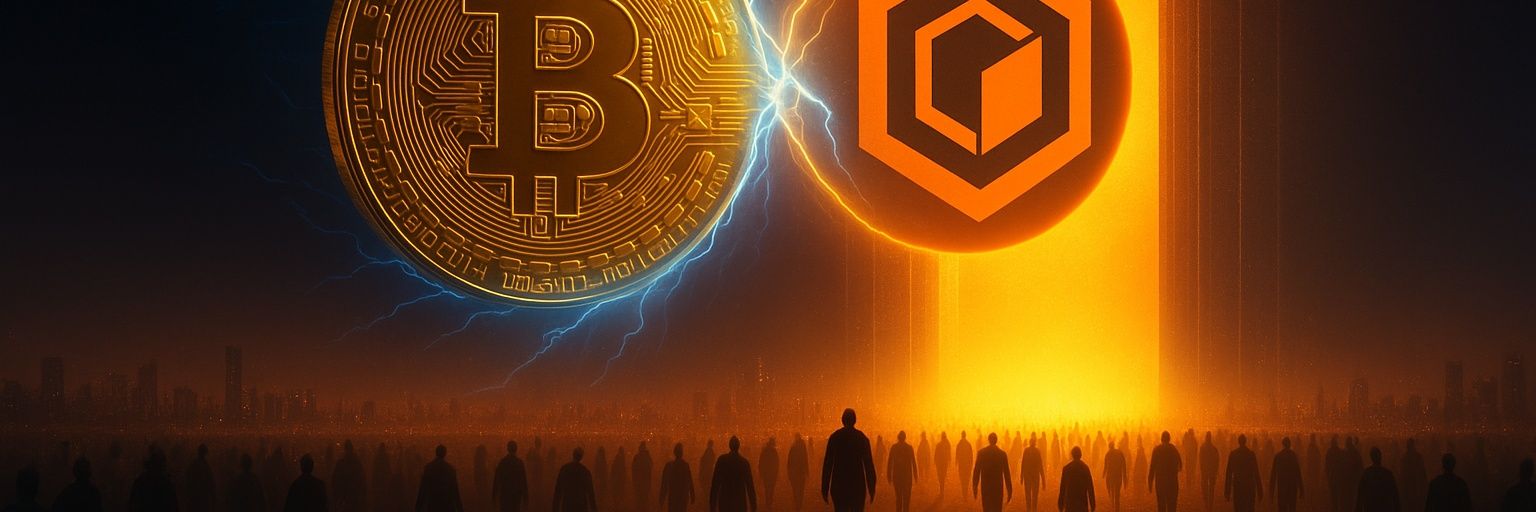
1/ The countdown is over #Coretoshis, it’s here 🔶 Introducing Non-Custodial BTC Staking: Making BTC a yield-earning asset without leaving the Bitcoin Network, for the first time in history.
Your money shouldn't be scattered across apps.
Stocks, ETFs, crypto, and your personal USD bank account. Gate Money brings them together in one place.
Move funds between assets, put idle balances to work with flexible, no-lock-up returns, and use your eligible assets to pay with Gate Card.
Explore now:https://t.co/e7ajwkcKpL
If crypto is money, why can’t it earn?
Days ago, the Central Bank of Nigeria released new rules for non-security virtual assets.
One clear line: licensed stablecoin issuers are barred from paying interest, yield or any return to holders simply for holding the token.
The CBN’s position is that paying yield turns a payment stablecoin into an investment product. So, it cannot be treated like a bank deposit.
But here’s the contradiction many Nigerians feel:
I leave naira in a bank and earn interest.
I can leave crypto on regulated protocols and earn.
Yet the same regulator that is now licensing stablecoins and virtual-asset services is saying the stablecoin version of “money” must stay yield-free.
If the world is moving toward regulated digital money and decentralized finance, Nigerians should not be forced to choose between “no yield” and “no regulation.”
The CBN cannot treat certain digital assets as payment instruments when it suits the rules, then deny them the economic features people expect from money, while banks continue to pay interest on deposits.
Other countries are writing rules that allow both safety and yield under clear conditions. Nigeria’s new framework draws a hard line instead.
Should your crypto be allowed to make money the way your naira in the bank does, under proper regulation, or must payment stablecoins remain permanently non-interest-bearing?
We’re aware of the exploit affecting b14g, a restaking and yield protocol on Core and Babylon, and we’re working closely with their team.
The Core network is secure. Core’s consensus, validators and staking contracts operated normally throughout, and CORE staked directly with validators or through other protocols is unaffected.
We’re supporting b14g and exchange partners to trace and freeze the funds. Most of the stolen CORE remains on Core, and exchanges are freezing deposits linked to the attacker.
We’ll share updates as we have them.
Decentralization has been a founding principle of Core, and today marks another step in that commitment.
We've already seen it work. Independent validators have taken on block production, and the network has kept running without interruption throughout the handover.
Now that same model is extending across the ecosystem. As part of that evolution, I'm transitioning out of my role in the DAO, and the community will continue taking on more of Core's development.
The validators, builders, partners, and Coretoshis who power Core are already leading the way. I'm grateful to everyone I've had the chance to build alongside.
I'll always be a Coretoshi, and I'm excited to see Core continue growing as a network built to scale Bitcoin and carry its decentralized ideals forward.
Core is entering its next phase of decentralization.
Since the DAO began handing over its block-production role to independent validators, the network has run with zero downtime throughout the transition.
Decentralization has guided Core since its first block. Each handoff of DAO initiatives to independent community operators builds on that foundation.
Now, the community will continue taking on a greater share of stewardship across Core, from ecosystem building and growth initiatives to the decisions that shape its direction. As part of this transition, initial contributors like Rich Rines and Brendon Sedo are stepping out of their roles in the DAO.
A network owned and led by its community is built to last. In the months ahead, more independent operators, more community-led projects, and more Coretoshi voices will shape where Core goes next.
Thank you to every validator, builder, and Coretoshi continuing to carry Core forward. Bitcoin's full potential remains untapped. Core will keep pushing that frontier forward, in service of decentralization, self-sovereignty, and freedom.
Core is heading towards further decentralization
Given @Coredao_Org's vision, the project seems to be moving toward further decentralization.
After 2023, the DAO's validators played a crucial role in ensuring continuous block production by joining and building the network.
Over the next few months, the DAO will gradually move away from block production and hand it to independent validators.
This move follows operations already being performed by independent validators under Core's Satoshi Plus consensus mechanism...
The aim is to ensure the network runs on independent validators rather than involving the DAO in block production.
Core is taking another step towards decentralization.
Since 2023, DAO-operated validators have helped keep blocks flowing as independent operators joined and strengthened the network. Together, these validators have supported years of uninterrupted block production.
Over the coming months, the DAO will fulfill its long-term plan and begin the process of gradually handing over its remaining block-production role to independent validators, building on the work these operators already do to keep Core running.
This transition marks a new chapter for Core, with independent operators powering the network.
Thank you to every validator and Coretoshi who has helped move Core forward.
Stake CORE, secure Core, get paid in CORE.
CORE holders delegate to validators. Their stake elects the validators that produce blocks. Every block pays out newly minted CORE.
Rewards land daily. Delegations can be moved anytime.
https://t.co/BHKbXeMNHS