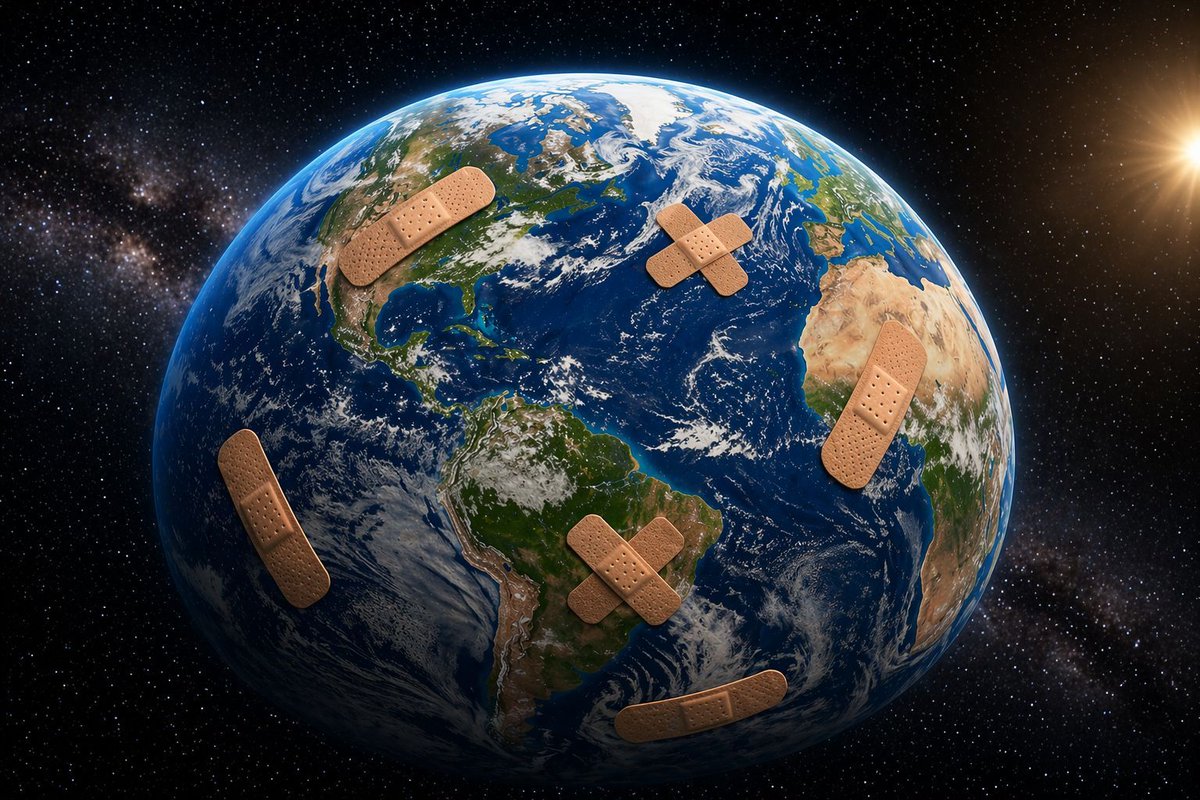
African nations should be free to choose the energy mix that best meets their needs. Natural gas, coal, hydroelectric power, nuclear energy, and renewables all have a role to play depending on local circumstances and development goals. https://t.co/VFsdtjXa5U
For years, some of the most alarming climate predictions were built on RCP 8.5—a scenario requiring massive coal expansion, extraordinary population growth, and virtually no technological progress. The international modeling community has now classified it as implausible and removed it from future assessments. But, the damage is done. https://t.co/I5J2pCazEE
"The Plastic Detox" raises important questions about microplastics, fertility, and corporate responsibility. But it also reveals a deeper question: Are children something we have a right to possess, or persons with dignity and claims of their own?
https://t.co/yjLGaSzsmL
AI may be the biggest technological revolution since the internet—but it comes with a physical requirement: electricity.
Data centers powering AI need massive amounts of reliable, around-the-clock energy. Increasingly, operators are choosing states that support natural gas generation and affordable electricity over states pursuing aggressive net-zero mandates.
The AI race isn't just about software. It's also about power.
https://t.co/52gODdygkw
What counts as “settled science” in court?
According to a new letter from leading physicists, recent changes risk treating contested claims as fact—while sidelining dissent. https://t.co/ChIWQlbOPl
The latest UAH satellite data shows the global lower troposphere temperature anomaly rose from +0.39°C in April to +0.53°C in May. But the longer-term picture remains unchanged: since 1979, the satellite record shows warming of about +0.16°C per decade globally.
Climate discussions often focus on monthly fluctuations. The more important question is what the long-term trends actually show.
https://t.co/uMms5d64J7
A $690 billion wastewater shortfall is coming by 2044.
The question isn’t whether we’ll pay—it’s whether we act now or wait for costly disasters. https://t.co/z4lHJwZL6c
The Federal Judicial Center’s manual has long helped judges separate real science from speculation.
Critics now say its latest revision blurs that line—replacing clarity with a more ideological framework. https://t.co/ChIWQlbOPl
Wastewater failures are increasing—yet maintenance rates are declining.
That’s not a funding gap. That’s a long-term neglect problem catching up in real time. https://t.co/z4lHJwZL6c
Federalism matters. Returning authority to states allows local solutions to environmental challenges—while preserving national accountability through Congress.
If you want, I can tighten them further for a more aggressive tone or tailor them to your typical Cornwall Alliance voice. https://t.co/Omm3y2MEfd
For decades, a judicial manual helped judges separate science from speculation.
Now critics say its new edition replaces the scientific method with “consensus” as the highest standard—turning science into a popularity contest. https://t.co/5ioB0Zutv7
Global temperatures have increased by about 1–2°C since the end of the Little Ice Age in the mid-19th century.
The central debate is not over whether warming has occurred, but over its causes—specifically, the relative roles of human activity and natural factors such as solar variability and oceanic cycles. https://t.co/HUmGxPXamK
7.15 million Americans are impacted by waterborne illness each year.
Infrastructure neglect isn’t abstract—it’s a public health issue. https://t.co/z4lHJwZL6c
The real question: do centralized mandates work better than markets? This shift opens the door to innovation driven by price signals, competition, and consumer choice—not top-down control. https://t.co/4psBIjxfhh
Science isn’t determined by consensus—it’s tested against reality.
That’s the core argument physicists are making as they challenge new judicial guidance on evaluating scientific claims. https://t.co/ChIWQlbOPl
CO₂ is often framed solely as a pollutant—but it also plays a measurable role in plant growth.
Higher concentrations can improve crop yields and water efficiency, especially when combined with modern agricultural practices. https://t.co/KeQNx1W9SO
“If it disagrees with experiment, it is wrong.” — Richard Feynman
That’s the standard of science. Not consensus. Not widespread acceptance.
A new debate is asking whether courts are being guided away from that principle. https://t.co/5ioB0Zutv7
Rome built one of history’s greatest sewer systems—and failed to maintain it.
History’s warning is clear: neglecting infrastructure comes at a cost. https://t.co/z4lHJwZL6c
Energy transitions aren’t cost-free. Large-scale wind and solar projects require extensive land use, mining, and backup systems—raising questions about environmental tradeoffs and reliability.
Policy decisions should weigh these full lifecycle impacts. https://t.co/KeQNx1W9SO