Happy Pi day... one of my favorite unexpected appearances if Pi is in calculating the number of elastic collissions between two blocks and a wall, as presented by @3blue1brown
https://t.co/6MsmuM5Ysl
Group pressure can sway a person to judge an obviously false perception as correct. The groundbreaking Solomon Asch conformity experiment passes the critical replication test with flying colors after more than 70 years. https://t.co/6GX7WKwVzU
The motor protein kinesin walks along microtubules within a human cell, expending ATP (adenosine triphosphate) to fuel each step, conveying essential cargoes like vesicles or organelles.
📽: John Lieber
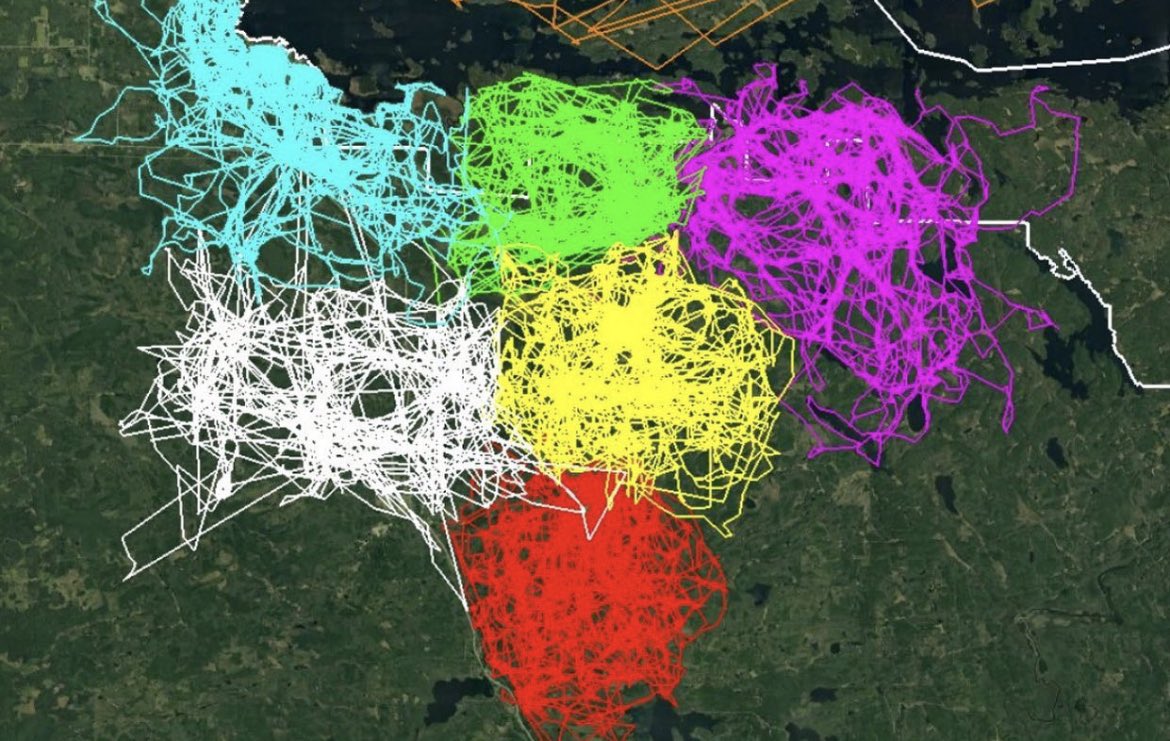
GPS tracking was used to monitor the movements of packs of wolves, revealing how these packs strategically avoid each other's territories. The data for this tracking was collected from wolves in six different packs located around Voyageurs National Park in Minnesota. This research has formed the basis of The Voyageurs Wolf Project.
The primary mission of this project is to conduct studies on wolves and their interactions with prey species such as moose, deer, and beavers during the summer months in and around Voyageurs National Park, Minnesota. The data provides fascinating insights into the avoidance behaviors among these wolf packs.
In general, the territory of a typical wolf pack in the park covers an area of approximately 50-70 square miles, although this size can vary from year to year. This territory is roughly equivalent to the regions delineated by different colors on the map, with the white line marking the boundary of the national park itself.
Wolves tend to steer clear of one another's territories unless they are compelled to compete for limited food resources. In such cases, conflicts may arise, leading to confrontations with rival packs as they seek to maintain their claims on specific locations and their associated food sources.
Human activities, like habitat clearing, can force wolves to adjust their territories. When their natural habitat is disrupted, wolves may be forced to find new routes to reach their sources of food. These changes can further contribute to conflicts between various wolf packs as they navigate the challenges of territorial boundaries and resource competition.