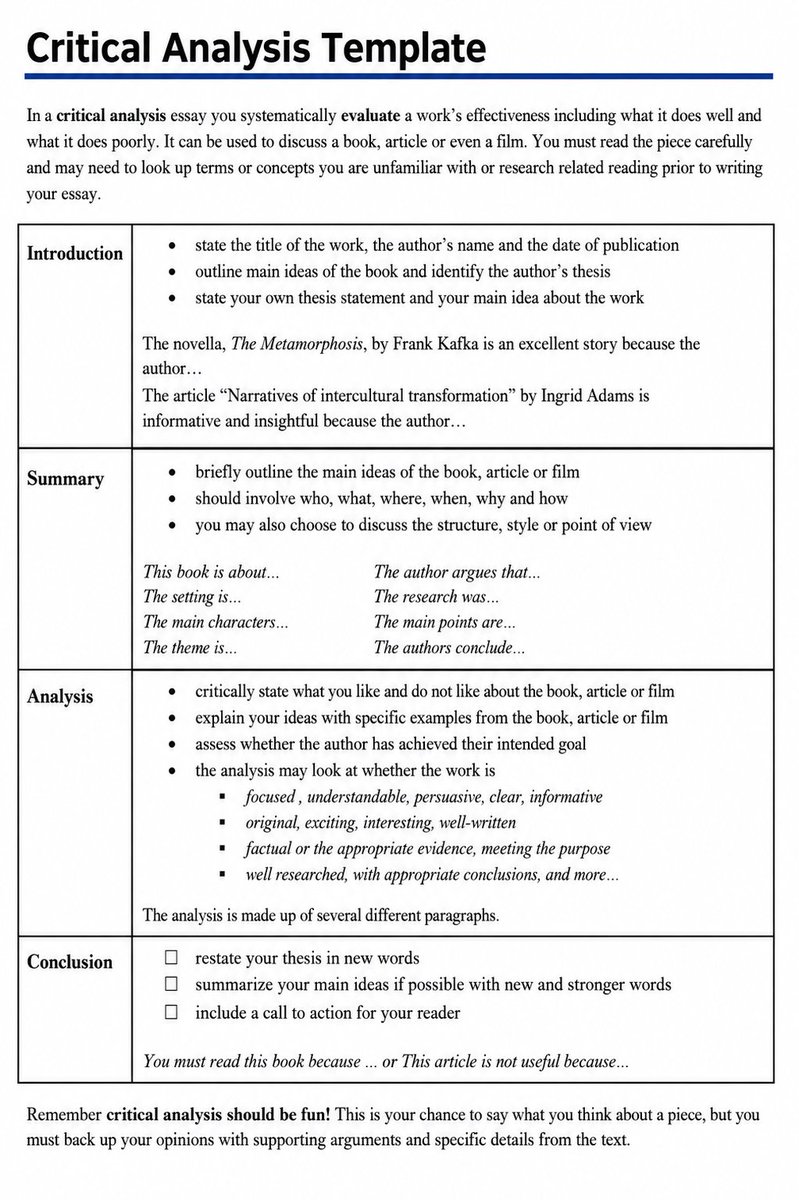
Strong critical analysis is more than a summary.
Ask:
• What is the author's main argument?
• What evidence supports it?
• What works well?
• What doesn't?
• Why does it matter?
Don't just describe the paper.
Evaluate it. Think critically. Write clearly.
A strong thesis statement answers one question:
What are you trying to prove?
Start with a research question.
Then take a clear, arguable position.
Everything else in your thesis should support that one idea.
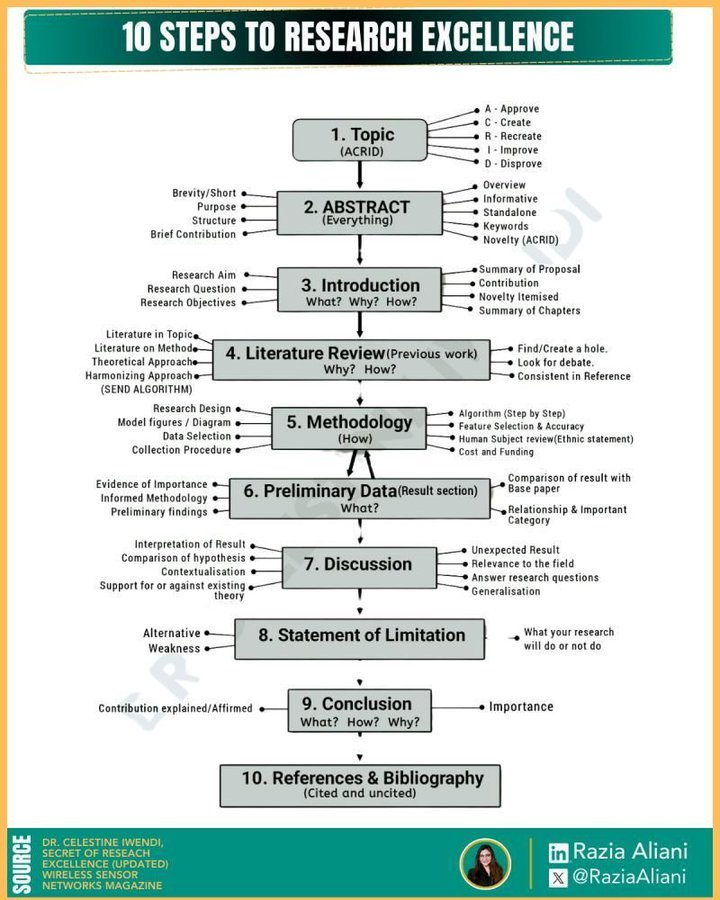
Whenever you are lost in research, use ACRID framework ⤵️
It helps how you:
- choose impactful topics (ACRID magic!)
- craft killer abstracts
- build rock-solid methodologies
- navigate limitations like a pro
--------------------------------
Found this helpful? Pass it on!
🔄 Retweet (& like)
--------------------------------
Expand thread to see the link to the article ⬇️
----------------------
✅ Follow @RaziaAliani to get more useful AI in #research content (no clickbait stuff!) in your X feed.
The quality of your thinking depends on the quality of your questions.
Different questions require different thinking tools:
• Define in context
• Describe qualities
• Compare and contrast
• Classify information
• Identify cause and effect
Great researchers don't just collect information.
They organize it. Connect it. Make sense of it.
Early in my PhD, I thought I was a decent writer.
My first chapter proved me wrong.
It took three weeks. I had read everything, cited everyone, and used every academic word I could reach for.
My supervisor read it and said: "I can't follow your argument."