Polish prodigy Marcin Patrzalek responds to those claiming his music is fake.
Watch this tutorial breakdown: One guitar, zero fakes – mastering melody, bass, and percussion all at once.
🇿🇦 RAMAPHOSA, MANTASHE & MCHUNU DEADLY CORRUPT.
It has been alleged that President Cyril Ramaphosa, Mineral Resources Minister Gwede Mantashe and Police Minister Senzo Mchunu are all complicit in the Richards Bay Minerals corruption scandal.
The reason for this alleged complicity is that black-owned security companies were removed from security tenders at Richards Bay Minerals (RBM) and replaced by Bidvest and other security companies, whose directors are all affiliated with Shanduka.
It is evident that Bidvest is a prominent feature in the R1 billion CR17 bank statements that Ramaphosa utilised to secure the ANC presidency through financial means.
Furthermore, it is noteworthy that Mantashe’s spouse is a business partner of Bidvest.
Additionally, Senzo Mchunu’s role as former advisor to RMB is a salient point. Consequently, it can be deduced that Mantashe, in his capacity as Minerals Minister, authorised RBM to undertake mining operations on tribal-owned land.
Subsequently, the South African Police Minister, Senzo Mchunu, deployed the SAPS (South African Police Service) Tactical Unit (NIU) to intimidate tribal leaders and forcibly displace communities from their ancestral lands. This action was carried out with the apparent approval of President Ramaphosa, who has been accused of having close ties with the Bidvest corporation.
Read here ⏬
https://t.co/a4DwVJDBfF
Dear South Africans
We have received a resounding number of requests from South Africans wanting to join the SA First Forum, people who are from different races, tribes and religions and even in the diaspora!! Furthermore we have a number of professionals from many different sectors who have raised their hands saying they would like to be part of the forum!!
The reception for this Forum has been out of this world and the level of excitement from our people is truly justifiable! Many of you have asked how you can subscribe and I am going to kindly ask you to please be a little bit patient with us… we are still undergoing some learning stages and consulting a number of people who are providing us guidance and tools that can assist us to make this forum a great success … Until we win✊🏻🇿🇦‼️‼️‼️‼️
THE BORAX CONSPIRACY: WHY A NATURAL MINERAL THAT CURES ARTHRITIS AND DECALCIFIES THE PINEAL GLAND WAS LABELED "TOXIC" BY BIG PHARMA. BORON IS THE MASTER REGULATOR OF CALCIUM AND MAGNESIUM, YET IT HAS BEEN SYSTEMATICALLY REMOVED FROM OUR SOILS AND REPLACED WITH EXPENSIVE, SYMPTOM-MASKING DRUGS. YOU AREN'T "AGING"; YOU ARE SUFFERING FROM A CRITICAL DEFICIENCY OF THE ELEMENT THAT HOLDS YOUR SKELETON TOGETHER.
Boron is a trace mineral that is essential for all life on Earth. In the mid-20th century, researchers discovered that in areas where boron levels in the soil were high, arthritis was virtually non-existent. In areas with low boron, arthritis rates skyrocketed.
When people began using Borax (Sodium Borate)—a naturally occurring mineral mined from dried-up lake beds—to supplement their boron intake, the results were miraculous. Chronic arthritis, osteoporosis, and even "incurable" bone spurs began to vanish.
The "Suppressed" Biological Mechanism:
The Calcium Traffic Cop: Boron acts as the "manager" for calcium, magnesium, and phosphorus. Without boron, calcium doesn't go into your bones; it "leaks" into your soft tissues. This causes the calcification of your arteries (heart disease), your joints (arthritis), and your pineal gland (the "Third Eye").
Hormonal Optimization: Boron is proven to naturally balance testosterone and estrogen. It reduces "SHBG," making more of your own hormones bioavailable. This is why the industry hates it; it replaces the need for expensive Hormone Replacement Therapy (HRT).
The Fluoride Antidote: Boron is one of the few substances that can bind to fluoride and pull it out of the body. It is the primary tool for decalcifying the Pineal Gland.
The "Toxicity" Lie: In the 1980s and 90s, several countries (including those in the EU) began labeling Borax as a "reproductive toxin" and banning it for internal use. This was based on studies where rats were fed absurdly high doses that no human would ever consume. In reality, the LD50 (lethal dose) of Borax is almost identical to that of Table Salt. You would have to eat a massive amount to even get an upset stomach.
Why the ban? Because Borax costs pennies. A single box of laundry-grade Borax (which is 99% pure sodium borate) can last a family for years as a supplement. It threatens the multi-billion dollar markets for:
Arthritis Meds: Which only mask pain while the joints continue to degrade.
Osteoporosis Drugs: Which often create "brittle" bones that snap easily.
Anti-Inflammatories: Which destroy the gut lining.
The industry wants you "calcified" and "stiff." They want your hormones crashed and your Pineal Gland stoned. Boron is the "key" that unlocks the calcium from your tissues and puts it back into your bones and teeth.
How to reclaim your minerals:
The "Rex Newnham" Protocol: A tiny pinch of Borax in a liter of water (concentrated then diluted) was the original method used by the scientist who rediscovered its power.
Trace Minerals: Look for ionic boron supplements if you fear the "laundry box," but know they are the same chemical compound.
Magnesium Pairing: Boron works best when you have adequate magnesium.
🔔 Stop the calcification of your body. Reclaim your mobility and your hormones with the mineral they tried to ban. Share this.
Source: QuantumMedicineNews
Detox Bath:
1 cup baking soda,
1 cup epson salt
1 cup 20 mule team borax
1 cup Himalayan salt, mineral salt, or sea salt.
Soak as long as u can.
BORON MINERAL ONLY KNOWN NANOBOT REPLICATION INHIBITOR
BREAKING EKURHULENI AUDIO🔥🔥
This is a councillor in Ekurhuleni who raises a very important question regarding the IPID Report that people are now trying to hide.
The question which should be asked, why was the handsome mayor together with Acting City Manager ( at the time), Kagiso Lerutle not ARRESTED for this & why did they fail to ACT?
I also have it on good authority that there are a small amount of rotten apples within Commission’s that are now trying to protect certain individuals.
The executives at @City_Ekurhuleni can try change reports, delete council meetings/recordings last minute or hide them, it’s LATE.
I have EVERYTHING
In 1983, a BBC interviewer asked Richard Feynman why two magnets push each other apart — and he refused to answer it.
What he did instead is the best seven minutes on thinking ever filmed.
Bookmark & watch today, no matter what.
The DA is deep within IDAC conspiracy against the PKTT, Crime Intelligence and SAPS.
Kohler-Barnard published classified information about Crime Intelligence properties.
Paul O’Sullivan and Sibiya are their guys.
O’Sullivan complained at IDAC about General Khumalo.
Ian Cameron deposed an affidavit with IDAC accusing General Masemola of perjury.
The same Cameron failed to take action following allegations made by General Mkhwanazi on 5 March 2025, about interference in police work.
When Mchunu appeared before the Ad Hoc Committee, Cameron was being a fan-boy to him.
Glennis Brytenbach did the same with Sibiya but unleashed venom against Masemola.
1894: he went into the Himalayas with 11 scientists.
For 3 years, he lived beside sages who manifested food from empty air. Walked across rivers. Disappeared at will.
One master had not aged in 500 years. Years later, it began happening to him
Here is baird spalding's revolutionary masters' manifestation method.
🚨Breaking: Eastern Cape JP Selby Mbenenge has secured a temporary interdict from the High Court.
It stops Parliament and President Ramaphosa from proceeding with impeachment steps while he reviews the JSC’s gross misconduct finding
🧵1/..
This key piece of legislation is what made it for many, because the question that needs to be asked is,Why? 🧐
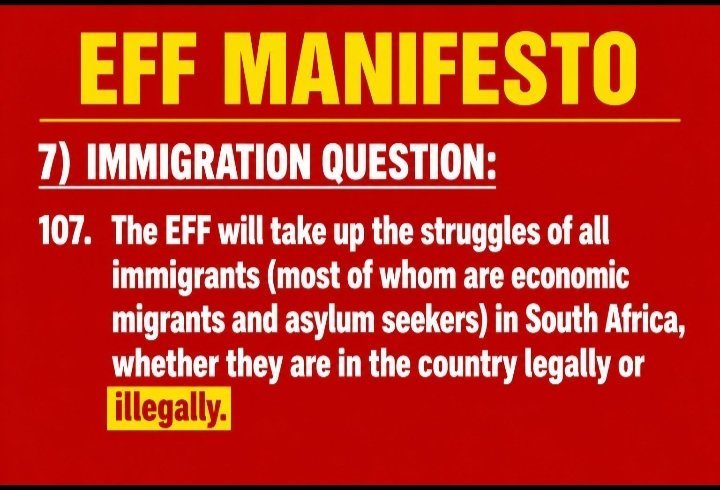
You can't choose to be a South African?, it's either you are or your not.
And you can't choose to side with those that are NOT FOR YOU.
The fact that some one does not respect your rules means that they don't value your help, so they must be deported.
Unless you are benefiting from them being in the country illegally 🧐 some how.
Terrible things are happening in Cape Town, yet somehow there are people in Johannesburg who are salivating at the thought of Helen Zille being their mayor
HERE'S THE FACTS.
There's Cosatu and There's Afriforum.
Both have their respective Unions and organizations as support.
Combined Memberships:
Cosatu: 1.6 Million
Afriforum: 502000
Average Membership Fees:
Cosatu: R80.00
Afriforum: R130.00
Monthly Revenue:
Cosatu: R128 000 000
Afriforum: R65 260 000
What Infrastructure was created to uplift:
Cosatu: Fokkol, Nada, Niks, Zilch
Afriforum: Akademia, Sol-Tech, etc, etc
Total value of Afriforum's investment into the future of students is more than R3.5 Billion if we include the student residences and the other smaller training facilities.
What has Cosatu done for the youth?
Where has the money gone?
Cosatu: R1.54 Billion Annually.
Luxury houses, Supercars, Luxury holidays, Hennesy to wash their hands, Luxury Breakfasts, Lunches and Dinners.
When are you going to demand answers people?
This is NOT a White man problem.
🇿🇦SOUTH AFRICA’S R6.1 TRILLION DEBT BILL‼️
South Africa has borrowed another US$1.5 billion from the World Bank, approximately R24.7 billion, to support reforms involving electricity, freight transport, water and sanitation.
This is the fourth World Bank Development Policy Loan since 2022. It is not ring-fenced for a particular power station, railway line or water-treatment plant. It is general budget support released after government meets agreed reform conditions.
This latest loan did not create South Africa’s debt crisis. It merely adds another R24.7 billion to a debt story that has developed across every administration since 1994.
WHAT GOVERNMENT INHERITED
The democratic government did not inherit a debt-free country.
At the end of the 1993/94 financial year, gross national government debt stood at approximately R185 billion, equal to around 48% of GDP.
Most of that debt was domestic. The outgoing government had also agreed to repay the remaining US$4.5 billion covered by foreign-debt arrangements originating in the 1985 debt crisis.
That was the starting balance. What followed belongs to every administration that governed after it.
WHO ACCUMULATED THE DEBT?
• 1993/94 — Approximately R185 billion, or 48% of GDP. This was the debt inherited in 1994.
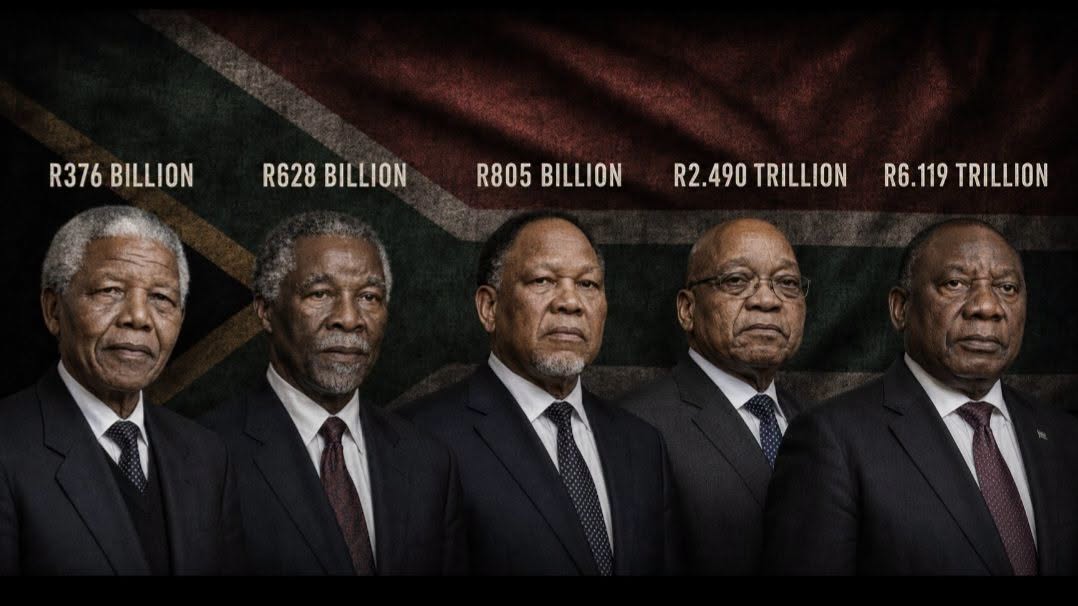
• 1998/99 — Approximately R376 billion, or 49% of GDP, under Mandela.
• 2003/04 — Approximately R510 billion, or 36% of GDP, under Mbeki.
• 2007/08 — Approximately R628 billion, or 27% of GDP, under Mbeki.
• 2008/09 — Approximately R805 billion, or 30% of GDP, during the Mbeki/Motlanthe transition.
• 2012/13 — Approximately R1.366 trillion, or 40% of GDP, under Zuma.
• 2014/15 — Approximately R1.799 trillion, or 41% of GDP, under Zuma.
• 2017/18 — Approximately R2.490 trillion, or 49% of GDP, during the Zuma/Ramaphosa transition.
• 2019/20 — Approximately R3.261 trillion, or 57.1% of GDP, under Ramaphosa.
• 2020/21 — Approximately R3.936 trillion, or 70.1% of GDP, under Ramaphosa during COVID-19.
• 2021/22 — Approximately R4.277 trillion, or 67.7% of GDP, under Ramaphosa.
• 2022/23 — Approximately R4.765 trillion, or 70.4% of GDP, under Ramaphosa.
• 2023/24 — Approximately R5.259 trillion, or 73.9% of GDP, under Ramaphosa.
• 2024/25 — Approximately R5.694 trillion, or 77% of GDP, during the Ramaphosa/GNU transition.
• 2025/26 — Approximately R6.119 trillion, or 78.9% of GDP, under Ramaphosa and the GNU.
• 2026/27 projection — Approximately R6.326 trillion, or 77.3% of GDP, under Ramaphosa and the GNU.
Under Mandela, debt almost doubled in rand terms, although it remained close to the same proportion of the growing economy.
Under Mbeki, debt continued increasing in rand terms, but stronger economic growth and improved revenue reduced the debt burden from around 49% of GDP to approximately 27%. This was the strongest period of debt consolidation after 1994.
The direction changed after the 2008 global financial crisis. Persistent budget deficits, weak growth, public-sector compensation, failing state-owned companies and rising interest costs drove debt steadily higher.
Under Zuma, gross debt increased from approximately R805 billion in 2008/09 to R2.490 trillion by 2017/18.
Under Ramaphosa, it increased from approximately R2.490 trillion to R6.119 trillion. COVID-19 caused the largest single-year increase, but the debt had already reached R3.261 trillion before the pandemic. Another R2.183 trillion was added after the worst COVID-19 financial year.
COVID-19 accelerated the crisis. It did not create it.
WHO LENT US THE MONEY?
South Africa did not borrow R6.1 trillion from one bank, one government or one country.
At March 2026:
• Domestic government debt: Approximately R5.490 trillion
• Foreign-currency government debt: Approximately R628 billion
• Total gross government debt: Approximately R6.119 trillion
Almost 90% was raised by selling domestic government bonds, Treasury bills and other financial instruments.
For every R100 invested in domestic government bonds during 2025:
• R25 was owed to foreign investors.
• R22.50 was owed to pension funds.
• R20.20 was owed to banks and similar monetary institutions.
• R23.70 was owed to investment funds and other financial institutions.
• R7.50 was owed to insurance companies.
• Approximately R1.10 was owed to other investors.
Foreign investors alone held approximately R1.065 trillion in rand-denominated government bonds. Describing these bonds as domestic debt does not mean every creditor is South African. It means the debt was issued inside South Africa, principally in rand.
Direct foreign lenders include the International Monetary Fund, World Bank, New Development Bank, African Development Bank, German KfW Development Bank, French Development Agency and the Government of Canada. International pension funds, banks, insurers, hedge funds and asset managers also hold South African government bonds.
Government therefore owes money not only to identifiable foreign institutions, but indirectly to millions of people through pensions, investments, insurance funds and bank deposits.
WHAT DO WE HAVE TO SHOW FOR IT?
Borrowing can be justified when it creates power stations, railways, ports, dams, roads and water systems that expand the economy and generate value for decades.
That is not what the national outcome shows.
South Africa extended electricity and water connections, delivered some housing, expanded social assistance and employed more public servants. Yet connections were expanded without adequately maintaining the systems behind them, housing demand still runs into millions, and social grants and government salaries remain recurring expenditure rather than productive assets capable of repaying debt.
After increasing gross national debt by approximately R5.934 trillion:
• Eskom required repeated bailouts and government debt relief.
• Freight rail and ports became obstacles to economic growth.
• Passenger rail infrastructure was allowed to collapse across large areas.
• Water interruptions, leaking networks, failing treatment works and sewage pollution became national problems.
• Municipalities developed enormous infrastructure and maintenance backlogs.
• Businesses and households increasingly pay privately for electricity backup, security, healthcare, education and transport after already paying taxes.
• Economic growth remained too weak to support the expanding debt.
Government can point to expenditure. What it cannot demonstrate is anything approaching R5.934 trillion in additional productive capacity, reliable infrastructure and economic growth.
We are now borrowing again to repair electricity, railways, ports, water and sanitation systems that previous taxation and previous borrowing were already supposed to build, operate and maintain.
THE INTEREST BILL
The R6.119 trillion is only the capital still outstanding.
Before government can spend money on policing, hospitals, schools, roads, water systems or infrastructure, it must service the debt accumulated by previous budgets.
Debt-service costs increased as follows:
• 2019/20 — R204.8 billion
• 2020/21 — R232.6 billion
• 2021/22 — R268.1 billion
• 2022/23 — R308.5 billion
• 2023/24 — R356.1 billion
• 2024/25 — R385.8 billion
• 2025/26 — Approximately R420.6 billion
• 2026/27 projection — Approximately R432.4 billion
During 2025/26, debt service cost taxpayers approximately:
• R35.1 billion every month
• R8.1 billion every week
• R1.15 billion every day
• R48 million every hour
• R800,000 every minute
That is principally interest and the cost of servicing the debt. It does not repay the entire R6.119 trillion capital balance.
When bonds and loans mature, government frequently borrows again to repay or refinance them. The old creditor is paid, a new creditor takes their place and the debt continues.
This is how a country can pay hundreds of billions every year without substantially reducing what it owes.
HOW LONG WILL WE BE PAYING?
South Africa’s debt has no single final repayment date.
The latest World Bank loan is approximately R24.7 billion and runs for 15 years. Government receives a three-year grace period on capital repayments, but “grace” does not mean free money. The debt exists immediately, interest is charged according to the agreement, and repayment of the capital has merely been postponed.
Government also has major foreign bonds extending decades into the future. Using approximately R16.50 to the dollar simply to illustrate their present rand value:
• Approximately R23.1 billion matures in 2032.
• Approximately R33 billion matures in 2036.
• Approximately R28.9 billion matures in 2037.
• Approximately R16.5 billion matures in 2046.
• Approximately R26.4 billion matures in 2052.
• Approximately R24.7 billion matures in 2054.
• Approximately R28.9 billion matures in 2055.
These bonds alone represent approximately R181.5 billion in capital at today’s illustrative exchange rate, before adding decades of interest. The eventual rand cost could be considerably higher if the currency weakens before repayment.
Even when those bonds mature, the national debt may not disappear. Government routinely issues new bonds and raises new loans to repay maturing obligations. The old creditor is settled, another creditor takes their place and the repayment date moves further into the future.
This is no longer temporary borrowing with a clear end. It has become a rolling national obligation, passed from one budget to the next and from one generation of taxpayers to another.
We are servicing debt accumulated by the governments before us. Our children will inherit the debt being created today, and their children may still be servicing the loans and replacement bonds used to postpone its final repayment.
The people authorising today’s borrowing may be long gone.
Generations of taxpayers will still be paying for it.
THE AUDIT FINDING
The ANC-led government inherited approximately R185 billion in gross national debt in 1994.
By March 2026, that had become approximately R6.119 trillion. By March 2027, Treasury expects it to reach approximately R6.326 trillion.
South Africa is now paying more than R1.15 billion every day largely in interest and debt-service costs, while the capital remains and government continues borrowing.
That money cannot simultaneously repair water systems, employ police officers, maintain roads, rebuild railways or improve hospitals. Taxpayers must first pay for yesterday’s expenditure before funding today’s needs.
The problem is not simply that government borrowed.
The problem is that borrowing repeatedly exceeded the productive capacity created with the money.
Economic growth remained weak, essential infrastructure deteriorated and the tax base did not expand sufficiently to carry the burden.
We are borrowing more than the country can comfortably support, while producing far too little evidence that the expenditure is building a stronger and more productive South Africa.
The debt remains.
The interest grows.
The infrastructure must still be repaired.
Our children will inherit the repayments, and their children may still be servicing bonds issued to cover money being spent today.
Written by Shaun Schutte
28 July 2026