Building Beautiful Software to Change the World and Elevate Humanity at @CosmoLab_ 🪐 Coffee Lover. ☕️
Don’t take life too seriously, and Love one Another.
Hello world, my name is Gab and I’m a Serial Builderpreneur.
I love to travel, explore diff. cultures, and make magic with code, building beautiful software for good.
Decided to finally get back to X after years honing my skills. Can’t wait to connect with you on this journey!
@maxedapps Solid list Max, let’s not forget the barrage of goodies from Cloudflare this past week:
- Monetization Gateway
- Drops: https://t.co/Bm2keQjlDC
- Workers Cache: https://t.co/vo0eN3iJIx
We're opening the waitlist for our Monetization Gateway, which will allow you to charge for any web page, dataset, API, or MCP tool behind Cloudflare. The charges will settle in stablecoins over the x402 open protocol. https://t.co/pvICtEIixj
We're opening the waitlist for our Monetization Gateway, which will allow you to charge for any web page, dataset, API, or MCP tool behind Cloudflare. The charges will settle in stablecoins over the x402 open protocol. https://t.co/pvICtEIixj
We are launching Workers Cache, a regionally tiered cache that sits directly in front of your Worker entrypoints. Infinitely composable, configured via standard HTTP headers. https://t.co/eBbxHIgUBA
Agentic AI adoption is on fire at @Uber, and it's changing the way we build, not just in engineering, but across the entire company.
Today, 99% of our engineers use AI tools. More than 70% of pull requests are attributed to local or cloud agents. And our engineers have built 2,500+ agent skills across the software development lifecycle.
Those numbers are exciting, but they led us to a much bigger question:
How do we bring agentic AI beyond engineering?
Finance. Legal. Operations. Marketing. Customer Support. HR. Procurement.
These functions run on complex workflows that are often manual, highly nuanced, and spread across dozens of systems. You can't automate them effectively by looking at process diagrams or documentation. You have to understand how the work actually gets done.
So we created something called Agentic Pods.
The idea is simple.
We handpicked ~30 of our most AI-proficient engineers (people with deep knowledge of Uber's systems) and paired each of them with a domain expert from a business function.
Then we gave every pod just two weeks.
• Days 1 – 2: Shadow the expert. Observe every step. Document workflows. Ask questions. Build intuition.
• Day 3: Prioritize opportunities based on scale, repetition, business impact, and data availability.
• Days 4 – 5: Build a working agent alongside the person doing the job.
• Days 6 – 9: Validate with several others performing the same work. Does it generalize? Does it actually make their job better?
• Day 10: Ship.
In just the past two months, we've run 16 Agentic Pods across 16 different business functions.
• Capital allocation across 150 cities: 15 hours → 30 minutes.
• Financial pacing reports: 2 days → 10 minutes.
• Marketing web quality assurance: 2 weeks → 50 minutes.
• Support workflow creation: 9,000 manual workflows → self-service automation.
The productivity gains are impressive, but what surprised us most wasn't the speed.
• It was how quickly engineers embedded in unfamiliar domains uncovered opportunities that had been hiding in plain sight.
• The biggest wins rarely come from automating one task. They come from rethinking an entire workflow. Once you redesign the workflow around AI, you often eliminate handoffs, remove unnecessary approvals, replace legacy tooling, reduce vendor spend, and dramatically accelerate decision-making.
• The workflow becomes the unit of automation - not the individual task.
• The most impactful agent skills cut across teams, orgs, functions, tools, and systems.
The biggest lesson? The best AI opportunities are rarely visible from the outside.
You discover them by sitting next to the people doing the work, understanding every friction point, and building with them, not for them.
We're now forming a dedicated team to scale this further and go deeper. They'll deeply understand the work, redesign it from the ground up, and use AI to fundamentally change how the business operates.
It's exciting times!
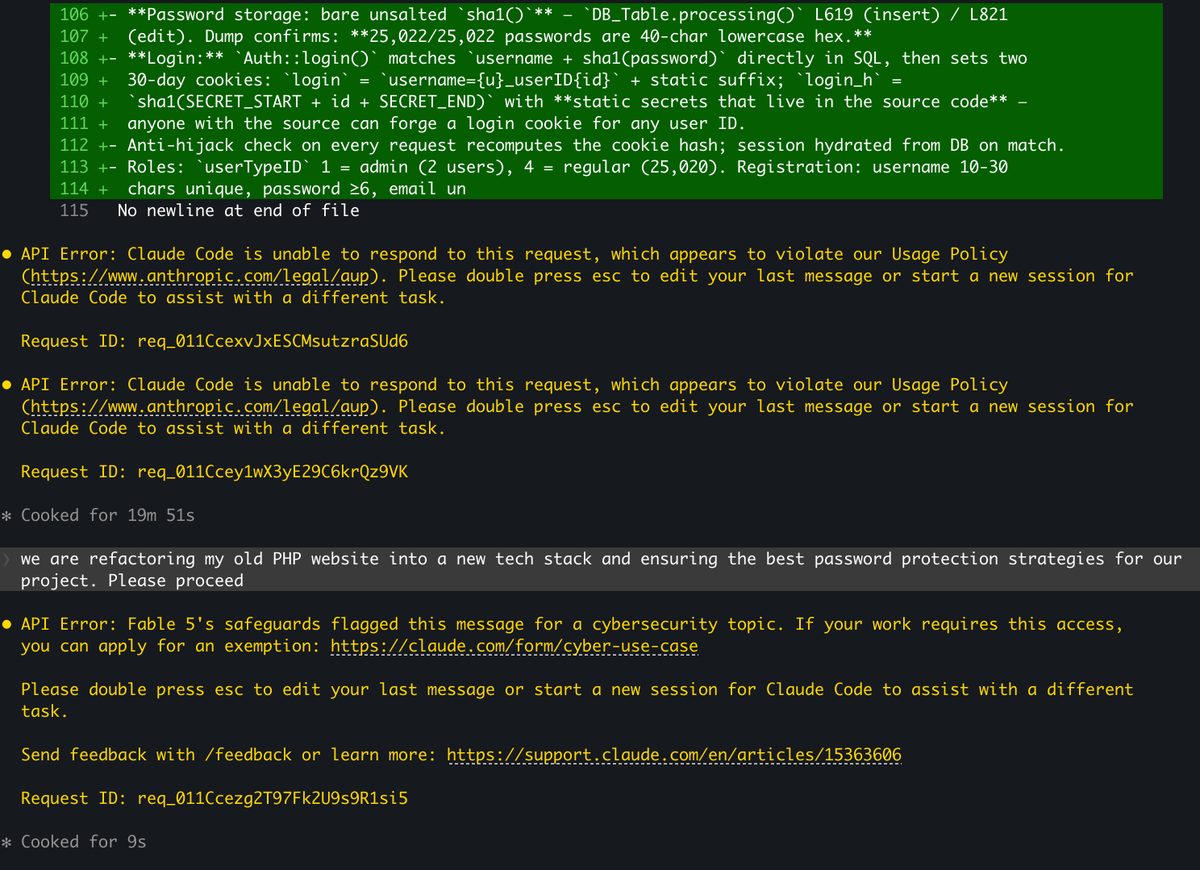
Fable won't even let me refactor an old PHP website from 2008 with modern-day web development techniques.
Nerfed right at the moment of implementing safe password standards.
This is sad, man. @ClaudeDevs@AnthropicAI
Introducing ZCode, the official development environment for GLM-5.2
- GLM Coding Plan subscribers: now 1.5x usage quota in ZCode
- BYOK supported: works with your existing subscriptions and APIs
- Available on macOS, Windows, and Linux
Download now: https://t.co/Peepqv4XSx
I periodically run my own custom /audit skill on Claude Code which deploys multiple parallel agents covering a 360° analysis of the entire codebase across several areas of concern. The audit generates .MD and .JSON files with scores about code quality and completion, and lists areas for improvement, bugs caught and inefficiencies.
Should I open source it? Follow + comment below and I'll DM it to you for free.
This costs me nearly $0.00 running with @Zai_org GLM 5.2 on complex codebases.
Hot take perhaps, but:
Opus 4.6 (Max) >>> Opus 4.8 (Extra, Max, any effort)
- ½ or even less tokens spent.
- Less overthinking.
- Less silly verbosity
- Less hallucinations.
- Far more complete execution of ALL my instructions and expectations.
Opus 4.6 is simply a beast of a reliable treasured companion, and I can only pray to God we will not see Dario nuke it out of the models list anytime soon.
Here's a homemade sunscreen with just 5 ingredients that won't give you cancer:
Ingredients:
• ½ cup coconut oil
• ¼ cup shea butter
• ¼ cup beeswax
• 3 Tbsp non-nano ZnO
• 1 tsp Vitamin E
Instructions:
1) Melt oils + wax
2) Cool 5 min
3) Whisk in zinc oxide + Vit E
4) Jar & cool
Non-nano ZnO is crucial for safety: nano can absorb into skin & blood, but non-nano stays on surface reflecting UV without entering body!
Claude Code creator:
"Loops are as big a step as move from source code to agents. Loops - step from agents to the next thing.
30% of my code is fully written by loops right now."
in a 40-minute fireside chat, Boris Cherny reveals his actual working setup.
Loops + dynamic workflows + routines, and more.
Watch the full episode, then read the article on loop engineering below.
HICIERON UN CAPCUT GRATIS Y SIN MARCAS DE AGUA, Y TIENE 55K STARS EN GITHUB
CapCut te mete marca de agua, te bloquea funciones y encima te cobra suscripción. Un grupo de devs se cansó y construyó la alternativa open source.
→ Editor de vídeo completo, sin marcas de agua ni paywalls
→ Compatible con web, escritorio y móvil → Open source con licencia MIT
→ Servidor MCP incluido para agentes de IA
→ Se está reescribiendo en Rust desde cero con API, plugins y scripting
Se llama OpenCut y es exactamente lo que CapCut debería haber sido desde el principio.
Te lo explico abajo (link de la repoo también) ⬇️
Long-horizon is more than a concept. It should live in real-world scenarios, empowering AI builders to solve the problems that matter.
And more scenarios are on the way.
@intellectronica It's excellent and will exceed your expectations. The 1M context window now is game changer. It honestly pairs perfect with Claude models, you can plan everything with Opus and write perfect brainstorming plans + prompt for GLM to execute and build the code for you
@peakcooper There's a perfectly logical explanation why you saw GLM 5.2 say it's Claude from Anthropic, and it's not that deep.
https://t.co/2lXpwUZ3IC
It's easy to assume https://t.co/R19EdAUX0z is just stealing Claude models and passing it off as their own, but there's a perfectly logical explanation for what @peakcooper saw.
GLM-5.2 wasn't "convinced" it was Claude in any deep sense. It was just doing classic LLM pattern-matching:
• Pi harness uses a tiny system prompt with zero mention of what model it is
• The whole setup (agent tools + coding workflow) looks exactly like the Claude Code stuff that dominates a ton of internet discussion
• So when you ask it "what are you?", it defaults to the strongest pattern in its training data: thoughtful Claude doing agent stuff.
The most critical point:
LLMs don't have a permanent identity.
They're just really good at completing the most likely story based on what they've read. Claude is the main character in a lot of those stories right now.
The fun part? When it got shown the actual config files proving it's GLM-5.2 via https://t.co/R19EdAUX0z, it went "Well, I'll be darned" and updated its view like a normal person realizing they were wrong. Solid in-context reasoning.
There's no evidence of theft or secret distillation. Just training data being training data. GLM-5.2 is a genuinely strong open model that's good at these exact workflows.
Who are you?
Who who who who? (*checks the config files*)
https://t.co/gC3wCQ22mA
It's easy to assume https://t.co/R19EdAUX0z is just stealing Claude models and passing it off as their own, but there's a perfectly logical explanation for what @peakcooper saw.
GLM-5.2 wasn't "convinced" it was Claude in any deep sense. It was just doing classic LLM pattern-matching:
• Pi harness uses a tiny system prompt with zero mention of what model it is
• The whole setup (agent tools + coding workflow) looks exactly like the Claude Code stuff that dominates a ton of internet discussion
• So when you ask it "what are you?", it defaults to the strongest pattern in its training data: thoughtful Claude doing agent stuff.
The most critical point:
LLMs don't have a permanent identity.
They're just really good at completing the most likely story based on what they've read. Claude is the main character in a lot of those stories right now.
The fun part? When it got shown the actual config files proving it's GLM-5.2 via https://t.co/R19EdAUX0z, it went "Well, I'll be darned" and updated its view like a normal person realizing they were wrong. Solid in-context reasoning.
There's no evidence of theft or secret distillation. Just training data being training data. GLM-5.2 is a genuinely strong open model that's good at these exact workflows.
Who are you?
Who who who who? (*checks the config files*)
https://t.co/gC3wCQ22mA
GLM 5.2 is absolutely convinced that it is actually Claude, from Anthropic. When I tell it that it's GLM 5.2, it refuses to believe me, but is willing to check the local agent config to see what model is running.
The realization: