@LukeKinsky Honestly, at the pace we're going, "offshore" may eventually mean "off Earth." The line between maritime infrastructure and space infrastructure is getting pretty interesting.
🚨 NEWS: SpaceX wants to launch AND catch Starship from offshore platforms.
In an official comment letter to BOEM dated August 7, SpaceX backed the use of federal waters for space launch and recovery operations.
The concept could involve repurposed oil platforms or purpose-built offshore structures capable of launching Starship and catching it during recovery.
SpaceX also argued that existing federal authority is sufficient and asked regulators to keep launch licensing with the FAA rather than creating another layer of regulation.
The bigger advantage is obvious:
Move Starship operations offshore → fewer impacts on populated areas → potentially much higher launch cadence.
Starship launch and catch operations could eventually happen far out at sea, turning offshore infrastructure into another piece of SpaceX's reusable rocket system. 🚀🌊
@Vinh_KhuuChi Absolutely, and that's where the transition gets complicated, as AI and robotics reshape labor and investment, traditional ideas about borders, jobs, and economic power will face some serious pressure.
@zentdaily I agree. AI and robotics may not eliminate work so much as change where the value and investment concentrate. Aerospace is already showing what that transition can look like, and the UAE is positioning itself well to capture a significant share of it.
🚨 Elon Musk's warning about the next 3 years is worth paying attention to.
His prediction is that AI and robotics could automate a huge portion of paid human labor, fundamentally changing the relationship between time, work, and income.
For 200 years, the basic equation has been:
“Give us your time, and we'll pay you a salary.”
What happens when machines can provide that time cheaper, faster, and at massive scale?
The biggest shift may not simply be job automation. It could be the transition from a world where income comes primarily from labor to one where ownership, capital, infrastructure, and productive assets matter far more.
AI isn't just changing how we work.
It could change what work itself means. 🤖⚡
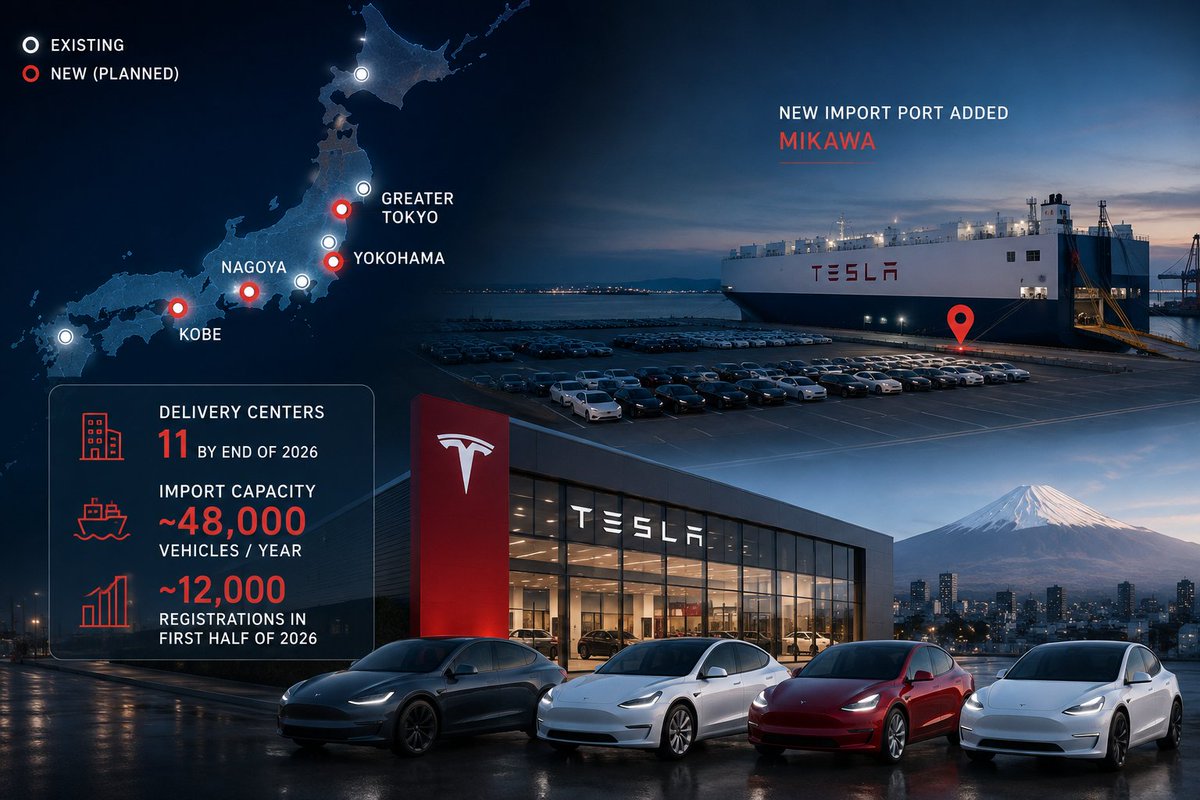
🚨 Tesla is rapidly expanding its delivery network in Japan as demand accelerates. 🇯🇵⚡
Tesla plans to add 4 new Delivery Centers across Yokohama, Kobe, greater Tokyo, and Nagoya, bringing the total to 11 by the end of 2026.
The company is also adding a second import port at Mikawa, nearly doubling annual import capacity to around 48,000 vehicles.
With roughly 12,000 registrations already recorded in the first half of 2026, Tesla is building logistics capacity ahead of demand.
More ships in. More delivery centers. More Teslas on Japanese roads.
🌍 At the core of everything Elon Musk is building is one mission: protect the future of humanity.
Build AI that seeks truth, understands humanity, values civilization, and ultimately benefits people rather than becoming a threat to them.
Make humanity multiplanetary, so our entire civilization isn't permanently dependent on a single planet.
And ultimately, ensure that the light of human consciousness doesn't just survive, but expands across the solar system and eventually the stars.
From AI to Mars, the goal is the same: give humanity a future. 🚀✨
🛰️ Elon Musk explains what makes Starlink different from traditional internet infrastructure.
Starlink satellites use laser links to communicate with one another, creating a mesh network in space.
That means data doesn't always have to depend on terrestrial fiber routes. If ground infrastructure is damaged, traffic can potentially be routed through satellites instead.
Musk pointed to the Red Sea cable disruptions as an example of Starlink continuing to operate despite damage to undersea infrastructure.
Instead of building the entire internet on the ground, Starlink is building part of it in space. 🌍🛰️
☀️ Tesla's $10.1 BILLION Crystal Sun project is taking shape in Texas.
A new flyover gives a look at the proposed site in Fort Bend County, covering more than 3,000 acres near FM 1994 and FM 762.
The planned facility would manufacture solar cells and modules at massive scale, strengthening Tesla's vertically integrated energy business.
The location is also strategically positioned near major energy infrastructure, including the W.A. Parish Generating Station and existing solar developments.
Tesla isn't just building cars and batteries in Texas. It's building an entire energy ecosystem. ☀️🇺🇸
🤯 Jensen Huang: “We're going from a billion people using computers to 100 billion agents using them.”
The scale of that prediction is almost impossible to comprehend.
At just 50 calls per day and 500 tokens per call, 100 billion agents would generate roughly 2.5 quadrillion tokens every day.
That would require an inference infrastructure orders of magnitude larger than today's.
And here's the fascinating part:
Jensen's AI forecast and NVIDIA's business opportunity point in exactly the same direction.
The question is whether we're watching an enormous AI infrastructure bubble...
or witnessing the early stages of the biggest compute expansion in history.
Google, Anthropic, NVIDIA and others aren't waiting to find out. They're building for it.
☀️ You're watching one of the Sun's most spectacular displays of power.
A solar flare erupts, followed by coronal rain, where superheated plasma cools, condenses, and falls back toward the Sun along invisible magnetic field lines.
And no, it's not water. It's electrically charged plasma, reaching temperatures of thousands to millions of degrees.
From 150 million km away, the Sun looks peaceful.
Up close, it's a constantly changing ocean of plasma and magnetic energy. ☀️🔥
🤖🚀 Jensen Huang and Elon Musk are teaming up to shape the future of AI and space.
NVIDIA CEO Jensen Huang met with SpaceX CEO Elon Musk at SpaceX's Starbase facility in Texas, bringing together two of the biggest forces in modern technology.
From DGX supercomputers and AI infrastructure to rockets, energy, and space-based computing, the convergence is becoming impossible to ignore.
AI + Compute + Energy + Space.
The next technological era is being built right now. 🚀
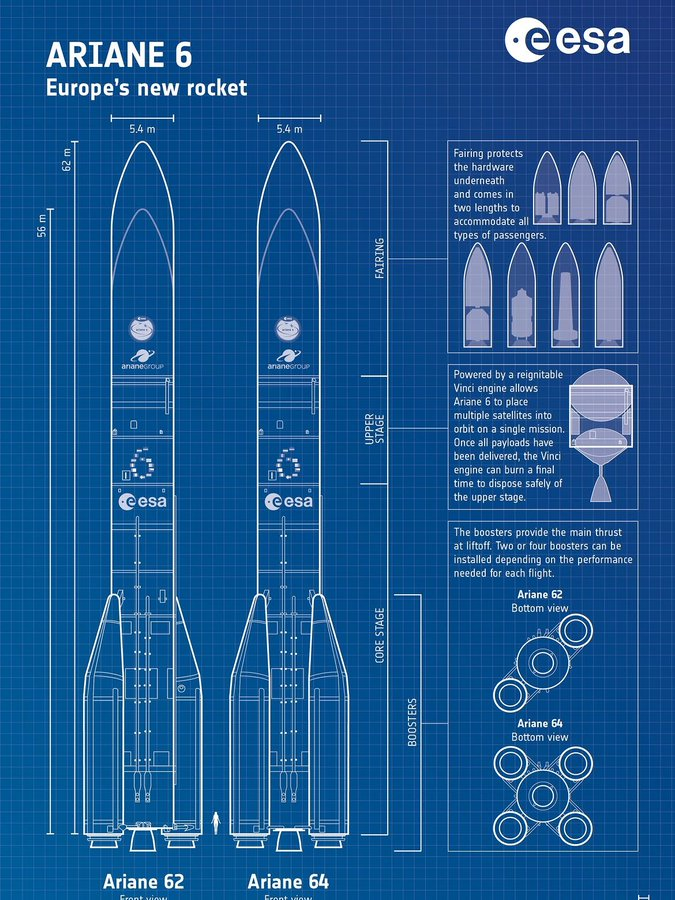
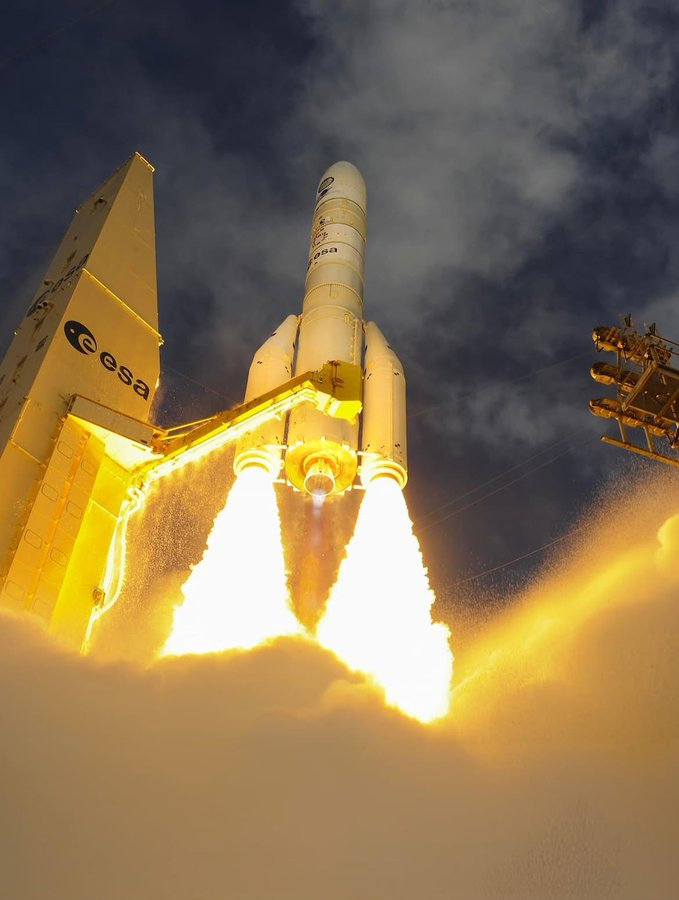
🚀 Ariane 6 is Europe's next-generation heavy-lift rocket, developed by ESA and led by ArianeGroup.
Designed to replace Ariane 5, Ariane 6 is built to provide Europe with independent access to space, allowing it to launch satellites, scientific missions, and spacecraft without relying on foreign launch providers.
Europe's next chapter in spaceflight has begun. 🇪🇺🚀
🚨 NVIDIA CEO Jensen Huang:
“Nobody writes prompts anymore. The new job is building loops and graphs.”
In a 50-minute breakdown, Huang explains how AI is moving beyond simple prompting toward agentic systems that can reason, iterate, use tools, and work through complex tasks.
The shift is simple:
Prompting = telling AI what to do.
Loops + graphs = building systems that make AI work for you.
The next AI skill may not be writing better prompts.
It may be designing the systems that let AI continuously do the work. 🤖⚡
🤯 Jensen Huang just told the incredible story of how Elon Musk became NVIDIA's first customer for its AI supercomputer.
When NVIDIA introduced the system, nobody wanted to buy it.
Jensen said:
“Not one purchase order. Except for Elon.”
In 2016, Jensen personally packed up the first system and delivered it to a small room in San Francisco where OpenAI was getting started.
At a time when almost nobody understood how important massive AI compute would become, Elon was already betting on it.
Looking back, that moment feels almost prophetic.
The AI revolution needed compute. Elon was willing to buy it before everyone else understood why.
@Stellarixorine Exactly. NASA’s visualizations turn something we normally can’t see into something we can actually understand. It’s a powerful reminder that Earth’s atmosphere is one interconnected system, where changes in one place can have effects far beyond it.
🔥 NASA visualization shows wildfire smoke from Canada and the western U.S. spreading across huge portions of the atmosphere.
The animation tracks smoke movement from mid-July through August 5, with intensity and transport modeled using NASA's GEOS-CAM system.
It's a striking reminder that wildfire smoke doesn't stay local. Atmospheric winds can carry it thousands of miles across borders and continents. 🌎
@SailorsMoon3@elonmusk I understand, connectivity in remote areas can be a matter of safety, especially when access to weather information is critical. Hopefully there can be a way to expand Starlink’s benefits without leaving sailors and other remote users behind. 🛰️
🚨 BREAKING: Lufthansa is joining the Starlink revolution. 🛰️✈️
Lufthansa's first Starlink-powered flight is set to take off on August 19, with its first Starlink-equipped Airbus A320neo entering service.
And this is just the beginning:
~850 Lufthansa Group aircraft are expected to be equipped with Starlink by 2029.
Starlink is rapidly turning in-flight Wi-Fi from a luxury into a standard expectation for passengers.
❤️ Elon Musk:
“I want all humans to be happy and prosperous, without regard to race, creed, religion or anything else.”
A simple goal, but an incredibly ambitious one.
A future where prosperity is shared by all of humanity.
🚨 BREAKING: Lufthansa just released new photos showing Starlink being installed on its aircraft. 🛰️✈️
Lufthansa's first Starlink-equipped Airbus A320neo is set to enter service on August 19.
Starlink is officially taking off with Lufthansa. 🚀📶
The era of high-speed Wi-Fi in the sky is here.