@MarkAntiBabylon@DF_UniatePapist Because protestants constantly come up with new ways to re-hash old heresies. Or simply make new ones. Such as idolizing the bible.
The Council of Nicaea is famous for defending Christ's divinity. Almost nobody mentions what its canons assume about the priesthood.
In 325 AD, the same 318 bishops who defined the faith against Arius issued Canon 18: deacons were forbidden from receiving communion before presbyters or from administering the Eucharist to them. Violations carried canonical discipline.
Read that carefully. This is not a rule about politeness or church manners. It is a rule about ontological order in the sanctuary.
If ministry were merely a functional job, as much of evangelicalism teaches, the distinction would make no sense. A deacon who serves tables and a presbyter who teaches are just different task descriptions. Nobody legislates canonical penalties over organizational etiquette.
But Nicaea treats the clergy as ranked in a sacred hierarchy that reflects the order of the Eucharist itself. The bishop stands at the altar. The presbyter shares in his priesthood. The deacon serves in a distinct order below both. This gradation was so fixed, so non-negotiable, that interfering with it was an offense against the Church's own structure.
And notice the timing. This is still the age before Constantine's church buildings were even widespread. The Church was emerging from the worst persecution it had yet endured, led by bishops who carried the scars of it. These were not comfortable imperial bureaucrats inventing hierarchy for political convenience. They were martyrs and confessors legislating a hierarchy they had inherited and were willing to die for.
The evangelical picture of a loose, informal early leadership that later "hardened" into priesthood runs into a wall here. By 325, the structure was already so developed that its internal ordering was a matter of conciliar law.
The question every Protestant should sit with: does your church's leadership structure look more like Nicaea's, or more like something the bishops of 325 would not recognize as ordination at all?
KoC doing good works isnt what everyone is talking about. The disconnect is. Young men want brothers who understand the world they live in so they can battle it together. Too many councils offer chores, boring meetings and lectures from a world that no longer exists. You can’t answer a hunger for brotherhood with a volunteer signup sheet and out of touch boostrap talks. Young guys and the old guys live in totally different worlds and its impossible to talk to the old guys. The old guys offer nothing the young guys want. Who wants to be around a bunch of neutered old boring boomers who have have been totally emasculated, domesticated and generally just lost their male spirit/spine. Sorry to say but this is a Catholic church problem. All Christian men have this a bit but protestants tend to do strong male fraternity better. Young men want someone to talk about sh** they are dealing with like struggling with lust and iron sharpens iron and challenging/supporting each other and having a good time.
Around 700, the monks of Wearmouth-Jarrow in England produced a complete Latin Bible, the Codex Amiatinus. It took the skins of roughly 515 calves and weighs about 75 pounds. Johannes Gutenberg, not Martin Luther, made Scripture accessible to the laity.
When stating the number of one's sins, there are four degrees of precision that one can use.
1. Exact number ("I sinned X times"). This is self-explanatory.
2. Probable number ("I sinned around X times"). This is used when you are generally aware of the number but have some doubt as to the exact number.
3. Conjectural number ("I sinned around X times per Y period," e.g., per day, week, month, etc.). This is used when an approximation of the total number is unclear, but the frequency can be estimated.
4. Confused number ("I habitually/often/occasionally sinned for Y period," e.g., 3 months, 10 years, etc.). This is used when the frequency can only be stated in general terms, but the length of time can be estimated.
The fourth is especially useful for those living in some immoral lifestyle (e.g., "I lived in concubinage for 2 years"), where the frequency cannot be reliably approximated.
There is no need to be anxious about estimating the number of sins for confession. If you do your best and seriously consider the number of times you have sinned, you're completely fine. Being able to distinguish between these types of numbers and use them in confession will be of great help in relieving your anxiety. The greatest moralists have approved these methods, and they have been in use for centuries.
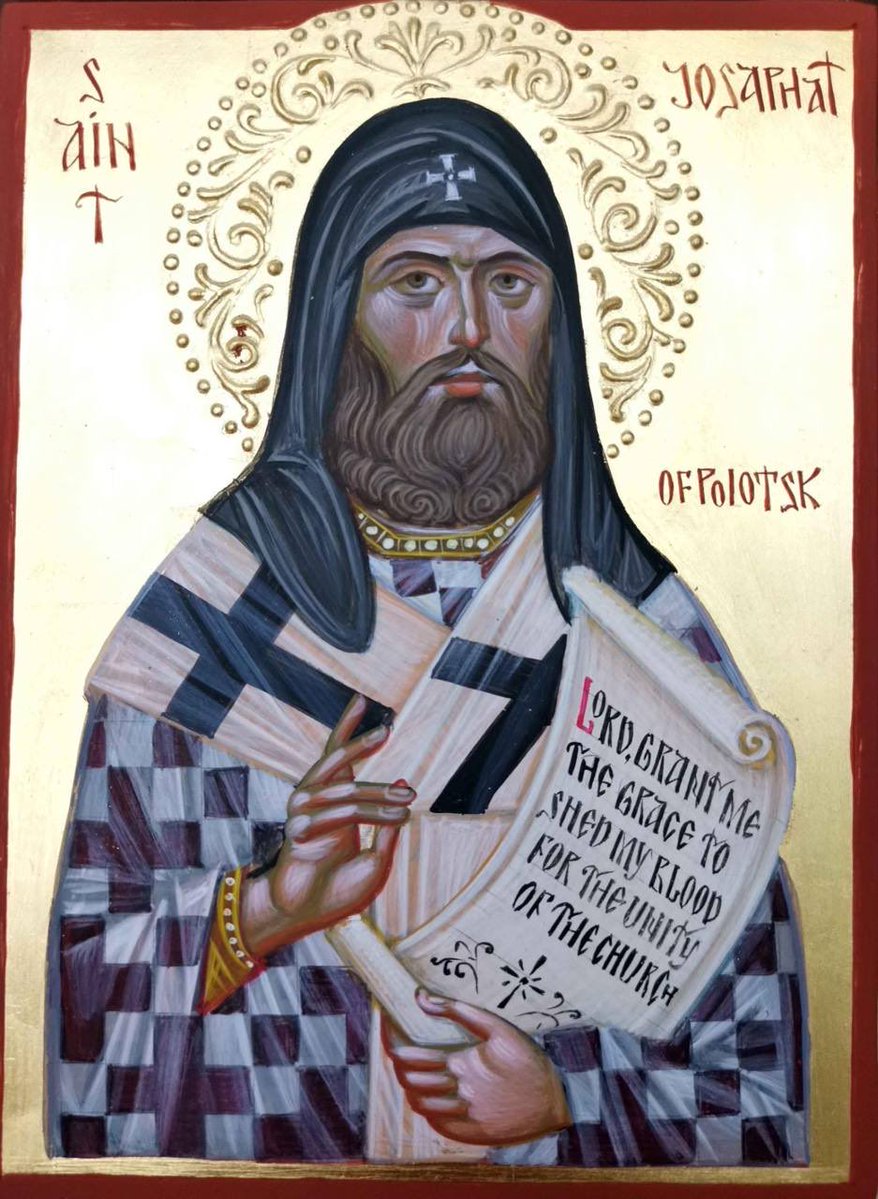
Today, November 12, we honor a luminary of the Uniate Church and its first martyr, Saint Josaphat. Every year on this day, the Orthodox attempt to portray him as a bloodthirsty persecutor of Orthodox peasants; yet, he looks upon this, smiles quietly, and forgives them.
@RdHdSteppeson@Hartlander_ If they're Catholic putting up those signs, they're probably in favor of things that automatically excommunicated them from the Church.
The Left has always correctly surmised that the "marketplace of ideas" is a total myth. Democracy, too, is a myth. So is the idea that if we leverage our freedom of speech or engage in enough open dialogue with the other side, the truth will inevitably prevail and then manifest itself in legislation.
All of these things are basically childish ideas about how politics actually works, but we keep clinging to them because they make us feel good.
Here’s how things actually work.
You take power
You defund your enemies
You hire your friends
You enact policies that send your enemies into exile while importing new voters who are loyal to you
And you rinse and repeat all of this until your political worldview gets installed as the equivalent of "just being a heckin' decent human being."
This is all so easy to understand, but every time someone says it out loud, we treat it like they’ve either said something unbelievably scandalous, or they're the second coming of Machiavelli.
The libs are completely right in all of their insights about cars. It's not even an urban/rural thing, the walkable town is just the historically normative way people live.
They offer no constructive suggestions, can't build nice places, don't know how to make density child-friendly, and won't address the elephant in the room, but they aren't wrong either.
The Yemeni women I see walking around the streets of New York in full burkas were let into this country legally
Almost all of the Somalis in Minnesota were let into this country legally, most of them were fast tracked to citizenship after only 5 years of residence by our own traitorous government
They're not Americans, most of their children did not assimilate
If you haven't had the bad experiences with *legal* immigration necessary to come to this conclusion, I'm happy for you, but many of us have
The hour is too late & the existential existence of America hangs in the balance, I don't know about exactly 100 million, however many millions of people have to go both legal & illegal