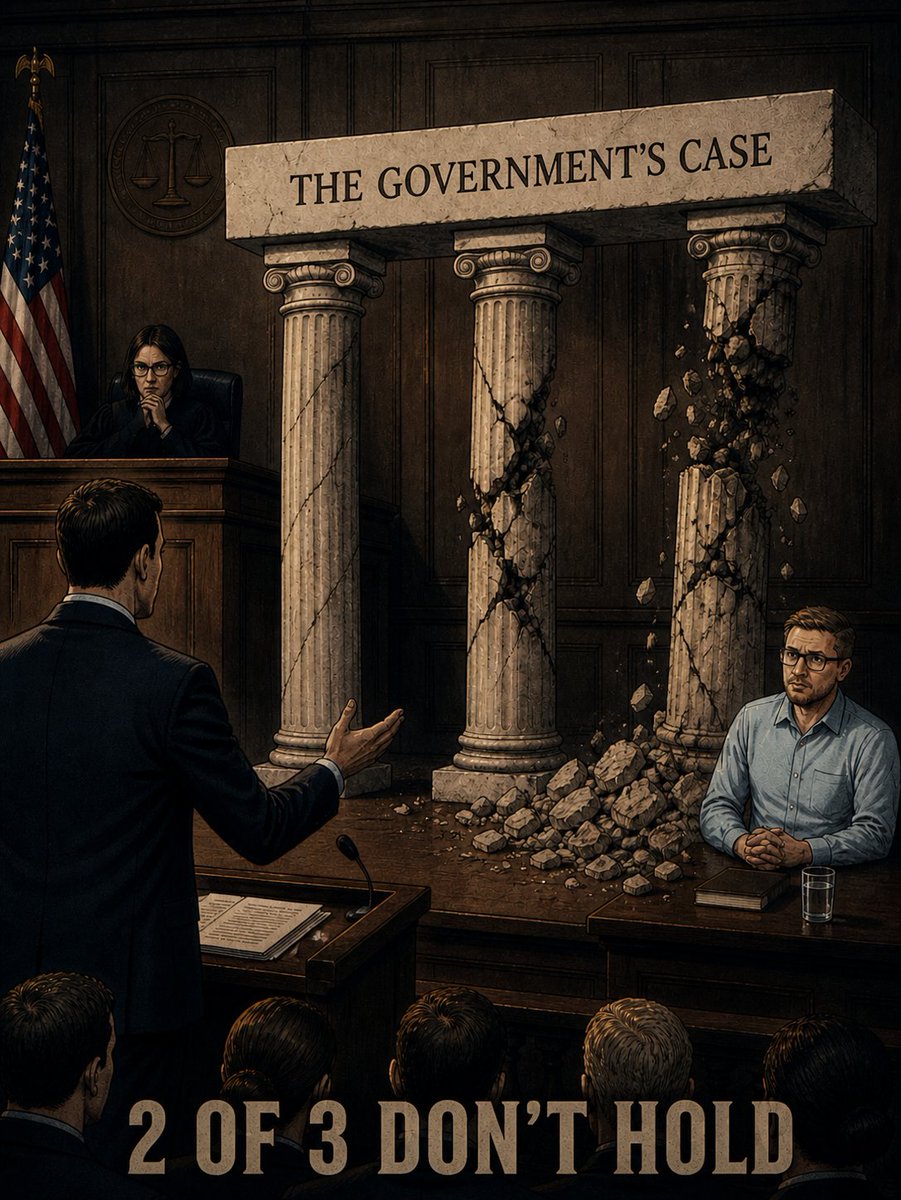
THE COURT: "How does speaking falsely become an overt act?"
MR. ARAD: [three sentences of hand-waving]
THE COURT: "A bit attenuated."
When even the Rule 29 judge says your overt act is "attenuated," you have a problem.
The jury hung on 2 of 3 counts. That alone tells you how thin the government's case was. At Rule 29 oral argument, the prosecution's theory was visibly struggling under the weight of its own contradictions.
The government's theory of the Storm prosecution, stripped to its essentials:
→Opening your laptop is a felony
→Clean money gets dirty by proximity
→Telling the truth can be an overt act
→Shipping a sanctions screener proves guilt
→You must "withdraw" from immutable code
Government theory: improving an open-source privacy tool proves you built it for criminals.
By that logic: if you build a faster car and a bank robber buys it as a getaway vehicle, you built the car for the bank robber.
The government says Storm should have walked away once a "large part" of Tornado Cash users were criminals. Asked what "large part" means, the government couldn't say. 15%? 37%? 55%?
"Nobody knows. When should he have walked away? Nobody knows." — Klein.
Even on a Rule 29 motion — where the judge must give the government every reasonable inference — Failla repeatedly signaled she wasn't buying it:
"I may ultimately agree with you that the affirmative conduct posited by the government does not suffice."
The government called the public, on-chain, community-voted Tornado Cash relayer registry "concealment."
It was proposed in a public Medium post, voted on by the community, and deployed on-chain. Per the government's own expert: "the founders did not control that vote."
Storm and his co-founders actually implemented the Chainalysis sanctions oracle — a real, working screening mechanism that blocked 100% transactions from sanctioned wallets —Klein
The government's response? Doing the right thing was evidence of guilt. Heads I win, tails you lose
1/ One of the government's "overt acts" in the money-laundering conspiracy: Roman Storm told a BitMart attorney he didn't control the protocol and couldn't recover their hacked funds. The government calls this a lie. 🧵
5/ The prosecution's theory: telling a hack victim a factually accurate statement can be an "overt act" of conspiracy because the *effect* of the truth was to discourage them from calling the police. This criminalizes reality. /end
1/ The government's star "willfulness" theory: Roman Storm should have added a *name-and-email login screen* to the Tornado Cash UI. Their expert calls it a "user registry." I have questions. 🧵
6/ Judge Failla cut right to it:
"I am concerned that that allows the jury to convict Mr. Storm for not doing what he was not legally required to do."
Arad had no answer. /end





![CourtCartoons's tweet photo. THE COURT: "How does speaking falsely become an overt act?"
MR. ARAD: [three sentences of hand-waving]
THE COURT: "A bit attenuated."
When even the Rule 29 judge says your overt act is "attenuated," you have a problem. https://t.co/saD8ChI43Z](https://pbs.twimg.com/media/HHe59y7XYAAWaWJ.jpg)