Compliance belongs at the app layer, not the network layer, as @RebeccaRettig1 explains here.
“You can put the compliance where your apps are, which is, PS, where you have almost all your compliance today.”
“This is like, can I use the open internet or do I have to use a closed version of the internet? ... You are putting your compliance tools around your products.”
“If you’re not doing it in a knowing, repeated, intentional way, then you can create systems where your products are on these networks, just like they’re on the open internet, where bad guys may be running around too, possibly.”
Can TradFi use permissionless blockchains, given the Bank Secrecy Act & sanctions laws?
This @LawofCodeFM episode is a deep dive into the BSA, crypto compliance and a paper by @RebeccaRettig, @malekanoms and @M_Mosier, which argues that TradFi can embrace blockchains while complying with existing law.
Timestamps:
0:00 Intro
3:24 Problems they see
5:39 The router principle
7:13 What permissionless systems get right
11:28 Lessons from the open internet
14:23 Credible neutrality
19:20 A brief history of the BSA
23:55 What OFAC enforcement looks for
26:16 Treasury, Iran and open networks
28:29 The SEC's innovation exemption
34:03 Compliance belongs at the app layer
37:04 "The government will never allow it"
39:39 The paper's nine-part framework
44:12 Network layer vs. transaction layer
46:28 The $50,000 canoe
48:02 Safety, soundness and final settlement
50:29 Why this matters for national security
51:27 Privacy
58:07 What this means for DeFi
Thank you to the presenting sponsor of this episode, @altitude.
Nothing in this podcast is legal or investment advice.
“Anything that could be said about the illicit use of a blockchain for financial activities is a thousand times worse for the illicit use of information on the internet.”
Omid Malekan (@malekanoms) on why people who think permissionless blockchains will never be allowed to serve as financial infrastructure actually misunderstand how lawmakers think.
“If the same people around 30 years ago, maybe they would say, ‘Well, the government would never allow this worldwide web thing to take off because then anybody could get the information on how to build a bomb and be a terrorist.’”
Can TradFi use permissionless blockchains, given the Bank Secrecy Act & sanctions laws?
This @LawofCodeFM episode is a deep dive into the BSA, crypto compliance and a paper by @RebeccaRettig, @malekanoms and @M_Mosier, which argues that TradFi can embrace blockchains while complying with existing law.
Timestamps:
0:00 Intro
3:24 Problems they see
5:39 The router principle
7:13 What permissionless systems get right
11:28 Lessons from the open internet
14:23 Credible neutrality
19:20 A brief history of the BSA
23:55 What OFAC enforcement looks for
26:16 Treasury, Iran and open networks
28:29 The SEC's innovation exemption
34:03 Compliance belongs at the app layer
37:04 "The government will never allow it"
39:39 The paper's nine-part framework
44:12 Network layer vs. transaction layer
46:28 The $50,000 canoe
48:02 Safety, soundness and final settlement
50:29 Why this matters for national security
51:27 Privacy
58:07 What this means for DeFi
Thank you to the presenting sponsor of this episode, @altitude.
Nothing in this podcast is legal or investment advice.
Not everything that calls itself a blockchain offers the same protections.
Omid Malekan (@malekanoms), Adjunct Professor at Columbia Business School, says it comes down to the system:
“The protections that we all believe come to token holders, DeFi users, the guarantees of smart contracts and so on, they only exist in systems where consensus is generally open and permissionless.”
“There could be, and often are frictions by design. So this is the proof of work for Bitcoin mining. It’s the financial commitment to participate in a proof of stake network.”
“But nevertheless, it is open and meritocratic.”
Can TradFi use permissionless blockchains, given the Bank Secrecy Act & sanctions laws?
This @LawofCodeFM episode is a deep dive into the BSA, crypto compliance and a paper by @RebeccaRettig, @malekanoms and @M_Mosier, which argues that TradFi can embrace blockchains while complying with existing law.
Timestamps:
0:00 Intro
3:24 Problems they see
5:39 The router principle
7:13 What permissionless systems get right
11:28 Lessons from the open internet
14:23 Credible neutrality
19:20 A brief history of the BSA
23:55 What OFAC enforcement looks for
26:16 Treasury, Iran and open networks
28:29 The SEC's innovation exemption
34:03 Compliance belongs at the app layer
37:04 "The government will never allow it"
39:39 The paper's nine-part framework
44:12 Network layer vs. transaction layer
46:28 The $50,000 canoe
48:02 Safety, soundness and final settlement
50:29 Why this matters for national security
51:27 Privacy
58:07 What this means for DeFi
Thank you to the presenting sponsor of this episode, @altitude.
Nothing in this podcast is legal or investment advice.
OFAC can hold you strictly liable for a sanctions violation. How does it actually enforce?
@m_mosier_ former Associate Director at OFAC who led its Office of Compliance & Enforcement, says the agency’s public enforcement guidelines tell you exactly what it weighs:
“Elements of control, knowledge, systemic deficiencies.”
“Officers at OFAC have to prioritize how they’re gonna do enforcement and that’s really looking at did you have knowledge? Was it willful? Was it systemic? How much did it undermine the sanctions?”
Can TradFi use permissionless blockchains, given the Bank Secrecy Act & sanctions laws?
This @LawofCodeFM episode is a deep dive into the BSA, crypto compliance and a paper by @RebeccaRettig, @malekanoms and @M_Mosier, which argues that TradFi can embrace blockchains while complying with existing law.
Timestamps:
0:00 Intro
3:24 Problems they see
5:39 The router principle
7:13 What permissionless systems get right
11:28 Lessons from the open internet
14:23 Credible neutrality
19:20 A brief history of the BSA
23:55 What OFAC enforcement looks for
26:16 Treasury, Iran and open networks
28:29 The SEC's innovation exemption
34:03 Compliance belongs at the app layer
37:04 "The government will never allow it"
39:39 The paper's nine-part framework
44:12 Network layer vs. transaction layer
46:28 The $50,000 canoe
48:02 Safety, soundness and final settlement
50:29 Why this matters for national security
51:27 Privacy
58:07 What this means for DeFi
Thank you to the presenting sponsor of this episode, @altitude.
Nothing in this podcast is legal or investment advice.
The Bank Secrecy Act and Permissionless Blockchains.
Questions compliance teams are asking, how the BSA applies and why the future should be permissionless.
Featuring @RebeccaRettig1, @malekanoms and @m_mosier_.
Can TradFi use permissionless blockchains, given the Bank Secrecy Act & sanctions laws?
This @LawofCodeFM episode is a deep dive into the BSA, crypto compliance and a paper by @RebeccaRettig, @malekanoms and @M_Mosier, which argues that TradFi can embrace blockchains while complying with existing law.
Timestamps:
0:00 Intro
3:24 Problems they see
5:39 The router principle
7:13 What permissionless systems get right
11:28 Lessons from the open internet
14:23 Credible neutrality
19:20 A brief history of the BSA
23:55 What OFAC enforcement looks for
26:16 Treasury, Iran and open networks
28:29 The SEC's innovation exemption
34:03 Compliance belongs at the app layer
37:04 "The government will never allow it"
39:39 The paper's nine-part framework
44:12 Network layer vs. transaction layer
46:28 The $50,000 canoe
48:02 Safety, soundness and final settlement
50:29 Why this matters for national security
51:27 Privacy
58:07 What this means for DeFi
Thank you to the presenting sponsor of this episode, @altitude.
Nothing in this podcast is legal or investment advice.
Ep. 210: The Law of AI Distillation
What it is, why Anthropic considers it illicit and how the decision in a web scraping case (involving @X) could guide what comes next.
Featuring @dbarabander, @sabina_beleuz and @PossibltyResult.
Anthropic calls some AI distillation illicit. But is distillation illegal?
This @LawofCodeFM podcast is a deep dive into how courts might rule, with @dbarabander, @sabina_beleuz and @PossibltyResult, who co-authored one of the sharpest papers on the topic.
We cover X v. Bright Data, what frontier labs' terms say about outputs, why Anthropic's own fair use arguments could be turned against it and predictions for the future.
Timestamps:
0:00 What is distillation?
1:52 Intro
3:01 Why distillation matters
5:44 X v. Bright Data @dbarabander
7:50 Access vs. selling
10:40 Copyright preemption
11:25 Why X doesn't own your posts
13:49 From scraping to distillation
16:12 Who owns AI outputs?
19:38 Is all distillation illicit?
24:10 Anthropic's fair use problem @sabina_beleuz
25:05 Bartz v. Anthropic
26:42 Predictions @sabina_beleuz
28:41 Distilling the distillers
29:21 Selling services, not tokens @PossibltyResult
32:34 Antitrust
37:06 Tech moves exponentially, law sublinearly @PossibltyResult
40:47 Humans, AI and personhood
45:15 Final thoughts
Thank you to the presenting sponsor of this episode, @altitude.
Nothing in this podcast is legal or investment advice.
Ep. 210: Cyber Letters of Marque
How they work, why they shaped the American Revolution and why hacking back might be the only realistic solution to cybercrime.
Featuring @ARedbord, @perkinscr97, @_mwc, @NelsonMRosario & Camelia Lopez Shoemaker.
Letters of marque and reprisal might be our best chance against cybercrime.
I spoke with security and legal experts, plus former DOJ and military for this @LawofCodeFM episode on cyber letters of marque.
Featuring @ARedbord of TRM, @perkinscr97 of Franklin Crypto, @_mwc of Solana Foundation, @NelsonMRosario of Rosario Tech Law, and Camelia Lopez Shoemaker of Holland & Knight.
This covers the role of these letters in the American Revolution, privateers, prize courts and a White House memo that trends toward implementing a modern version for cyberspace.
Timestamps:
0:00 The $200 billion problem
2:16 The Model T and the FBI
4:18 Pig butchering
7:03 History
7:50 The high seas and the internet
8:30 Marque vs. reprisal
11:35 American Revolution
14:08 Building a (private) navy
17:25 The Constitution
18:40 The Paris Declaration
20:34 Pirates or privateers?
22:12 The five-part system
22:40 Why government can't scale
23:30 The Fourth Amendment
25:26 Suspicious Activity Reports
28:23 Recent memorandum
30:40 The bond
32:34 The blockchain
33:49 Latest from U.S. gov't
34:56 The attribution problem
36:30 Who's involved today?
37:49 The Beacon Network
39:16 Pre-clearance and due process
41:10 Reporting cybercrime
44:26 International law
Thank you to the presenting sponsor of this episode, @altitude.
Nothing in this podcast is legal or investment advice.
New @LawofCodeFM podcast: Vaults.
What they are, how they've evolved and how they might be regulated.
You'll hear from experts @AndreCronjeTech, @adcv_, @CharlieStLouis, @NYcryptolawyer, @TuongvyLe12, @RSSH273 and @LindaJeng1, as well as SEC Commissioner @HesterPeirce.
Timestamps:
0:00 Intro
4:27 What is a vault?
9:34 History of onchain vaults
11:55 The first vault
21:05 SEC's early interest
22:30 Investment contracts & Howey
31:28 Notes & Reves
37:10 The strategist
48:54 The curator
58:30 Investment company?
1:12:40 Investment adviser?
1:20:00 Separately managed accounts
1:30:30 Custody rules
1:55:43 What's next
Thank you to the presenting sponsor of this episode,
@altitude.
Nothing in this podcast is legal or investment advice
What is Reg Crypto?
Can projects use it to legally sell tokens to the American public? (Yes, soon)
This @LawofCodeFM episode is a deep dive into the SEC's proposal, covering the startup exemption, two tiers of fundraising, tailored disclosures and the formal off-ramp, plus the history behind it all.
You'll hear from lawyers whose work was cited in the proposal, such as @NYcryptolawyer, @lex_node, @SH_Brennan, @RSSH273, w/ @propelforward & a clip from @milesjennings.
This should get you to the 99th percentile for understanding Reg Crypto, regardless of whether you're a lawyer, founder, operator or Dallas Cowboys fan.
Timestamps:
0:00 Intro
4:17 How we got here
6:53 Solving two problems
10:21 Reg A, Reg CF and Reg D
12:10 Five subparts of Reg Crypto
14:12 Who will use these? @lex_node
18:08 The Startup Exemption
19:35 Rule 103 disclosures
21:03 LBRY and silence @lex_node
30:14 Secondary markets and Telegram @NYcryptolawyer
34:13 The Fundraising Exemption
42:21 Why Reg A and Reg CF failed @SH_Brennan
48:14 Rule 400: Exit
50:23 Third-party problems
57:34 Incentives @RSSH273
1:02:08 Essential managerial efforts
1:12:09 The state of crypto
1:15:13 State law questions @propelforward, @SH_Brennan
1:20:37 What's next?
Thank you to the presenting sponsor of this episode, @altitude.
Nothing in this podcast is legal or investment advice.
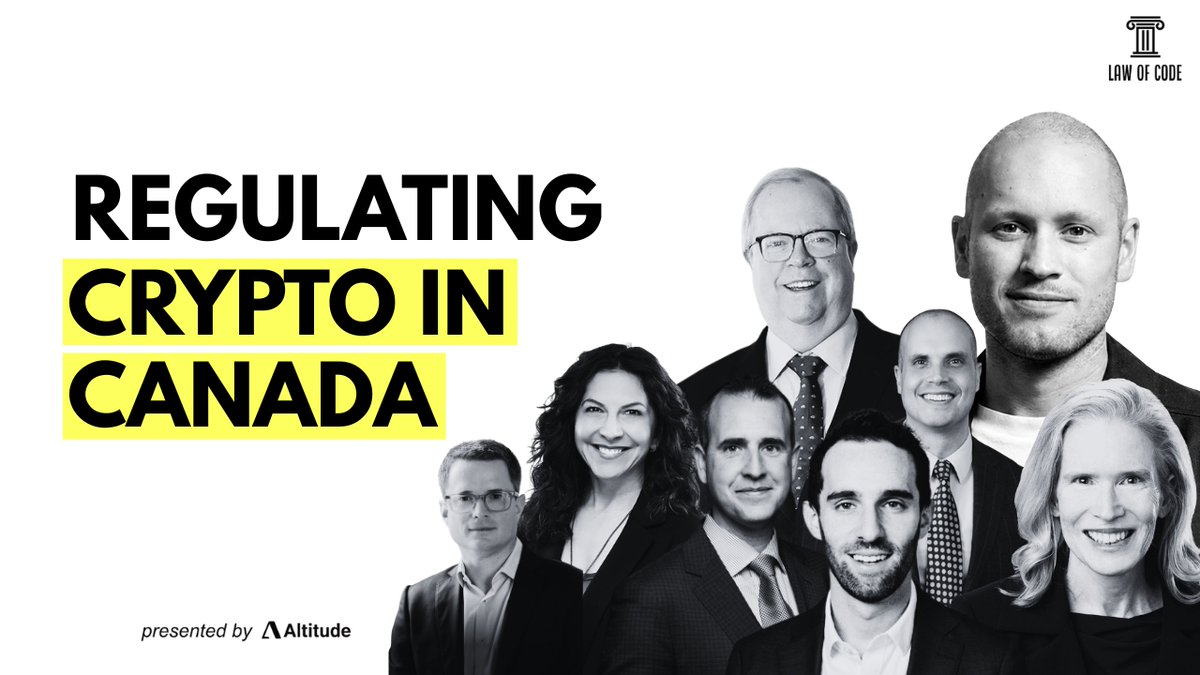
Ep. 207: Crypto in Canada
How is crypto regulated in 🇨🇦? How is it different from other countries? What could the U.S. learn?
Featuring Grant Vingoe, @ryanjclements, @ericrichy, @BurgoyneMatt, @BlairWiley, @loriandreastein & the Bank of Canada's Anne Butler.
The US is still fighting over crypto rules. Canada settled many of them years ago.
This podcast explains Canada's approach to regulating crypto, why builders left despite some clarity, plus Canada's opportunity with tokenization, perps.
You'll hear from Grant Vingoe, CEO of the OSC, @ericrichy, CEO of Coinbase Canada, the @bankofcanada's Anne Butler, McCarthy's @loriandreastein, Osler's @BurgoyneMatt, @evanmthomas, @BlairWiley of @Wealthsimple and @ryanjclements of the ASC.
It should be the internet's most comprehensive podcast on Canadian crypto law.
Timestamps:
0:00 Intro
2:42 Tax
4:53 AML Rules
8:06 Securities
12:00 Investment contracts
16:13 Quadriga's collapse
23:00 The Crypto Contract
34:29 World's first Bitcoin ETF
38:23 Stablecoins
46:47 Canada's opportunities
52:53 The speed problem
Thank you to the presenting sponsor of this episode, @altitude.
Nothing in this podcast is legal or investment advice.
Episode 205: AI, Crypto and Free Speech
When is software protected under the First Amendment, and when does it lose that protection?
What are the foundational cases on that question, and where might the courts have gotten it wrong?
That and much more in the full episode.
Should code ever lose First Amendment protections?
This podcast covers free speech and software, including cryptography, cryptocurrency and AI. It should be the internet's most comprehensive.
You'll hear from experts like @valkenburgh, @prestonjbyrne, @LazPieper, Sam Enzer, and Professors Eugene Volokh (@VolokhC) and @JaneYakowitz.
We trace the history of Cold War export controls through to the recent restrictions on Anthropic's AI models, and explain why the Supreme Court has never definitively answered the question above.
Timestamps:
0:00 Anthropic AI export controls
6:17 Intro
9:39 The First Amendment
10:38 @VolokhC on his free speech philosophy
13:42 Speech vs function
19:24 @valkenburgh interview
25:50 The Cold War, munitions list and Phil Zimmermann
29:57 The Bernstein case
34:53 Strict scrutiny
38:48 The Corley case
49:17 Sorrell, Stevens and where the Supreme Court is heading
53:25 @prestonjbyrne on the Supreme Court's AI case
57:23 Defense Distributed and 3D-printing
1:04:00 Where publication ends and conduct begins
1:15:20 Lowe v. SEC and the agency line
1:45:45 Compelled speech
2:04:17 @LazPieper on Sorrell and third-party liability
2:11:29 @prestonjbyrne on the GRANITE Act and foreign censorship
Thank you to the presenting sponsor of this episode, @altitude.
Nothing in this podcast is legal or investment advice.
Prediction markets are a (poorly understood) multi-billion dollar industry.
This @LawofCodeFM episode is a multi-hour deep dive on prediction markets, from conclave betting in 15th century Rome to proposed rulemaking from the @CFTC earlier this month.
My goal: the internet's most comprehensive explainer on prediction markets.
I spent several months and over 100 hours on this podcast, and spoke to the world's leading experts on the legal layer of prediction markets: @robertjdenault, @WALLACHLEGAL, @SPSchropp, Sam Enzer, @iampaulgrewal, @BradBourque, @ThaniaCh, @passalacqua_mj, @JoshSterlingLaw, @_jamico, as well as @KolemanStrumpf, @mattkalish, with clips from prior conversations with @giancarloMKTS, @DustinGouker.
By the end of this episode, I promise you'll be in the top percentile for understanding prediction markets, regardless of your starting point.
(You just might want to listen twice. There's a lot here.)
0:00 Intro
1:40 16th century papal betting @KolemanStrumpf
11:13 Insider trading rules @robertjdenault
16:20 The Google insider case
27:38 Why prediction markets matter @giancarloMKTS
33:20 Election betting in America
44:50 Iowa Electronic Markets
52:11 Dodd-Frank, swaps and the Special Rule
54:23 Senator Lincoln on sports contracts
1:02:04 Parlays as swaps
1:07:38 CFTC's exclusive jurisdiction @ThaniaCh
1:13:45 Perspective on CFTC's NPRM @passalacqua_mj
1:21:10 Exceptions that swallow the rule @iampaulgrewal
1:33:40 How prediction markets actually work
1:42:20 Kalshi's fee structure
1:44:33 Cardi B and the resolution problem @DustinGouker
1:51:20 @Polymarket's decentralized resolution @_jamico
1:58:10 The Ninth Circuit case
2:14:04 CFTC's proposed rulemaking @BradBourque, @SPSchropp
2:25:21 @Kalshi's landmark 2024 win
2:29:20 PASPA, Murphy v. NCAA @WALLACHLEGAL
2:51:29 The case against banning prediction markets @robertjdenault
Nothing in this podcast is legal or investment advice. Thank you to the sponsors of this episode, @CahillGordon (@NYcryptolawyer), @HyperliquidPC and .
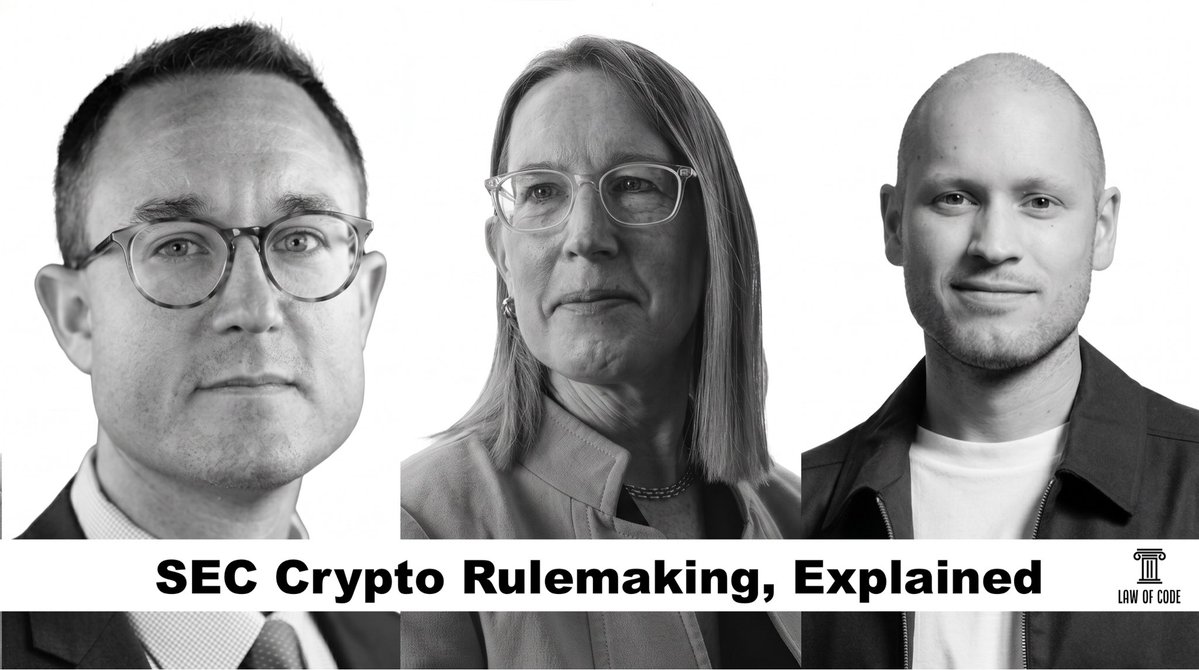
Episode 203: SEC Crypto Rulemaking
How the SEC’s Crypto Task Force works, what happens inside the SEC when rules need to be written, and why @HesterPeirce and Taylor Lindman joined the agency.
How do regulators actually write rules for crypto?
SEC Commissioner @HesterPeirce and Taylor Lindman, Chief Counsel of the Crypto Task Force, answered that and more in our conversation at the @SECGov offices in Washington, D.C.
We cover CLARITY Act rulemaking, lessons from Dodd-Frank, principles-based regulation and navigating the risks of decentralized projects.
If you want to understand how an agency like the SEC works, this episode is for you. I'm enormously grateful to Commissioner Peirce and Taylor for speaking with me and for their continued public service.
Timestamps:
0:00 Intro
1:20 Commissioner Peirce's philosophy on capital markets
5:04 Rulemaking at the SEC
6:48 The SEC's divisions, explained
8:27 How the Crypto Task Force is staffed
10:37 Lessons from Dodd-Frank
13:10 Legal artisans
15:15 The Clarity Act deadlines
18:55 Decentralized intermediaries
20:56 Principles-based vs prescriptive regulation
24:49 Tackling difficult crypto questions
26:23 Leveraging AI for data review
29:46 "Come in and register" under this SEC
33:50 SEC & CFTC collaboration
35:52 Re-engaging the crypto industry
40:00 Crypto Task Force & the Clarity Act
45:54 The SEC's non-crypto priorities
48:41 Avoiding another regulation-by-enforcement era
57:14 Thank you to Sam Enzer, @NYcryptolawyer and @CahillNXT, plus a shoutout to @DayOneLaw & @NickPullmanEsq.
Nothing in this podcast is legal or investment advice.