Outside of the San Antonio Spurs, and largely because they have Victor Wembanyama, hardly anyone in the #NBA plays meaningful defense anymore.
Defense is becoming a lost art.
The modern NBA is a game of offensive skill, spacing, and shot-making. Defense has become an afterthought.
Joel Sherman wants the Yankees to give Adrián Morejón four or five years, and the case is real: a 2.83 ERA and 107 strikeouts in 86 innings for San Diego.
But Sherman's own column says the Yankees' greatest need is a bat. Long money belongs to the player who touches all 162 games. A great reliever gives you 86 innings. Fill the lineup first, then buy arms with what's left.
#Yankees #MLB
The pushback in the replies is fair: from 2018 through 2023, Kelsey Mitchell was the Fever.
That is exactly the point. Indiana's best player before Clark arrived is the one who makes Clark harder to guard now.
Letting her walk to free up shots for Caitlin would be paying for a superstar by taking away her cover.
#WNBA
If Kelsey Mitchell leaves Indiana, Caitlin Clark could score more and the Fever could become easier to defend.
That is the danger hiding behind the excitement of giving a superstar more shots.
Mitchell averaged 24.7 points in 2026. Replacing that production would be difficult enough. Replacing the decisions she forces on a defense would be harder.
When opponents commit extra attention to Clark, Indiana needs someone who can make that choice expensive. Mitchell can catch and fire, attack a recovering defender or create a basket when the original play has broken down.
Her value includes the possessions Clark does not have to rescue.
Remove that threat without a convincing replacement, and opponents gain more freedom to load up on Caitlin. More of the scoring burden lands on the same player already responsible for organizing the offense.
Clark is capable of extraordinary things. Building a contender means giving her fewer possessions that require something extraordinary.
There is a possible opportunity in a Mitchell departure. Indiana could pursue more size, stronger perimeter defense and a different balance around Clark and Aliyah Boston.
But available money is only useful if the right players are available to take it.
Replacing an elite scorer with the idea of a more balanced roster is easy. Actually assembling that roster is the front office’s job.
Mitchell has earned the right to choose her future. If she leaves, the basketball question will be what Indiana puts on the floor afterward.
Can someone else punish pressure on Clark? Can the Fever defend well enough to compensate for lost scoring? Can they build an offense with multiple answers when the first action fails?
The worst response would be to celebrate Caitlin’s rising numbers while ignoring how much harder her job has become.
Her first championship will require more than proving she can carry a heavier load.
Indiana has to build a team that makes carrying it worthwhile.
Jordan's worst scoring run in a title year was 30.7 a game. LeBron's best was 30.3, in 2012.
The lowest number on that list still beats the highest of LeBron's four title runs.
Six tries and no off year. That isn't a peak. It's a floor.
#NBA
Michael Jordan didn’t just win 6 championships.
He averaged 30+ PPG in the playoffs during EVERY SINGLE championship run.
1991: 31.1 PPG 🏆
1992: 34.5 PPG 🏆
1993: 35.1 PPG 🏆
1996: 30.7 PPG 🏆
1997: 31.1 PPG 🏆
1998: 32.4 PPG 🏆
Six titles. Six Finals MVPs. Six postseason scoring masterpieces.
That’s not just winning.
That’s DOMINANCE.
@Cover3_mx And with all that said, that's not even the best part of it all. The best part of it all for fans is having a team that is disciplined, something that had been sorely lacking this decade like I stated in a previous post
As someone who lived through both 2006 and the big-3, it was not in my bingo card for this new Heat team to have a rougher start than the big 3, but also get it together quicker than the big 3 did. They did not put together a winning stretch as quickly as this team has, and it all started with a game-winning 3-pointer by Klay Thompson.
We knew what we would get from Giannis and Bam, but wht has been a huge surprise for many of us is the absolute breakout Davion Mitchell is having and just how well rookies Conwell and Gardner have been for the team. We forget that it's a long season due to the amount of pressure some teams have on them
November is when the NBA tempts us to confuse an explanation with a verdict.
A team starts quickly and we declare its problems solved. A contender loses three games and suddenly its entire construction is wrong.
The more useful question is what keeps working when the easiest points disappear.
San Antonio reached 14 wins in its first 17 games. Wembanyama’s extraordinary performances deserve the attention, but the larger test is whether the Spurs can keep creating good possessions when opponents change the coverage and take away the first option.
Miami offers another reminder about early conclusions. After opening with four straight losses, the Heat won eight of their next ten.
Both stretches counted. Neither deserved to become the entire story.
That is the challenge of reading this season: separating the record from the habits producing it.
A hot shooting week can conceal careless possessions. A cold one can obscure an offense consistently creating good looks. Winning a close game does not automatically mean every late decision was sound.
Look at what happens after the initial action fails.
Does the ball keep moving? Can a second player create an advantage? Does someone make the unglamorous rotation, then finish the possession with a rebound?
And when the star sits, does the team still know what it is trying to do?
Those details rarely dominate the conversation in November. They become the conversation when a playoff opponent has several games to study the same weaknesses.
This season already offers plenty of reasons to be excited. It should also encourage patience with teams learning how their pieces fit.
The standings tell us who has won so far.
The basketball underneath them offers clues about who can keep winning when the conditions change.
Enjoy the spectacular nights. Watch the ordinary possessions closely.
That is where a contender starts telling the truth.
The worst part about those accounts is that they recycle the same three or four talking points over and over and over again.
Scrolling through their timelines is about as entertaining as watching paint dry.
That’s why I’ve mostly stopped engaging with them. Admittedly, I still take the bait every now and then.
Maybe I just need to get better at reminding myself of a simple truth:
Bees shouldn’t waste their time trying to convince flies that honey is better than shit.
4 of 14 is real. So is the rest of it.
In that same stretch he went 10 of 12 at the line and scored 18 points. Then, down three with 41 seconds left, he scored a layup, stripped Karl Malone and hit the jumper that ended the dynasty's last Finals.
Choking is when the moment beats you.
Jordan scored 45 of Chicago's 87.
This is exactly why I speak out against MJ. The propaganda never ends
MJ had a legendary finish to the game, but before that he was choking. He was 4-14 in the 2nd half before that. If he played well they would have won by 20
Here are all his second half shots:
Utah is 11-0, the only unbeaten team in FBS and No. 2 in the AP poll. ESPN's FPI has the Utes 11th. People are reading that as an insult. It's the most useful split in college football right now.
Every power rating agrees with FPI. SP+ has Utah 10th, PRIME eighth, Elo 12th. Those models answer one question: who wins on a neutral field next week. Utah's schedule ranks 30th, its average margin is 19.5 points, and its best win is BYU. Very good, not overwhelming.
Strength of record answers a different question: how hard is it to do what you did. There, Utah ranks first of 138. Nobody has had a better season.
The playoff is supposed to reward seasons, not forecasts. Utah has earned a place near the top of the bracket, and first-year coach Morgan Scalley deserves real credit for it. The models are only saying what happens after that is a separate question, and the bracket won't care about the 11-0.
#CFB #GoUtes
Michael Jordan made defenders work for the entire possession.
That sounds ordinary until you consider how many offensive possessions end with a gift: a loose handle, a careless pass, a decision made before the player knows where he is going.
In his final Bulls regular season, Jordan averaged 28.7 points and just 2.3 turnovers while playing all 82 games.
He took 23.1 shots per night.
That combination deserves more attention. Chicago asked him to finish an enormous amount of offense, and opponents rarely got to escape the assignment through a giveaway.
Watch the economy of his movement.
The catch established position. The pivot tested the defender’s balance. A shoulder fake created a reaction. Sometimes one dribble was enough to reach the shot he wanted.
Every extra movement gives a defense another chance to interfere. Jordan could create difficulty for his opponent without adding unnecessary complexity for himself.
His footwork was a form of ball security.
There is context here. Jordan was not carrying the same passing responsibilities as a point guard orchestrating every action. Turnover averages alone cannot settle comparisons between different offensive roles.
But they reveal something important about the scorer he became.
A missed jumper still gives your team a chance to rebound. A live ball turnover can send the opponent running before your defense is organized. Protecting the possession matters beyond the individual box score.
Jordan’s spectacular plays made him famous. His command of the smaller details made his greatness repeatable.
By 1998, defenders had years of evidence. They knew the tendencies, the preferred spots, the familiar moves.
They still had to stay balanced, resist the fake, contest the release and finish the possession.
He could beat you with something you had studied all morning.
And he gave you very few shortcuts out of having to stop it.
Dwight Howard says the Magic wanted to trade for Stephen Curry in 2011 and he pushed for Monta Ellis instead. He called it stupid. It's an easy story to laugh at, and the wrong lesson to take from it.
In 2011, Curry's ankles were the story. He played 26 games the next season and ended it with surgery. Golden State had to choose between its two small guards, and in March 2012 it kept Curry and sent Ellis to Milwaukee for Andrew Bogut, a center who was hurt at the time. Plenty of people called it a mistake.
Then the ankles did something nobody planned. On Oct. 31, 2012, with his health still in doubt, Curry signed a four-year, $44 million extension. In 2015-16 he made $11.37 million and became the first unanimous MVP in league history. That bargain, plus the 2016 cap spike, gave Golden State the room to sign Kevin Durant.
The injury that scared Orlando off is the same reason the dynasty could be built. Howard didn't uniquely miss on Curry. Nearly everyone did, which is exactly how one team got him at that price.
#DubNation #NBA
An offense spends all week disguising its intentions.
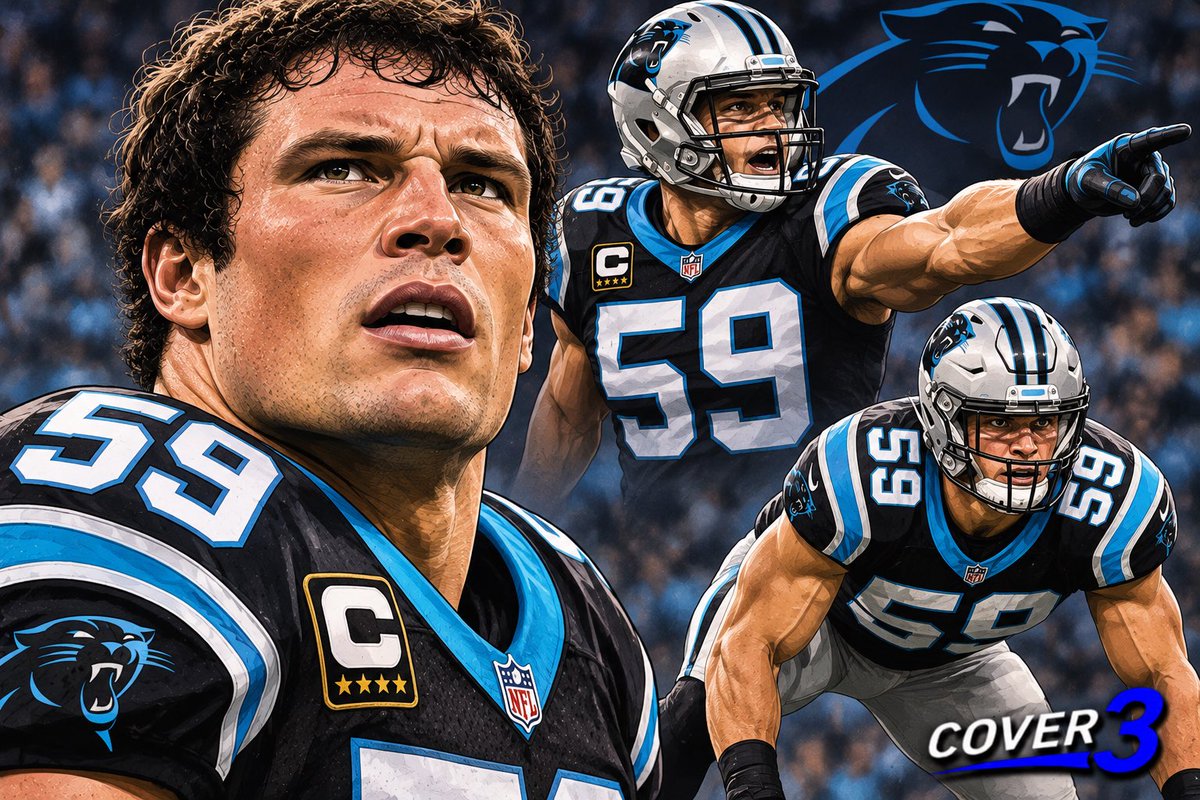
Then Luke Kuechly starts pointing.
That was the unsettling part of playing against him. Before the snap, Carolina’s middle linebacker could already be organizing the response to something the offense had not yet revealed.
Kuechly belongs among the highest football IQ players ever to play the game.
His intelligence had a physical consequence: he arrived sooner.
Recognizing a blocking scheme could save him a step. Understanding a formation could sharpen his angle. Anticipating a route combination could put him in the passing lane before the quarterback expected company.
At NFL speed, those advantages are enormous.
We often call that instinct. With Kuechly, that word can hide the work.
His preparation involved detailed notes, repeated film study and mentally rehearsing formations, defensive calls and teammates’ responsibilities. He studied the picture until he could recognize it while everything was moving.
Then he communicated what he saw.
That is the difference between a smart defender and someone who makes an entire defense smarter. Knowledge becomes more valuable when the player beside you can use it.
The résumé reflects how consistently he turned understanding into performance.
Eight NFL seasons. Seven Pro Bowl selections. Five AP First Team All Pro selections. Defensive Player of the Year in 2013, his second season.
He had the athletic ability to cover ground and finish tackles. His mind helped ensure that movement served a purpose.
There is a particular kind of dominance in making an opponent’s carefully prepared play look predictable.
The offense has motion, misdirection and a week of planning.
Kuechly has seen enough.
The ball moves. He moves.
And what looks like a perfect reaction may have begun days earlier, with a notebook and the same piece of film playing again.
If Kelsey Mitchell leaves Indiana, Caitlin Clark could score more and the Fever could become easier to defend.
That is the danger hiding behind the excitement of giving a superstar more shots.
Mitchell averaged 24.7 points in 2026. Replacing that production would be difficult enough. Replacing the decisions she forces on a defense would be harder.
When opponents commit extra attention to Clark, Indiana needs someone who can make that choice expensive. Mitchell can catch and fire, attack a recovering defender or create a basket when the original play has broken down.
Her value includes the possessions Clark does not have to rescue.
Remove that threat without a convincing replacement, and opponents gain more freedom to load up on Caitlin. More of the scoring burden lands on the same player already responsible for organizing the offense.
Clark is capable of extraordinary things. Building a contender means giving her fewer possessions that require something extraordinary.
There is a possible opportunity in a Mitchell departure. Indiana could pursue more size, stronger perimeter defense and a different balance around Clark and Aliyah Boston.
But available money is only useful if the right players are available to take it.
Replacing an elite scorer with the idea of a more balanced roster is easy. Actually assembling that roster is the front office’s job.
Mitchell has earned the right to choose her future. If she leaves, the basketball question will be what Indiana puts on the floor afterward.
Can someone else punish pressure on Clark? Can the Fever defend well enough to compensate for lost scoring? Can they build an offense with multiple answers when the first action fails?
The worst response would be to celebrate Caitlin’s rising numbers while ignoring how much harder her job has become.
Her first championship will require more than proving she can carry a heavier load.
Indiana has to build a team that makes carrying it worthwhile.
Tennessee beat Alabama by 16 in October. Both are 9-2. The AP poll still has Alabama sixth and Tennessee seventh.
If the committee does the same on Tuesday, it should say it plainly: between two teams with identical records, a head-to-head win counts for nothing. That's the only honest reading of that order.
#CFB
The most frightening thing about Victor Wembanyama is that scoring on him does not give you a break from defending him.
Against New Orleans on Saturday: 50 points, five blocks and four steals. San Antonio won 114 to 91.
For us, the verdict is clear: Wembanyama is the best basketball player on the planet.
The argument starts with how much of a possession he can control.
Most offensive superstars force you to reorganize your defense. Wembanyama also forces you to reconsider your offense. The player demanding extra attention at one basket is waiting to erase your advantage at the other.
Beat the first defender and the hardest part may still be ahead. An opening that would produce a layup against another team becomes a hesitation, a higher release or a pass back outside.
Those abandoned opportunities never appear beside his blocks.
Then he takes the ball the other way, and you have to solve him all over again.
That combination is why his ceiling deserves a conversation without comfortable historical boundaries. There may never have been an NBA player with a higher one.
Jordan’s peak, LeBron’s completeness, Shaq’s force and Wilt’s extraordinary production set a formidable standard. Wembanyama still has to earn his place alongside their sustained accomplishments.
But consider what further development could mean.
Tighter ball control. Earlier recognition of double teams. More consistent shooting decisions. Greater strength holding position near the basket.
Those are ordinary areas of improvement for a developing player. Applied to Wembanyama’s physical tools, their consequences could be extraordinary.
He can become considerably better without needing another inch of height or reach. He needs experience to make more of what is already there.
Fifty points makes the headline.
The possibility that he is still learning how to use his advantages should keep the rest of the league awake.
James Harden scored 51 on Friday night at 37: 15 of 26 from the field, 7 of 11 from three, 14 of 14 at the line. It was his 26th 50-point game, one more than Kobe Bryant. Only Wilt Chamberlain, with 118, and Michael Jordan, with 31, have more.
That list is the cleanest way to judge Harden, and the one his reputation keeps ignoring. He won three straight scoring titles. In 2018-19 he averaged 36.1 points, the most since Jordan's 37.1 in 1986-87 and more than Kobe's best season, 35.4. He also has an MVP and two assist titles, which tells you the scoring was never just appetite.
The case against him lives in the playoffs, and it's fair. Rings and deep runs decide all-time rankings, and he doesn't have them. But a scoring ranking should rank scoring. On that list, I take Harden's peak over Kobe's.
Friday was the reminder, in a smaller role in Cleveland, years after anyone expected one.
#NBA #Cavs
Cover3 #NFL Week 11 Recap: Jets vs Chargers
The Jets had the ball six times and scored on the first five. No Jets team has ever scored on every possession of a game, and this one only fell short because the sixth didn't need points: Braelon Allen's 15 yards on third-and-7 sealed it.
Jets 27, Chargers 24.
This one was won with the clock. New York converted 9 of 11 third downs and burned 30 minutes on five scoring drives, which left Justin Herbert six possessions. The Chargers scored on four of them and still lost. Herbert was sacked six times, two by rookie David Bailey, who is up to 9.5 on the year.
The detail that matters: the Jets' first touchdown in 10 quarters came the day Frank Reich moved from the booth to the field to call plays. Geno Smith went 17 of 21 for 176 yards and three scores, two to Sterling Shepard, who was elevated from the practice squad on Saturday.
A 3-8 team doesn't fix its season in one afternoon. But this is the clearest evidence yet that the Jets' problem was the operation, not the roster. The Chargers fall to 1-9 and 0-5 at home.
#NFL
Cover3 #NFL Week 11 Recap: Raiders vs Broncos
Las Vegas outgained Denver 370 to 351 and lost by 14. The Broncos went 4 for 4 in the red zone. The Raiders went 2 for 3, failed on both fourth-down tries and gave up five sacks.
Broncos 38, Raiders 24.
Denver led 17-0, then watched Fernando Mendoza and Ashton Jeanty erase it. Jeanty's 68-yard wheel-route touchdown and 169 scrimmage yards were the best football on the field. Rookie Jonah Coleman answered the way this team wins now: 24 carries, 111 yards and touchdowns from 1, 4 and 7 yards, the last two after the lead was gone. Ja'Quan McMillian's one-handed 35-yard pick-six with 1:52 left closed it.
That's six straight wins since Sean Payton took back play-calling, 8-2 overall and 5-0 at home, keeping pace with Kansas City atop the AFC West. Denver isn't explosive at 5.0 yards per play. It doesn't need to be when it finishes every trip inside the 20 and the other side doesn't.
#NFL
Kobe or Bird is back on the timeline, and the debate keeps getting stuck on rings. Kobe has five, Bird three. Count jewelry and Kobe wins. Rank how good each man was at his best and it tilts the other way.
From 1983-84 through 1985-86, Larry Bird won three straight MVPs. Only Bill Russell and Wilt Chamberlain had done it before him, and nobody has done it since. His lines in those years: 24.2, 10.1 and 6.6; 28.7, 10.5 and 6.6; 25.8, 9.8 and 6.8. Two titles and two Finals MVPs came with them. Then he went 50-40-90 in back-to-back seasons.
Kobe's case is real, and it's about endurance: 20 seasons, 33,643 points, 11 All-NBA First Teams, and two titles as the clear lead after Shaq left, with Finals MVP both times. That's a career built to outlast arguments.
But all-time rankings should measure the ceiling, and Bird's ceiling was the best player in the world three years running, in a league with Magic Johnson in his prime. Kobe won one MVP. That gap is the debate.
#NBA