1) You might have missed it but the EU just published the CMDI package – one of the most consequential pieces of bank regulation. It fixes something that has been really embarrassing about European banking regulation for more than a decade. And the impacts are huge.
To elaborate on my interview last week on @BloombergTV, as well as my response to @elonmusk, a thread.
Restrictive policy rates have succeeded in slowing the rate-sensitive segments of the U.S. economy (including goods inflation), but a >5% Fed Funds rate is not doing much to slow the insensitive, services-oriented segments. In fact, given the unique historical context, we believe >5% cash rates are doing unnecessary damage to certain cohorts today and may even be supporting services inflation.
1/13
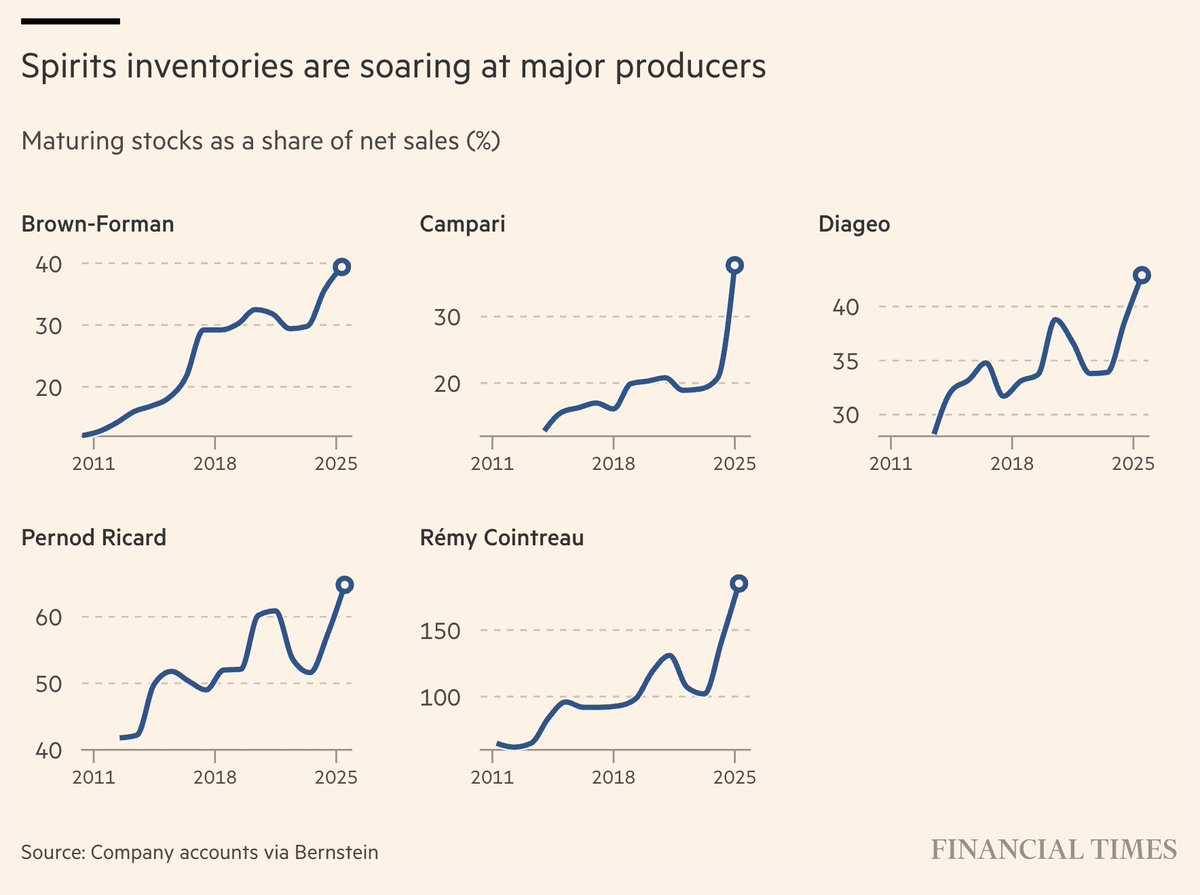
Alcohol companies are sitting on huge stockpiles as demand keeps falling. Five of the world’s largest listed spirits makers – Diageo, Pernod Ricard, Campari, Brown-Forman and Rémy Cointreau – are holding about $22bn worth of ageing spirits, the highest inventory level in more than a decade.
https://t.co/4tfAyZ7ObZ HT @knowledge_vital
Looks like this is finalized?
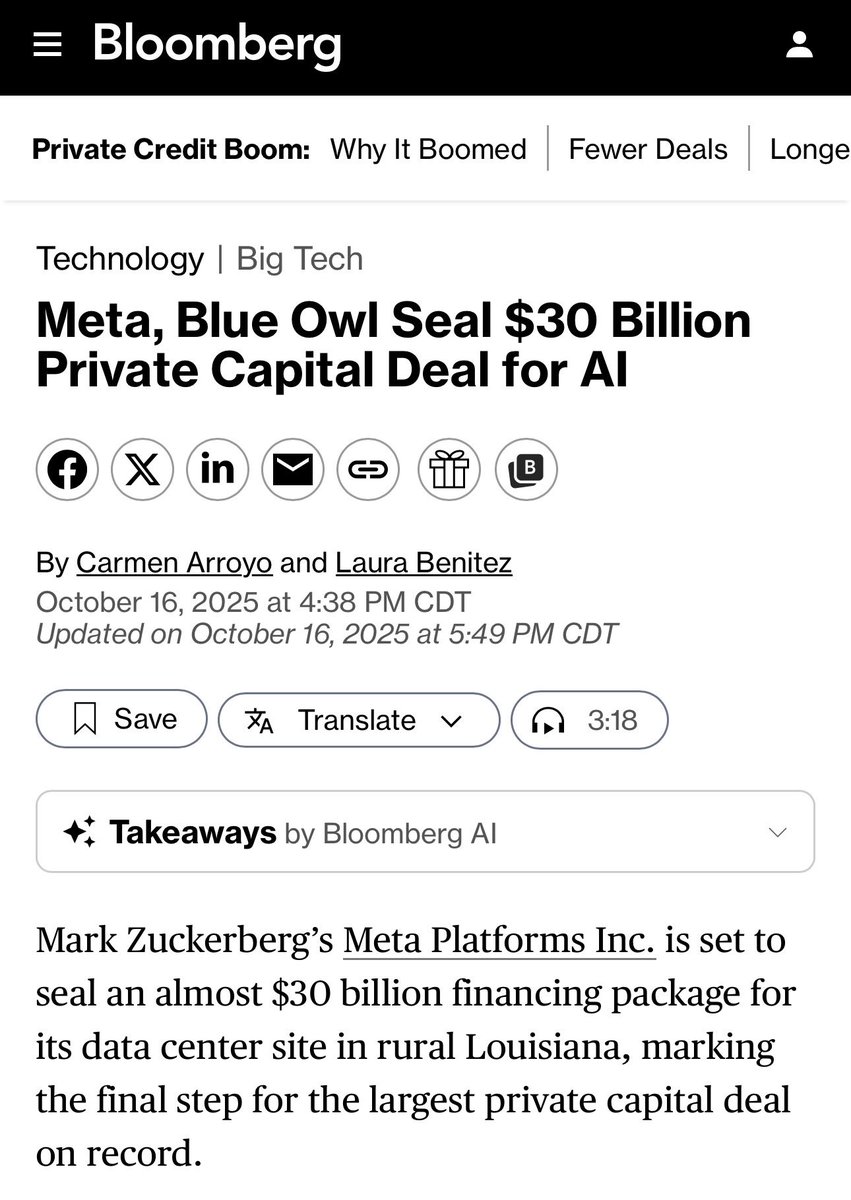
Meta sealed ~$30B financing for Louisiana’s Hyperion data center via SPV structure: Blue Owl gets 80% ownership, Meta 20%. Morgan Stanley arranged $27B+ debt (Pimco anchor) + $2.5B equity. Bonds: 144A format, A+ rated, mature 2049, price at ~225bps over Treasuries. 4M sq ft facility with 5 gigawatt capacity (equivalent to 4M homes), completion 2029. Structure keeps debt off Meta’s balance sheet while providing investment-grade asset-backed opportunity.
And another one with a unique structure!
xAI is raising $20B ($7.5B equity, $12.5B debt) via a special purpose vehicle to buy Nvidia GPUs for its Memphis Colossus 2 data center. Nvidia is investing up to $2B in equity. The SPV will rent out chips for 5 years, with debt backed by GPUs rather than the company. Valor Capital leads equity; Apollo and Diameter participate in debt.
Benn's tweet about Buffett's sale of long-term equity puts in the 2007 period got me going down the rabbit hole to remember this bet & its outcome:
1) In addition to Buffett insisting on no mark-to-market capital calls having to be paid by BRK for the duration of the put option, I forgot that this was a "worst of basket" put option (if the Lehman example is typical of his entire position). The put option exposed BRK to equity index/currency volatility in a menu of three choices with the best outcome for the put buyer at expiration solely at the buyer's discretion.
2) So, of course, these put options go way offside on a m-t-m basis during the GFC as global equity markets slide. Since his counter-parties could not ask for more capital from Buffett for this and some other derivatives he held), they began using Credit Default Swaps on BRK(!!) to hedge their counter-party risk. CDS prices on BRK went kinda nuts in Oct 2008 and Feb 2009. I didn't know truly at the time why CDS prices on BRK were going up, but I do remember it was a sweet time to buy the underlying common as BRK's price-to-book fell below 1-to-1 for a time. (that had never happened before - or since).
3) Eventually, all this forced hedging of BRK credit risk, made even CDS prices probably too expensive for the put holders. And so in Q2, 2009, Buffett's counter-parties came to BRK to amend these put contracts to reduce their accounting exposure. Buffett, ever the predator, got reductions in duration of the put options and strike prices that provided a big economic gain for BRK. But Buffett gave up nothing for this gain as his counterparties did not charge him for restructuring of the put contracts.
Despite the homespun folksy manner, never forget that Buffett is a shark at all times in his business dealings.
Last year, Ben Bernanke and I proposed and estimated a simple model of the inflation process, which we used to analyze US inflation since 2019. Ten central banks expressed interest in using our model to study inflation in their own economies. This new paper is the result of this joint project. https://t.co/lrcFpI8qoY . These are the main take aways:
Two reasons why:
1. LLMs struggle with generalization (the only thing that actually matters), due to being entirely reliant on memorization
2. Benchmark-topping LLMs are trained on the test set (some more than others). Especially salient with Phi-2, but largely true across the board.
The Fixed Income macro crowd spent all 2023 between 2 narratives. A) Higher for longer amid sticky inflation and supply imbalances and B) Imminent recession.
US rates are ending the year on a strong note proving wrong the former crowd and giving a Xmas gift to the later crowd. But don’t be fooled by loud #fintwit - ers
Only a handful of professionals were betting on the productivity / supply miracle with most buy and sell side participants completely paralyzed to make a call as such, because “nobody” bets on productivity. Those that did had a phenomenal November.
The 2 crowds that were proven wrong, one got lucky the other one not, are now dictating that the Fed needs to cut rates to 2.5% quickly. This is mainly motivated reasoning since they now have joined the momentum trade.
If productivity / supply side benefits were the pivot force for the Fed in 2023, next year will be a higher r* once they realize growth is tracking consistently above 1.8%-2.0%
“Madrid is a strange place anyway. I do not believe anyone likes it much when he first goes there. It has none of the looks that you expect of Spain. Yet when you get to know it, it is the most Spanish of all cities, the best to live in, the finest people, month in and month out the finest climate. It is in Madrid only that you get the essence. The essence, when it is the essence, can be in a plain glass bottle and you need no fancy labels. But when you can have the Prado at the same time as El Escorial two hours to the north and Toledo to the south, a fine road to Avila and a fine road to Segovia, which is no distance from La Granja, it makes you feel very badly, all question of immortality aside, to know that you will have to die and never see it again.”
- Ernest Hemingway