Latest BMW car: "Our result eliminates the need to invoke new physics to explain the measurement of the muon (g−2)"
(with an uncertainty similar to the R-ratio one)
https://t.co/mK3b4UtFxJ
To say 'for finetuning to be a problem you need to know the probability distribution of the parameters' entirely misses the point
The point is that *if* a more fundamental theory explains the value of these parameters the apparent finetuning can be a hint on its structure
1/8
A new study shows that crows are capable of sophisticated reasoning based on statistical inference, reports @kennaculture for @arstechnica.
https://t.co/3cvgMF9DsL
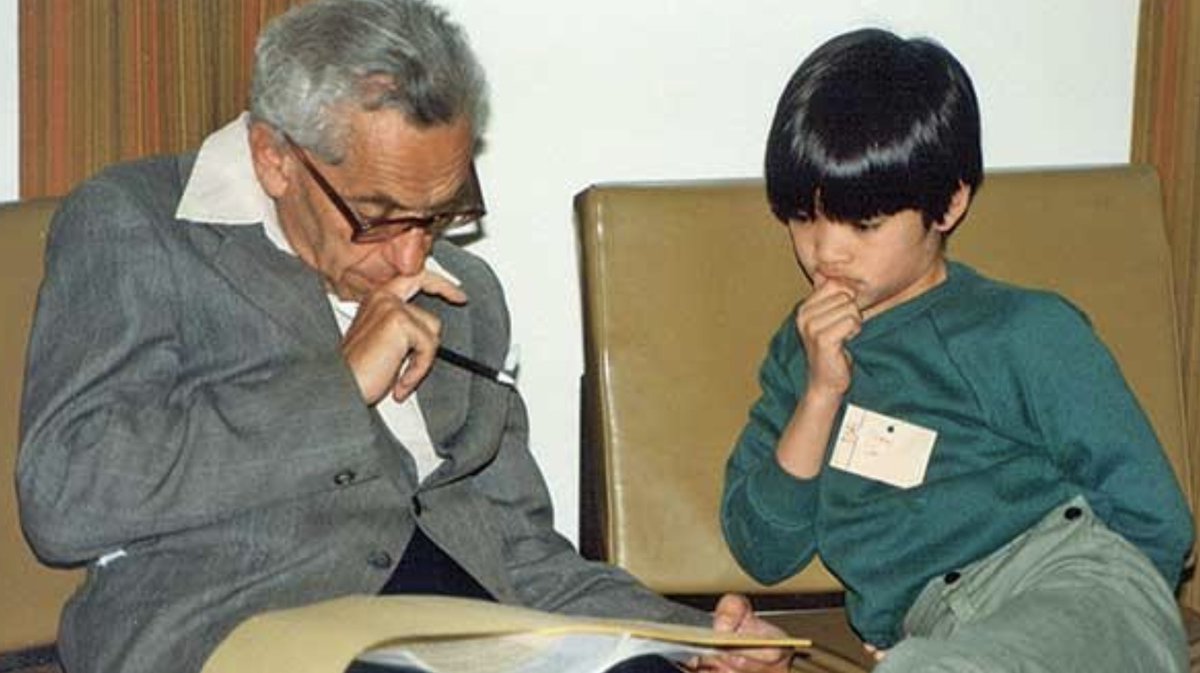
The Erdős-Tao encounter remains one of the most peculiar interactions in the history of mathematics. When Tao was merely 10, he met the eminent mathematician Paul Erdős during the latter's visit to Adelaide. Known for his distant demeanor with adults, Erdős held a fondness for engaging with children, whom he affectionately termed "epsilons."
To young Tao, Erdős was a kindly elderly figure, his celebrated stature in the world of mathematics unbeknownst to the child. Erdős treated Tao with an unusual maturity, speaking to him as an equal. This meeting would later take on profound significance when Erdős penned Tao's recommendation to Princeton, foreseeing his development into a formidable mathematician.
Though Erdős passed away in 1996, his influence on Tao's career trajectory was unmistakable, particularly kindling Tao's fascination with prime numbers. These seemingly randomly occurring numbers have puzzled mathematicians since Euclid's time, despite his proof of their infinity, as they searched for some hidden structure.
In 2015, Tao solved a long-standing mathematical conundrum known as the Erdős discrepancy, which began as a mathematical puzzle. Imagine that someone captures you and sticks you on a precipice. You can take only one step forward or one step backward without falling to your death. Can you construct an infinite set of steps that keeps you safe? Yes, if you alternate steps forward and backward, but suppose your captor gets to choose every third — or sixth — or some other numbered step for you. Now is there a sequence of steps that will keep you safe no matter what sequence your captor chooses? Erdős hypothesized an inevitable fall, but was unable to prove it, even offering a reward for a solution in the 1950s.
This Erdős-Tao interaction remains as a beautiful moment in mathematical history, remembered for the deep inspiration and ensuing achievements that transpired from the encounter between the fledgling and the established mathematician.
Five Feynman rules for Life: 🧠
i) Take mistakes as Lessons.
ii) Focus is the key.
iii) Study hard what interests you the most.
iv) Don't worry about what other people think.
v) Skills are more valuable than your grades.
The nine facts about the origin of SARS-CoV-2 that everyone needs to know are as follows:
1) SARS-CoV-2 is related to bat SARS-like coronaviruses from southern China and northern Laos.
2) SARS-CoV-2 entered humans in or near Wuhan in August-November 2019.