Introducing CraftCanvas: Where Craft Meets Luxury ✨
At CraftCanvas, we don’t just create art—we craft experiences. Our work lies at the intersection of heritage, craftsmanship, and contemporary luxury, transforming traditional techniques into bespoke installations for global brands and architectural spaces.
Three craft traditions. Three completely different tools and materials. The same physical limit running through all of them.
In Gond painting, the figures are divided into horizontal bands. Birds, animals, trees sectioned into segments, each filled with dense parallel lines. While most people read this as style, it is also a record of the body. A Gond painter's arm can only reach so far across a large form before control slips. The band ends where the reach ends. The next band begins where the next reach begins.
In Sanjhi, a paper-cutting tradition from Mathura, the constraint is the handspan. An artisan cannot cut wider than approximately two feet which one foot from each side. Beyond that, the hand loses precision at the centre of the cut. The paper is thin. There is no margin for error here.
When we designed the Sanjhi installation for Organic India, we knew this before we began. The architect wanted panels of unequal widths so the eye would follow the landscape rather than register the grid. We set the widths at 500mm, 300mm, 900mm, 500mm, 900mm, all under two feet. Artisan Vijay Verma cut every panel cleanly. At Antara Senior Living, Artisan Mohan Verma worked within the same limit on an entirely different composition.
On a loom, the width was restricted by the arm span of the weaver, as they had to pass the shuttle from one side to the other.
Three crafts. Painting, cutting, weaving. The body is present in each one not as a limitation that the tradition works around, but as a parameter that the tradition works with. The grammar of the work was built around what the body can do. What looks like aesthetic is often engineering. What looks like style is often the accumulated solution to a physical problem that was solved once, absorbed into the tradition, and never needed to be solved again.
I have spent fifteen years working with craft traditions at architectural scale. The most consistent thing I have found is this: every tradition has already solved the problem of its own physical limits. The solution is invisible because it works. The designer's job is not to override it. It is to understand it well enough to design with it.
When you do, the constraint disappears. What remains is a composition that could not have been made any other way.
28 days from brief to installation.
That is not how craft works. Except this time, it did because the client asked for it.
The brief was simple: something nature-related, and ready in time for their opening.
This is the Sohrai mural we made for Taj Tadoba, in one of India's tiger reserves.
Sohrai is a wall painting tradition from Jharkhand. It is made during the harvest festival when women paint the walls of their homes with images of animals, forests, and the natural world from a grammar that has been passed down without interruption for centuries.
The brief and the tradition were a natural match.
One might argue that twenty-eight days is not enough time to commission craft, at least in the way most people understand commissioning.
What made it possible was the absence of the things that usually slow a project down- the approval chains, the revision loops, and the time it takes for a studio and their client to align.
The architect team made decisions quickly and with confidence. We have a 12 years + working relationship with the architects. So we were aligned right from the word go and we able to bring designs that were ready to approve.
The rest was the artisans.
Adam Christopher Imam. Alka Imam. Diwakar Indwar. Pramila Kiran Lakra. Usha Panna.
Five Sohrai artists who carried a harvest tradition into a wildlife reserve.
Design team: Udit Parekh, Roshni Adarsh
Made in collaboration with Studio Lotus.
Gond painting began as songs sung by Gond Pardhans for generations.
From there, they moved to the walls of their homes. It has since travelled, to canvas, to paper, to ceramic, to fabric, to the walls of hotels and offices and cultural institutions across the country. Every time it moves to a new surface, it reveals something new about itself.
This time it is on light.
A lighting installation for an office, currently in progress in our studio. The Gond motifs with the characteristic layered lines, the fish, the birds, the trees rendered in the visual logic of the Gondi worldview will sit on a surface that glows from behind.
The light changes what the eye does with the image. In natural light, you read the pattern. In the installation's own light, maybe the pattern reads you.
This is what we mean when we say Gond travels.
It is not a decorative tradition that can be applied to surfaces. It is a visual language complete enough to find meaning on any surface it encounters, be it mud wall, paper, canvas, light.
Put it anywhere. It will make sense.
If you have ever seen a Bandhini fabric being made, you'll know what disservice Ralph Lauren has done to the craft.
Bandhani is a traditional Indian tie-and-dye technique, primarily from Gujarat (and some parts of Rajasthan), involving tying THOUSANDS of tiny, precise knots on cotton or silk fabric before dyeing it. Artisans, often women, pluck and bind sections with thread to create resist-dye patterns like dots, waves, or motifs, starting from lighter to darker colors.
Tying the knots, referred to as 'Bandhana' in Hindi, artisans meticulously pinch small portions of the cloth and bind them tightly with a durable thread (often with a protective fingernail or ring) to create small points. The smaller the point, the more difficult the task, and the more intricate the design is.
The tied fabric is dipped into lighter-colored dyes first, dried, and then re-tied to protect those colors before dipping into darker colors. Note that this tying of thousands of knots happens for every colour in the design. This process is repeated to create multicolor, complex patterns.
Mostly the knots are usually left tied to show authenticity (the "Bandhani crunch") and only opened when worn for the first time. The satisfaction of doing this in a brand new Bandhini saree or dupatta CANNOT ever be replicated in a printed piece.
Wherever you are in the world, please don't spend that money on Ralph Lauren. I will happily connect you to some of the very best artisans of the craft. Own the best, not a cheap printed fake just for the sake of a brand name.
What does being an entrepreneur entail? Someone very dear to me told me in passing that she hated her corporate job and wished she had my job. It was her dream.
Now to burst her bubble and everyone else's in a corporate job, let me tell you what I do. Yes, I get to design. Yes, it makes my soul sing. Yes, it makes all other drudgery (almost) meaningful.
I also monitor design development, speak to vendors and artisans endlessly through the day following up for the 6746899th time and getting 'nahi hua abhi tak' in response, cater to craft emergencies, book tatkal tickets, follow up on payments with clients who were in such a hurry to get work done that they slipped into coma at payment time, make contracts, revise contracts, hire people, negotiate fees, renegotiate fees because clients ko iss design main mazza nahi aa raha hai, pay every plus/paid subscription, take pictures, edit pictures, make content (a.k.a how to kill any urge to write for pleasure) for 4 platforms, post content, engage with 'PP' and 'Great job, Sir!' comments, document projects (a full day job altogether), attend networking events (ok, this is a stretch, I don't go to these because Friday evenings are for biryani and TV), manage IT (I have a growing stack of unlabelled HDDs that I play content roulette with) and there's my accountant and government in cahoots who make sure to take away the last few seconds with GST, TDS, IEC, ABC, XYZ....
Of course, I am not spared from regular adulting tasks like meal planning and eating enough protein, except, I work from home mostly, so my day-to-night wardrobe is pretty solid and always on point. #iykyk
Ok, this is not a rant. I LOVE LOVE what I do. I don't begrudge this one bit. In fact, on days when I have less than 97% of these tasks, I feel so unmoored that I set out on a sadistic path of 'how can we improve an already approved design' and other such torturous ideas.
So if you have a corporate job with its own challenges, remember we entrepreneurs do too. But it's nice that you think that what I do is cool! Thanks babe :)
Madhubani is traditionally made by women, at home, on the walls of their houses.
The tradition has its own working conditions built in. It is done in the maker's own space, her own schedule, syncing with the rhythms of a household around her. When you extract that tradition from those conditions and ask the artisan to work on a construction site, or in a studio, or on someone else's timeline, something changes. It may not be overtly visible, but it does.
For this residential project, we designed the installation to go home before it came to the wall.
The composition is built around circles of varying sizes, each one a separate portable piece. We sent the circles to the artisans in Madhubani. They painted them at home. The background wall was prepared on site separately. When the circles came back, we assembled them on the wall and called the artisans over for a short duration, just long enough to connect the painted circles to the background, to make the seams between the two disappear.
The women were at our studio and on on-site for 4 days in total. The majority of the work happened in their homes, on their schedule.
This was not a welfare decision. It was a design decision, one that came from watching, over many projects, that the quality of the work and the conditions of the making are not separate variables. With crafts practiced primarily by women, the more they work from their own environment, the better the outcome.
Have you seen this happen?
Vummidi Bangaru Chetty is one of the oldest jewellery houses in India.
Growing up in Chennai, I had peered into the store every time I passed it. I never had the courage to step inside that kind of grandeur. The diamond jewellery in the display seemed like something made for goddesses.
Turns out, it was.
The brief was a divine wedding scene. The client wanted the sacred and the celebratory together. In the Indian context, this is not a contradiction, it is the definition of a wedding.
Tanjore painting was the first instinct. But Tanjore, for all its devotional richness, is a single-figure tradition. We needed a composition, a full scene with movement, narrative, multiple figures in relationship with each other. Pattachitra offered that. A sacred narrative tradition from Odisha, used for centuries to tell the stories of gods on cloth and palm leaf with extraordinary density and precision.
We took our references from literature on the Chozha dynasty, including my favorite Ponniyin Selvan, which I used this project as an excuse to re-read.
The panels were hand-illustrated by Meghana in Pattachitra style. The goddesses and divine figures sit behind the jewellery displays, not just as backdrop but also as context. In a store where jewellery has always been made for weddings, for temples, for rites of passage, the art and the product are making the same argument.
That what is offered here is not merely beautiful. It is significant.
And when you wear this jewellery on your wedding day, may you have the divine blessings and the everlasting love that our art signifies.
Made in collaboration with Studio Lotus for Vummidi Bangaru Jewellers.
In 1922, Anni Albers arrived at the Bauhaus.
She wanted to study painting, or perhaps architecture. The Bauhaus said NO. Women were directed to the weaving workshop. The serious disciplines, the school had decided, were for men.
Anni Albers went to the weaving workshop.
What followed was one of the most rigorous investigations into textile as a discipline that the twentieth century produced. She didn't weave decoratively. She treated her craft as a problem to be solved. She focused on structure, material and the logic of interlocking threads as a visual and tactile language with its own grammar. She studied pre-Columbian textiles not as historical curiosity but as technical intelligence. She wrote about weaving the way architects write about load-bearing structures.
In 1949, the Museum of Modern Art in New York gave her a solo exhibition. She was the first textile artist to receive one.
The constraint that was meant to diminish her became the discipline that defined her.
I think about Anni Albers often, not just because she inspires our work in a huge way, but because of what she understood about the materials she worked with. That complexity and simplicity are not opposites. That the most rigorous thinking can produce the most apparently effortless result. That a craft discipline, taken seriously, is as intellectually demanding as any other.
She was assigned to weaving because she was a woman.
She turned it into a life's work that outlasted the institution that tried to limit her.
And we will remember her in our own way.
In 2012 (I think), we got a brief for a living room mural. It had to be subtle and something that they can live with for years to come. It had to have the same sense of calm that the owners did, absolutely trusting us and the process.
It was our first attempt at combining two crafts in one installation. We didn't know then that it would start off a path for us.
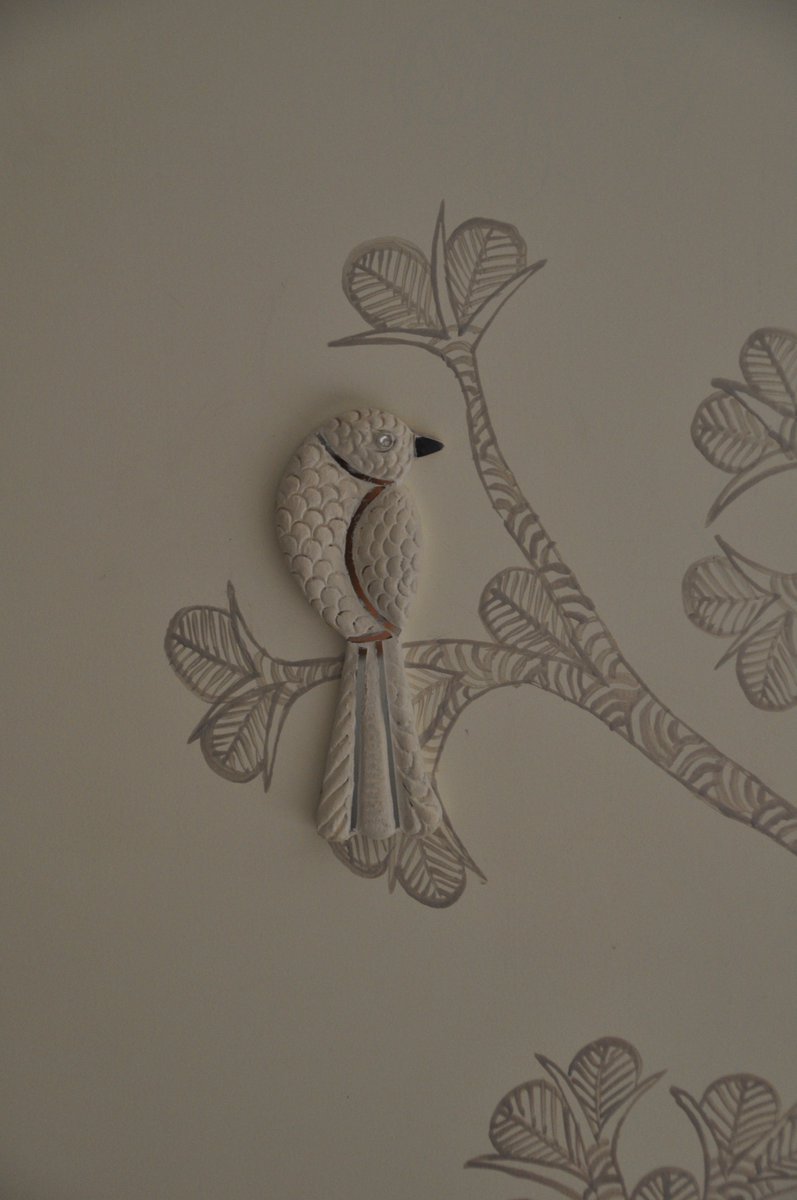
The wall is in Gond painting, the tradition of the Gondi people of central India, where every line is the logic of nature, every form connected to every other form. Painted in silver-grey on a warm white wall. No strong colour, just the suggestion of a forest.
Into that forest we placed birds. Three-dimensional. Made in mud mirror work which is a craft tradition where clay is shaped, dried, and inlaid with tiny mirrors. Each bird perched on a painted branch or is flying towards one, one foot in the two-dimensional world of the Gond painting, one foot in the physical world of the room.
The palette was deliberately muted as the brief demanded it. But the glass shards in the mud mirror work meant the installation was never the same twice. Morning light read it one way. Afternoon another. The birds caught what the wall absorbed.
Two crafts. Two dimensions. One forest that changed with the light.
We have never been able to fully explain why this combination worked as well as it did. Some things you discover by doing, not by planning.
Team: Artisan Kaushal Prasad Tekam, Surprit Dang
Made in collaboration with IDO DESIGNS
Early in my career, I told a Mata Ni Pachedi artisan to reduce the density of the design.
I thought I was making the craft ‘contemporary’ and ‘graphic’. I even imagined myself as a visionary who broke norms, thought outside the box, asked the tough, ‘why?’, questions. All this before I ate the humble pie.
The brief was a formal government office. The instinct was restraint; open space, breathing room, something that was contemporary and didn’t scream craft.
The artisan said it won't work. To my credit, he didn’t give me an explanation at that point. So as young as I was, I overrode his advice and asked him to follow MY design.
Here is what I didn't know. Mata Ni Pachedi is hand-dyed with vegetable dyes. Hand-dyeing large areas with these pigments evenly is nearly impossible. The density of the design is not an aesthetic preference. It is a structural solution, the dense pattern manages the uneven dye application. Every bit of intricate line work is secretly hiding the variation in the dye beneath it.
When I removed the density, I exposed the dye.
The large open areas came back blotchy, uneven pools of colour with no pattern to absorb them. It was not a subtle imperfection. It was clearly visible from across the room.
I still remember sitting in the car with the botched-up piece on my lap, my heart beating fast, trying to find the right explanation for the client. Back then, I had neither the funds nor the time for a complete redo.
The artisan (Vasantbhai Chitara) went back and redyed those areas. Multiple times. Until it was passable at the height it would hang. It was never flat. It was never what it should have been.
The artisan didn't say I told you so. They just fixed it, as much as it could be fixed.
What I learned: when an artisan says it won't work and cannot immediately explain why, that is not ignorance. That is centuries of accumulated knowledge that has never been written down, because it never needed to be written down. It lived in their blood, in their hands.
My design instinct was working purely from aesthetics. Their instinct was working from material reality.
Material reality wins. Every time.
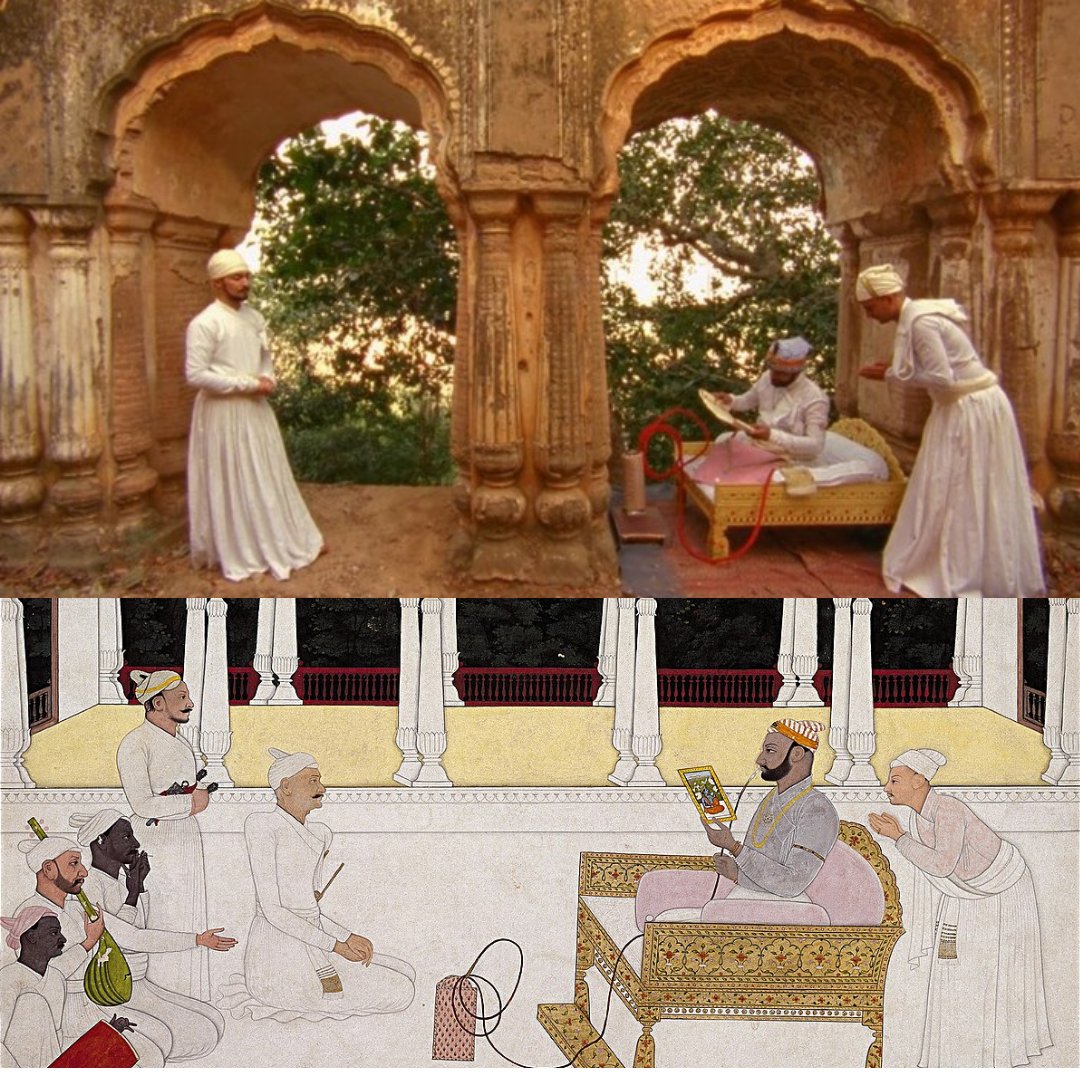
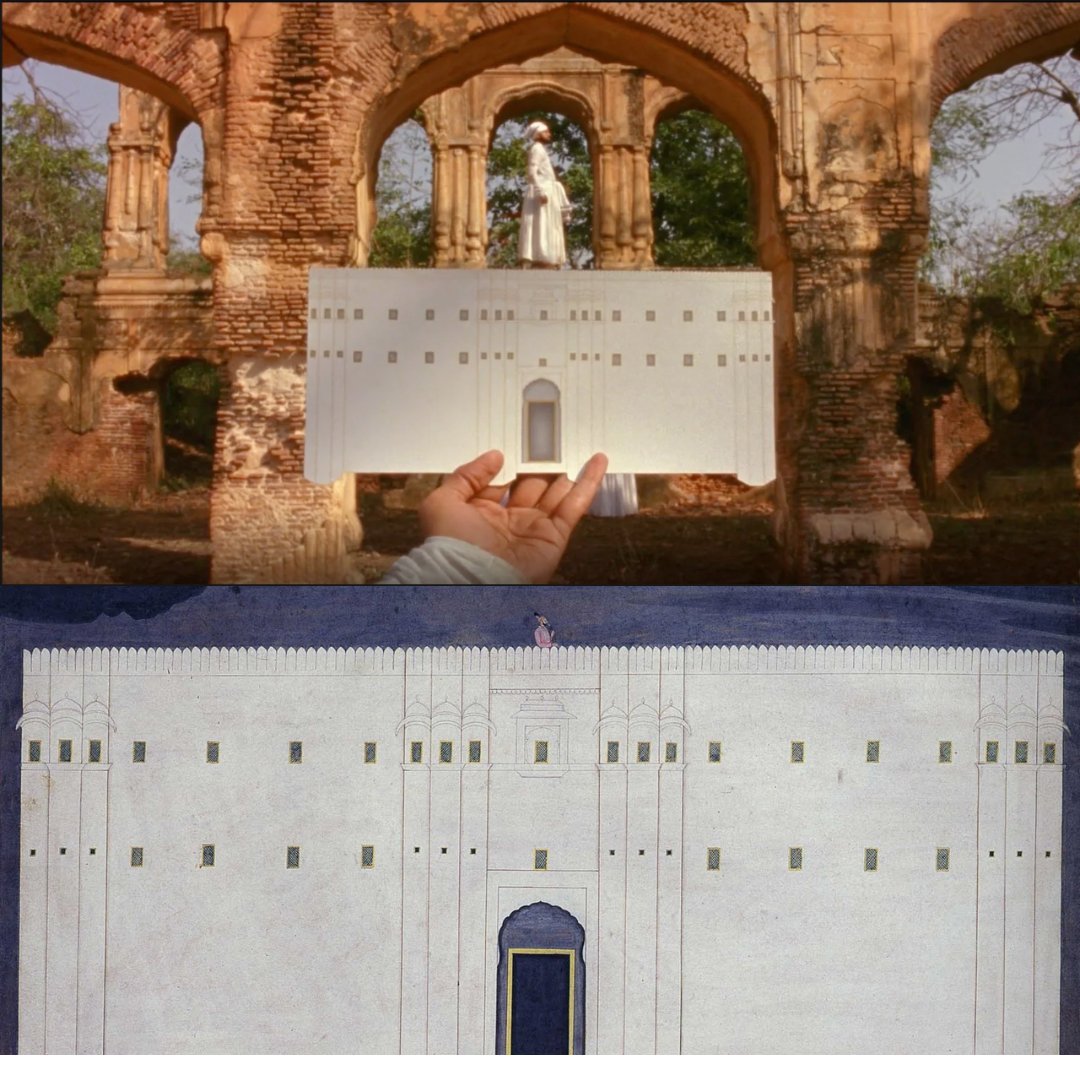
In 2015, Amit Dutta made a film called Nainsukh.
There is a scene where a king is being shaved. That is all that is happening. A barber. A blade. A king sitting still.
In almost every court painting tradition in India, kings are painted at war, at hunt, at court. Heroic, formal, monumental. Nainsukh, an 18th century painter from the Pahari tradition, painted his patron Balwant Singh being shaved. Waking up. Writing letters. Watching a thunderstorm.
The inane made art. The ordinary made permanent.
This is what made Nainsukh radical in his time and contemporary in ours. Restraint in a tradition that rewarded spectacle. Intimacy in a format built for grandeur. A peacock peeking from behind architecture in a composition that could have been filled with ornamentation.
When we worked on the Museum of Meenakari Heritage in Jaipur, it was Nainsukh's approach that guided how we approached the problem. Traditional that is also contemporary. His quality of line, his relationship to architectural space, the way he used the edges of a composition to suggest a world continuing beyond the frame.
The way he documented a moment, photographing a point of time.
That distinction matters more now than it did in the 18th century. We are drowning in heroic imagery, in narcissism at every corner. Everything is curated, everything is monumental, everything screaming importance.
Nainsukh painted a man lost in thought as he smokes a hookah. He made it poignant.
Watch Amit Dutta's film. Then look at the Pahari miniatures again. You will not see them the same way.
Photo courtesy: All images were sourced online.
P.S: I hope to showcase the background work that goes into what we do. It is thoroughly academic, it borrows from other mediums and arts, and it is never linear. And while we are not one for showcasing the final work often, it is only because it pales in comparison to the richness of the process.
Sanjhi is a paper-cutting tradition from Mathura, practiced over generations.
The cutting tool is a small, precise pair of scissors. The hand that holds it determines everything, the pressure, the angle, the length of each cut.
A Sanjhi artisan cannot cut wider than their handspan. Approximately 2 feet, 1 foot from each side. Beyond that, the hand loses control at the centre of the cut. The precision disappears and the cuts start to get wonky. Mind you, the paper is very thin, so the artisan needs to handle the paper lightly.
I learned this the hard way.
At Antara Senior Living, a project we executed in 2016-17, we sent Artisan Mohan Verma designs wider than 2 feet. He didn't refuse outright, but he warned us that the middle is an issue. And when he completed them, the edges were perfect. The centre was not.
For Organic India, we knew before we began.
The composition is a continuous landscape of trees, water, birds, a boat, all spread across five panels. The architect wanted the panels to be uneven widths. Because equal panels would have made the grid visible. Unequal panels make the eye follow the landscape instead. So, we decided that the widths should be 500mm, 300mm, 900mm, 500mm, 900mm. All under 2 feet, but without the eye registering as a deliberate measure.
The constraint became the composition.
Artisan Vijay Verma cut every panel beautifully.
Proof that when you understand what a craft cannot do, you stop fighting it. You start designing with it.
Made in collaboration with Studio Lotus, Delhi.
'AI is a threat to the Indian craft ecosystem,' said a clickbait reel on Instagram.
In a world where binary thinking is on the rise, this is no surprise.
But artisans are already using AI. Just not for what anyone expects.
A Madhubani artisan in Bihar uses ChatGPT for her Instagram captions.
She speaks in her dialect. ChatGPT transcribes, translates, posts.
The communication barrier between her workshop and her clients, across language, across geography, is narrower than it has ever been.
AI has managed to democratise language.
The design story is more complicated.
Every major craft tradition in India encodes knowledge that exists nowhere in written or digitally legible form.
Gond painting carries a community's blueprint; how water moves, how trees grow, how animals and humans share a world.
Chikankari has 36 named stitches with clear contextual rules for use.
Mata Ni Pachedi encodes ritual sequence, which deity, which narrative, which dye, in which order, for which occasion.
This knowledge has never been transferred, not to design schools, not to archives, not to any institution.
It lives in the gap between a guru and their shishya standing next to each other for decades.
AI image generation can produce something that looks like Gond painting.
It cannot produce something that means what Gond painting means.
Because meaning in craft is not just visual.
It is procedural, relational, and oral.
So where does AI actually help?
Documentation. Translation. Market access. Business communication.
The infrastructure around the craft. Not the craft itself.
The artisan in Bihar understood this intuitively.
She didn't ask AI to design for her. She asked it to speak for her.
That's the right question.
I had the best Math teacher in school. Mrs. Shakila Prabhu.
Back when rote learning ruled, she made sure we got the concept. I still use tenth grade Math in my work.
This mural at the Chief Minister's office, Swarnim Sankul is one such instance. I used trigonometry to figure out how big to paint a goddess.
Mata Ni Pachedi is painted on cloth held in a woman's lap.
The goddess is 6 inches tall. Her face, 1 inch.
The brief: mount it 15 feet off the floor, readable from 25 feet away.
The tradition had no template for this. Neither did we.
The problem has a name: Minimum Angle of Resolution (MAR).
Astronomers use it for telescopes. Apple used it to define the Retina display. I used it for a goddess.
At 25 feet, the minimum readable detail = 0.87 inches.
Readable face = minimum 4 inches. Traditional Mata Ni Pachedi face = 1 inch. Required scale-up: 4x. Required figure height: at least 2.5 feet.
Then the vertical angle.
Mural up at 15 feet. Viewer at floor level. 25 feet away. 31° upward angle, compresses apparent height by another 15%. Real requirement: closer to 3 feet per goddess.
The mural was 8 feet tall.
Each goddess ended up at roughly 5 feet. The math cleared. Just.
The trigonometry didn't change what the Chitara family painted. It told us how much room the craft needed to remain itself.
Thank you, Miss! (that's how we addressed our teachers).
Chikankari is not one stitch. It is 32, 36 by some accounts.
Each one has a name. Each one is used for a different reason. Each one can play the hero or the supporting character depending on what the design needs.
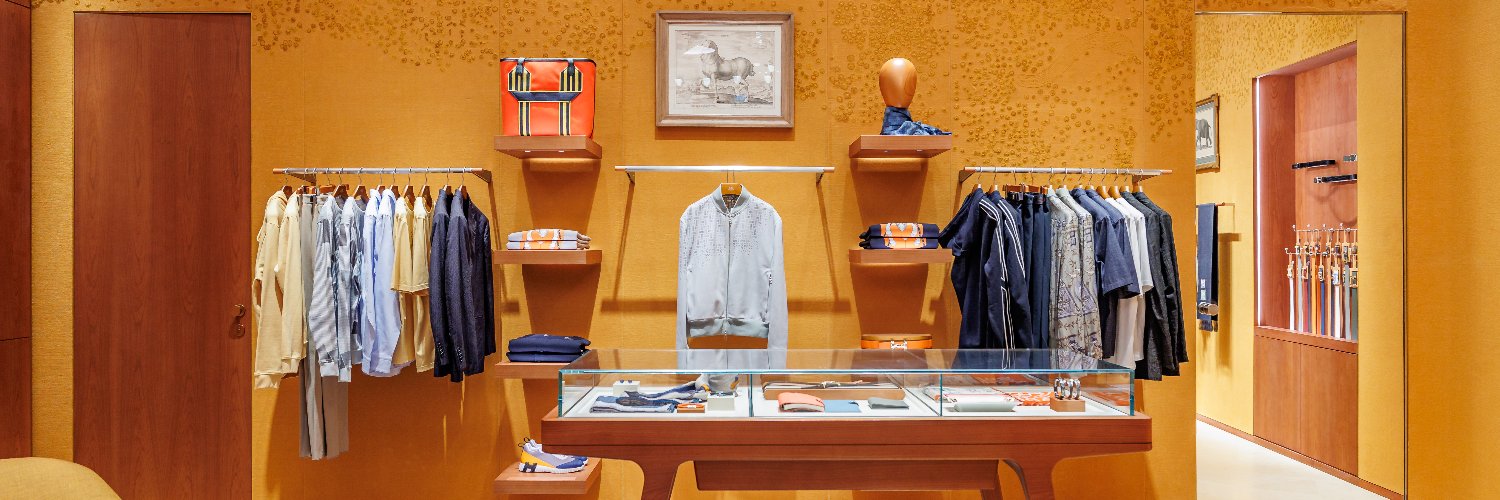
The craftswomen in Lucknow who worked on both the Hermès project and the Organic India installation know all 32 the way we know our alphabet. The poems they write with this script are something to behold.
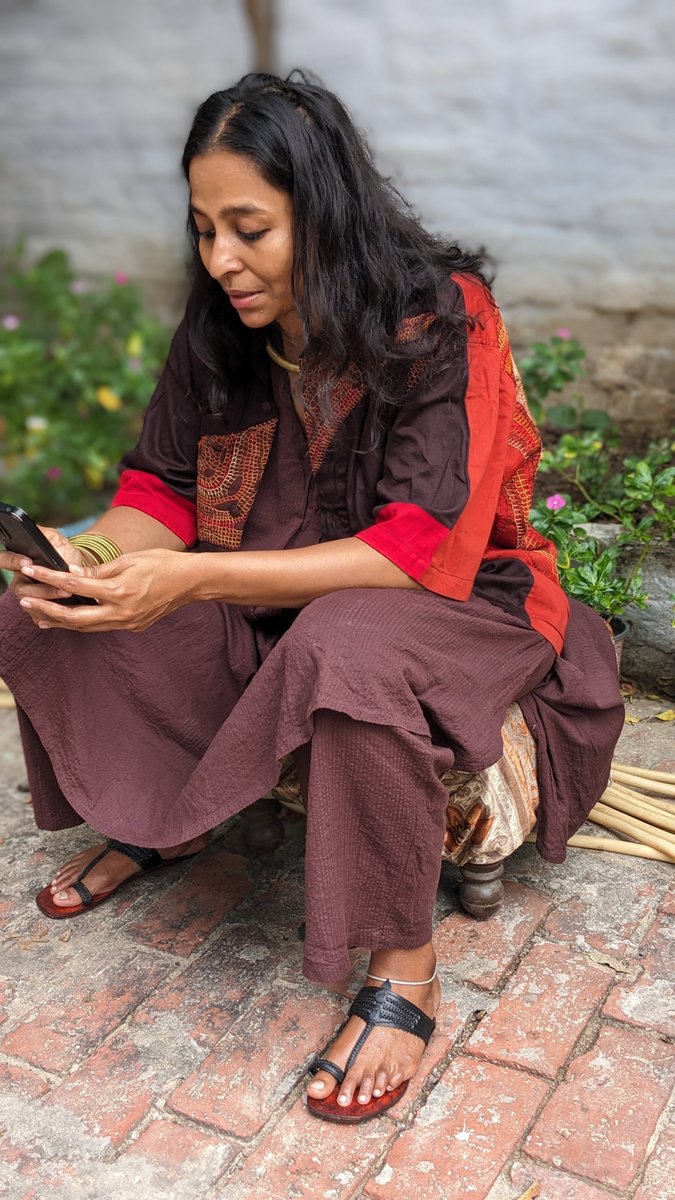
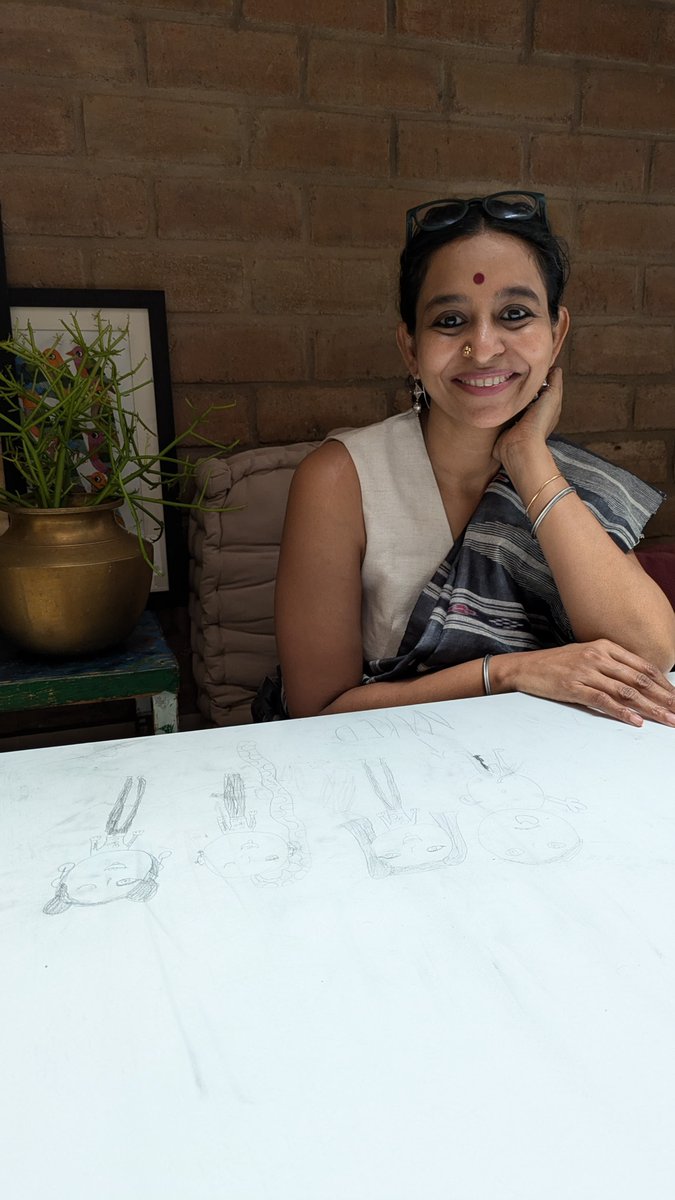
My name is Nisha Vikram. I started CraftCanvas 15 years ago because I believed India's living craft traditions deserve to be in the most important spaces, not just in gift shops or haats selling the same things for decades.
We've completed over 200 projects now. The PM's office in New Delhi. Hermès Mumbai. Taj. Oberoi. IIM Ahmedabad. I've posted about the work, but I haven't really said much about what it means or how we think about it.
Most recently, I curated Craft Forward , a month-long programme at Courtyard Koota exploring what craft can be in contemporary life. Workshops, talks, performances, and collaborations between designers and artisans.
I teach short courses on craft-design thinking when I can, not regularly, but often enough to notice that craft is mostly missing from design education today. I write occasionally about craft and contemporary space. And I run a studio that works with artisans from over 30 craft traditions across India, translating their knowledge into installations at architectural scale.
This account has always shown the work. I'd like to also talk about the ideas behind it, the questions we ask, the problems we solve, the way we think about craft in spaces that weren't designed for it.
If you've been following for a while: thank you. If you're new: this is us.
If there's something you'd like to know, about a project, a craft, or how we work, ask. I'll answer what I can.
— Nisha
Image courtesy: Sandeep Nanu
This is a prime example of metal casting technology. The #Cholas from the 9th-13th century are renowned for bronze casting.
Ironically, This is in the @metmuseum & the statue was cast before Columbus discovered #America in 1492.
Img: Parvati, 10th cent.
"Full of unpopular opinions, my piece in @DeccanHerald on why crafts don’t need saving, they need a seat at the table. #CraftMatters#ArtisanVoices
https://t.co/y6PoO5RHWp