@ive_arc Happens more frequently than not when the cop ask him if he's had anything to drink and he says yes, but he didn't specify. What did he have to drink?
Best-seller author and scientist Gregg Braden: "Climate change is a fact... It's also a fact that humans are not causing it."
"Is there more CO₂ in the atmosphere now than there was 10 years, 20, 50, 100 years ago? The answer is absolutely yes. Is it a bad thing?
The answer is no."
"Is it the most we've ever had? We're right about 440 parts per million right now. In geologic history... the Jurassic [had] over a thousand parts per million. Triassic, 2,000 parts per million."
"The Earth was lush. The Earth was green. Life was abundant during that time."
"And what we see in geologic history... there are times when CO₂ levels are high and the temperatures are low, and times when just the opposite is happening. It's not necessarily a one to one correlation."
Credit: @GreggBraden@missmayim
The Texas Quote of the Day is SO, SO good, explaining how Thomas Moore moved to Texas from Georgia after the Civil War ... and became a cowboy:
"Though my father had lost nothing by the Civil War, he was impatient to go to a new country. Many of his former comrades were going to Texas, and, as our worldly possessions were movable, to Texas we started. Our four oxen were yoked to the wagon, in which our few household effects were loaded and in which mother and the smaller children rode, and with the cows, dogs, and elder boys bringing up the rear, our caravan started, my father riding the mule and driving the oxen. It was an entire summer’s trip, full of incident, privation, and hardship. The stock fared well, but several times we were compelled to halt and secure work in order to supply our limited larder. Through certain sections, however, fish and game were abundant. I remember the enthusiasm we all felt when we reached the Sabine River, and for the first time viewed the promised land. It was at a ferry, and the sluggish river was deep. When my father informed the ferryman that he had no money with which to pay the ferriage, the latter turned on him remarking, sarcastically: “What, no money? My dear sir, it certainly can’t make much difference to a man which side of the river he’s on, when he has no money.”
Nothing daunted by this rebuff, my father argued the point at some length, when the ferryman relented so far as to inform him that ten miles higher up, the river was fordable. We arrived at the ford the next day. My father rode across and back, testing the stage of the water and the river’s bottom before driving the wagon in. Then taking one of the older boys behind him on the mule in order to lighten the wagon, he drove the oxen into the river. Near the middle the water was deep enough to reach the wagon box, but with shoutings and a free application of the gad, we hurried through in safety. One of the wheel oxen, a black steer which we called “Pop-eye,” could be ridden, and I straddled him in fording, laving my sunburned feet in the cool water. The cows were driven over next, the dogs swimming, and at last, bag and baggage, we were in Texas.
We reached the Colorado River early in the fall, where we stopped and picked cotton for several months, making quite a bit of money, and near Christmas reached our final destination on the San Antonio River, where we took up land and built a house. That was a happy home; the country was new and supplied our simple wants; we had milk and honey, and, though the fig tree was absent, along the river grew endless quantities of mustang grapes. At that time the San Antonio valley was principally a cattle country, and as the boys of our family grew old enough the fascination of a horse and saddle was too strong to be resisted. My two older brothers went first, but my father and mother made strenuous efforts to keep me at home, and did so until I was sixteen. I suppose it is natural for every country boy to be fascinated with some other occupation than the one to which he is bred. In my early teens, I always thought I should like either to drive six horses to a stage or clerk in a store, and if I could have attained either of those lofty heights, at that age, I would have asked no more. So my father, rather than see me follow in the footsteps of my older brothers, secured me a situation in a village store some twenty miles distant. The storekeeper was a fellow countryman of my father—from the same county in Ireland, in fact—and I was duly elated on getting away from home to the life of the village.
But my elation was short-lived. I was to receive no wages for the first six months. My father counseled the merchant to work me hard, and, if possible, cure me of the “foolish notion,” as he termed it. The storekeeper cured me. The first week I was with him he kept me in a back warehouse shelling corn. The second week started out no better. I was given a shovel and put on the street to work out the poll-tax, not only of the merchant but of two other clerks in the store. Here was two weeks’ work in sight, but the third morning I took breakfast at home. My mercantile career had ended, and forthwith I took to the range as a preacher’s son takes to vice. By the time I was twenty there was no better cow-hand in the entire country. I could, besides, speak Spanish and play the fiddle, and thought nothing of riding thirty miles to a dance. The vagabond temperament of the range I easily assimilated.
Christmas in the South is always a season of festivity, and the magnet of mother and home yearly drew us to the family hearthstone. There we brothers met and exchanged stories of our experiences. But one year both my brothers brought home a new experience. They had been up the trail, and the wondrous stories they told about the northern country set my blood on fire. Until then I thought I had had adventures, but mine paled into insignificance beside theirs. The following summer, my eldest brother, Robert, himself was to boss a herd up the trail, and I pleaded with him to give me a berth, but he refused me, saying: “No, Tommy; the trail is one place where a foreman can have no favorites. Hardship and privation must be met, and the men must throw themselves equally into the collar. I don’t doubt but you’re a good hand; still the fact that you’re my brother might cause other boys to think I would favor you. A trail outfit has to work as a unit, and dissensions would be ruinous.” I had seen favoritism shown on ranches, and understood his position to be right. Still I felt that I must make that trip if it were possible. Finally Robert, seeing that I was overanxious to go, came to me and said: “I’ve been thinking that if I recommended you to Jim Flood, my old foreman, he might take you with him next year. He is to have a herd that will take five months from start to delivery, and that will be the chance of your life. I’ll see him next week and make a strong talk for you.”
True to his word, he bespoke me a job with Flood the next time he met him, and a week later a letter from Flood reached me, terse and pointed, engaging my services as a trail hand for the coming summer. The outfit would pass near our home on its way to receive the cattle which were to make up the trail herd. Time and place were appointed where I was to meet them in the middle of March, and I felt as if I were made. I remember my mother and sisters twitted me about the swagger that came into my walk, after the receipt of Flood’s letter, and even asserted that I sat my horse as straight as a poker. Possibly! but wasn’t I going up the trail with Jim Flood, the boss foreman of Don Lovell, the cowman and drover?
Our little ranch was near Cibollo Ford on the river, and as the outfit passed down the country, they crossed at that ford and picked me up. Flood was not with them, which was a disappointment to me, “Quince” Forrest acting as segundo at the time. They had four mules to the “chuck” wagon under Barney McCann as cook, while the remuda, under Billy Honeyman as horse wrangler, numbered a hundred and forty-two, ten horses to the man, with two extra for the foreman. Then, for the first time, I learned that we were going down to the mouth of the Rio Grande to receive the herd from across the river in Old Mexico; and that they were contracted for delivery on the Blackfoot Indian Reservation in the northwest corner of Montana. Lovell had several contracts with the Indian Department of the government that year, and had been granted the privilege of bringing in, free of duty, any cattle to be used in filling Indian contracts.
My worst trouble was getting away from home on the morning of starting. Mother and my sisters, of course, shed a few tears; but my father, stern and unbending in his manner, gave me his benediction in these words: “Thomas Moore, you’re the third son to leave our roof, but your father’s blessing goes with you. I left my own home beyond the sea before I was your age.” And as they all stood at the gate, I climbed into my saddle and rode away, with a lump in my throat which left me speechless to reply."
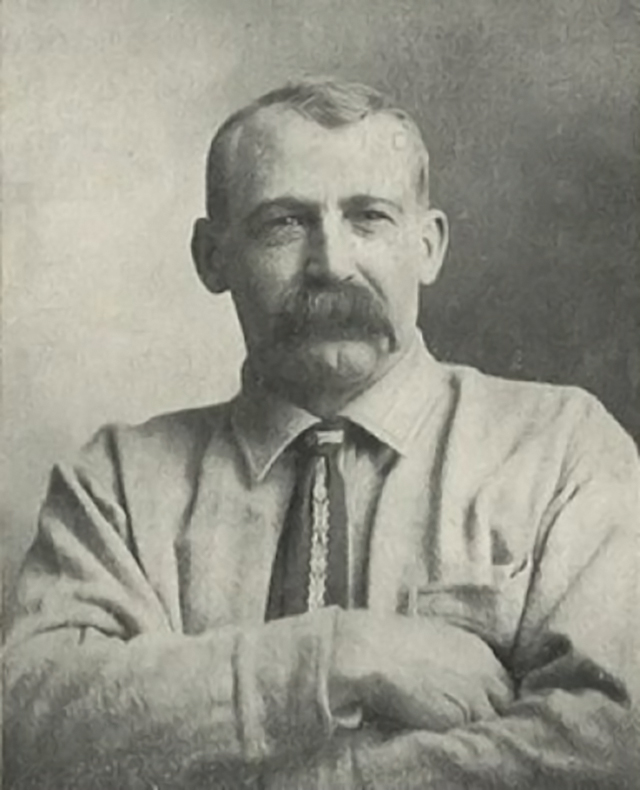
---- Andy Adams, "The Log of a Cowboy," 1903. "Andy Adams" was the pen name of Thomas Moore. Here's a photo of Andy/Thomas
A man uses a mallet to seal a keg at the Gulf Brewing Company in Houston back in 1936 or 1937. Notice the stack of kegs lines the wall behind him. Somehow, to me, this seems like it would be a pretty good job. The Gulf Brewing Co., which I have written about before, was founded in 1933 by Howard Hughes Jr. immediately following the repeal of Prohibition. Located on the grounds of the Hughes Tool Company at 5301 Polk Avenue in Houston’s East End, the brewery was a strategic venture to diversify Hughes’ business interests during the Great Depression. Its profits helped sustain the tool company during tough economic times. The facility, designed with steel-frame and tile walls, spanned 50,200 square feet and boasted a production capacity of 600 barrels daily, making it a state-of-the-art operation for its time. Y'all may remember that its most famous beer was Grand Prize, which was Texas' most popular beer for a quite a few years.
This photo was taken by Robert Yarnall Richie, a commercial photographer who left a FABULOUS archive of photos to SMU's Degolyer Library when he died in 1984.
If you're like me, you're probably wondering how the town of Rising Star, Texas got it's beautiful name. Relax. I've got you covered.
Rising Star, which is where U.S. Highway 183 crosses State Highway 36, about 56 miles southeast of Abilene, got its start on January 6, 1876, when six pioneer families—the Agnews, Fields, McKinleys, and Smiths—rolled in and put down roots. It wasn’t exactly a quiet neighborhood back then. Indian raids, vigilantes, and gunfights were part of the scenery, but the families were determined. That same year, they built a sturdy log building that doubled as a schoolhouse and church, a sure sign they planned on sticking around. By 1879, Thomas W. Anderson and his son William had opened the first store, and in 1880 the town got its own post office.
Originally, in 1876 and 1877, the locals called the place Copperas Creek but it had no formal, official, post-office approved name. D. D. McConnell from nearby Eastland thought “Star” would be a fine, simple name instead. The settlers agreed—until they sent it off to the postal authorities and got the bad news: another town in Mills County had already claimed it.
So they gathered to settle the matter once and for all. They argued. They debated. They wrangled over names deep into the night, but no one could agree. Finally, worn out and empty-handed, they called it quits and headed for home. That’s when it happened—off in the east, the morning star (Venus) began to climb into the sky. Someone pointed to it, and in that quiet moment, everyone knew. No more arguing, no more lists of names. The town would be called Rising Star. And I think it's a mighty fine name, indeed.
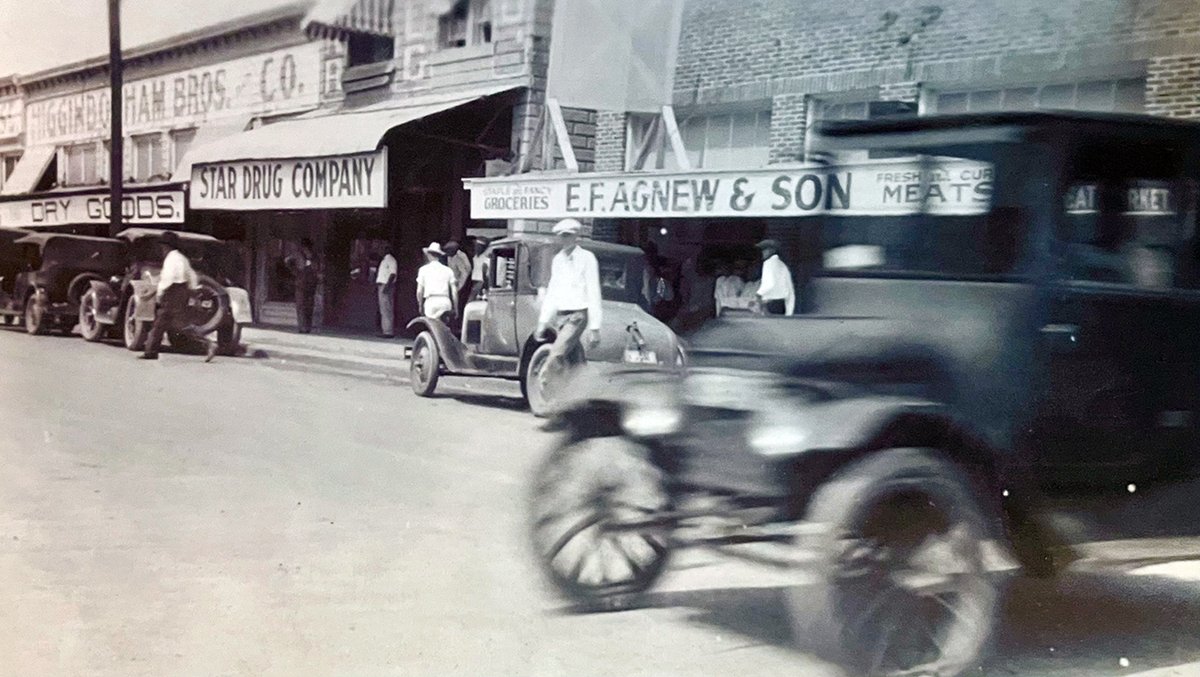
Shown here: downtown Rising Star circa 1918.