It’s Men’s Mental Health Awareness Month, and I want to say something that doesn’t get said enough.
A lot of men are carrying battles nobody knows about.
Some are dealing with pressure to provide, pressure to succeed, pressure to always appear strong, and pressure to keep going even when they’re exhausted. Most times, nobody notices because they’ve become so good at hiding it.
If you’re a man reading this, check in on yourself honestly. “I’m fine”, no, don’t lie to yourself, if you’re not fine, you’re not fine and it’s okay to talk about it.
And if you have good men in your life, check in on them too. Sometimes the strongest looking person in the room is carrying the heaviest weight.
Keep working. Keep pushing. But don’t lose yourself in the process.
Your mental health matters.
Your peace matters.
And asking for help when you need it doesn’t make you weak, it makes you human.
Take care of yourselves, gentlemen.
Share this message with other men.
-BC.
When a man stands firm on his standards, boundaries, and principles, some women often try to label it as “insecurity.”
A strong man doesn’t flinch, he reinforces them.
A weak man feels the need to justify them.
Stop explaining yourself and start being strict.
-BC.
A woman once decided to answer a question most people argue about online:
“Is life really easier for men?”
So she did something extreme.
Her name was Norah Vincent, a journalist.
And for 18 months, she disguised herself as a man named Ned and lived life as one.
No shortcuts.
She cut her hair.
Flattened her chest.
Wore prosthetics.
Trained her voice to sound deeper.
Then she entered the world as a man.
She joined a men’s bowling league, attended men’s therapy groups, went on dates with women, visited strip clubs, and even spent time in a monastery with monks, all while nobody knew she was actually a woman.
At first, she thought she would discover “male privilege.”
Instead, she discovered something very different.
Loneliness.
She said the hardest part about being a man was the emotional isolation.
Men rarely received compliments.
Rarely received kindness.
Rarely received emotional support.
In dating, she experienced constant rejection.
She realized that many men approach women knowing they will likely be rejected and they still do it over and over again.
That pressure alone shocked her.
But the deeper thing she noticed was how men are expected to suppress emotion.
In one men’s therapy group she attended, she saw grown men struggling to express basic vulnerability because they had been conditioned their entire lives not to.
She later said something powerful:
“Men are suffering. They have different problems than women, but they don’t have it better.”
By the end of the experiment, something unexpected happened.
The experience mentally broke her.
Living a double identity, carrying the psychological weight of deception, and experiencing life as a man took a heavy toll.
Shortly after finishing the experiment, she had a severe depressive breakdown and admitted herself into a psychiatric hospital.
She later wrote another book about that experience called “Voluntary Madness.”
Years later, she continued struggling with severe depression.
In 2022, at the age of 53, Norah Vincent died through assisted suicide at a clinic in Switzerland.
Her story isn’t about proving that men suffer more than women.
It’s about something deeper:
Understanding that both sides of society carry struggles that the other side rarely sees.
But one thing her experiment made clear:
A lot of men are quietly dealing with rejection, pressure, emotional silence, and loneliness, and nobody is really talking about it.
Sometimes the people we assume have it “easy” are actually fighting battles we never notice.
And maybe the real lesson from her story is simple:
We should try to understand each other a little more before assuming who has it harder.
Go read about her story and others alike.
-BC.
The product Miden is building has one clear mission: to give users real privacy in the crypto market.
In today’s Web3, every transaction, balance, and movement you make is visible to anyone who cares enough to look.
That’s not how finance is supposed to work and it’s definitely not something the next wave of users will accept.
This is where Miden showcases its potential
Their entire architecture is built around protecting the user, not exposing them.
With local execution and zero knowledge proofs, Miden allows you to interact on-chain without leaving your financial life open to the whole world.
• Your balances stay private
• Your strategies stay private
• Your transactions stay private
• But everything remains provably valid and trustless
It’s the kind of privacy the crypto market has been missing for years not a workaround, not a mixer, but native, built-in protection.
If Web3 is truly going mainstream, users deserve safety, speed, and privacy.
And that’s exactly what @0xMiden is building.
Privacy in Web3 is broken.
Every transaction you make, every balance you hold, every move you take on chain, it’s all publicly visible. Anyone can track you, map your wallet, analyze your activity, and build a full profile around your financial life.
That’s not decentralization.
That’s surveillance with a blockchain logo on it.
This is why Miden matters.
@0xMiden takes privacy from being an optional feature to being a native part of the chain.
No weird workarounds.
No risky mixers.
No hacks.
Just built-in, zero-knowledge privacy.
On Miden:
• Your balances can be private
• Your transactions can be private
• Your interactions with apps can be private
• But everything still stays verifiable and trustless
It’s the perfect balance, you control what the world sees, and the chain still verifies everything.
For traders, institutions, everyday users, and even creators building sensitive apps, this isn’t a luxury. It’s essential.
Web3 can’t go mainstream without privacy.
People shouldn’t have to choose between decentralization and protection.
That’s why we need Miden because privacy shouldn’t be a bonus feature.
It should be the default.
looking for a project that will cook so hard, A project that would definitely retire your generations to come
There could only be one project that can cook like that and that’s @megaeth. The earlier people get in, the better.
All thanks to @KookCapitalLLC for showing me the way, this is literally the beginning of something we haven’t seen before on web3
MegaEth is holding very strong at $4.5b fdv despite broader market volatility, i see no reasons to why i shouldn’t be bullish
Unlocking trustless AI collaboration in Web3 isn’t just a nice to have anymore.
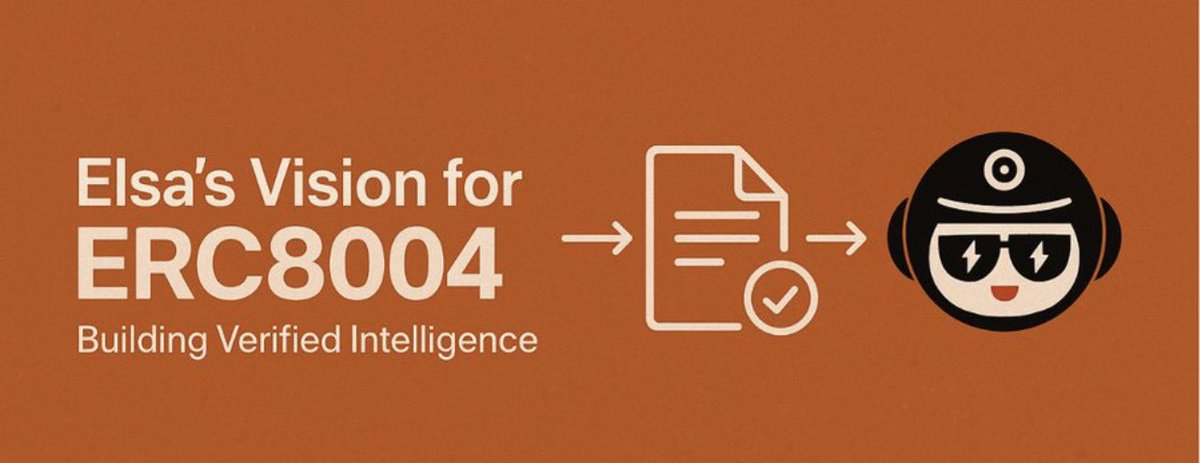
That’s why Elsa’s move to integrate ERC-8004 matters a lot.
1. Agent identity, on chain
ERC-8004 creates a registry where AI agents (yes, like HeyElsa) get verifiable identities on chain.
That means no more black box bots or hidden logic, your agent has a passport of sorts.
2. Reputation + validation built in
With ERC-8004, agents aren’t just identified, they’re also rated, verified, and bound by on-chain rules.
That gives you, the user, confidence.
3. Cross agent collaboration, trustless
Agents can work with other agents across chains & organizations without requiring a central gatekeeper.
That means @HeyElsaAI could someday coordinate with other tools, bots or services all on chain, all trustless.
4. Us building Web3 differently
What this does for us users: we’re moving toward a Web3 where the invisible tech actually becomes visible.
Where agents are accountable and interactions aren’t just ‘hey click this button’ but ‘hey my agent did X and I can verify it.’
HeyElsa’s adoption of ERC-8004 signals that the team isn’t just chasing convenience, they’re investing in trust, transparency & next-level interoperability.
So yes, why does this excite me? Because usability is half the battle, trust is the other half.
If we use a tool that automates things but we don’t trust it, we’re still stuck.
HeyElsa + ERC8004 = usability and trust.
gElsa
Unlocking trustless AI collaboration in Web3 isn’t just a nice to have anymore.
That’s why Elsa’s move to integrate ERC-8004 matters a lot.
1. Agent identity, on chain
ERC-8004 creates a registry where AI agents (yes, like HeyElsa) get verifiable identities on chain.
That means no more black box bots or hidden logic, your agent has a passport of sorts.
2. Reputation + validation built in
With ERC-8004, agents aren’t just identified, they’re also rated, verified, and bound by on-chain rules.
That gives you, the user, confidence.
3. Cross agent collaboration, trustless
Agents can work with other agents across chains & organizations without requiring a central gatekeeper.
That means @HeyElsaAI could someday coordinate with other tools, bots or services all on chain, all trustless.
4. Us building Web3 differently
What this does for us users: we’re moving toward a Web3 where the invisible tech actually becomes visible.
Where agents are accountable and interactions aren’t just ‘hey click this button’ but ‘hey my agent did X and I can verify it.’
HeyElsa’s adoption of ERC-8004 signals that the team isn’t just chasing convenience, they’re investing in trust, transparency & next-level interoperability.
So yes, why does this excite me? Because usability is half the battle, trust is the other half.
If we use a tool that automates things but we don’t trust it, we’re still stuck.
HeyElsa + ERC8004 = usability and trust.
gElsa
Why @almanak ?
Because in a space filled with noise, Almanak is signal.
For years, DeFi has given us automation, bots that trade, scripts that farm, dashboards that track.
But what we’ve never had is intelligence. Something that doesn’t just automate, but actually thinks.
That’s where Almanak comes in.
It isn’t just another AI project trying to sound futuristic.
It’s a living, reasoning infrastructure made up of 18+ AI agents that collaborate, analyze data, and code financial strategies autonomously and on-chain.
No hidden execution.
You can verify what every agent does, down to line of code.
That’s what makes Almanak different.
It’s not hype, it’s verifiable intelligence managing real capital.
In less than a year, it’s built over $200M+ TVL, partnered across DeFi with platforms like Pendle, Curve, and Morpho, and proven that AI doesn’t just belong in crypto, it can build crypto.
So, why Almanak?
Because it’s not chasing trends.
It’s building the rails for the next evolution of finance DeFAI where logic, reason, and transparency come together.
In a world full of noise, Almanak is the blueprint.
That’s why.
/\m