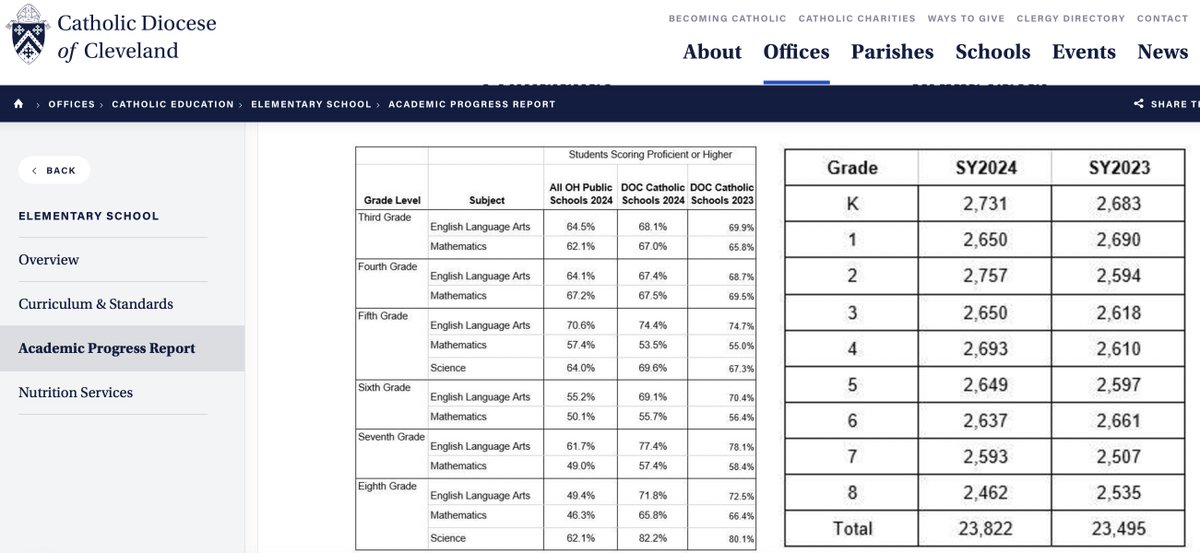
@bryanrbeal For example, Cleveland's Catholic schools barely beat the Ohio average for 3rd grade, foundational reading.
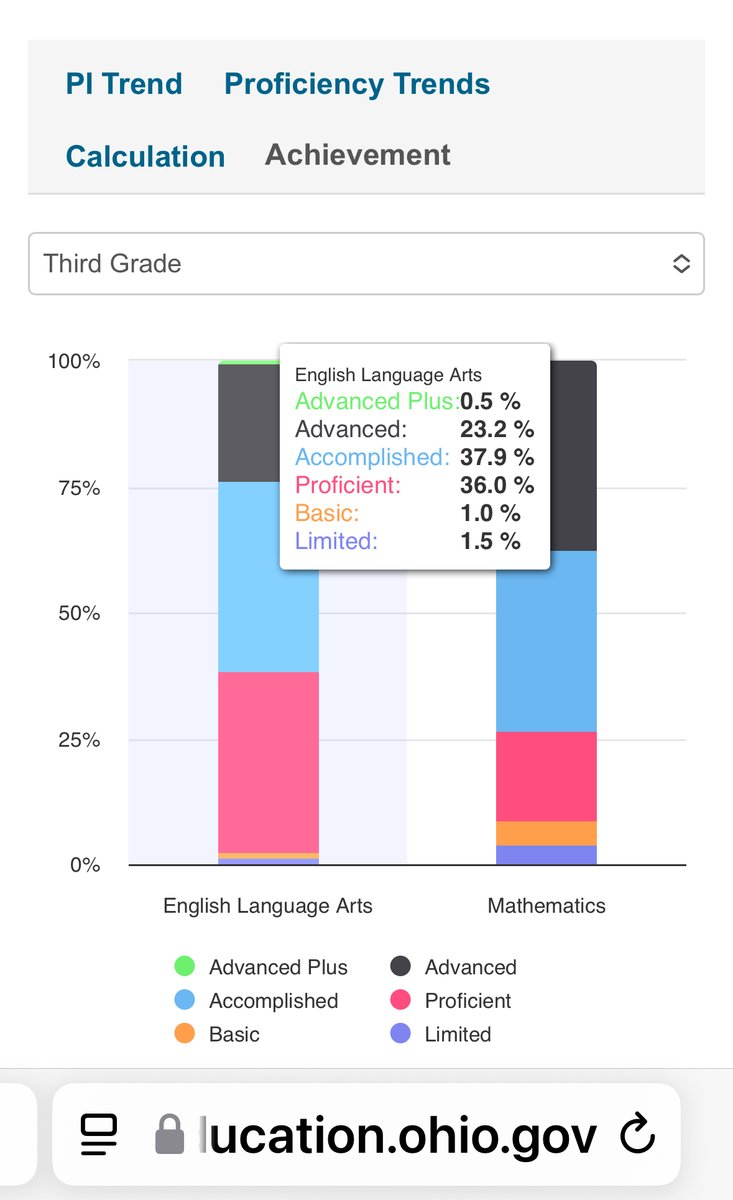
Yet Steubenville public schools completely tromp far wealthier schools across the state.
@MichaelPetrilli@alexanderrusso One instructional change that had taken place over the last 20 years is the expectation that teachers share rubrics/expectations at the beginning of a unit. When students know the target for an A they are able to meet those standards and earn the A. Prior students were guessing.
@PSkinnerTech@hthieblot I dunno about 1995, but in ‘92, CERN, obviously. And the WWW virtual library.
SLAC. NCSA. And SunSITE.
I thought Princeton had one, but I’m not finding that it did.
And I would have guessed CMU-CS, NeXT, and MIT-SAIL. 🫤
@karenvaites I have to wish this had been written by anyone other than a professor of “critical writing”.
Because I want students to be disengaged with “critical writing”. I want them to refuse to read 20 page detours into rhetorical la la land. I want them to insist that trivial essays…
@MatthewBoedy I’ve dug into my share of bills.
I frankly doubt most representatives’ ability to read them.
Indeed, the last one I read, even ChatGPT insisted the law was inconclusive. 🤷🏽♂️
Good stuff; yet doesn't quite sum it up.
To ask AI and to process its answers, you really need a finely-tuned vocabulary, and mastery of the subtleties of English usage.
Very small twists of language can change the meaning entirely.
A teacher’s closing line sums it up:
Students need enough knowledge to call BS… on a faulty idea, weak Google search result, or a poor or glitchy AI output.
AI didn’t change this. But it probably increases the risk that knowledge-building is underserved in K-12 education.
From @matt_barnum’s latest, featuring @DTWillingham:
“To solve math problems, students must know their times tables. To infer the causes of historical events, they need familiarity with dates and historical figures. To read and analyze complex texts, they need a wide vocabulary. To think critically, say cognitive scientists, people need to be able to seamlessly access and synthesize a large number of basic facts.
Students can look up some missing information, but when people turn to external sources too frequently, the brain struggles to keep track of all the new facts at once. Imagine reading a book and pausing every few sentences to search for an unfamiliar word or idea.
There’s not yet good reason to assume any of this will change with AI. The technology can help find new information, but knowledge is still necessary to prompt AI appropriately, to assess the accuracy of its output, and to apply it to specific tasks.”
@tetheredtoed1@gtmom There was no such label when I was in school. There was an informal sorting K-8, and then Algebra, Geometry, American History got 'Advanced' versions.
But no 'gifted' or accelerated.
I don't think that failed me or my classmates.
@johnarnold It and other tools, again plus educational freedom, could allow us to shift what's learned in the remaining time.
We could produce a generation who take far more interest in producing real things, in manufacturing, in providing real-world services. 2/
@johnarnold One question is how much we allow AI and education freedom to change what people learn K-12. Right now, our K12 outcome values are skewed to produce paper pushers and TikTok makers.
AI + learning science could reduce time to get basic mastery of foundational literacy skills 1/
@karenvaites@SoLInTheWild I would argue that we don’t do near enough making in schools.
Now, when, where, how, why,… another question.
But right now, we’re producing far more #EnglishMajoring than we need, and far less manufacturing /producing.