FortisX continues to strengthen its position as one of the most transparent and security-focused infrastructure projects in the crypto industry.
Today, CertiK assigned FortisX an official “A” Security Rating with a Skynet Score above 80, placing the project among the top-ranked monitored crypto platforms on CertiK Skynet. This is not just a badge, it reflects months of continuous work on security architecture, operational monitoring, infrastructure hardening, and transparency.
Security in crypto is not built overnight. It’s a long-term process that requires constant audits, monitoring, testing, and improvement. Over the past months, FortisX has significantly expanded its security framework:
• CertiK Audit completed
• CertiK Skynet monitoring active
• Bug Bounty program launched for white-hat researchers
• Infrastructure security continuously upgraded
• Ongoing operational monitoring and risk management
• Public transparency initiatives and ecosystem expansion
Reaching an “A” rating on CertiK is an important milestone because CertiK is one of the most recognized blockchain security firms in the world. Their ratings analyze multiple layers of a project, including code security, operational resilience, community trust signals, and overall infrastructure quality.
For us, this is more than just a score.
It’s proof that FortisX is building for the long term.
In an industry where many projects focus only on hype and short-term marketing, we continue focusing on what actually matters: stability, transparency, infrastructure, and user security.
We know trust is earned over time - not through promises, but through consistent actions.
That’s why we continue investing heavily into:
• platform security
• monitoring systems
• infrastructure resilience
• external reviews
• white-hat testing
• ecosystem transparency
The crypto industry is evolving fast, and security standards must evolve even faster. Our goal is simple: continue raising the bar and becoming one of the most trusted infrastructure platforms for long-term crypto holders worldwide.
This is only the beginning.
We encourage everyone to review the CertiK report, monitor the Skynet page, and follow our progress as we continue improving every part of the platform.
Security is not a marketing slogan for us.
It’s the foundation of everything we build.
@eddo_farina If this is a successful as I want it to be why do we even need the other Banks? They've been raping us for years. I think their time is over
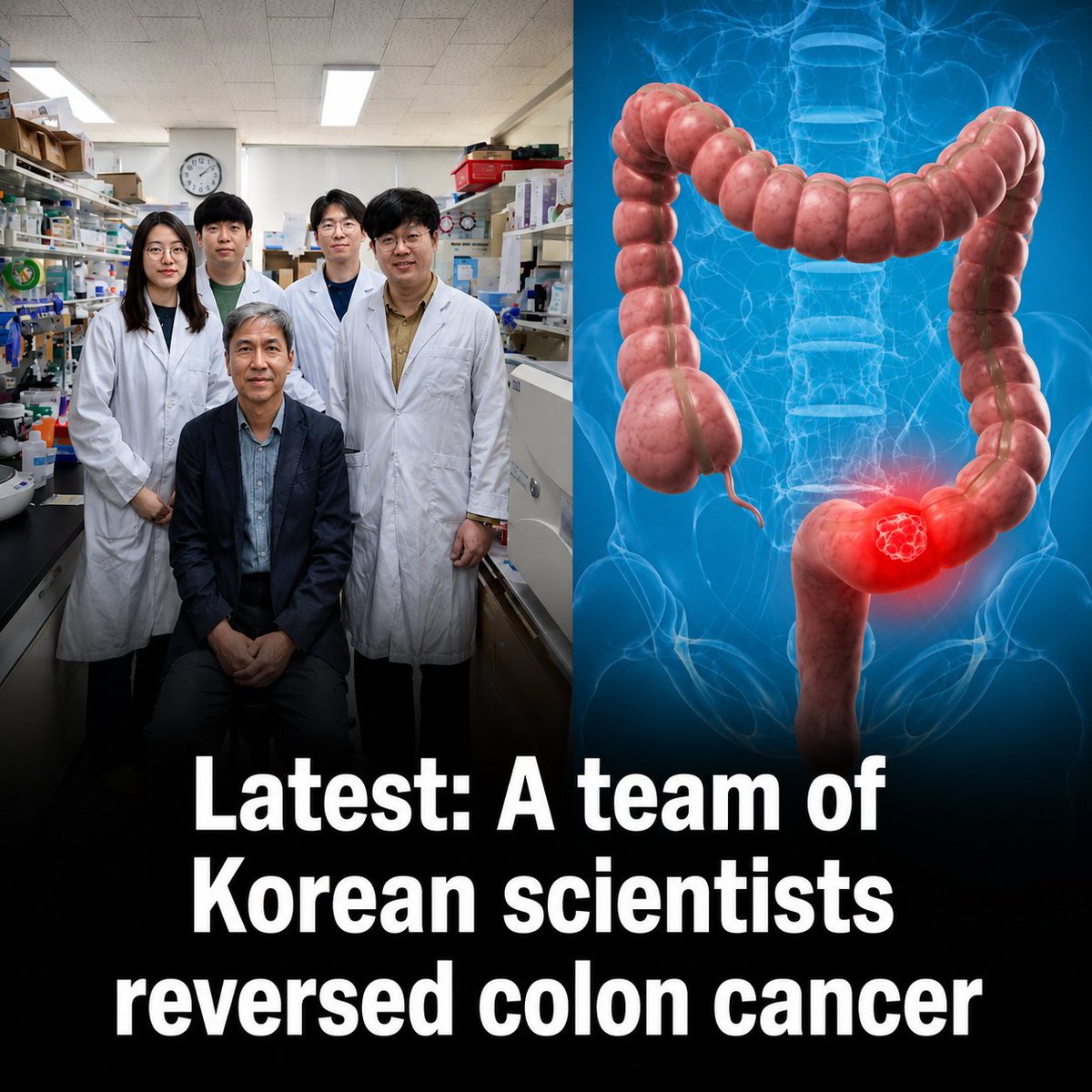
They didn't kill the cancer. They told it to go home.
A team of Korean scientists at KAIST just pulled off something that sounds like science fiction.
Instead of nuking colon cancer cells with chemo or radiation, they convinced them to turn back into normal, healthy colon cells.
No killing. No collateral damage. Just a quiet U-turn at the cellular level.
Here's how it works.
Led by Professor Kwang-Hyun Cho at the Department of Bio and Brain Engineering, the team built a "digital twin" of the gene network that controls how a normal cell becomes cancerous.
They ran simulations. They hunted for the exact moment a healthy cell flips into a malignant one.
Then they found the switches.
Three master regulator genes — MYB, HDAC2, and FOXA2 — were the keys to the whole transformation.
Flip those switches back, and the cancer cell stops behaving like a cancer cell. It starts looking and acting like a normal enterocyte, the kind of cell that lines a healthy intestine.
No gene editing. No permanent rewiring. Just the body's own natural signals, used in reverse.
The team confirmed it in molecular experiments, cellular experiments, and animal studies. The malignant cells stopped multiplying out of control and went back to doing their actual job.
The research has already been handed off to a company called BioRevert Inc. to develop into real-world treatments.
This isn't a cure tomorrow. But it rewrites the entire playbook for how we think about cancer.
You don't always have to destroy the enemy.
Sometimes you just have to remind it who it used to be.
Source: KAIST / Advanced Science (Gong et al., 2024) via ScienceDaily and OncoDaily