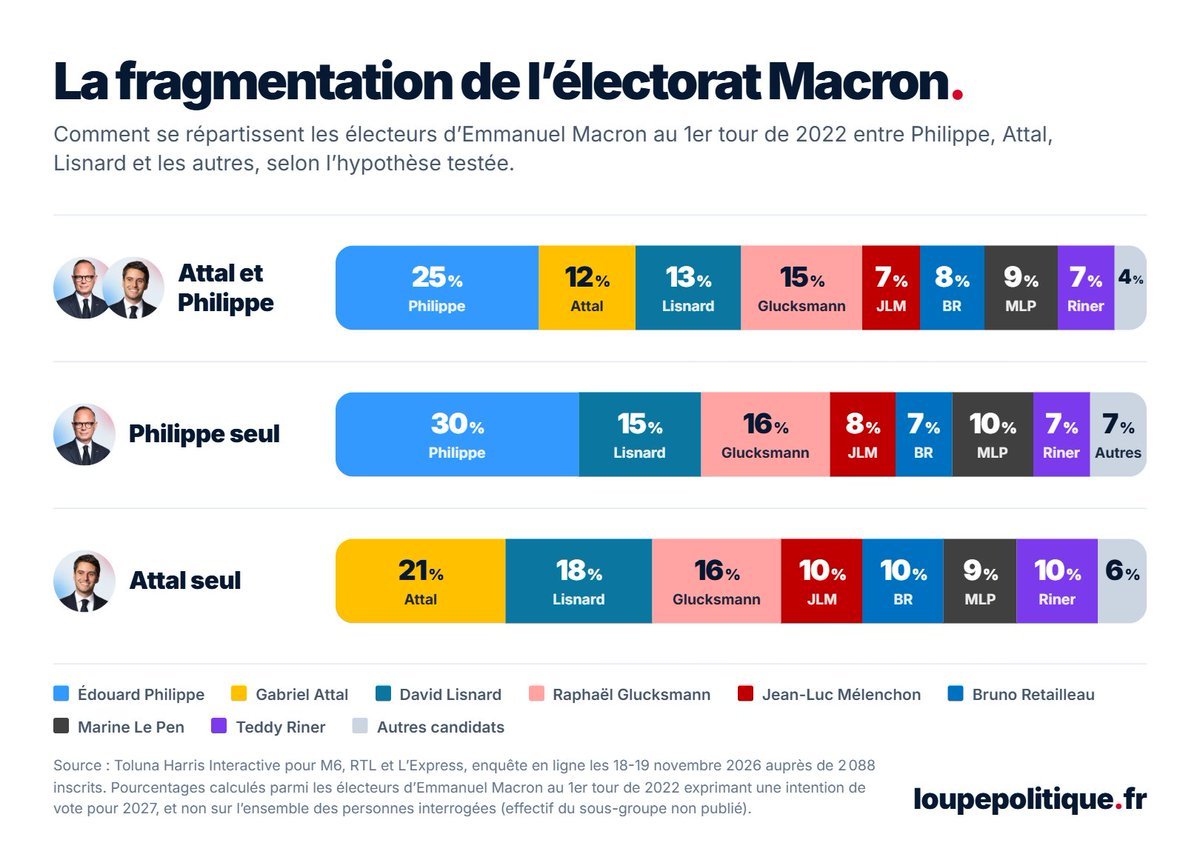
One day centrist politicians will look back at Macron like some kind of Roman empire of centrist politics
For a decade he managed to unify a broad centrist coalition under his banner, now that he's gone we're back to the warring kingdoms
Might take a generation to see it again
🇫🇷 Interesting development in French politics as President Macron is reportedly pushing for the adoption of a budget rule in the constitution using a bill passed in 2011. There's an element of manoeuvring the RN into making a decision, but that's precisely the point.
Another element here, which I suspect is creeping in is that those with (good) jobs increasingly perceive the world in which they have a relatively short time to extract the (labour) rents they're currently getting in wage before they tap out to AI, and that makes for a labour market with very low churn in the good jobs.
Nice piece from Claus, going over all things AI/ageing/automation.
I particularly like the idea of level vs growth shift in productivity: shift to automation might give us one time level boost, but continued ageing will not be offset.
The three big A’s in Macro - AI, Automation and Ageing, https://t.co/6qFKvxeQOA, my latest blog post with a nod to some of @CrisisStudent's recent work.
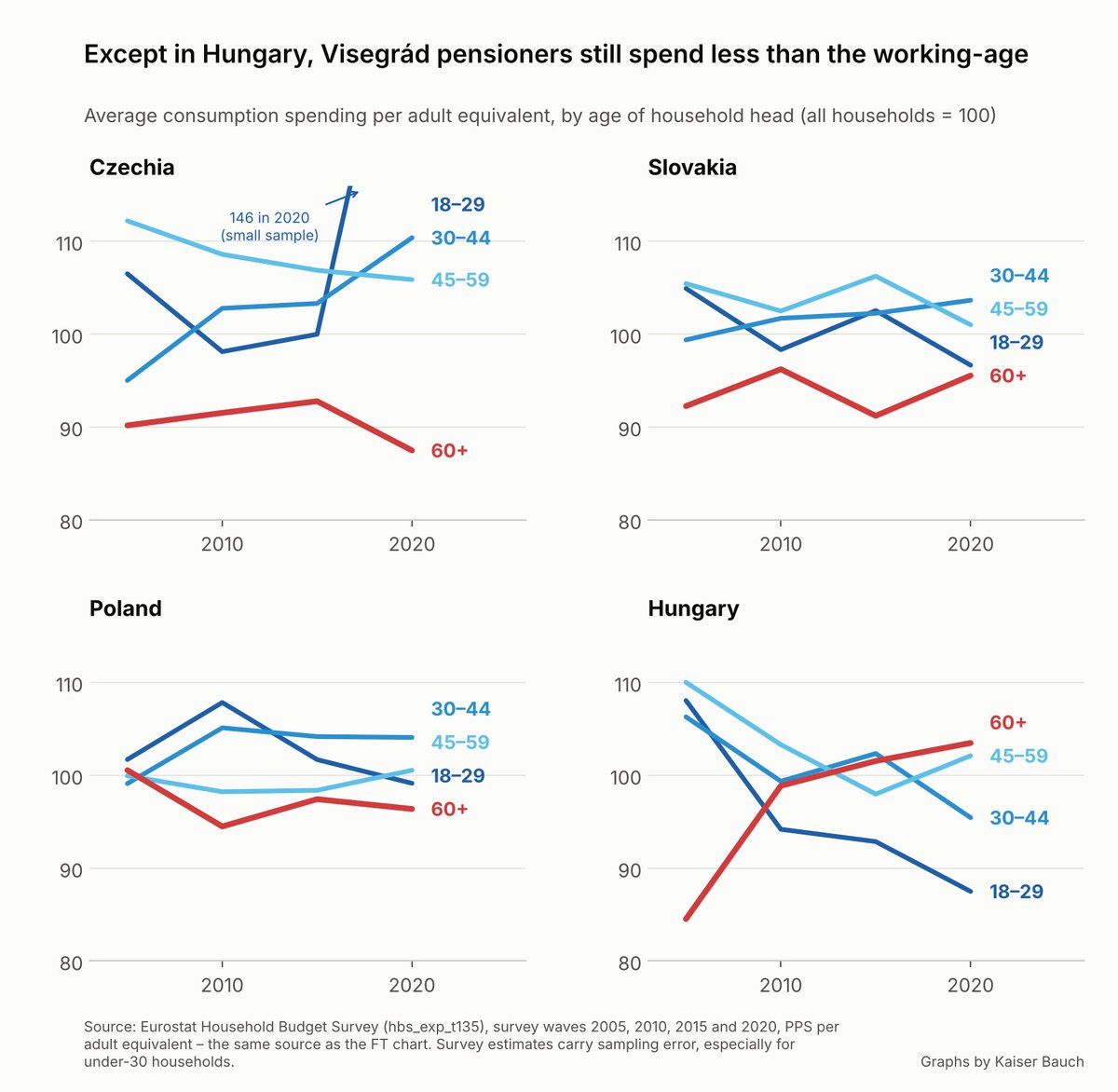
I recreated @jburnmurdoch FT charts on the West’s “gerontocracy” for the Visegrád countries, using the same sources (mostly Eurostat). The picture is different – for now.
1.) Pensioners are not yet the biggest spenders. Unlike in France, Italy or Spain, households headed by over-60s in Slovakia (96) and Poland (96) still spend less than the average household (adjusted for household size). Czechia shows 88, but its figures leave out the imputed rent of homeowners. Hungary is the exception: its over-60s jumped from 84 to 104 since 2005 and now outspend the young.
2.) Old age hasn’t swallowed the state yet. Unlike France and Spain, every V4 country still spends more on education, transport, police, defence and housing combined than on old age. But the gap is closing fast: in Czechia it shrank from about 17 percentage points of total spending in 1995 to 6.
3.) Old-age spending is outpacing tax rises. Since 2001, spending on pensions and estimated health care for over-65s has grown faster than tax revenue in all four countries (Czechia +3.7 pp of GDP vs +2.2 in taxes).
Part of what keeps the Visegrád countries in check is that pensions are relatively modest. A typical Czech pensioner gets 56% of what a typical worker in their fifties earns, a Hungarian 50% and a Pole 60%, compared with 79% in Italy and 81% in Spain. Slovakia (77%) is already at Southern levels. When the large post-communist baby-boom cohorts start retiring from the late 2030s, reforms will be needed – otherwise the trajectory could look very similar.
I just had a very funny situation with AI.
I am in process of writing a blog, and in part of it I link it to @tylercowen's ZMP workers, or more precisely my interpretation of that concept.
I wanted to check whether my interpretation is correct, so...
1/3
...I started discussion with Claude about the concept, and it very much gives me something like my interpretation. Encouraging.
Then I ask for blog where this comes from.
Answer: that was a reconstruction, partly taken from your own blog draft. It isn't Cowen's wording!
2/3
A sea of illuminating charts on pension spending from @jburnmurdoch
“If the France’s pension age had followed the same path as that of Denmark, France’s debt-to-GDP ratio today would be closer to 70 per cent than 120 per cent”
https://t.co/UUICUIZrSM
What do repeated supply shocks mean for monetary policy? @economistmeg of the @bankofengland MPC joins us to discuss why doing too little on inflation may now carry bigger risks than doing too much, and whether AI could deliver a positive supply shock. https://t.co/eHP1VRj1SO
One argument I have never understood is that automation will offset ageing, so growth should remain largely unaffected.
After reading a recent paper by Acemoglu and co., I now get the argument.
But I remain unpersuaded that this is the case.
A longish geeky 🧵.
1/23
One argument I have never understood is that automation will offset ageing, so growth should remain largely unaffected.
After reading a recent paper by Acemoglu and co., I now get the argument.
But I remain unpersuaded that this is the case.
A longish geeky 🧵.
1/23
Bottom line: This is a very interesting paper that definitively shifted my priors on the topic, but just not to the degree the authors would wish.
While I think automation will offset part of the ageing, based on experience so far, I think it will be only a small part.
23/23
What was surprising was how geographically broad-based the increase in energy prices was.
It wasn’t just Italy; we saw large jumps in gas prices in France, Spain, and Belgium.
7/
The final eurozone inflation report provided some clarity on the sources of strength in the October report.
Main takeaway: the relative hot service print has pretty benign drivers.
1/
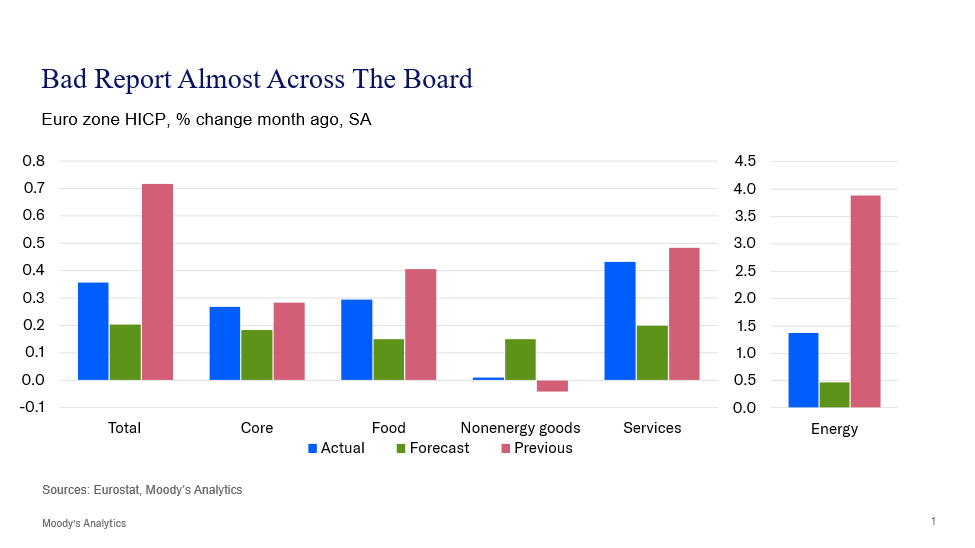
Euro zone inflation had another bad month in October, with only German fuel tax cut saving us from even worse numbers.
Headline came in at 4.01% (vs 3.86% exp, 3.78% prev), and core also accelerated to 2.55% (vs 2.46% exp, 2.51% prev).
To boot, composition was very nice.
1/7
Finally, the energy detailed revealed what we suspected: the main driver were ga prices, seconded by electricity prices.
We have moved away from a narrow energy shock focused on fuel alone…
6/