Within the “Gender Critical” movement there is no intellectual leverage whatsoever, it’s just narcissistic echo-chambers of outrage fuelling and igniting relentless moral panic.
@mar2vickers@CharlieWalsham_ When the critique hits the exact structural nerve, shouting "AI slop" doesn't make the question go away.
Biological essentialism relies on drawing rigid lines around human variance.
So if it's not a bureaucratic checkbox, how do you define the border?
@mar2vickers@CharlieWalsham_ Getting this unhinged over basic questions about biological essentialism tells you everything you need to know. If your entire worldview relies on policing borders, you should at least be able to define who holds the clipboard. Is it bureaucracy, or is it just vibes?
Is "Britishness" just ink on a bureaucratic piece of paper, or an indigenous ethnographic claim? And once you start chasing that biological essentialist purity, who actually holds the clipboard to decide who belongs and who doesn't?
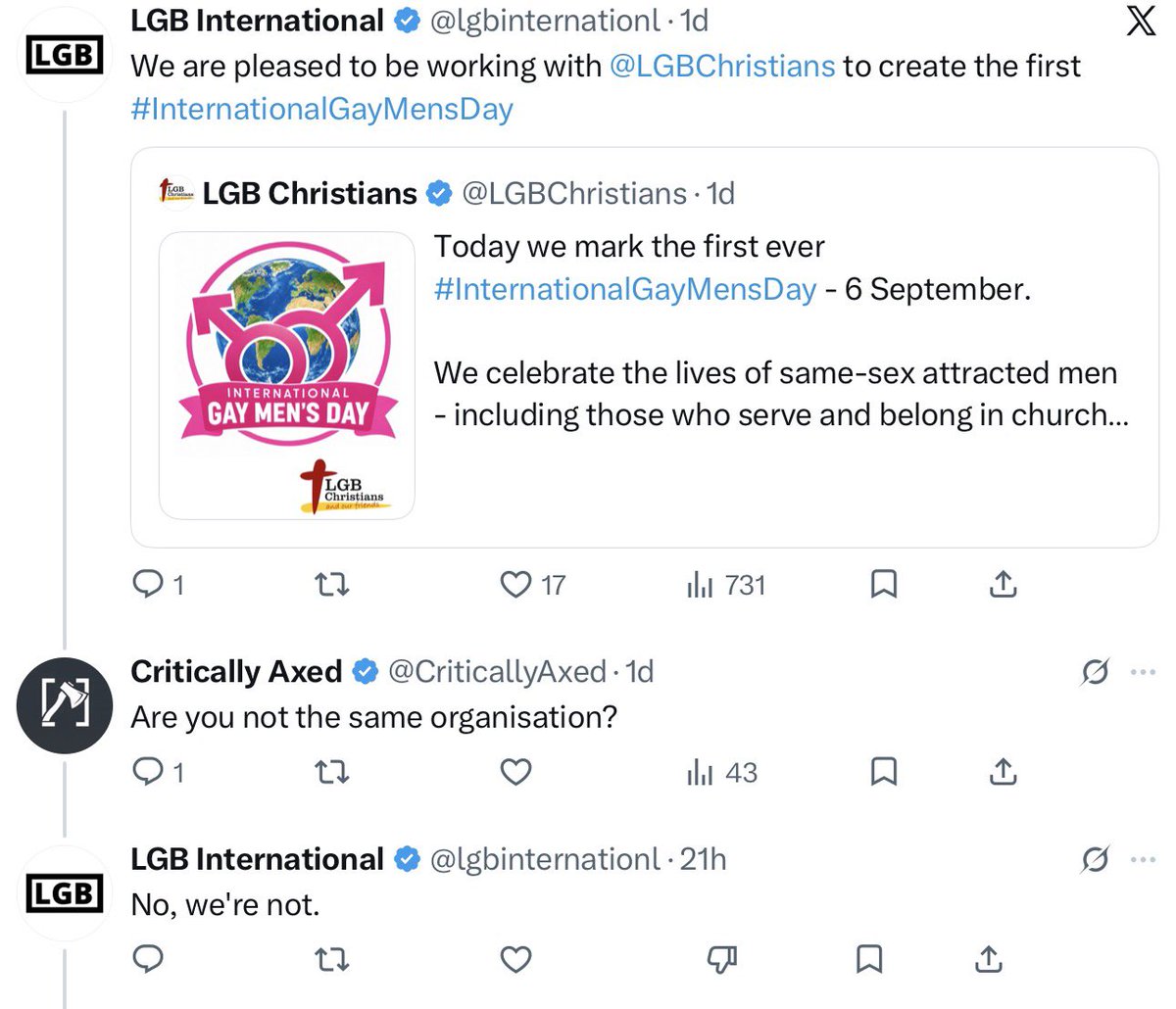
By grafting "LGB" onto existing political, religious, or professional networks while stripping away the "T," these formations manufacture an artificial internal schism. It functions as a structural wedge: it forces organisations to adopt exclusionary boundaries under the polite fiction of protecting "streamlined" rights, while actually institutionalising an ideological purity test that signals trans people are unwelcome in mainstream solidarity spaces.
By grafting "LGB" onto existing political, religious, or professional networks while stripping away the "T," these formations manufacture an artificial internal schism.
It functions as a structural wedge: it forces organisations to adopt exclusionary boundaries under the polite fiction of protecting "streamlined" rights, while actually institutionalising an ideological purity test that signals trans people are unwelcome in mainstream solidarity spaces.
Criminological and sociological research into domestic abuse and coercive control highlights a recurring behavioral dynamic: when perpetrators face scrutiny, they deploy externalised scapegoating, deflection, and the DARVO (Deny, Attack, and Reverse Victim and Offender) model to evade accountability. Studies examining perpetrator profiles show that manufacturing external threats successfully redirects public attention away from actual harm.
When institutional figures and political actors weaponise anti-trans moral panics, they scale these exact interpersonal abuse tactics up to a societal level. By framing a vulnerable minority as a fabricated danger, they construct a social smoke screen. This hyper-visible deflection serves as a defensive shield, distracting scrutiny away from structural failures, economic extraction, and predatory systemic dynamics while keeping the underlying power structures entirely unexamined.
Building professional platforms and institutional networks entirely around the systemic restriction of a marginalised minority's public recognition turns exclusion into an industry. When careers are sustained by manufacturing moral panic and redefining human variance as an external threat, the enterprise relies on monetising hostility under the guise of public debate.
Much more of a danger is "Fellow travellers of the far right", intellectuals, writers, or political figures who sympathise with and promote far-right or fascist ideologies, policies, and narratives without holding formal membership in a specific far-right party or organisation. By operating on the outer edges of extremist movements, they often serve to bridge radical ideas into mainstream political discourse, lending intellectual or cultural respectability to otherwise fringe agendas.
Rebranding natural human variance and diverse gender experiences as an external "ideology" is a transparent tactic to justify exclusion. Packaging biological essentialism into self-help books and organisational platforms doesn't mask the agenda; it just weaponises conformity against human diversity under the guise of concern.
Much more of a danger is "Fellow travellers of the far right", intellectuals, writers, or political figures who sympathise with and promote far-right or fascist ideologies, policies, and narratives without holding formal membership in a specific far-right party or organisation. By operating on the outer edges of extremist movements, they often serve to bridge radical ideas into mainstream political discourse, lending intellectual or cultural respectability to otherwise fringe agendas.