Yazının düşünceyi genişleterek, dönüştürerek ve ona yeni hareket alanları açarak bilişsel bir teknoloji olduğundan söz eden bu makaleye denk geldim. Kısaca yazmak düşüncenin hareket halidir diyor. Mutlaka tavsiye ederim.
Link: https://t.co/T1SfD6aR3G
Daniel Kahneman - the psychologist who won a Nobel in economics - spent his life proving one thing: your confidence is lying to you
A bat and a ball cost $1.10. The bat costs $1 more than the ball. The answer "10 cents" jumps to mind instantly. It's wrong (it's 5 cents) - and ~50% of students at Harvard, MIT and Princeton say it without checking.
That gap is his whole point: the fast, intuitive mind builds a clean story from almost nothing, and the feeling of certainty has nothing to do with being right.
"Confidence is a feeling, not a judgment."
"Stock pickers can't develop intuition - there isn't enough regularity for it to form."
"You can build a very coherent story out of very little information."
~45 min, free. how your mind fools you - from a man who studied it for 50 years ↓
En 2007, el profesor de Stanford Joel Peterson impartió una clase de 1 hora sobre cómo negociar y obtener lo que quieres.
Sus 3 principios:
→ Nunca muestres necesidad
→ La confianza vence a la manipulación
→ Piensa en crear relaciones
12 lecciones para negociar mejor:
An engineering professor who failed math her entire childhood spent years figuring out exactly what had been sabotaging her, and the answer was not low intelligence. It was a hidden mode her brain kept switching into that nobody had ever told her existed.
Her name is Barbara Oakley. The book is called A Mind for Numbers.
She failed math and science from grade school to the end of high school. Numbers felt like a language everyone else had been taught in secret.
So she ran toward the thing she was good at. She enlisted in the Army right after graduation, and the Army paid her to learn Russian at the Defense Language Institute in Monterey.
She got very good at Russian. Good enough to earn a degree in Slavic Languages, serve four years in Germany as a Signal Officer, and rise to Captain.
Then the wall appeared.
She watched her career options shrink because she could not handle the technical side of her own job. The people with math moved up and moved out. The people without it stayed stuck. So at 26 she did something that sounds insane. She left the Army and enrolled in engineering, starting from remedial math, sitting in classrooms with teenagers.
In between, she worked as a Russian translator on Soviet trawlers in the Bering Sea and as a radio operator in Antarctica. Today she is a professor of engineering at Oakland University with a doctorate in systems engineering.
The question that drove her for years was simple. What changed? She was the same brain that failed algebra. Why did it suddenly start working?
The clue was hiding in the one subject she had mastered. She noticed she had never learned Russian by staring at it. She practiced a little every day, walked away, came back, and the language quietly assembled itself between sessions. Math she had attacked the opposite way. Lock eyes with the problem. Push harder. Refuse to look away until it cracks.
It never cracked. And neuroscience explains why.
Your brain has two modes. The focused mode is the one you know. Tight attention, prefrontal cortex engaged, grinding through familiar steps. The diffuse mode is the one nobody teaches you. It runs in the background when you relax. It is loose, wide, and wired for connecting ideas that sit far apart from each other.
Oakley uses a pinball machine to explain the difference. In focused mode, the bumpers are packed tight. Your thought bounces in the same small circle, over the same ground, again and again. In diffuse mode, the bumpers spread out. The thought travels. It reaches parts of the brain the tight loop could never touch.
The trap has a name. The Einstellung effect. The first approach that comes to mind blocks every better approach behind it. The harder you focus, the tighter the loop, the more locked in you become. The grinding feels virtuous. It is actually the cage.
And every time her mind wandered off a math problem as a kid, she dragged it back, believing the wandering was laziness. The wandering was her brain trying to switch into the mode that solves things. She spent ten years fighting the half of her brain that wanted to help her.
You cannot run both modes at once. The diffuse mode only takes over when you genuinely let go. Which is why answers ambush you in the shower, on a walk, at the edge of sleep. Salvador Dali knew this. He napped in a chair holding a key over a plate, and the instant he drifted off, the key dropped, woke him, and he carried the half-formed ideas straight back into focused work. Edison did the same trick with ball bearings. Two of the most inventive minds in history were deliberately farming the mode the rest of us treat as slacking off.
The practical version fits in two sentences. Focus hard on the problem until you stall. Then stop completely, and let the other mode take the shift.
The break is not a reward for the work. The break is the work. It is also why cramming fails and procrastination is fatal. Diffuse mode needs hours and nights between focused sessions to build anything, and procrastination burns that time before the first session even starts.
Oakley failed math for ten years using one mode at full strength.
She became an engineering professor the day she started using both.
To those who have long awaited a truly modern, pedagogical textbook on thermodynamics:
Now you can appreciate the beautiful cover illustration by Mari Okazaki @cafemari of our book! Please wait a little bit more for the book; we are working on the proof.
https://t.co/5U0qo9Bcg8
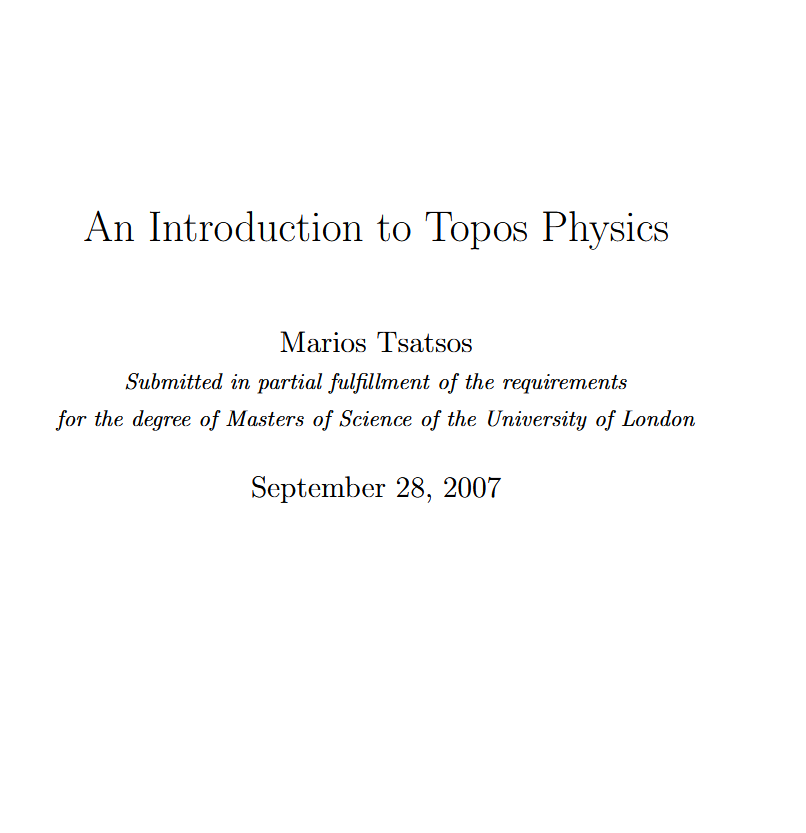
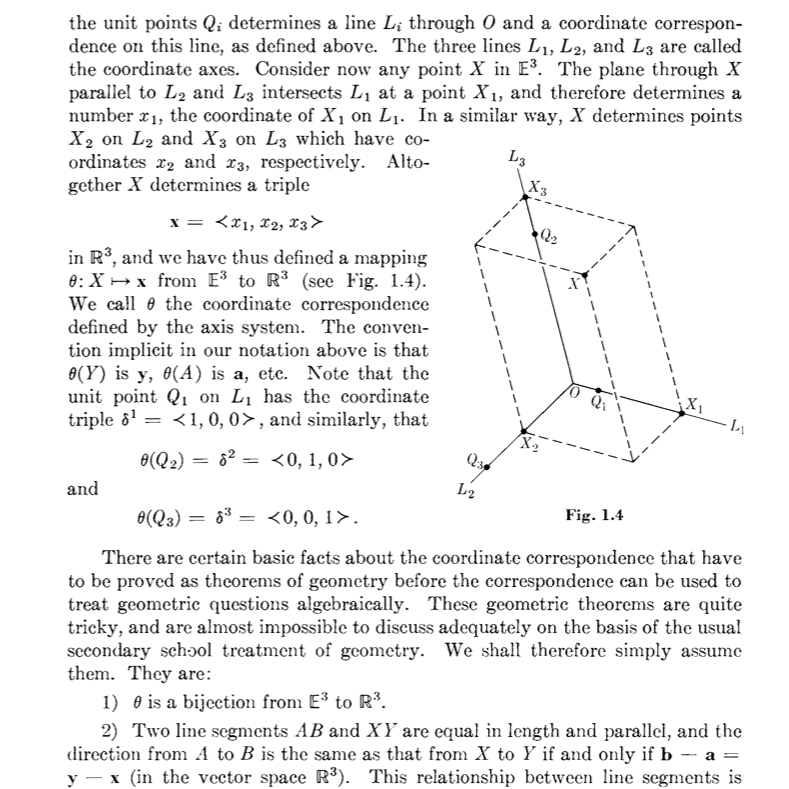
Topos are mainly seen in pure mathematics and logic, but there is also an approach to physics in which topos are used!
So, if you're confident about your understanding of basic category theory, check out this 100 page primer titled ' An Introduction to Topos Physics' by Tsatos.
This is a very gentle introduction, well written and pedagogically sound.
If you need more material on topos along side this primer, check out Goldblatt's Topoi, the categorical analysis of logic and sheaves in geometry and logic by Mac Lane and Moerdijk.
🔗👇
"Advanced Calculus" is a free book of more than 500 pages published by the Harvard Mathematics Department and represents a real gold mine for the study of mathematical analysis.
It covers normed vector spaces, compactness and completeness, multivariable differential calculus, integration, differential equations, multilinear forms, differentiable manifolds, exterior calculus, potential theory, and classical mechanics.
It is a mathematically substantial book, rigorous yet accessible to readers with a solid background in analysis and linear algebra. Despite its advanced level, it maintains remarkable clarity and develops the theory in a progressive and coherent way.
It is one of those resources worth keeping in your mathematical toolbox, useful not only for mathematicians but also for those working in physics, mechanics, engineering, data science, and computer science, where many of the concepts developed in the text find direct applications.
https://t.co/ZbShWnOpWN
ANDREJ KARPATHY COULD HAVE CHARGED $2,000 FOR THIS COURSE.
He put it on YouTube.
The full training stack. Tokenization. Neural network internals. Hallucinations. Tool use. Reinforcement learning. RLHF. DeepSeek. AlphaGo.
3 hours of the most comprehensive LLM education that exists anywhere at any price.
Not how to use the tools.
How the entire system was built from the ground up and why it behaves the way it does.
The engineers who understand this build things the ones who only use the tools cannot even conceive of.
The gap between those two groups is not 3 hours.
It is everything those 3 hours quietly unlock for the rest of your career.
The Feynman Technique involves four key steps:
(1) Identify
(2) ELI5 ("Explain It To Me Like I'm 5")
(3) Reflect & Study
(4) Organize, Convey & Review
Let's cover each step and how you can make this powerful framework work for you...
INCREDIBLE
The MOST COMPLETE GUIDE for understanding LLMs from first principles is now available online to read for free
Covers the model mechanics
- Tokens / tokenizers
- Transformers
- Attention
- KV cache
- Prefill vs decode
- Decoding controls
- Model packages
- Chat templates
- Long context
- RAG
- Agents / tools
- Fine-tuning
- Multimodal models
Then connects that to running models locally
- What "local" really means
- Open-weight vs opensource
- Quantization
- VRAM math
- Hardware tiers
- File formats / load safety
- Runtimes / serving modes
- Model selection
- Privacy
- Failure modes
- Benchmarks
- Practical setup paths
You should read this, and if you cannot now then you most definitely wanna bookmark it for later
Opensource AI FTW
"Algorithms for Decision Making" is a free book about the mathematical foundations of artificial intelligence, autonomous decision systems and modern machine learning.
Published by MIT Press, the book connects probability, optimisation, planning, search, reinforcement learning, Markov decision processes, utility theory, and sequential decision-making in a rigorous yet modern way.
With more than 700 pages, it provides a remarkably broad view of how intelligent systems reason, evaluate uncertainty, and make decisions under constraints.
One of the most interesting aspects of the web is the enormous amount of high-quality free knowledge available today. Complex subjects that once required access to expensive institutions or specialised libraries are now accessible to anyone willing to study!
https://t.co/I9cHSCvvlm
In 2013, psychologist Daniel Goleman gave a lecture on how to regain your focus before distraction destroys your life.
His frameworks:
- Emotions hijack focus
- Deep focus creates flow
- Attention is a mental muscle
15 lessons on mastering attention in a distracted world:
arXiv release more than 20k new papers a month. I can't read that; nobody can. Keeping up with a field stopped being about access and became about attention. Skim is the second pair of eyes I built for it: read deep where it counts, trust the triage everywhere else
https://t.co/TlmNggHRpJ
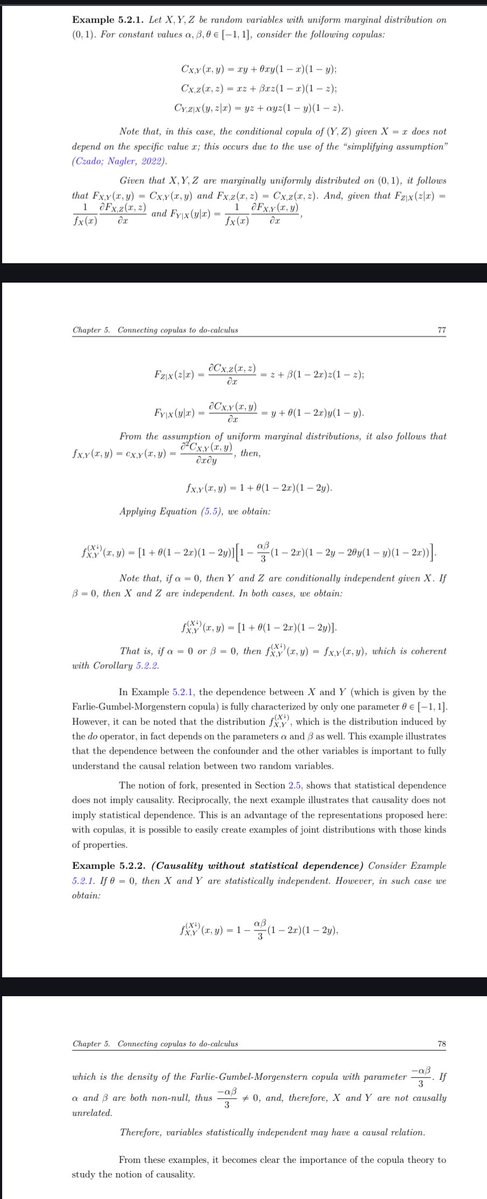
Not only does causation NOT imply correlation, it doesn’t even imply statistical dependence! Here’s a snippet from my friend @viniliff master’s thesis on copulas & causality, showing variables can be causally connected yet completely independent. 👇
If you're tired of your life, read this:
Joe Dispenza wrote one of the most dangerous books I’ve ever read:
Breaking the Habit of Being Yourself.
It shows you exactly why you're stuck and how to break free.
Here are 11 insights that’ll punch your old self in the face (in a good way):
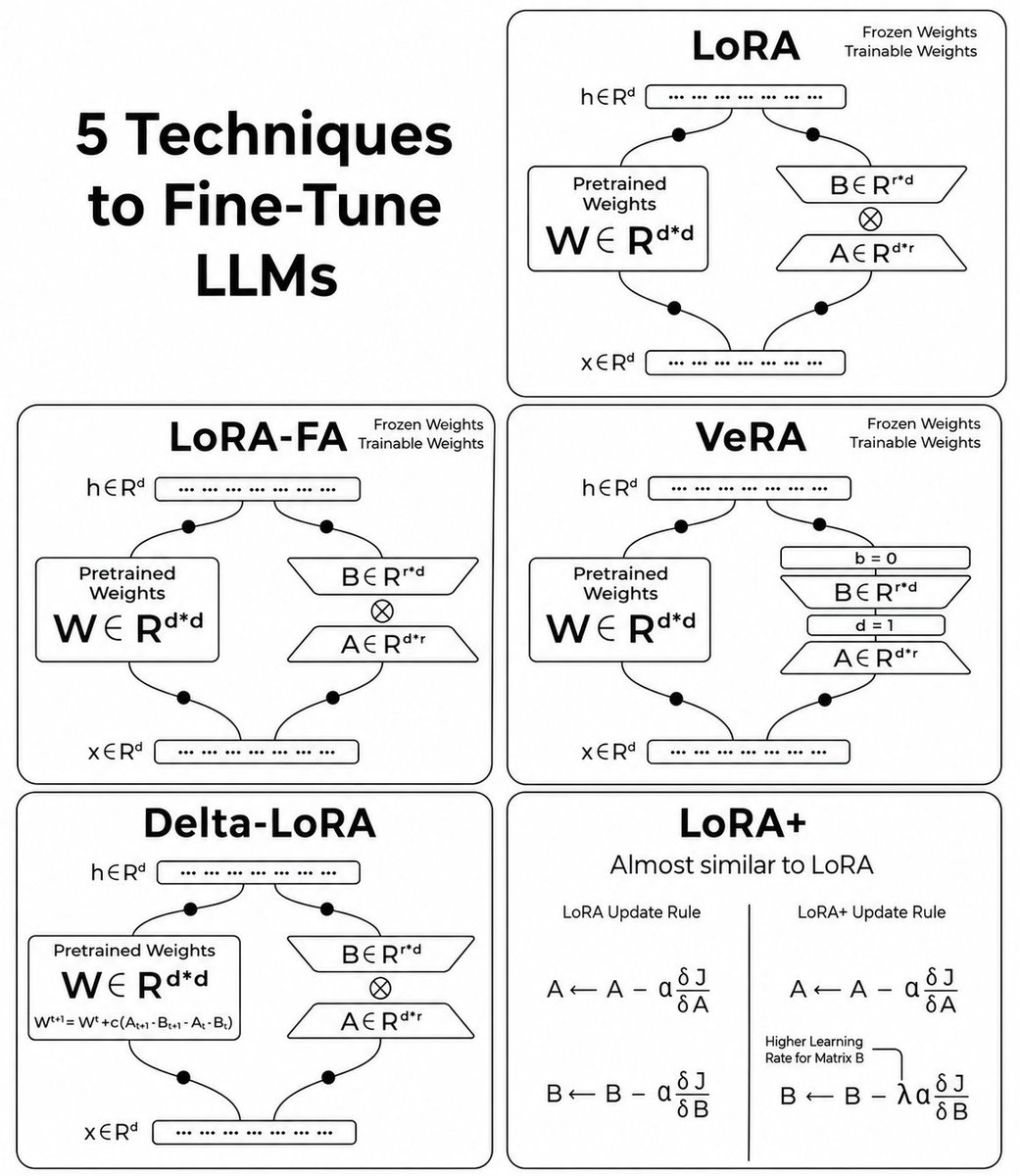
5 Mathematically Efficient Fine-Tuning Techniques for LLMs
This diagram compares the core math behind:
• LoRA – Low-rank decomposition (A ∈ R^{d×r}, B ∈ R^{r×d}) with frozen W
• LoRA-FA – Freezes one low-rank matrix during updates
• VeRA – Vector-based scaling with fixed d=1 and b=0
• Delta-LoRA – Updates pretrained weights using difference of low-rank products
• LoRA+ – Applies asymmetric learning rates to matrices A and B
Clear visual breakdown of weight matrices, dimensions, and update rules for parameter-efficient adaptation.