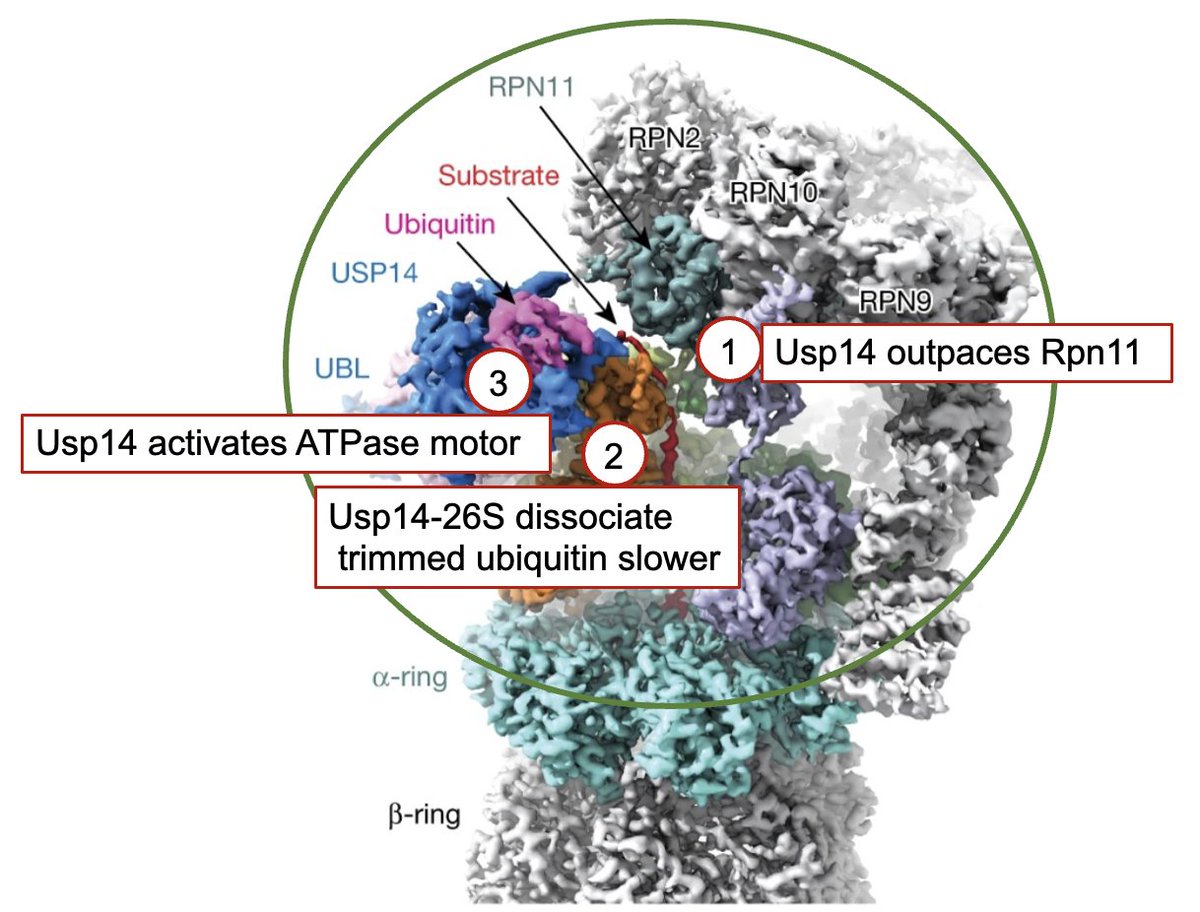
Extraordinary mechanistic dissection of proteasome activities and definition of roles of ubiquitin beyond substrate recruitment. Always @AndyMartinLab !
https://t.co/fWFLGQxS7S
Our paper describing the 3Å #cryoEM structure and chain-elongating function of UBR5, one of the largest HECT E3 ligases, is now out! at https://t.co/dy9kMqKBqj
Join us next week for #DegradoZoom on July 6th, 12pm EST:
Bernat Crosas @CrosasLab IBMB: Development of proteolytic chimeras based on direct 26S proteasome targeting
Muhar Matthias @matthias_muhar ETH Zürich: A chemical degron marks C-terminally modified proteins for degradation
Certain MEK inhibitors induce a complex between #MEK & difficult-to-degrade #cRAF. This allows bystander degradation of recalcitrant cRAF w/ #PROTACs targeting MEK. Excellent study by the Duncan & Jin labs @FoxChaseCancer@IcahnMountSinai@biorxivpreprint https://t.co/cE8i5lUsw7
Fascinating parallel architecture and functioning of Npl4-Ufd1-CDC48 and 19S Proteasome complexes. The same evolutionary solution put together twice in the same pathway: Ubiquitin recognition, MPN domains and ATPase engine. #TPD
https://t.co/wQX7Hmzrsi https://t.co/wLSEDi93rP
Can allostery be decoded? the complexity of allosteric regulation, essential to understand cell biology and pharmacology, approached from different standpoints in two outstanding papers:
https://t.co/QF29OfIDiE
https://t.co/j09FI4iBaV
Spectacular tuning effect of Usp14 mediated by 3 allosteric checkpoints that make the 26S proteasome even more sophisticated. Thanks Y. Mao, D. Finley and all contributors. Retain in memory.
https://t.co/581v4lId4f
The 26S proteasome is this fantastic machine that nature has created to achieve homeostatic control of intracellular protein content in a timely and perfectly regulated manner. Most of the strategies used in the #TPD field rely on that. #Proteindegradation
@monteiro_dalmo In principle it could be feasible, as long as you have good ligand(s) of the non-functional protein, adaptable chemistry and then a good experimental model.
https://t.co/Eiryf71T6Q
In where we show that dynein adaptors, like most things in life, are also regulated by phosphorylation.
Featuring: BICD2 and PLK1. You heard that right: no NEKs this time (but, of course, just wait).