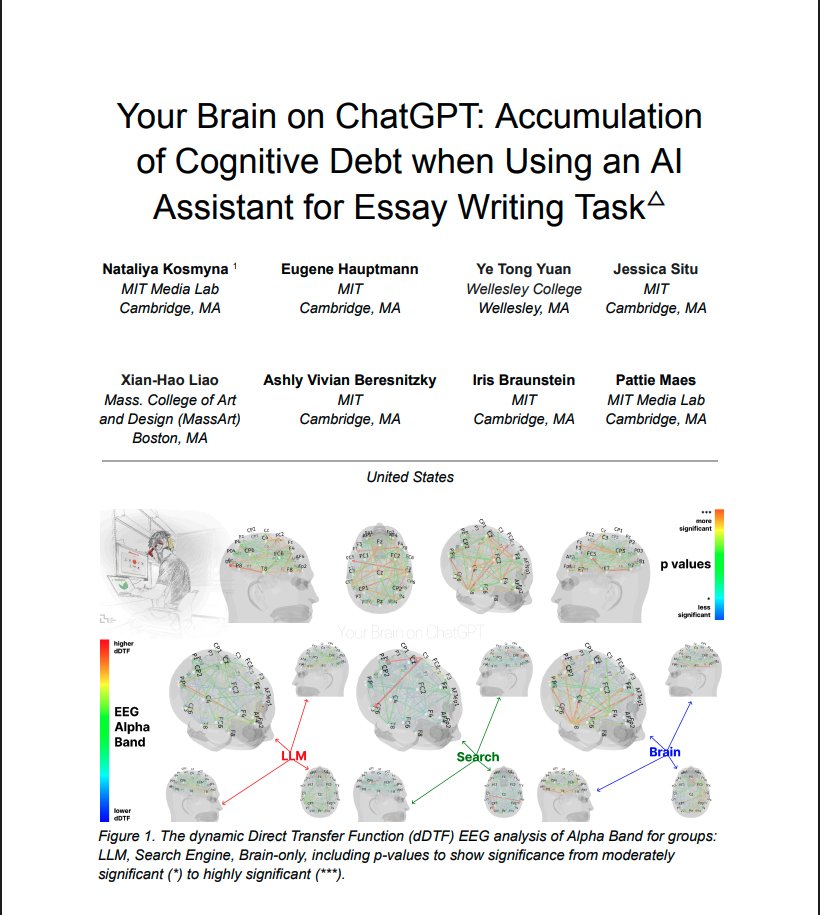
BREAKING: MIT just completed the first brain scan study of ChatGPT users & the results are terrifying.
Turns out, AI isn't making us more productive. It's making us cognitively bankrupt.
Here's what 4 months of data revealed:
(hint: we've been measuring productivity all wrong)
Why your 250+ unit property management company needs a Matrix organizational structure:
Blog-like post ahead.
I’ve heard a lot of discussion about whether the right org structure for large PM companies is Departmental or Pod. Departmental starts to fall apart at large volume because there is no single person looking out for the overall property and who the owner can call. But the pod structure is so dysfunctional, there’s not enough room on all of X to list out all the reasons why.
The solution is a Matrix Structure.
This is a page right out of the hospital administration playbook, which was also my profession in a former life. In a Matrix structure, you have division heads who have ultimate accountability and responsibility for their business lines AND those business lines are completely dependent on the performance of other internal departments.
So for example, in a Cardiology department, the Administrative Director is responsible for making sure patients can easily schedule appointments when they need them, the exam rooms are clean and in good repair, there’s enough equipment to perform all echos, stress tests, etc, and the department is profitable (or in healthcare, at least break even). But to achieve these things, the Call Center, Housekeeping, IT, Equipment Management, and Billing departments must also all be performing well. Those departments report to their own managers who likely report up to a completely different VP.
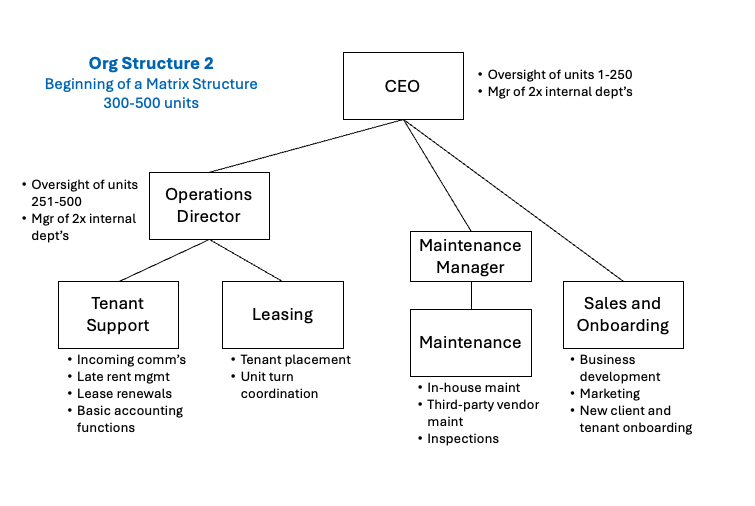
The comparison in property management is that you need an Operations Director who is ultimately responsible for the performance of X number of units. For those units to perform well, that Director will be reliant on the Tenant Support team, the Leasing team, and Maintenance Team.
As the Director monitors KPIs and various systems and reports, they should be asking questions or noticing when something is off and then checking in with the related team to investigate further. A listing isn’t renting. Rent is past due on Unit 4 and notice hasn’t gone out. You keep seeing repeat maintenance tickets for 123 Main St for the same problem.
In an ideal world, the Leasing team, Tenant team, and Maintenance teams will have already caught and resolved these issues. In many cases they will, but we all know these things can have a tendency for falling through the cracks despite good efforts or intentions. A Director with a bird’s eye view can help spot issues before they become full blown problem. They’ll also be able to answer a property owner’s questions about these issues, or better yet, proactively update them.
The real cherry on top is: what if these issues are actually all interconnected in some way, signaling a bigger issue with the overall property. Only someone looking at the property across all departments will catch that. And if you don’t want to lose clients, that “someone” better be someone employed by you and not the property owner.
Before you go charging off to change your org structure, this comes with an important caveat (sorry, I didn’t promise this would be easy).
YOU MUST HAVE A CULTURE TO SUPPORT THIS STRUCTURE.
If you try this without establishing the right culture, your Leasing Manager will blow a fuse and maybe even quit when the Director comes knocking to ask about why a property hasn’t been leased yet. Here’s how you avoid that:
1. All internal departments must identify as such and understand they have 2 or 3 equally important customers: the property owner and/or the tenant/applicant, and the Director
Imagine transport for an inpatient at a hospital who needs a test done. The Transport professional might be the friendliest, sweetest transporter who puts a smile on a weary patient’s face. The external customer (the patient) rates him 5 stars! But what if it took him an hour to get the patient? The patient may not care – they were comfortable in bed watching TV. But the nurse (internal customer) is furious. She had to call 3 times to ask for an update after getting yelled at by the testing department who is now falling behind schedule and wants to know why she hasn’t sent the patient yet.
The equivalent in property management is a maintenance team member who might be doing beautiful work in the field but isn’t documenting what was done or why so there’s no history or understanding of repairs and related expenses. So this brings me to the next key point:
2. It’s not enough just to identify internal colleagues as your customers. Team members must also have their annual performance reviews tied to outcomes for both internal and external customers.
3. You need a sense of joint problem solving and collaboration.
When leasing cycles are too long, you can’t come to the table ready to point fingers at each other and blame your colleague. It must be an open data-driven conversation that aims to identify root causes in PROCESS, NOT PEOPLE. This is what a CEO does (or should do) every day. What a great skill to develop in your directors and team leads. But it may not come naturally and will require strong facilitation and leading by example on how this is done.
Regular meetings will help facilitate this. You should have a monthly or quarterly meeting where the internal department and Director review the performance and status for their group of properties. One meeting per director. It should be a report-out from the internal department to the Director on how things are going with the opportunity for the Director to ask questions. Because the Director is the “customer”, this meeting should be organized and lead by the internal department. This will help reduce some of your culture strain. DO NOT CANCEL these meetings when there are no problem. You don’t want the group only coming together when there are problems. Discuss, celebrate and do root cause on your wins as well and you will fuel your desired culture even more.
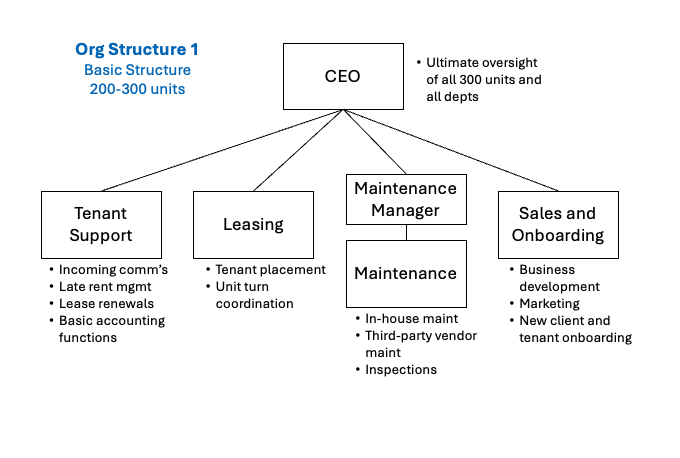
As I think about incorporating a Matrix structure into our growing company, below are the org charts I plan to move us through.
Today, all functions report to me (Org Structure 1). We’re at 200 units and I already feel the strain of the load I’m carrying. When we get to 300, I plan to hire a director to take half the portfolio (Org Structure 2). Because we’ll still be small-ish, they’ll also have responsibility and the bandwidth to oversee at least one of our internal functions, sparing me that work as well.
As we continue to grow, each of the internal functions will also need to grow and will eventually be large enough to support their own manager (Org Structure 3).
Take the unit counts with a huge grain of salt. I know everyone wants that magic number of how many units a property manager should be able to handle, but it really does depend on whether it’s multi or single family and A, B or C class.
There is no doubt in my mind that this is the org structure to pursue as we grow. While we’re only 200 units today, I was in several hospital director roles in my prior life with direct responsibility for $20M+ lines of business. I speak from experience on this type of org structure and believe there is huge opportunity in applying it to property management.
Have you tried this structure or are you thinking about it? I’d love to hear about it.
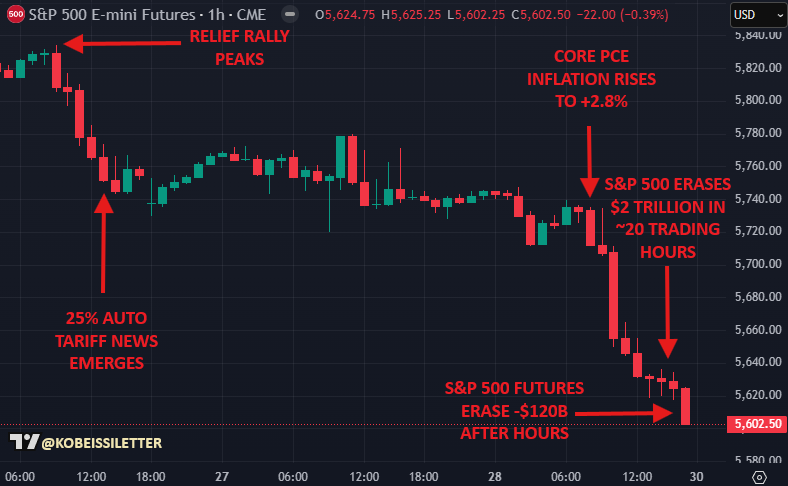
This is absolutely insane:
From Wednesday to Friday, the S&P 500 lost -$100 billion PER trading hour for a total of -$2 TRILLION.
Then, after the market closed on Friday, S&P 500 futures erased ANOTHER -$120 billion in minutes.
What happened? Let us explain.
(a thread)
@realEstateTrent Try with 6 kids….travel is not designed for families.
Hotel sites don’t make it easy
Restaurants don’t make it easy
But it is worth it….just have to get creative
My hottest take is true AGI should be defined by its ability to filter 100% of spam emails at the level of a fully capable, educated 35 year old human.
G2's rankings are driven by real customer feedback, and seeing ourselves among the best tells us we’re doing something right.
Thank you to our customers for trusting us to build the tools that help you work smarter, grow faster, and lead with confidence.
#PropertyManagement
@moseskagan I would give more pause before starting to speak and when ending.. this will give a tad more time before your intros and outros. Makes it not as harsh a transition.
@moseskagan Same with the Wall Street landlords so they can create distressed assets to then swoop up because the individual owner is tired of the legal game and just gives up.
We turned off the deposit alternative options in our software.