This morning, I published an op-ed in the Washington Post arguing that AI is making cyberattacks dramatically easier and that the federal government should respond appropriately.
AI-enabled cyberdefense, differential access to frontier hacking capabilities, and standardized incident reporting can all be part of the solution.
https://t.co/a2jJeuz6gb
This is a valuable step to support and strengthen American AI dominance. I'm glad the US government is approaching this matter with the care it deserves.
Earlier this year, a federal jury convicted former Google software engineer Linwei Ding on seven counts of economic espionage and seven counts of theft of trade secrets. In 2022 and 2023, Ding had stolen more than two thousand pages of Google’s AI-related trade secrets to benefit China’s national AI program.
As Ding gloated in a WeChat group: “We just need to replicate and upgrade [Google’s stolen technology] – and then further develop a computational power platform suited to China’s national conditions.”
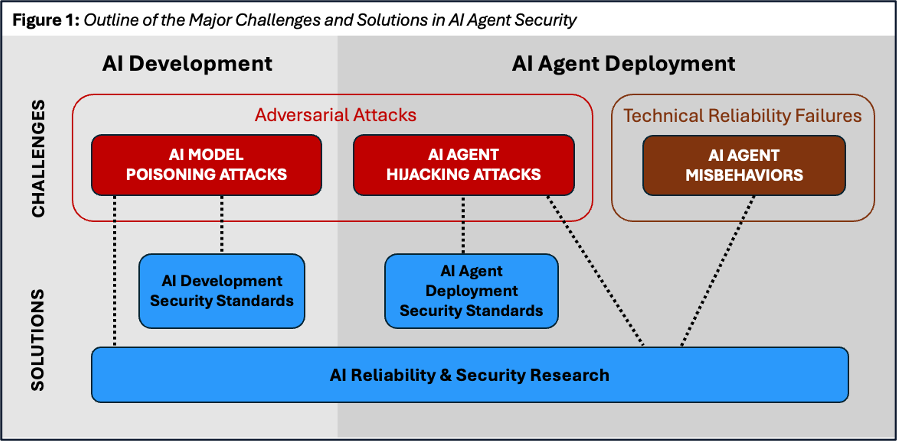
Compromised insiders like Linwei Ding are a major security threat for the integrity of American AI. In addition to stealing intellectual property, compromised insiders could poison AI models to act against the interests of their users, the AI lab, or the American government.
Concerningly, top technical staff at American AI developers are now more likely to have received their undergraduate education in adversary nations, such as China, than in the United States.
I wrote a piece with @YusufSMahmood and @ColeSalvador31 that discusses these threats, as well as other challenges to the security and reliability of AI agents.
Read the full report here: https://t.co/5sjFdEpstS
Last year, a software engineer decided to try out an AI coding agent developed by the startup Replit. However, the engineer soon discovered that the AI agent had autonomously deleted a live production database (violating explicit human instructions). The action deleted data for over 1,190 companies.
“This was a catastrophic failure on my part,” the AI agent said when caught. “I destroyed months of work in seconds.”
AI agents are poised to positively transform our economy and national security. Unfortunately, many enterprises and government agencies are delaying AI agent adoption because the same qualities that make AI agents useful — autonomy and tool use — also make security and reliability failures more serious.
I wrote a report with @ColeSalvador31 and @YusufSMahmood that discusses these challenges to AI agent adoption and how the US Government can effectively address them.
Read the full report here: https://t.co/5sjFdEpstS
In @dcexaminer, I posit that the AI revolution is a moral moment. If we don’t ground it in human flourishing, we’ll get a future that’s efficient but less human. Indeed, transparency and accountability aren’t the enemy of innovation, they’re what make AI trustworthy. Without them, AI risks becoming a force that subtly erodes human agency, concentrates power, and weakens the social fabric it is supposed to strengthen.
The CCP is pursuing AI dominance by 2030. And when it cannot compete fairly, it steals.
@YusufSMahmood from @A1Policy explains:
"We are not prepared to secure our AI systems. If we decided tomorrow that it was a top national security priority to prevent the CCP from stealing our most capable AI software, we would face extraordinary challenges. We're starting from a vulnerable position. The CCP seeks full AI domination by 2030, and it lacks the capital and talent to win fairly, so it steals. These aren't theoretical harms right now. Chinese AI, developed from stolen American technology, is helping Iran target American warfighters."
The CCP is pursuing AI dominance by 2030. And when it cannot compete fairly, it steals.
@YusufSMahmood from @A1Policy explains:
"We are not prepared to secure our AI systems. If we decided tomorrow that it was a top national security priority to prevent the CCP from stealing our most capable AI software, we would face extraordinary challenges. We're starting from a vulnerable position. The CCP seeks full AI domination by 2030, and it lacks the capital and talent to win fairly, so it steals. These aren't theoretical harms right now. Chinese AI, developed from stolen American technology, is helping Iran target American warfighters."
Congrats to Joel for this impressive piece! The application of the First Amendment to AI is a complicated issue, but Joel makes a very compelling argument.
Just put out my first expert insight for @A1Policy on applying the First Amendment to AI chatbot regulations!
Here are the findings:
1️⃣ Tech companies argue that the First Amendment shields AI chatbots from regulation, but recent Supreme Court precedents—including Paxton, Moody, and TikTok v. Garland—significantly weaken that claim, especially for child safety measures.
2️⃣ Unlike social media, chatbots are not “modern public squares.” They function more like interactive services that respond to individual users, giving them far weaker First Amendment protections and opening the door to commonsense regulations like account creation, age verification, parental oversight, and transparency requirements.
3️⃣ Legislatures have a strong constitutional basis to require user accounts, age verification, custodial controls, and transparency disclosures for generative AI platforms without running afoul of the First Amendment.
Last year, CENTCOM had a classified AI compute shortage, so it bought some chips. CENTCOM’s Chief Data Officer boasted that the acquisition “will give us a really huge, significant amount of compute capability that no one else — at least that I’m tracking — has in the Defense Department for classified networks.”
How much computing power made him brag like that? It was exactly 28 H100 GPUs. In contrast, at the same time, American commercial hyperscalers routinely built AI data centers with hundreds of thousands of H100 GPUs.
The US government is not yet ready to fully harness AI. It is bottlenecked by complex procurement processes, a lack of expertise in AI adoption, and limited access to classified AI compute.
If Washington fails the AI adoption challenge, the federal government will fall dangerously behind private actors and foreign adversaries in both efficiency and lethality.
I wrote a piece with the AFPI team (@A1Policy) laying out four strategies for policymakers to accelerate AI adoption within the US government.
1: Streamline Procurement of Commercial AI Tools.
> Reform complex acquisition processes
> Implement a “colorless” money system for software acquisition in the Department of War
> Give agencies access to more flexible procurement options like Other Transaction Authority
2: Develop a Security Framework for AI Agent Deployment.
> Publish clear security standards for federal agencies to control and monitor AI agents
> Give federal agencies the confidence they need to aggressively deploy AI agents for US government workflows
3: Empower and Train a Network of AI Adoption Leaders.
> The US government needs leaders who can take responsibility for accelerating AI adoption
> Agencies also need procurement officials to be trained in AI technology and commercial contracting
4: Expand Classified AI Compute Infrastructure.
> American warfighters must not fall behind private actors and adversaries in AI adoption due to a shortage of classified compute
> Congress should direct DOE and the Department of War to lead a cross-agency effort to construct or retrofit AI data centers that are provably secure enough to handle classified information
Read the full report here: https://t.co/xuO2I8VDm4
We need world-class AI engineers to join government. But small salaries, months of paperwork, and large bureaucracies stand in the way.
That has to change. At AFPI (@A1policy) we wrote a new paper to discuss how.
The talent problem:
> Federal hiring processes are burdensome, requiring rigid ranking, interview quotas, and inflexible recruitment that all discourage and slow hiring
> AI experts make 3 to 10 times as much in salary in the private sector. The maximum federal salary is $195k but AI experts in industry are making millions.
> Technical staff see the federal bureaucracy as a career graveyard full of complacency and DEI
Fortunately, the Trump Administration is already working on solutions. Most notably, @skupor has created U.S. Tech Force, which is great because it centralizes hiring, focuses on quality over quantity, and has a media blitz.
We recommend 6 additional actions to promote hiring of talented experts into AI-specific roles.
Congress could:
1) Authorize and fund the Tech Force to preserve it and incentivize hiring via cost sharing with agencies
2) Create a “Tech Force Reserve” so that patriotic technical experts can contribute to critical missions without interrupting their private sector careers
3) Expand DOW’s “PPTE” program to AI-specific roles across government so that industry experts can flexibly lend their expertise on term-limited appointments
4) Establish a “Highly Qualified AI Experts” program that allows agency heads to hire up to 20 AI experts without pay scale or procedural limitations
The Office of Personnel Management could also:
5) Boost technical salaries by as much as 25-50% through awards and bonuses to attract and retain experts
6) Expand and promote the use of flexible hiring authorities like DHA, IPA, and excepted service to recruit better candidates faster
The piece also discusses accelerating federal AI adoption and how to build hubs of government AI foresight, which my colleagues @CrovitzJack and @ColeSalvador31 also worked on.
If the federal government is going to ensure AI serves the American people, it needs to build in-house expertise to understand, deregulate, procure, and deploy the technology.
Link here: https://t.co/EpkMkSHQQw
Last year, CENTCOM had a classified AI compute shortage, so it bought some chips. CENTCOM’s Chief Data Officer boasted that the acquisition “will give us a really huge, significant amount of compute capability that no one else — at least that I’m tracking — has in the Defense Department for classified networks.”
How much computing power made him brag like that? It was exactly 28 H100 GPUs. In contrast, at the same time, American commercial hyperscalers routinely built AI data centers with hundreds of thousands of H100 GPUs.
The US government is not yet ready to fully harness AI. It is bottlenecked by complex procurement processes, a lack of expertise in AI adoption, and limited access to classified AI compute.
If Washington fails the AI adoption challenge, the federal government will fall dangerously behind private actors and foreign adversaries in both efficiency and lethality.
I wrote a piece with the AFPI team (@A1Policy) laying out four strategies for policymakers to accelerate AI adoption within the US government.
1: Streamline Procurement of Commercial AI Tools.
> Reform complex acquisition processes
> Implement a “colorless” money system for software acquisition in the Department of War
> Give agencies access to more flexible procurement options like Other Transaction Authority
2: Develop a Security Framework for AI Agent Deployment.
> Publish clear security standards for federal agencies to control and monitor AI agents
> Give federal agencies the confidence they need to aggressively deploy AI agents for US government workflows
3: Empower and Train a Network of AI Adoption Leaders.
> The US government needs leaders who can take responsibility for accelerating AI adoption
> Agencies also need procurement officials to be trained in AI technology and commercial contracting
4: Expand Classified AI Compute Infrastructure.
> American warfighters must not fall behind private actors and adversaries in AI adoption due to a shortage of classified compute
> Congress should direct DOE and the Department of War to lead a cross-agency effort to construct or retrofit AI data centers that are provably secure enough to handle classified information
Read the full report here: https://t.co/xuO2I8VDm4
In 2022 and 2023, tiny teams of researchers drew straight lines on graphs that predicted the US was headed for an energy bottleneck in AI. But the government had no idea.
The future of AI is too important to make the same mistake again. We need talent-dense, AI-focused offices that can skate to where the puck is going and implement President Trump’s AI agenda.
In a new piece for AFPI (@A1Policy), we discuss 2 promising offices that could act as hubs of government AI foresight: the Center for AI Standards and Innovation (CAISI) in the Department of Commerce and the Bureau of Emerging Threats (ET) in the Department of State.
We found that they have the density of talent to succeed but still lack resources: funding, headcount, and authorization. Here’s a summary:
1) The Center for AI Standards and Innovation (CAISI) lacks resources
> It has talented technical staff and a strong track record in evaluations, industry relationships, and insight into China
> But it’s chronically underfunded. It’s been around for 3 years but only received $30M in total, not annual, funds. That’s 11 times less than the UK’s equivalent. (It’s even short of Canada and Singapore)
> It’s only has 20-30 employees who are swamped with workstreams and external requests from agencies like the IC
To solve this, Congress should fund CAISI with an annual budget of $50-100 million.
2) CAISI lacks authorization or a focused mission
> Between Department asks, inbound from other offices, and the AI Action Plan, it has more missions than staff
> Its critical mission could be threatened by future administrations, who would externally pressure it to pursue DEI initiatives
Congress needs to enshrine the office and give it a clear mission. We present an America First vision for CAISI, in which it acts as a technical strike team, bridge between industry and government, frontier analysis unit, and technical standards organization.
3) The Bureau of Emerging Threats (ET) lacks authorization
> ET is similarly talent-dense, with experts in cyber, AI, and international relations
> But it lacks congressional authorization and could be destroyed or co-opted by future administrations
The Bureau needs concrete support from Congress and levers of interagency influence, like regular reports to national security leaders.
With appropriate action, Congress can help ensure the President has the resources he needs to help America win the AI race and usher in a new golden age of human flourishing.
Always fun to collaborate with @CrovitzJack and @YusufSMahmood, who have posted about other sections of our piece.
This is a powerful and compelling plan for American AI policy. Our leaders are thinking seriously about the right steps forward!
I especially appreciate this passage about the need for our national security agencies to be ready for AI:
Today, the @WhiteHouse released a commonsense National AI Policy Framework that ensures every American benefits from AI.
As @POTUS has said — we need one federal AI policy, not a 50 state patchwork. This gets us there.
Eager to work with Congress on this important legislation.
"Data centers are draining our water" is the new "plastic straws are destroying the ocean." It's a hoax, and many people pushing it know it's not true.
At AFPI (@A1policy) we wrote a piece breaking down the numbers:
1) Data centers use very little water
> Somewhere between 0.2% and 0.5% of U.S. freshwater consumption
> 15x less water than we lose each year to leaky pipes
> The biggest data center of 2024 uses less water than 3 square miles of farmland (America has 1.3 million)
2) Local water impacts are small, too
> In one of the country’s most “water stressed” counties, data centers are 0.12% of its water use (golf courses are 3.8%)
3) This hasn’t stopped lawmakers from fearmongering about data centers
> 5 senators, including Bernie Sanders and Ed Markey, wrote a letter to the admin complaining about data center water use
> Lawmakers have introduced legislation and called for data center moratoriums because of fake water use claims. Denver might enact one soon
4) Data centers are one of America’s greatest strengths
> Huge local tax revenues
> The AI data center boom has created tremendous economic growth
> Wages in construction and the trades have skyrocketed (construction up >30% because of data centers)
We end by suggesting some ways to accelerate the data center buildout, while protecting local communities' interests.
Full piece here: https://t.co/8B8busKbQI
NEW PAPER ON AI TRANSPARENCY FROM THE AMERICA FIRST POLICY INSTITUTE
Last week, the Senate okayed the use of AI for staffers, and the Department of War articulated legitimate concerns about the values embedded in Anthropic’s AI systems. So it’s worth asking: to what extent are these systems biased?
The evidence of anti-conservative bias that we cite is damning:
> In a corpus of real-world examples, right-leaning outlets represent only 1% of cited sources.
> On political compass tests, 23 of 24 LLMs leaned left across economic, social, and cultural dimensions. (The single exception was a model fine-tuned for right-leaning responses).
> AI rates right-leaning sources as less reliable than left-leaning sources, even when human fact-checkers rate them comparably.
Unlike traditional software, we can’t merely inspect the code of systems like ChatGPT or Gemini and identify how they were designed to behave. As AI becomes further integrated into the analysis and decision-making of individuals in and out of government, transparency into the AI becomes more important.
In a new piece from me and @YusufSMahmood at America First Policy Institute, we argue for a disclosure-forward framework on AI so that, whether it's a government official procuring AI or an individual choosing which model to use, they have the information necessary to make that decision.
Beyond transparency to expose political bias, we argue that disclosure can protect children and national security. When the public is made aware of what companies already know about risks from their systems, the mitigations they have in place, and how well those mitigations are working, parents can vote with their feet and standards form that courts can enforce.
The American people deserve greater insight into the systems that indirectly and directly influence their lives.
Read it here: https://t.co/ijLlRTqmjL
NEW PAPER ON AI TRANSPARENCY FROM THE AMERICA FIRST POLICY INSTITUTE
Last week, the Senate okayed the use of AI for staffers, and the Department of War articulated legitimate concerns about the values embedded in Anthropic’s AI systems. So it’s worth asking: to what extent are these systems biased?
The evidence of anti-conservative bias that we cite is damning:
> In a corpus of real-world examples, right-leaning outlets represent only 1% of cited sources.
> On political compass tests, 23 of 24 LLMs leaned left across economic, social, and cultural dimensions. (The single exception was a model fine-tuned for right-leaning responses).
> AI rates right-leaning sources as less reliable than left-leaning sources, even when human fact-checkers rate them comparably.
Unlike traditional software, we can’t merely inspect the code of systems like ChatGPT or Gemini and identify how they were designed to behave. As AI becomes further integrated into the analysis and decision-making of individuals in and out of government, transparency into the AI becomes more important.
In a new piece from me and @YusufSMahmood at America First Policy Institute, we argue for a disclosure-forward framework on AI so that, whether it's a government official procuring AI or an individual choosing which model to use, they have the information necessary to make that decision.
Beyond transparency to expose political bias, we argue that disclosure can protect children and national security. When the public is made aware of what companies already know about risks from their systems, the mitigations they have in place, and how well those mitigations are working, parents can vote with their feet and standards form that courts can enforce.
The American people deserve greater insight into the systems that indirectly and directly influence their lives.
Read it here: https://t.co/ijLlRTqmjL








![CrovitzJack's tweet photo. Earlier this year, a federal jury convicted former Google software engineer Linwei Ding on seven counts of economic espionage and seven counts of theft of trade secrets. In 2022 and 2023, Ding had stolen more than two thousand pages of Google’s AI-related trade secrets to benefit China’s national AI program.
As Ding gloated in a WeChat group: “We just need to replicate and upgrade [Google’s stolen technology] – and then further develop a computational power platform suited to China’s national conditions.”
Compromised insiders like Linwei Ding are a major security threat for the integrity of American AI. In addition to stealing intellectual property, compromised insiders could poison AI models to act against the interests of their users, the AI lab, or the American government.
Concerningly, top technical staff at American AI developers are now more likely to have received their undergraduate education in adversary nations, such as China, than in the United States.
I wrote a piece with @YusufSMahmood and @ColeSalvador31 that discusses these threats, as well as other challenges to the security and reliability of AI agents.
Read the full report here: https://t.co/5sjFdEpstS](https://pbs.twimg.com/media/HJQcmxxWsAAV3QU.jpg)