Group of UK scientists and international advisors aiming to advance research in cryobiology and cryonics. Our goal is to use technology to defeat death.
Want to do a PhD in ageing and rejuvenation?
Join our lab @unibirmingham !
We have a PhD studentship @MIBTP_BBSRC for a project @InflamAge_UoB to study ageing, longevity and cellular rejuvenation.
Deadline: 23 November 2026.
For more details about the project:
https://t.co/fwrFQRivNz
1/2
A major step towards organ cryopreservation! 🧊
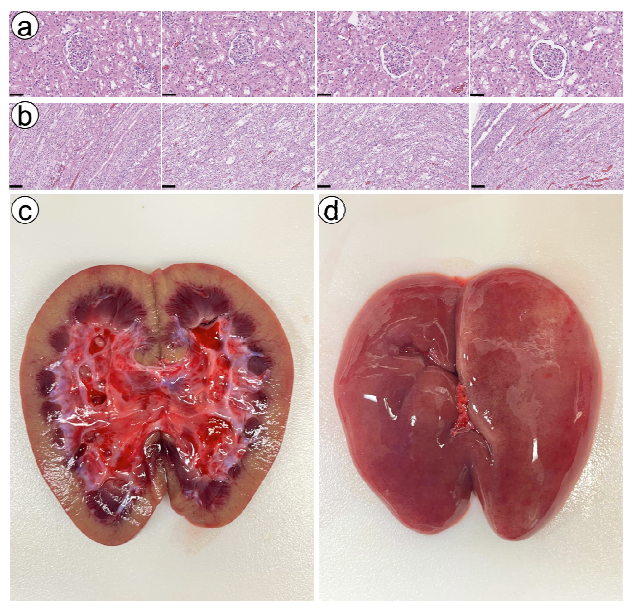
A new preprint reports functional recovery of human-scale pig kidneys after vitrification and storage at −150°C for up to a year.
The kidneys showed vascular, metabolic and excretory function, and produced urine after transplantation.
Huge progress towards making organ banking (and ultimately human biostasis) a reality! 🚀
functional recovery of vitrified and nanowarmed human-scale pig kidneys from up to one year at -150 °C
it is increasingly clear that cryopreservation is the single best shot we have at defeating death in our lifetimes
https://t.co/4Z9e863HFQ
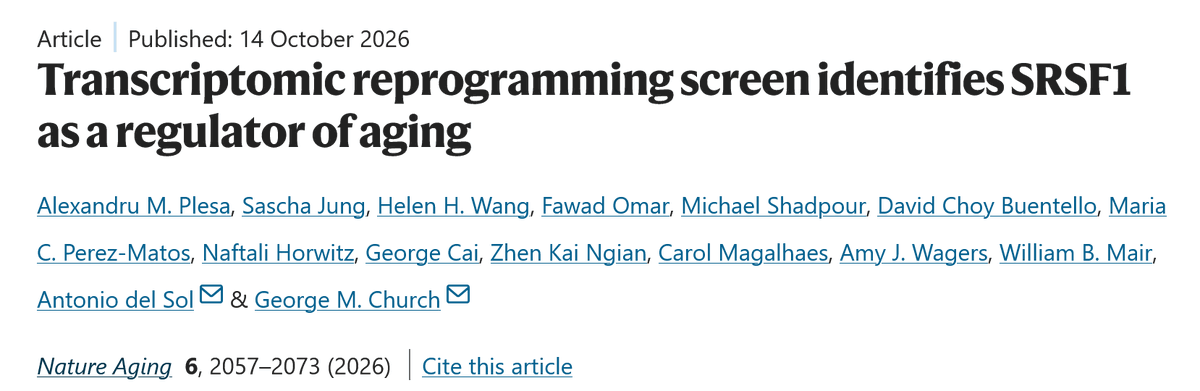
A promising new rejuvenation factor discovered by @geochurch et al. 🚀
Using a transcriptomic screen they found SRSF1, an RNA-processing and splicing factor that restores youthful profiles in cells.
In a small mouse study, activating SRSF1 extended median lifespan by 14%.
https://t.co/czgoRc9gMQ
Should aging research focus on lifespan or healthspan? What is the ultimate goal of the field?
Delighted that our paper, led by David Gems, is finally out @GeroScienceAGE !
We argue that extending healthspan rather than lifespan is a misguided cliché.
https://t.co/FuRGjNCg2K
Cryopreservation - aka cheating death - remains one of my favorite topics. I find it odd and wonderful to think about.
The field has suffered for decades from bad science and bad press. But there are now folks trying to add real rigor to the science and business behind it.
We spent 90 minutes with @emilkendziorra who runs @tomorrowbio and went deep on how they preserve bodies and the implications of this technology.
Get the Core Memory podcast wherever you pod.
Timestamps
00:00:00 Intro
00:05:08 Cryonics Without the Ice
00:08:45 Heads in a Russian Shed
00:12:26 Longevity's Backup Plan
00:19:39 The First Hours After Death
00:30:11 Funding a Second Life
00:37:15 Does Cryonics Actually Work?
00:43:40 Preserving Brains Without Bodies
00:50:52 Why Not Reverse Aging?
00:55:21 Can the Company Outlive You?
01:03:37 Waking Up Centuries Later
01:08:28 The Problem of Rewarming
01:15:14 Selling Hope Without Overselling Science
01:19:40 Would Longer Lives Be Better?
01:23:42 Elective Cryonics and Family Life
this is (to our knowledge) the largest cryo chemical campaign ever run!
we’ve physically screened over 7,000 new chemical entities, most of which were not previously associated with cryopreservation
last quarter, we did 2,943 formulation runs for biocompatibility, across a diverse panel of cell types
Come build the future with us 🙂
No, we're not on the brink of ending aging. More clickbait, even from prestigious scientific magazines that should know better.
Why not? A short 🧵
1) The strongest lifespan-extending intervention in mice is caloric restriction, discovered nearly a century ago. So even in animals we haven't truly made much progress on how to slow (much less reverse) aging.
2) Our understanding of the aging process and its cellular and molecular drivers is still poor - which helps explain 1).
3) There is no proven intervention that retards human aging itself.
Cellular reprogramming is an exciting technology with many companies* and labs now working on it. It may have important clinical applications, including the current clinical trial for glaucoma - fingers crossed!
But while reprogramming allows cells to be rejuvenated in vitro, we don't yet understand whether or how it can be used safely and effectively in whole organisms.
And rejuvenating cells isn't the same as rejuvenating an organism. Remember that an immortal cell is a cancer cell, so rejuvenating a cell may or may not be beneficial in an organism made of many different types of cells. We know from mouse experiments that reprogramming can induce cancer, so it needs to be carefully controlled and tailored to the tissue and context.
*Disclosure: I'm CSO of YouthBio, a company developing rejuvenation gene therapies based on cellular reprogramming.