One last point that I don't make often enough:
We carefully and intentionally designed XRPL so that we could not control it. It's not because we weren't 100% confident we were the very smartest and very best people who could always make the very best decisions. We were confident we were and that we could. We did not lack ego.
But what we also knew was that given the regulatory environment and practical realities of being a company and having investors, there was simply no way we could be assured that we were in control over our own actions.
Ripple, for example, has to honor US court orders. It cannot say no. I think US courts are great and generally issue orders that make sense for good reasons. But could a US court decide that international comity with an oppressive was more important than XRPL or Ripple? We were quite concerned that could come down either way.
We absolutely and clearly decided that we DID NOT WANT control and that it would be to our own benefit to not have that control.
We always want people to trust us. People trusting me is all upside for me. I want as much of that as possible. So does Ripple. But people *having* to trust me or Ripple or anyone else to use XRPL is all downside for us. We knew very early that we wanted as little of that as possible.
We designed it so that we could not own or control it because that was the only way to ensure that nobody could own or control it.
And think about it. Say Ripple could censor transactions or double spend. If we ever did that, all trust in XRPL would be destroyed. It would never make sense for anyone to use that power. And the best way to be able to say "no" is to have to say "no" because you cannot do the thing asked.
Our entire objective in designing the consensus model was to limit its power, for selfish reasons at least as much as noble ones. And the design reflects those objectives.
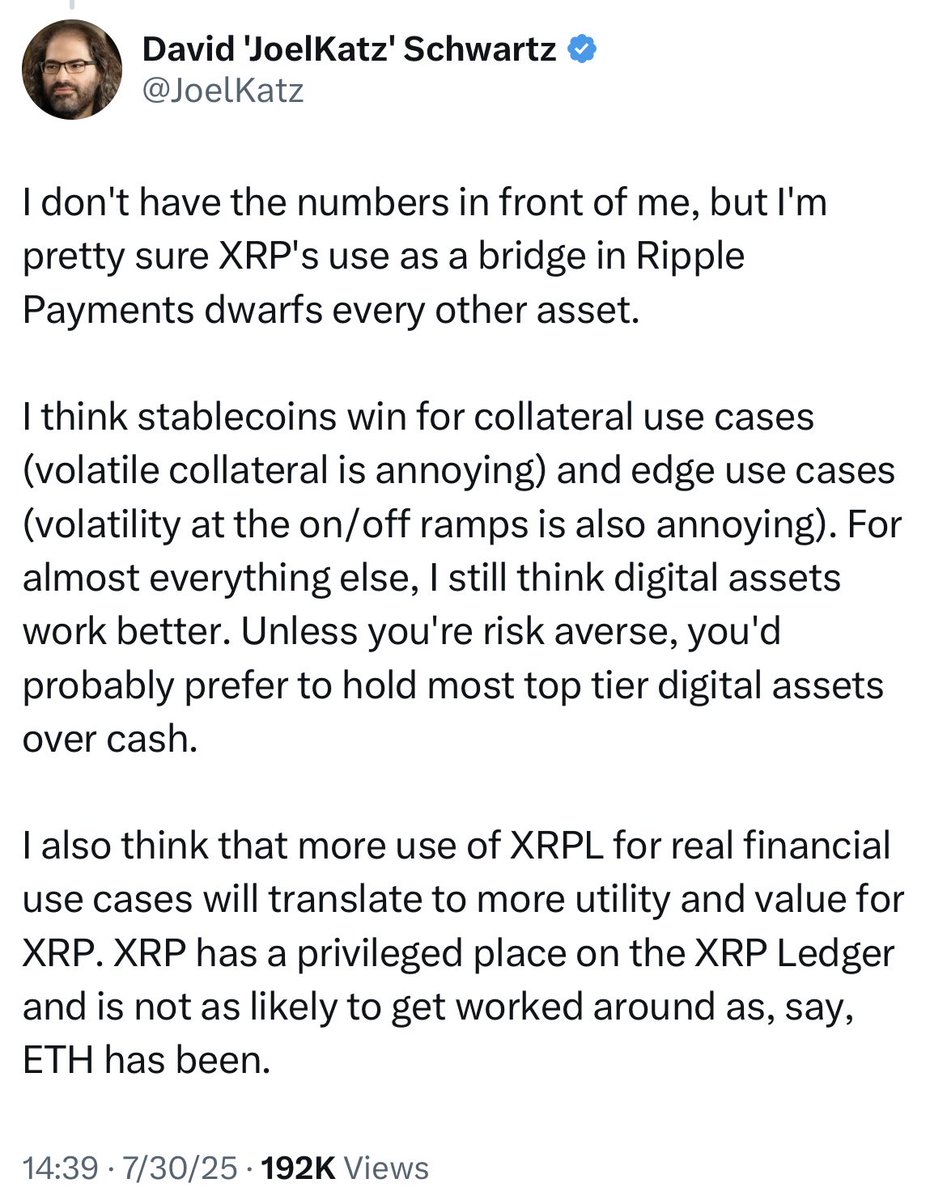
It doesn’t matter whether or not “they use XRP or stablecoins”…
All that matters is usage of the XRPL… everything else will take care of itself because of the ledger’s design.
David gave it all away here:
What the XRP Ledger can do that your chain likely can't. 👇
▪️ Cross-currency payments that are fully atomic across many (more than 1) paths.
▪️ Deterministic settlement finality for transactions when included in a validated ledger.
▪️ Native CLOB-based DEX on Layer-1.
▪️ Native AMM (better than UniswapV2) on Layer-1.
▪️ CLOB and AMM working in conjunction.
▪️ Exchanging one token for another to automatically use XRP to bridge the tokens for greater price efficiency (auto-bridging).
▪️ Scalability via Layer-1 payment channels.
▪️ No artificial financial incentives to solve the double-spend problem.
▪️ The ability to avoid having your account spammed with coins or tokens you don't want to hold.
▪️ Tokenization without Smart Contracts.
What the XRPL still misses but will get in the years to come. 👇
▪️ Granular Control and Customization via permissioned features and extensions.
▪️ Smart contracts for solving complex compliance requirements and DeFi composability.
▪️ Confidentiality with simultaneous auditability via ZKP and encryption.
a few hours ago a drug addict stole a bottle of water from me.
came up from behind and grabbed it out of my hand.
i was shocked.
but i’ve reflected on the experience.
and it actually kicked off a great train of thought.
that’s made me more bullish than ever for crypto.
because things like this are happening more and more.
to normal people like me.
people getting robbed.
stores getting shoplifted.
and what we’re all realising is that the powers that be won’t protect us.
we don’t know who’s in our borders.
criminals don’t get prosecuted.
they’re even starting to come into our homes.
a girl i know woke up with a homeless guy literally staring at her in her own bedroom.
he’d broken into her house share.
this wasn’t in some village.
this was in san francisco.
crazy.
and what doesn’t get stolen from us through force.
is being stolen silently through inflation.
the hidden tax.
we all feel it.
everything is more expensive.
literally everything.
but there’s hope.
and it’s crypto.
crypto gives us our rights back.
it enshrines what is rightfully ours in code.
in the future i think we will live in our own sovereign communities.
governed by our own rules.
codified on the blockchain.
we will pay in crypto.
if we find criminals we will just kick them out.
if they come through our borders without our permission.
they will be expelled immediately.
this is my prophesy.
somewhere along the way we in crypto got distracted by memecoins and gambling.
we forgot why it was created in the first place.
remember how the big banks failed in 2008?
remember how we the ordinary people bailed them out?
crypto was made to solve this.
crypto was created to serve a much higher purpose than many people remember.
ever tried withdrawing cash from your bank account?
they’ll try to stop you.
unbelievable.
it’s YOUR MONEY!
money is how they control us.
it’s how they enrich themselves at our expense.
to be free.
we must own our own money.
until we do this.
we will never truly be free.
Ripple is living Caitlin Long’s nightmare.
While she's been begging for a Fed Master Account since 2020, Ripple is now gliding toward one with institutional support, real regulatory momentum, and a stablecoin to match.
All that time spent lobbying, suing, and talking about "fair access" and now Ripple walks in with the infrastructure and partners the Fed actually wants.
This isn’t personal.
It’s just what happens when you build real pipes instead of preaching from the sidelines.
The system isn’t fair. It’s not supposed to be. It rewards winners.
And right now, Ripple’s winning.
Ripple is dropping our cross appeal, and the SEC is expected to drop their appeal, as they’ve previously said. We’re closing this chapter once and for all, and focusing on what’s most important – building the Internet of Value. Lock in.