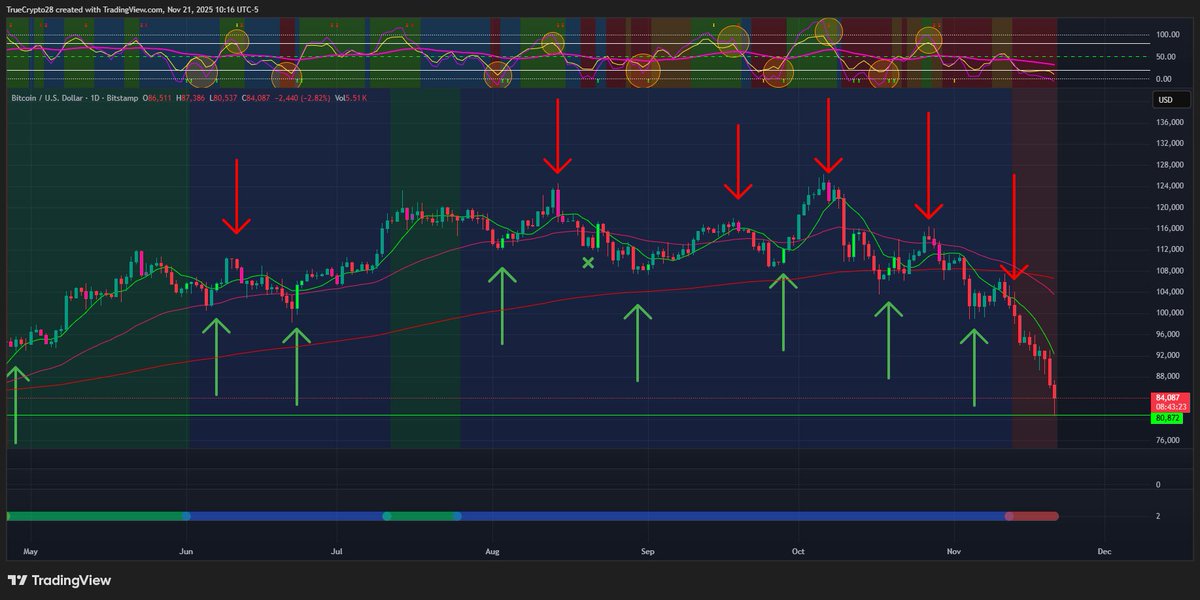
Back in 2022, I made a video calling the Bitcoin bottom using Wyckoff accumulation.
This one is different.
I’m not saying “the bottom is in.”
I’m asking the question that actually matters right now
Is this accumulation, or is this redistribution?
The redistribution story is easy.
Lose the lows, fail the reclaims, start living below value, and the market is probably searching lower. That part is simple.
So in this video, I spend more time on the harder question:
What would this need to look like if it was accumulation?
Because BTC is sitting right back near the same area that created the February stopping action.
The chart is ugly. The regime is still bearish. There is a lot of repair work to do.
But support usually looks ugly when you’re sitting on it.
I walk through the Wyckoff case, the value area, the key reclaim levels, and what bulls actually need to prove from here.
Holding the low keeps the accumulation idea alive.
Reclaiming value gives it teeth.
Losing the range changes the conversation fast.
Enjoy!
https://t.co/en6Kee7FtK
@samuraipips358 Yes, a few that I missed by an hr or so looked good but as of right now I dont have a tested “what if “ so I will just treat as missed. Thank you
@samuraipips358 Question, eg 4hr tf signal comes in, but u miss it by 1hr. Do u have a rule to enter somehow or is it just a missed trade, wait for the next one? Thanks
@s_guilbeault You took the easy way out. As a country we are at a crossroads, we have done the easy thing for the last 50 years and Trump is calling our bluff. We have all sorts of world class resources that the world needs, every project needs to happen now and you could have been there.
Honestly, this is one of the best compliments you could give. It’s like being in the gym and someone asks if you’re on steroids; you know you’re just working hard, but the results make them wonder.
No, it didn’t perfectly time every top and bottom. It’s not designed to be perfect; it’s designed to give phase-recognition EDGE. And as you can clearly see… it does.
But I appreciate the compliment.
And yes, I will be making this available soon. That wasn’t the original plan. My entire goal has been to teach traders that there’s a hole in their game and guide them toward fixing it themselves.
The demand has been overwhelming, though, so I’ll share the tools.
Just letting the Thanksgiving holiday pass, I'll need to be available to teach a bit. Check out the videos until then.
(If interested, say so below, and I will circle back to you after the holiday)
Here’s the full video on how recognizing market phases gives you a real edge, not theory. You'll see the proof for yourself!
Watch it once, and you’ll never look at market structure the same way again.
https://t.co/MkwNvRMrUo
The Impatience Epidemic in Crypto
It’s wild right now. Everyone’s frustrated, convinced the market “owes” them something.
But if you’re feeling that way, it’s not the market that’s broken. It’s your perspective.
The impatient chase noise. The patient study structure.
Markets don’t reward emotion; they reward endurance. And when volatility clears, it’s never the loudest who win, it’s the longest.
I might record a video later breaking down how to master patience in markets (and in life).
Like and retweet if you want me to drop it.
Last Friday delivered one of the worst altcoin wipeouts in crypto history, and the post-mortem of it has been a whisper.
When LUNA blew up, it owned the news. When FTX collapsed, it ruled the cycle. When we had our COVID crash, Crypto Twitter couldn’t stop talking about how we almost went to zero and what saved us.
But this time, a week later, there’s near silence. Instead, we’re told it was just a tweet. That’s not serious analysis. Yes, late Friday, Trump dropped a trade-war headline after U.S. markets closed: 100% tariffs on China and new export controls. That was the spark.
But a single tweet doesn’t send alts down 70% in minutes or vaporize entire portfolios within an hour.
The violence came from structure, from a breakdown deep in crypto’s plumbing.
During the flush, Ethena’s synthetic dollar, USDe (ticker USDe), printed as low as $0.65 on Binance while holding near $1 on other venues. This wasn’t a global depeg. It appears to have been a Binance-local pricing failure, an oracle and order-book divergence that instantly slashed collateral values for users on Binance’s unified margin system.
When your collateral is repriced that far down on a single venue, everything built on it collapses.
On Binance’s unified / cross-margin system, traders can post multiple assets, including USDe and wrapped tokens, as collateral across all their open positions.
When Binance’s feed suddenly marks USDe at $0.65 instead of $1.00, the user’s collateral value shrinks, maintenance ratios blow up, and the liquidation engine begins selling their other assets, often high-beta alts, into an already collapsing market.
Those forced sells push prices lower, triggering more liquidations across the exchange and, through arbitrage, across the entire crypto market.
Example:
Imagine a trader with $200,000 total equity.
$50,000 in USDe collateral
$150,000 in long altcoin positions
Binance marks USDe at $0.65, so that $50,000 becomes $32,500; In this case, $17,500 in margin cushion vanishes instantly.
The system detects the shortfall and auto-liquidates part of the alt positions to rebalance. Those sells slam into thin order books, driving alt prices down another 20–30% almost instantly.
Now the trader’s remaining alts, which weren’t yet liquidated, are worth even less, cutting collateral ratios further and triggering the next round of liquidations.
Each liquidation dump pushes prices down for everyone else using the same assets as collateral, igniting a chain reaction. By the time the loop finishes, hundreds of millions in positions are forcibly sold, and the cascade becomes self-fueling, a liquidation spiral that consumes everything in its path.
What started as a local pricing glitch becomes a global liquidity collapse.
Arthur Hayes @CryptoHayes summed it up perfectly: “USDe didn’t depeg. Binance did.”
The Ethena protocol remained solvent and over-collateralized. The problem was the venue’s internal feeds and book structure under stress.
When an exchange values collateral based on its own shallow order book instead of a broad market reference, small cracks become sinkholes.
This doesn’t absolve Ethena, any asset printing 35% below peg, even locally, shows fragility. But this wasn’t another LUNA.
It was a mechanical failure, a venue-specific collateral mispricing colliding with excessive leverage and opaque cross-margin rules. The result was one of the largest liquidation waves in crypto history, nearly $19 billion in forced unwinds within 24 hours.
That doesn’t happen from headlines. It occurs when margin engines and oracles fail under stress.
Binance has since promised to compensate affected users and rework how wrapped and synthetic assets are priced. That alone is an admission something broke. And yet, this event has been largely swept under the rug thus far.
We’ve seen bigger macro shocks before: Liberation Day, COVID, and even FTX contagion, yet none triggered alts to implode 70–99% in an hour.
This wasn’t fear. It was faulty design.
One venue’s pricing feed dislocated, collateral collapsed, and liquidation engines spread that contagion everywhere. The industry’s core issue is now undeniable: Too many opaque, venue-specific risk systems govern leverage, collateral, and liquidation.
When one breaks, the entire system pays for it. Design flaws, not tweets, keep blowing up the market.
If this reconstruction is wrong, then @binance and @cz_binance should publish the data:
Which feeds broke and when?
Which collateral assets were hair-cut, and how many users were liquidated? How is the compensation being calculated?
And @ethena should release a venue-by-venue chart showing USDe pricing, redemptions, and hedging during the event, to prove solvency and pinpoint where the break occurred.
Roughly $19 billion didn’t vanish into thin air. People were liquidated, portfolios erased, and careers ended because the pipes broke. If this wasn’t the cause, prove it. If it was, fix it.
Because headlines aren’t destroying crypto, it’s being destroyed by its own infrastructure.
This can’t be another story buried under “macro fear.” The silence is the loudest signal of all.
Systems failed. Users paid the price. And the industry owes them an explanation.
If we don’t fix the plumbing now, the following “tweet” could light the same fuse, and eventually, there might not be much left to save.
Because if a tweet can burn $19 billion, it’s not the tweet that’s the problem; it’s the system.
Turn noise into levels of interest—clean, anchored—with this FREE indicator.
This is Part 1 of 2: My Imbalance (Fair Value Gap) script, tuned to how I trade. The OB/Breaker indicator will follow.
The page includes a clear write-up (and there’s plenty of FVG content and videos online).
Grab it here (free): https://t.co/x228masbul
Retweet for others. Enjoy!
FREE Indicator Release #2: my Order Block / Breaker tool.
It maps classic Supply & Demand (Rally-Base-Rally / Drop-Base-Drop) a.k.a. OBs & BBs.
There are many versions around, I’m sharing the one that fits my style.
Lots of videos exist; just don’t fall into teh trap of paralysis by overanalysis. Treat these as levels of interest and integrate them into your process.
👉 BB/OB (Clean v6): https://t.co/KE1LaQPCIk
Retweet and share with others. Enjoy!