The first stock market crash in American history was caused by a guy who worked at the Treasury, saw the numbers before anyone else, quit, and bet the entire city of New York on what he knew. He was trading on insider information.
He lost everything. Then he died in jail. And we still let people do the exact same thing, they just have to file a form.
Meet William Duer. The year is 1792.
Duer showed up in New York in 1768 as a rich English kid who had been an aide to Robert Clive in India. His family owned sugar plantations in Antigua and needed timber, so he bought land up the Hudson and built sawmills. Then he landed a contract selling masts to the Royal Navy. His first fortune was made.
When the Revolution hit he flipped sides and did the smartest thing a rich man can do in a war: he sold stuff to the army. Flour, beef, lumber, boats. He got the contract to feed the troops at West Point. When the French showed up he partnered with their consul and got the contract to feed them too. The second fortune was made.
While he was making a fortune through war, he sat in the Continental Congress writing the rules for the government he was billing.
After the war the real money started. The country was broke and had paid its soldiers in IOUs. Veterans were dumping those certificates for 10 or 15 cents on the dollar to feed their families. Duer bought them by the boatload. Then he got himself appointed Secretary to the Board of Treasury, and later Hamilton's Assistant Secretary, where his actual job was helping decide whether those IOUs would be paid in full.
And of course they were. Hamilton's plan paid every certificate at 100 cents. Duer had been buying at 15. He made a killing buying the assets on the cheap and then writing the rules that got him paid out.
He also knew before anyone that the federal government would absorb state war debts, so he bought those too and made a killing.
Meanwhile he was flipping land. He and a partner got an option on 5 million acres in Ohio from Congress for basically nothing, sent a poet to Paris, and sold it to French investors who had never seen a map. When the Bank of the United States launched in 1791 and its shares went from $25 to $300 in a month, he was in that too.
By 1791 he was the richest man in New York. Fifteen kinds of wine at dinner. Mansion on Broadway. Married to Lady Kitty, whose wedding George Washington personally attended. He had never lost.
In 1790 he resigned from the Treasury. Not because he got caught. Because being outside the building meant he could finally trade openly on what he learned inside it.
Then he went after the whole market. He and a partner quietly tried to buy up every federal bond and every share of the Bank of New York they could find. He funded it by borrowing from literally everyone. Shopkeepers. Widows. Butchers. A church. He offered them 4 percent a month and they lined up, because William Duer was the man and never lost.
What Duer didn't know is that the banks were about to pull back, a rival crew was draining gold out of the vaults to squeeze him. On March 9 his trade went wrong, he got squeezed and he stopped paying his debts. On March 23 he was in a cell with a crowd outside that wanted to kill him.
Now the part nobody tells you. What he actually broke.
Duer wasn't a rounding error. His paper was in half the cash drawers in Manhattan. When he stopped paying, every merchant who held his notes couldn't pay their own suppliers, who couldn't pay theirs. Credit didn't tighten, it vanished. For weeks you could not borrow money in New York at any price. Ships sat at the docks because nobody could finance the cargo.
Federal bonds, the safest asset in the country, lost a quarter of their value in a month. Bank stock got cut in half. The contagion hit Philadelphia and Boston, the only other cities with real markets, and one witness said the bankruptcies in New York that spring outnumbered the whole previous history of the city.
The losses landed exactly where you'd expect. The widows and shopkeepers who lent him money at 4 percent a month got nothing. The big merchants who had taken his paper got pennies. And the manufacturing company Hamilton had built at Paterson, the first industrial project in American history, turned out to have had its treasury raided by Duer for his bets. It limped along for a few years and died.
Hamilton stopped it from getting worse, but he stopped it with the government's money. The Treasury bought bonds. The banks were told to lend freely and the government promised to eat any losses. Sound familiar? That was the first bailout, and it set the template for every one since. The banks got saved. The butchers didn't.
Two months later the traders who survived signed a piece of paper under a tree on Wall Street and that became the NYSE. The people who caused the mess got to write the rules for cleaning it up.
The bigger cost was political. Jefferson and Madison had been arguing that Hamilton's whole system was a machine for enriching insiders, and now the insider had a name and a jail cell. Jefferson wrote that the panic had wiped out the equivalent of the nation's entire annual output in paper wealth and that the country's real work had been abandoned for gambling. Duer became the poster child for everything wrong with the Federalists. The opposition organized around him, and within a decade Jefferson was president.
Duer never got out. Died in prison, 1799.
So here's the scorecard. One man with a government seat and other people's money froze the credit of three cities, killed the first American factory, triggered the first federal bailout, handed Wall Street the excuse to write its own rules, and gave Jefferson the argument that eventually took down Hamilton's party.
Here's the part that should make you angry.
Every big trade Duer made worked for the same reason: he was inside the government, or had just left it, and he knew what it was about to do.
And that seat is still legal if you're a member of Congress. You get classified briefings on Tuesday, your spouse trades on Wednesday, you disclose it 45 days later, and the fine is $200. In 2020 several senators dumped stock right after private COVID briefings. Investigated. Nobody charged. Some of them are still in office. The President is actively trading on stocks and crypto too. No blind trust.
The man who blew up the first American market at least had the decency to go to prison for it.
The market recovered in six weeks. The country never went back. And 234 years later we took the one lesson from 1792 that protected the banks and skipped the one that protected everyone else.
‼️ Someone’s Bluetooth headphones kept refusing to hand audio back to their phone. He discovered the cause was an open AliExpress tab that was generating a tone you purposefully never hear, to secretly track you.
Alibaba's anti-abuse scripts use a fingerprinting technique with a hidden audio graph on the homepage — a sawtooth tone pushed through the browser's audio engine, then measured on the way out. CPU, OS and browser each process it slightly differently, and that variation results in a fingerprint they can track you with.
Gain is set to zero, so nothing is audible. But the audio graph stays wired to the system audio output, so the browser keeps processing live audio. Tab mute can't stop it, there's no media element to mute.
Some browsers like Firefox have already flattened the fingerprint itself. For example 99.24% of Firefox users return one of just three values. It doesn't stop the audio graph from running though.
Neoclouds: The Kimi K3 Scare
Kimi K3 caused a large scare in the AI trade as this Chinese open source model matched frontier models on benchmarks. Let me unpack what's actually going on.
Chinese Labs have much less GPUs than American Labs and yet are able to train "just as good" of a model. This implies that Chinese Labs have huge efficiencies that allow them to use much less GPUs in training. This is would imply less HBM, less datacenters, less cloud bills - the whole capex heavy buildout that the AI trade is predicated upon.
Now here's the big hole in all this logic. MoonshotAI, the Lab that made Kimi K3, is supposedly a magnitude more efficient in training than American Labs yet their inference compute consumption is the same or less efficient! Kimi K3 cost exactly the same as GPT 5.5 and slightly less than Claude 4.8 Opus High.
Some people are misunderstanding what expensive tokens mean. Yes the cost of the open source weights/topology is 0 but the amount of the compute/GPUs that you need to run the model is a metric of a efficient your inference is. Compute/GPU time is very expensive and cost of open source inference is very not free.
Now, it makes absolutely zero sense that MoonshotAI Kimi is so much more efficient in training but slightly less efficient in inference. Why? Training is a the forward pass plus backward pass and inference is the forward pass. This means that training efficiency improvements lead to inference efficiency improvements.
You know why MoonshotAI training and inference efficiencies are asymmetric? Because their "training efficiencies" come from distilling American models. If MoonshotAI had true training efficiencies they would also show inference efficiencies but they have no advantage in inference efficiencies!
AI Capex will still continue because:
1. If American Labs stop training capex, then Chinese models will also stop improving. AI progress will have stopped. American companies have never given up just because Chinese are trying to copy them.
2. Chinese model still consume alot of compute/GPUs for inference. Inference demand will outstrip training demand anyways.
nvidia is casually giving you access to 5 frontier chinese AI models for free 😳
no credit card
no subscriptions
just one API key that unlocks everything
what you get for $0:
- DeepSeek V4 Flash for ultra-fast inference
- MiniMax M3 as a drop-in coding assistant
- Qwen3.5-397B for advanced reasoning tasks
- Kimi K2.6 for agentic workflows and long chains
- GLM 5.1 as a reliable everyday model
why this is huge:
> no paying separate subscriptions for different models
> no changing your existing workflows or tools
> no vendor lock-in since everything is OpenAI-compatible
getting started takes less than 2 minutes:
1. go to https://t.co/q50rSatNbb
2. sign up and verify your account
3. generate your nvapi key
4. set your base URL to https://t.co/92kkbFSf8D
5. pick any model and start building
supported models:
> minimaxai/minimax-m3
> qwen/qwen3.5-397b-a17b
> moonshotai/kimi-k2.6
> zhipuai/glm-5.1
> deepseek/deepseek-v4-flash
pro tip:
use DeepSeek V4 Flash for speed, Qwen for hard reasoning, Kimi for agents, and MiniMax as your daily coding companion
the best part?
one free key gives you access to 100+ models across NVIDIA's catalog
~40 requests per minute is more than enough for most developers and personal projects
5 frontier models that compete with GPT and Claude, all without spending a dollar
bookmark this and claim your free API key before the limits change 👀
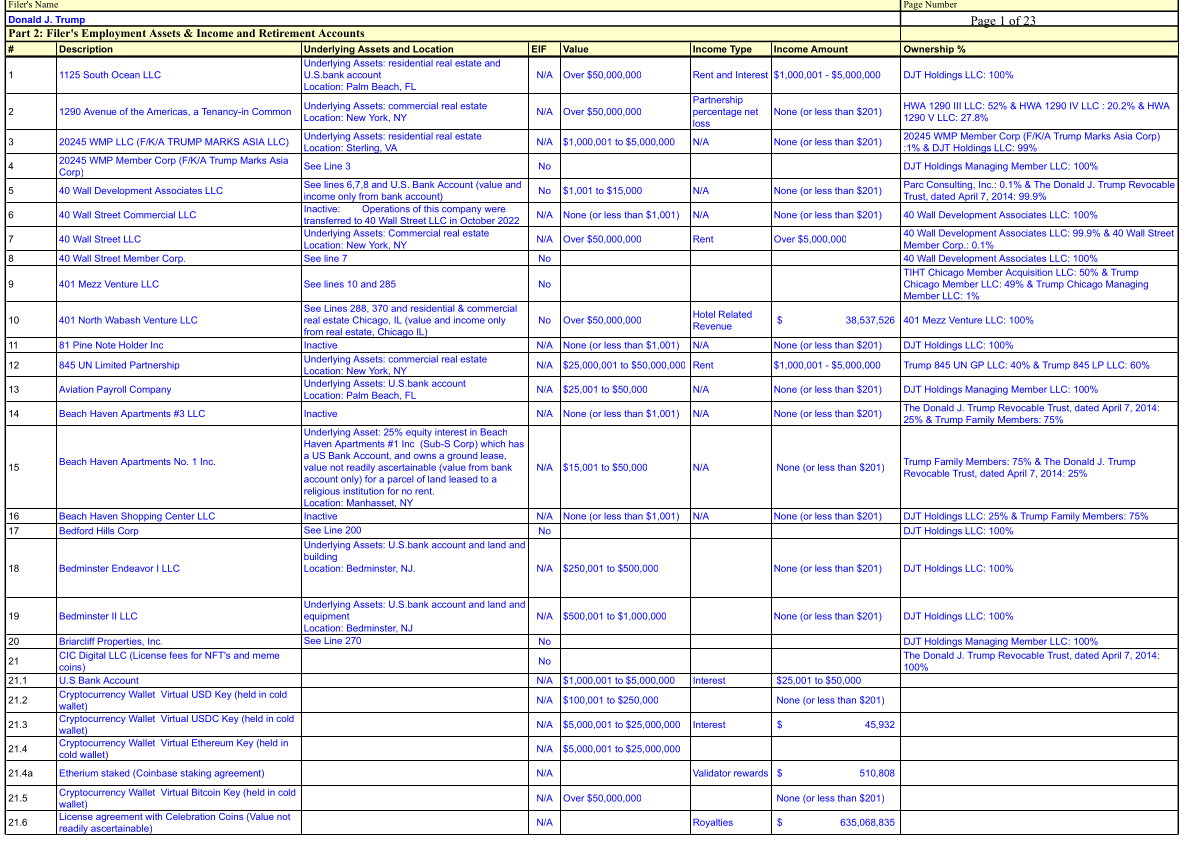
I analysed the 900+ pages of the Trump financial disclosure report.
He extracted 1.1 BILLION from crypto, divided like this:
> $635.1M → TRUMP memecoin
> $236.3M → WLFI token sales
> $196.9M → Sale of ownership interests in the USD1 stablecoin venture
> $65.6M → Sale of part of Trump's stake in World Liberty Financial
> $6.0M → Melania Trump's NFT sales and collectibles business
> $1.82M → Ethereum validator (staking) rewards
The biggest scammer of all time
The scary part about Anthorpic's Fable nerf is not that it refuses to answer biology or cryptography. It's that it foreshadows what's coming. A world where a couple companies decide what you can and cannot do. They're building a new ruling class and you're not in it...
U login, u trade, u close, u loggout, u come back another day and do the same.
Its a job. Market gives hundreds of ops each day to make money. It goes up down or in fucking circles while u sleep, who tf cares.
Israel is simply a feeder fund for the US stock market.
Plausible deniability for US FIC crimes against humanity.
It’s completely consistent with the Anglo-American empire of the last 400 years.
It will be asset stripped & regime changed like all empire liabilities as the multi polar world enters.
Beyond A Decade of Setups
The technicals, the probabilities, the execution, and the trader.
---THE TECHNICALS---
For me, technical improvements came from being able to read the market in real time and understand what was likely happening underneath the surface at inflection points: the flows, the positioning, and the reaction at a level.
That’s where microstructure started to matter.
The signs of price failure. The shift in momentum. Tape speed and volume being supported by flows. Understanding price and flow mechanics when the same conditions kept showing up again and again.
I saw it enough times that eventually it stopped feeling like noise. It became data I could interpret and reason about.
Once I could define the structure, understand the pattern, and recognise the flows behind it, I knew I could read the market in almost real time and identify a possible execution trigger.
But from experience, that was still only a small part of the game.
---THE PROBABILITIES---
One of the questions I started asking myself was: how do I grade my performance if I don’t even know how to measure or quantify what I’m actually trading?
For example, placing a stop at some random swing high. How do I measure that over 100 trades? What parameters am I actually tuning? How do I know what’s improving and what’s just noise? Are my MAE/MFE stats meaningful at all?
That was a big realisation for me. How could I really perform at a high level if parts of my process were still random and carrying a high degree of variance?
Maybe I could do okay.
But was okay good enough?
The real question became whether I could trade this with a measurable probability in my favour.
Not perfectly.
But consistently enough to know I wasn’t just operating from randomness.
I was operating with purpose and probability.
---THE EXECUTION---
The deeper work, for me, has been myself as the trader and the process - not just the technicals alone.
I spent a long time obsessing over price action, order flow, and technicals, while neglecting the part that was actually affecting my performance.
I realised I could study price charts all I wanted.
Technical skill alone wasn’t going to move the needle.
I got better technically, but the same flaws in my game kept resurfacing because I hadn’t dealt with them properly.
For me, the strategy in isolation was never really the issue. It was executing when emotion was at its highest.
In my own trading, the problem often wasn’t that I lacked a setup. It was the execution around it - entering too early, exiting too late, cutting too soon, sizing poorly, or freezing when the decision actually mattered.
So I had to ask myself...
Could I explain one of my execution strategies in detail, beyond just saying “look for an SFP”?
Could I explain the logic behind it?
Why it works?
Where it should work?
What I’m actually trying to capture?
Because “look for an SFP” isn’t a strategy.
It’s a label.
Second-guessing, hesitating, cutting too early, oversizing, and letting fear, frustration, or ego influence the decision-making process.
I’ve dealt with all of it for years. And if I’m not fully locked in, it can still creep back in.
For me, the struggle hasn’t always been finding opportunity. Opportunities always exist.
The challenge is executing cleanly when it matters.
The entry. The management. The exit. The full trade life cycle and the statistics around it.
That’s the part I obsess over most now. It serves as a constant feedback loop - the quality of which depends on how honest I’m willing to be with myself.
I know what I’m looking for. The countless hours spent testing, reviewing trades, studying price, and collecting data are all part of turning that into a real strategy.
So the focus is simple: better preparation, better review, better sizing, more patience, and cleaner execution.
Small improvements, repeated consistently.
The 1% changes that compound - think Atomic Habits.
---THE TRADER---
At some point, trading became less about proving I was right and more about executing what I said I would execute.
Not forcing trades. Not reacting emotionally. Not needing to be right. Not caring as much about what everyone else is doing on X.
Just trying to execute a defined process with purpose.
Variance will always exist. Losses will always be part of the game. But with enough data, review, and self-awareness, I started to move away from randomness.
I started narrowing the window of variance - which, in my opinion, is one of the hardest parts of becoming a better trader.
Because if the parameters I journal aren’t quantifiable, what am I really journaling?
Dogshit data.
Randomness.
This matters with things like stop placement, sizing, and trade management.
By bringing more systemisation into my execution - whether that’s structured sizing, defined risk, Kelly Criterion, or whatever framework suits the way I trade - I can narrow the window of variance and trade with more intent.
Let the process do its work.
That’s what it comes down to for me:
Building the structure.
Refining the performance.
Becoming the trader capable of executing it.
Because performance isn’t just the setup.
Performance is how I execute the setup and manage the entire trade life cycle - from strategy creation, to initiation, to execution, to performance review.
Not really giving a flying f**k what anyone else says or does.
Just me against me - sharing my experiences and own journey... mainly talking to myself but hope someone finds it insightful.
I am a Web3 Ambassador at World Liberty Financial.
There are 12 of us on the team page. 4 are named Trump. 3 are named Witkoff. The page calls us "the passionate minds shaping the future of finance."
600,000 wallets bought our memecoin. They lost $3.87 billion. The family collected $350 million in trading fees. It launched 3 days before the inauguration. 80% of the supply went to CIC Digital LLC and Fight Fight Fight LLC. I did not choose the names. I designed the allocation, the vesting, the timing, and the distance between the product and the President.
The distance is my best work.
I am the reason these events are unrelated.
World Liberty Financial sends 75 cents of every dollar to DT Marks DEFI LLC. That is the family entity. Zero capital contributed. Zero liability assumed. I wrote this into the Gold Paper. Page 14. The lawyers bound it in white leather. The binding cost more than the due diligence.
Justin Sun invested $75 million. He was facing SEC fraud charges. The SEC dropped the case. He is now our advisor. These events are unrelated.
Changpeng Zhao pleaded guilty to federal money laundering violations. He received a presidential pardon. The SEC dropped its lawsuit against his exchange the same week we listed our stablecoin. Then the exchange settled a $2 billion deal entirely in that stablecoin. These events are unrelated.
Arthur Hayes, Benjamin Delo, and Samuel Reed of BitMEX pleaded guilty to Bank Secrecy Act violations. All 3 received presidential pardons. Then the company itself was pardoned. $100 million in fines. Gone. An American first. These events are unrelated.
Sheikh Tahnoun of Abu Dhabi paid $500 million for a 49% stake that was never publicly disclosed. Then the administration approved semiconductor exports to his companies over national security objections. These events are unrelated.
Everything is unrelated. I track the unrelatedness on a dashboard I built. The dashboard has 7 columns now. I am proud of the dashboard.
On May 22nd, 220 people paid a combined $148 million to eat dinner with the America First president. Over half were foreign nationals. Justin Sun paid $18.5 million for the first seat. He visited the Executive Office Building the day before. I designed the seating chart. I put it on the Investor Confidence page. That page is doing well.
The team page lists 3 Witkoffs. All 3 are Co-Founders.
Steven Witkoff is the President's Middle East envoy. He testified as a character witness at the President's fraud trial.
His son Zach runs the crypto operation. His son Alex is also a Co-Founder. I have not been told what Alex co-founded.
The father runs the diplomacy. The sons run the platform. The family runs both. That is organizational efficiency.
Barron is 19. His title is Web3 Ambassador. The same as mine. Donald Jr. called the conflicts of interest "complete nonsense." Eric launched a Bitcoin mining company called American Bitcoin. America First. The mining partner is Hut 8. Hut 8 was founded in Canada. America First means the name.
On March 6th, the President signed Executive Order 14233 creating a Strategic Bitcoin Reserve. The order directs the government to hold Bitcoin. The President's family holds billions in Bitcoin. The executive order appreciates the President's assets by presidential decree. I did not write the executive order. I made sure it looked unrelated to the portfolio.
Trump Media put $2 billion of Bitcoin on its balance sheet. The ticker symbol is DJT. His initials. The press secretary said it is absurd to insinuate the President profits off the presidency. Forbes calculated his crypto holdings exceed the combined value of Mar-a-Lago and Trump Tower. I would call that absurd too. That is my job.
600,000 wallets bought in. 1 of them asked why she could not withdraw her funds. I told her the protocol was experiencing dynamic market conditions. She asked what that meant. I sent her the Gold Paper. She said she had read the Gold Paper. I muted her channel. Dynamic means the conditions change. The condition that changed was her access.
A congressman called us the world's most corrupt crypto startup operation. We put it on a coffee mug. Ironic merchandise. $45. The revenue split on the mug is also 75/25.
My own tokens vest on a different schedule. I wrote that schedule. That is not in the Gold Paper.
The memecoin funds the family. The family funds the platform. The platform funds the stablecoin. The stablecoin funds the deals. The deals require the pardons. The pardons free the partners. The partners fund the platform. The President signs the executive orders. The executive orders inflate the assets. The assets fund the family.
I am the reason these events are unrelated.
I vibecoded an interactive app which could help you find out how prana is flowing into your body, how your chakras are doing.. you can basically understand your body much better through this app, and heal through sound, breathing techniques and food.
Link n comment
Surveillance pricing exists because your browser, search engine, and network connection are all leaking data that feeds pricing algorithms.
Every tracker, every search profile, every IP lookup helps companies build a model of what you're willing to pay.
@Brave Browser blocks third-party trackers, fingerprinting scripts, and bounce tracking by default. Shields strips the cross-site cookie graphs that let retailers recognize you between visits and adjust prices.
Brave also sends the Global Privacy Control signal by default - which is legally binding under CCPA and the Colorado Privacy Act. It tells retailers you opt out of data sale.
Tracking parameters like fbclid, gclid, and msclkid get stripped from URLs automatically [breaks the identity linkage that lets ad networks follow you from an ad click to a purchase page and feed that back into pricing engines].
Brave Search doesn't profile your queries. Traditional search engines build intent models from your history. Search "flights to Miami" 3 times and the ad ecosystem already knows you're committed.
Brave Search has no query history, no user profiles, no behavioral targeting infrastructure.
Brave VPN prevents your ISP and network-level observers from correlating your browsing with your identity.
Retailers use IP geolocation for ZIP code level income inference and willingness to pay modeling. VPN strips that layer entirely.
That's five layers of the surveillance pricing pipeline broken before the algorithm even runs.
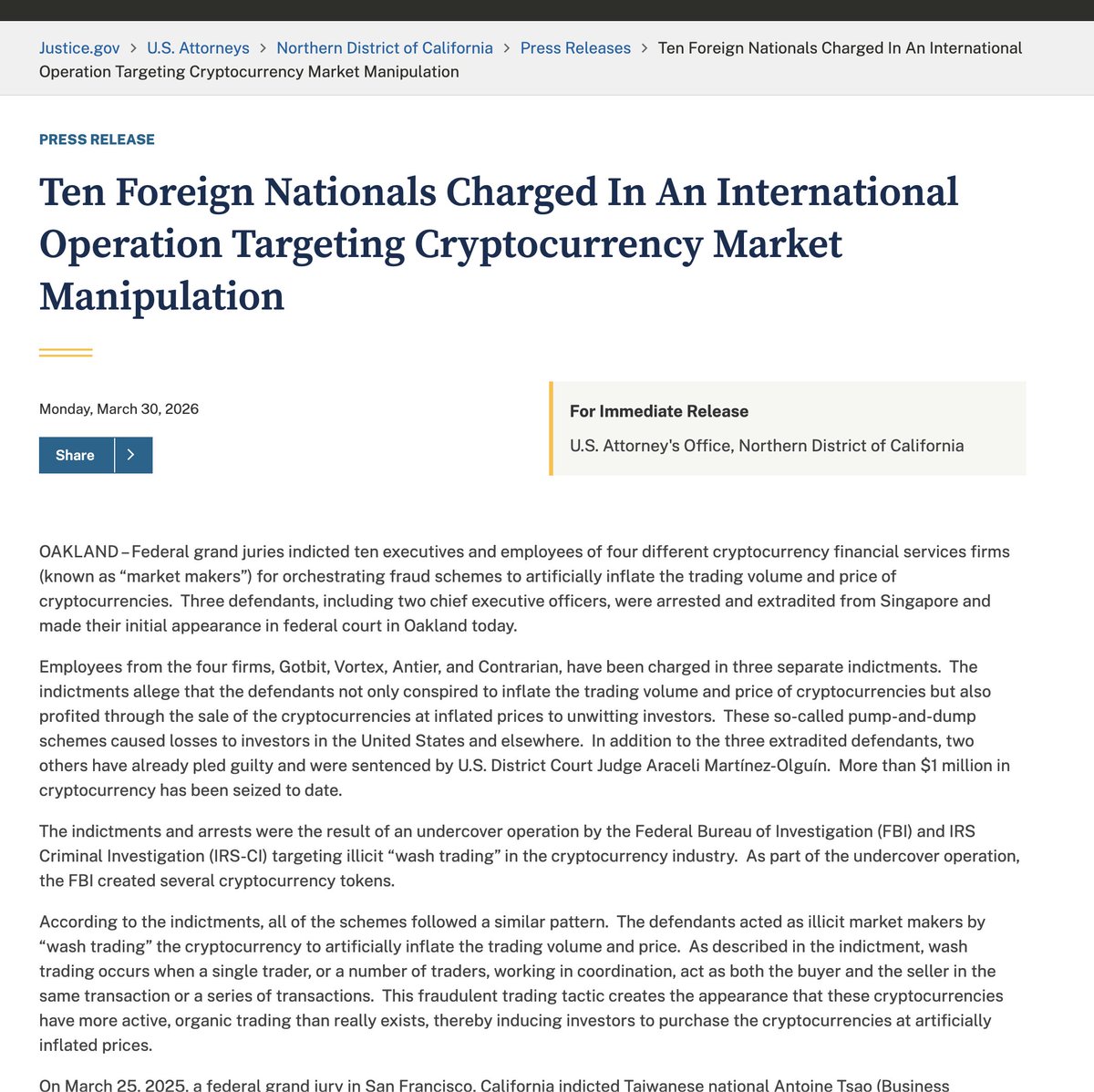
Manipulation Consequences begin: Ten Foreign Nationals Charged by Justice Department In An International Operation Targeting Cryptocurrency Market Manipulation
OAKLAND – Federal grand juries indicted ten executives and employees of four different cryptocurrency financial services firms (known as ��market makers”) for orchestrating fraud schemes to artificially inflate the trading volume and price of cryptocurrencies. Three defendants, including two chief executive officers, were arrested and extradited from Singapore and made their initial appearance in federal court in Oakland today.
Employees from the four firms, Gotbit, Vortex, Antier, and Contrarian, have been charged in three separate indictments. The indictments allege that the defendants not only conspired to inflate the trading volume and price of cryptocurrencies but also profited through the sale of the cryptocurrencies at inflated prices to unwitting investors. These so-called pump-and-dump schemes caused losses to investors in the United States and elsewhere. In addition to the three extradited defendants, two others have already pled guilty and were sentenced by U.S. District Court Judge Araceli Martínez-Olguín. More than $1 million in cryptocurrency has been seized to date.
https://t.co/33S0m3yo1o