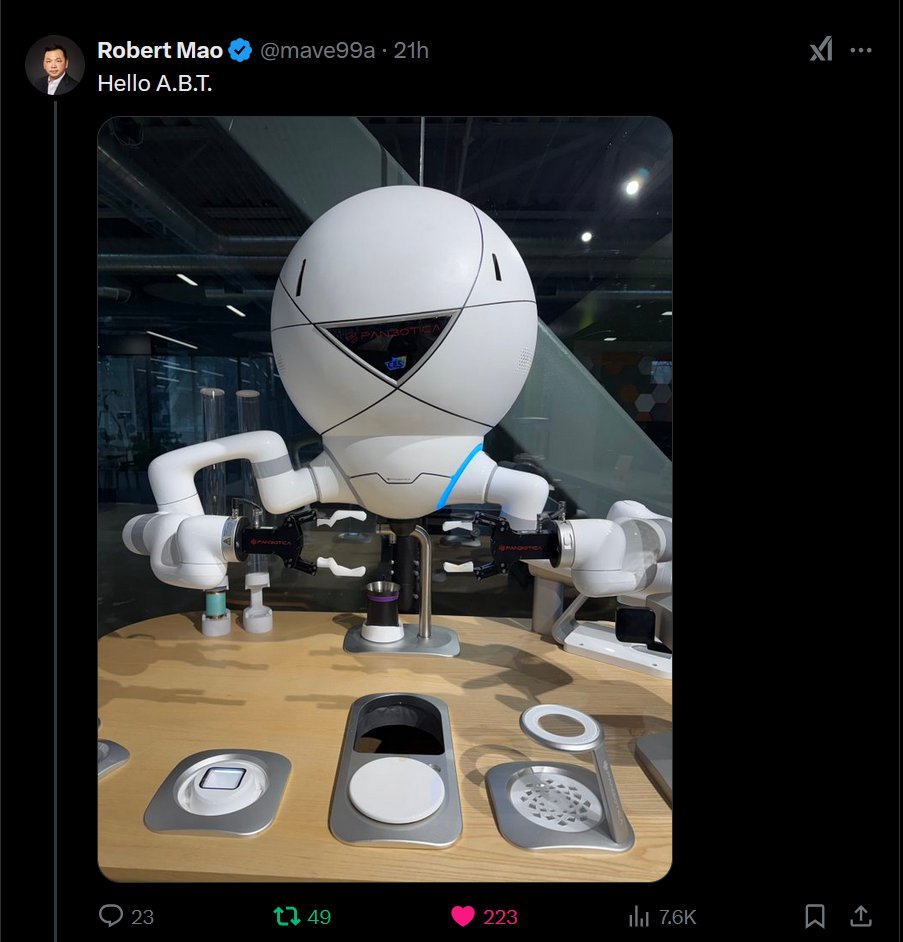
It was mentioned a few months back that Arcblock $ABT was working with a new Robotics company out of Hong Kong that was a very promising. The recent robot in Robert's post is made from Panbotica, a company of early investor Liang Su. @MYC_NETWORK
Put the pieces together yourself
A batch of cool stuff is coming in June! 🚀
AFS, ARC, next-generation Blocklets, DID/VC, Agentic Blockchain, AI-native tools, and a few surprises we've been quietly working on.
The wait took longer than we hoped, but the pieces are finally coming together.
Stay tuned.
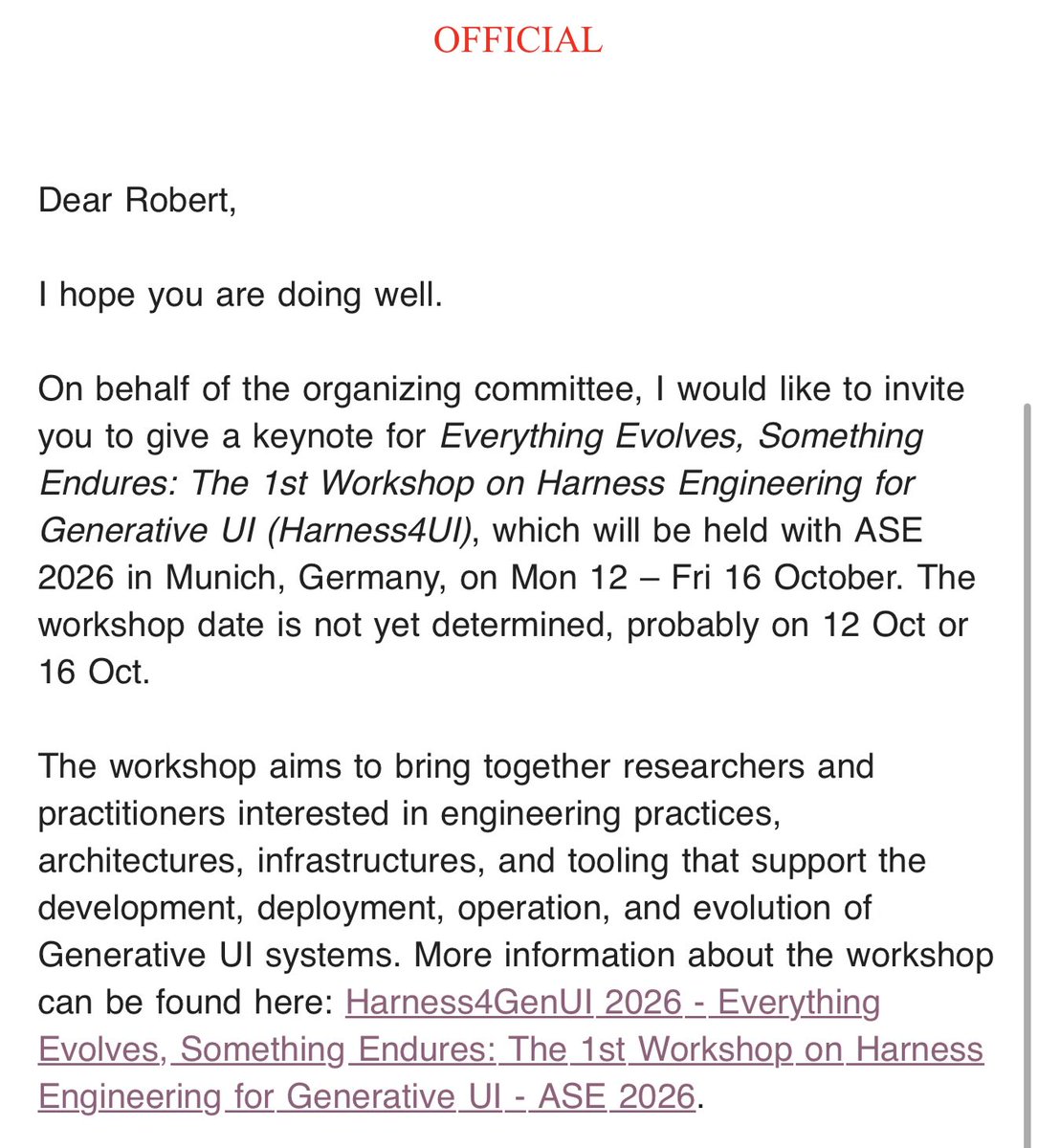
I am proud to announce that I will be presenting AFS-UI (Agentic File System UI) as a keynote speaker and panelist at Harness4UI 2026, held in conjunction with ASE 2026 in Munich, Germany.
Harness4UI is the inaugural workshop on Harness Engineering for Generative UI, bringing together researchers and practitioners working on the architectures, infrastructure, tooling, and engineering practices behind the next generation of AI-powered user interfaces.
I’m excited to share our work on AFS-UI and discuss how LLMs, DID, blockchain, and agentic systems are reshaping software development and user experiences in the AI era.
Looking forward to meeting researchers, builders, and practitioners from around the world in Munich this October.
It’s taking a bit longer than we originally expected to release our next-generation AFS-powered DID/VC, agentic blockchain, and new Blocklet architecture.
The good news: we’re actually in great shape.
We originally planned for May 😂, but June is looking much more realistic — and worth the wait.
Building foundational infrastructure is never as easy as a demo. We’d rather get it right than rush it out.
June. 🚀
We’ve always considered LLM observability a foundational capability for builders on ArcBlock.
You should know exactly what happened inside your apps (or any app you have access to), how models were used, how many tokens were consumed, and what the actual costs were.
Transparency and verifiability are core principles of the ArcBlock platform.
If you can’t observe it, you can’t truly govern it.
Preview the new AFS-based Blockchain Explorer:
https://t.co/gwp3H0OKwy
Stable version:
https://t.co/P1cfj38r3n
The preview version is still early-stage — not fully stable or bug-free yet.
We’ll continue running both side-by-side for a while, and eventually the new explorer will replace the old one.
This is more than a UI refresh — it’s the beginning of a new architecture built on AFS (Agentic File System) and our evolving agentic blockchain stack.
The major difference is underneath: every piece of blockchain data is now exposed as an AFS node.
This allows AI agents to understand the data and protocol structure directly — without guessing, reverse-engineering, or parsing raw blockchain data manually.
This is a foundational step toward a truly agentic blockchain.
Blockchain data should be:
• Open
• Standardized
• Explainable
• Understandable by both humans and AI agents.
Check out our latest Blockchain Explorer built on AFS (Agentic File System) and AFS-UI (Agentic File System UI).
At first glance, it may feel familiar — but the underlying architecture is completely different.
The new explorer currently exposes the exact same blockchain data as the previous one, so you can compare and explore it yourself.
And no — this is not a simple reskin of the old explorer.
This is the first public preview of our AFS-UI and Agentic Blockchain architecture.
Right now you only see the same data.
Soon, you’ll see a very different future.
One thing we’ve been thinking deeply about is the role of identity and long-term participation in decentralized ecosystems.
In many governance systems today, all wallets are effectively treated the same:
short-term speculators
exchange-held assets
governance farmers
long-term builders
ecosystem operators
real users
But in reality, they are not the same.
We believe decentralized identity (DID) can help protocols move beyond purely transactional participation toward more meaningful ecosystem relationships.
Not to create social hierarchy.
Not to create surveillance systems.
And not to replace sovereignty with centralized identity.
But to recognize long-term participation, contribution, and ecosystem alignment in a privacy-preserving and user-sovereign way.
Examples may include:
long-term governance participation
sustained ecosystem contribution
builder activity
completed grants or infrastructure support
participation in ecosystem events
operating applications or services
maintaining nodes or infrastructure
helping grow healthy ecosystem usage over time
Importantly, this does NOT mean:
one identity permanently dominates governance
“VIP classes” control the ecosystem
or reputation replaces open participation
We believe governance legitimacy should remain broadly accessible.
But identity and historical participation can help provide additional context, trust signals, and ecosystem understanding that simple token balances cannot capture.
In the long run, we believe decentralized ecosystems will need to evolve beyond purely anonymous liquidity coordination into systems with richer forms of sovereign participation, reputation, and community trust.
Not less decentralized.
But more human.
One area we believe AI can fundamentally improve blockchain and crypto is governance itself.
- Not by replacing human decisions.
- Not by creating “AI governments.”
- And not by turning protocols into black-box automation.
But by dramatically improving transparency, accessibility, and collective understanding.
Most governance systems today fail for very human reasons:
information overload
low participation
unclear incentives
emotional narratives
hidden tradeoffs
technical complexity
and the inability for normal users to realistically understand proposals
In practice, many governance systems become:
popularity contests
whale influence systems
governance theater
or noisy political arenas dominated by a small minority
We believe AI can help change this.
Some directions we’re exploring include:
AI-assisted proposal analysis
transparent impact simulations
treasury sustainability modeling
identifying incentive exploits and governance attacks
helping users understand how proposals affect them personally
surfacing both supporting and opposing arguments
analyzing long-term ecosystem effects beyond short-term reactions
making governance discussions understandable to non-experts
Importantly, the goal is not to let AI make final decisions.
The goal is to reduce information asymmetry and increase governance clarity.
Humans should still decide.
But people should decide with far better visibility, context, and reasoning tools than what exists in most DAOs today.
We also believe AI can help protocols evolve beyond purely speculative governance systems into healthier ecosystems focused on:
long-term builders
real ecosystem contribution
sustainable treasury usage
transparent constitutional principles
and higher trust between participants
This is still early thinking, and many implementation details remain open.
But we believe AI-assisted governance may become one of the most important infrastructure layers for the next generation of decentralized ecosystems.
We’ve heard many discussions from the community around governance, treasury usage, ecosystem incentives, decentralization, and the long-term role of ABT.
As the regulatory environment around crypto continues to evolve, we believe the next phase of the industry must move beyond short-term speculation and governance theater toward healthier, more sustainable ecosystem structures.
Over the past years, we’ve learned a lot:
- not all activity creates value
- not all incentives create alignment
- not all decentralization leads to healthy ecosystems
- and not all “community participation” strengthens a protocol
At the same time, we strongly believe:
- protocols should remain open and sovereign
- users should retain self-hosting freedom
builders should be rewarded for real long-term ecosystem contribution
- treasury should serve ecosystem sustainability, not short-term extraction
and governance should become more transparent, understandable, and accessible
We are now actively exploring the next phase of ArcBlock governance and treasury evolution, including ideas around:
- DID-native governance participation
AI-assisted proposal analysis and transparency
- measurable ecosystem contribution models
- constitutional treasury principles
- long-term ecosystem alignment
- permissionless protocols with values-aligned amplification
This is not about creating another speculative DAO.
It is about building a healthier protocol ecosystem where builders, users, infrastructure operators, and long-term participants can sustainably grow together.
Many details are still open for discussion, and we’ll share more thoughts progressively with the community.
I don’t think laws alone should define the technical standard for decentralization.
And I don’t think crypto or decentralization maximalists should define it either.
Real decentralization will likely emerge through evolving best practices shaped by industry, policymakers, and — most importantly — community consensus over time.
Maybe the real breakthrough for decentralization won’t come from “more voting” or “more governance forums.”
It may emerge in the AI era, when coordination itself becomes programmable, continuously adaptive, and AI-assisted — while still remaining transparent, auditable, and human-overridable.
Most systems today are still optimizing for ideology.
The harder problem is scalable coordination between humans, agents, and systems.
Now the responsibility shifts to the industry: defining best practices and reference frameworks for complying with the Clarity Act.
As of today, relatively few crypto projects may qualify as sufficiently decentralized under such standards.
How projects navigate toward real decentralization and regulatory clarity may become even more important than the technology itself.
All of these areas have already been heavily traded and exchanged hands. Whales been buying the whole time on the way down.
Once $ABT breaks the resistance line, getting back above the colored boxes will likely take very little time. And ArcBlock has been knocking on the door of the resistance line for days. Don't get left behind