再见,2025!你好,2026!
愿新年,胜旧年!
无灾,无难,有趣,有盼!
🫰🏼 🫶🏻✌️🏽👌🏾
Bye, 2025! Hello, 2026!
May the new year surpass the old one!
free from disaster, free from hardship, full of fun, and full of hope!
#2026Year
@NoLimitGains Market makers don’t care about direction, they care about liquidity. Volume–price shows where it sits, Delta tells you whether flows are aggressive or forced. Combine both and the move makes a lot more sense.
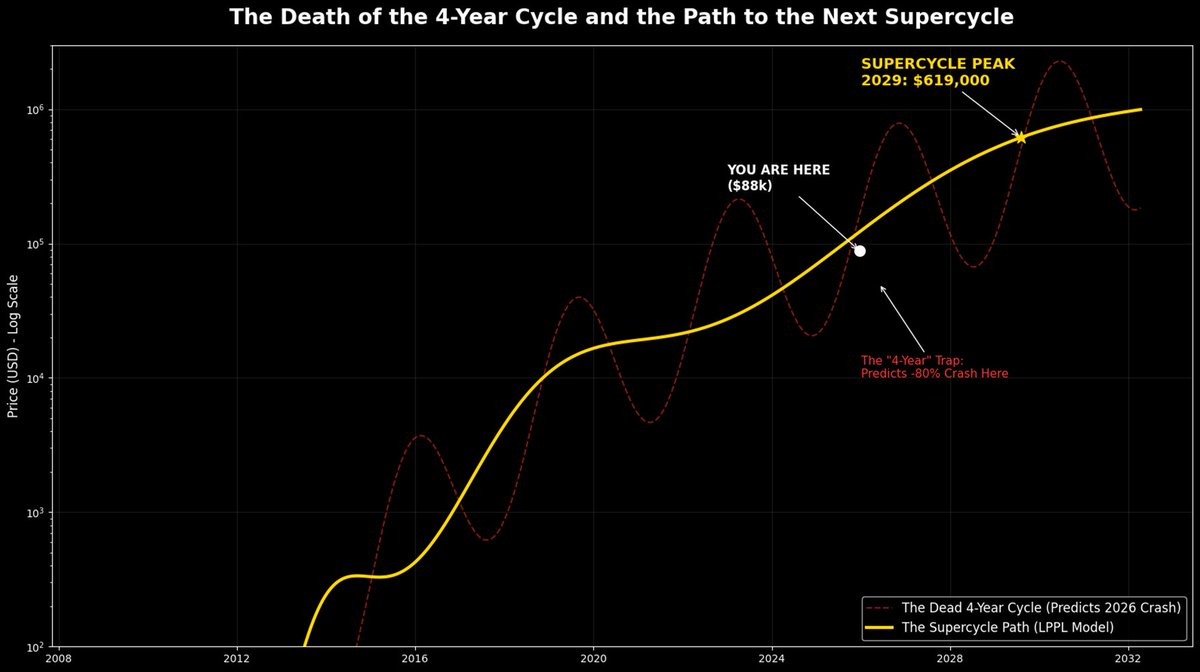
The Death of the 4-Year Cycle and the Path to the Next $600K Super-Cycle
Current Price: $88K
Many on X and social media are still echoing a 4-year cycle false narrative. Let’s kill it tonight.
Investors wedded to the 4-Year Cycle are selling now for one simple reason: their “clock” tells them time is up.
According to that theory, Bitcoin is past its expiration date. The model dictated a peak 18 months post-halving (October 2025), followed by a guaranteed crash in 2026.
Because we are sitting at $88k instead of the predicted $250k, they believe the cycle has failed.
It hasn’t failed. It has evolved.
The “4-year cycle” never made mathematical sense. Bitcoin is a multiplicative system evolving in log-time (power law).
Imposing a fixed, linear clock on a scaling asset guarantees failure. Expecting Bitcoin to follow a 4-year cycle forever is like expecting a 40-year-old to grow the same number of inches they did at age four.
The clock isn't broken. You're just looking at the wrong one.
1. The Statistical "Smoking Gun"
Ran a head-to-head competition between the Fixed 4-Year Model and the Log-Periodic Power Law (LPPL) Model over Bitcoin's entire history. The results were decisive.
Fixed 4-Year Model AIC: -6,386.1
LPPL Model AIC: -7,510.5
The Difference (AIC): 1,124.4
In statistics, a difference of 10 is strong evidence. A difference of 1,000 is a disqualification. The fixed 4-year cycle is statistically incompatible with the data. Bitcoin does not tick like a clock; it grows like a living system.
2. The Physics of Time Dilation
If the cycle isn't 4 years, what is it?
The LPPL model unlocked a natural frequency (omega) of 8.89. This value is within 1.90% of the theoretical constant for "Age-Doubling" (~9.06).
Bitcoin operates in Log-Time, not Calendar Time.
Infancy (2010-2013): Cycles were fast and violent because the network was small.
Adulthood (2025+): As the network scales, "time" effectively slows down. It takes exponentially more energy and capital to move the price, causing the cycle duration to stretch.
The "4-Year Cycle" was a temporary optical illusion created during Bitcoin’s adolescence. That window has closed.
3. The Death of the 80% Crash (Damping)
The 4-Year narrative depends on the "inevitable" 80% crash in 2026. The math says those crashes belong to the past.
The model detects a Damping Rate (beta) of -0.40
2011 Volatility Amplitude: ~100%
2025 Volatility Amplitude: ~47%
Bitcoin has shed 53% of its historical volatility. We are no longer facing a vertical blow-off top followed by a total collapse. We are entering a phase of sustained, lower-volatility compounding.
4. The Trap vs. The Supercycle
This is where confusion creates the ultimate opportunity.
The Trap: The 4-Year model predicts a crash in 2026 because it thinks "time is up." Sellers are exiting now at $88k to avoid a phantom bear market.
The Reality: The LPPL model predicts that 2026 will be a breakout year, not a breakdown year.
Model Forecast for 2026: ~$219K (End of Year)
2026 is likely to deliver a decisive, mathematical rejection of the “4-Year Cycle” model. While the old guard waits for a crash, the Supercycle model projects a grind higher, targeting a true structural peak of $619K in August 2029.
Conclusion:
We are not witnessing the death of Bitcoin.
We are witnessing the end of the speculator’s cycle and the emergence of Bitcoin as a world class sovereign asset class.
The conclusion is purely mathematical.
Selling at $88k is not “risk management.” It is almost certainly a miscalculation of historic scale.
The data shows you are not avoiding a crash you are exiting a supercycle at the point where it is most likely just beginning.
Distinguishing between clean trends and liquidity games is exactly what saves capital right now. Chasing shorts in a weak but messy market is a recipe for getting trapped at the bottom.
$BTC Perfect, the levels are clear.
From here, I expect aggressive and messy movements, typical of a phase where the market works more on liquidity manipulation than on clean trends.
At the macro level, the context remains weak, so it makes no sense to force directionality or chase extended movements.
That's why I won't be looking for short scalps: in these conditions, they risk becoming continuous traps. Trade, but do so with intelligent sizes.
Instead, I will focus on long scalps on level flips, exploiting:
sweeps,
clean reclaims,
rapid reactions in already tested areas.
It is also Monday: volume is gradually returning, and the market often 'builds' the week with deceptive movements.
Crypto is now deeply entangled with traditional finance (TradFi) rules, where a single line in an index provider's policy can trigger a market-wide nuke.