I largely think of "crypto" as a failed asset class at this point.
I've written about the causes multiple times. Mainly, most crypto assets are worthless, or have dreadful value accrual, and most founders have abused the lack of guardrails and dumped on people indiscriminately, or are outright scammers.
On top of that we had the Memecoins SuperBullshitCycle, a trend that brought the worst out of people, and sucked everyone's souls & pockets dry. And then came the never-ending wave of DeFi hacks, which has dramatically increased since last April.
This can seem contradictory, as adoption of "crypto" is surging:
> Stablecoin adoption continues growing fast
> Politicians in the US are openly pro crypto
> Tradfi is looking at tokenizing everything
> Usage of equities & commodities perps is exploding in offshore and DeFi exchanges
> The US is in the early stages of adopting perps
> Prediction markets are becoming part of everyone's daily lives
These are more "blockchain" than "crypto", although there are some exceptions with a token in those fields, most of which have been performing very well in recent months. A few among those exceptions even distribute most revenue to holders via buybacks (Hyperliquid in particular), which is what every investor actually wants to see to be invested in a good business rather than a fleeting narrative.
We also have the privacy category. The one old school crypto category that is not liquid diarrhea. The world needs private non-custodial stores of value.
Crime in particular needs privacy, as proven by the DoJ confiscation of $15 billion in Bitcoin from Cambodia's pig butchering farms, legal filing for which was submitted on October 8, 2025 (coincidentally right before 10/10). Of course, everyone needs privacy, not just criminals, but crime flows are real, and large.
The asset attracting the most flows in this niche is Zcash. Zcash's recent performance has been fascinating, as it has been trending higher with bitcoin trending lower, a sign of real reallocation among bitcoiners.
Another crypto category that is not dead is the "AI" category, full of high flying, fundamentally lacking, narrative driven tokens. The standout exception is Venice, a private AI platform with growing users and revenue, whose tokens are directly backed by the business rather than a narrative.
So one could say old "crypto" is a failed asset class, but from the ashes come new beginnings, and the new face of crypto is one heavily dominated by the needs of Tradfi, prediction markets, AI, and privacy.
Crypto sucks. Long live crypto.
Korea is ahead of the curve on everything. If you wanted to see where our society was going to be today, just go to Seoul 10 years ago. Every single trend, from looksmaxxing to salaryman margin gambling to jailing former presidents started there first.
They are speed running the end of history, and possibly, whatever comes next, they will be at the beginning.
Ur dedication to ur craft will either payoff in the end or it won’t and you’ll still have the same end result of..
sacrificing ur time to achieve ur dreams, with the cost of losing other personal desires. So regardless of win or lose this is the reality of anything
One way or another something goes for something new to come in.
Wasting ur time In doubts about if ur gonna be successful in something or not is genuinely the most useless mental roadblock you can after. ESPECIALLY if you haven’t even put a full effort attempt
u can only control whats within ur limits, and thats based on ur skills, determination and knowledge either u succeed or u failed & need to reevaluate, and see if it’s worth trying again.
If it’s something ur really tryna get at and stay at. REGARDLESS of the results win or fail ur still gonna wake up & TRY to replicate or attempt winning results OR try to get the win. Ur attempt goal no matter what is to win / achieve so why does a few failures get in ur way of continuing
The more you soak up on ur failures the more Mental doubt ur mind starts visioning and road blocking.
holy fuck, a hair dryer at a Paris airport broke Polymarket weather markets & made someone $34,000 richer
- polymarket was settling Paris temperature bets on a single Météo France sensor sitting near the Charles de Gaulle runway perimeter - basically unguarded
- the guy bought the long-shot outcome (like "22°C" when everyone expected 18°C) for pennies, since nobody thought it'd hit
- then he walked up to the probe and briefly heated the air around it with a portable heat source, spiking the reading just long enough to register as the daily max
- temperature snapped back to normal in minutes, the market resolved in his favor, and he cashed out - twice, on April 6 and April 15, before Météo France caught on and filed charges
hyperstitions.
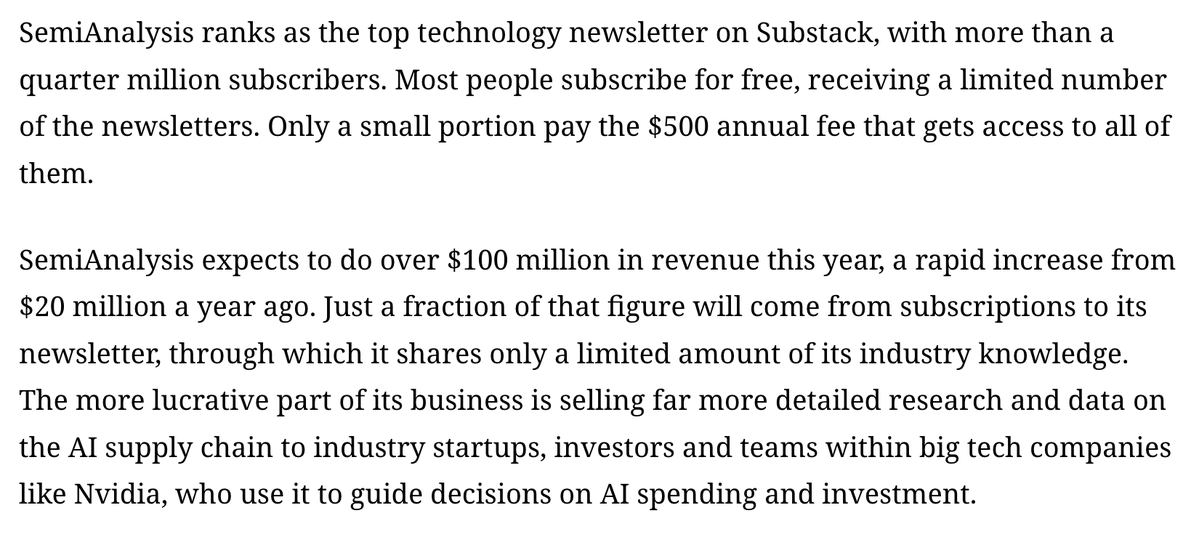
SemiAnalysis will generate $100 million in revenue this year, and the newsletter accounts for only a very small portion of that.
This is something I’ve been thinking for a while: SemiAnalysis’s newsletter is basically a charitable project. He could shut it down at any time and it wouldn’t really matter.
Introducing Noesis 👁️
Telegram bot and unified API for token analysis, wallet profiling, bundle detection, holders analysis & on-chain data.
Build your own tools, ask your agent to build it for you with one API key or use our telegram bot instantly.
🔜
Sellers are exhausted, sentiment couldn’t be worse and
everything (except BTC) has been written off
Meanwhile… price isn’t breaking lower
@jvb_xyz shares why he's been actively buying crypto on this recent dip
Lots of commenting on why the solana trenches died. Beyond simple bear market (which is a decent bit of it), I think the answer is pretty simple: (1) Fees; (2) Professional rapists; (3) no wealth effect. I think each of these also provides PF a great opportunity to gain market share from competitors and significantly increase their own bottom line.
My thesis below is simple: onchain requires a certain amount of money in the hands of gamblers and the velocity of money from gamblers to VIG needs to be slowed down. All of this money will eventually end up in the house (PF), and each of my action items directly benefits PF and allows them to gain market share from their competitors.
I've been onchain trading full-time since mid-2021. I started on ETH and have traded on just about any chain you can name. Significant amount of that has been in bear markets, even.
ETH onchain died because of four issues: (1) Gas fees; (2) 99% of all onchain deploys were instant liquidity rugpulls (professionalized rapists); (3) UX (compared to sol); (4) lack of projects building (signifying attention/opportunity/eventual wealth effect through airdrops).
UX hasn't changed and is still superior to ETH (but not really to Base or BSC), so I won't comment on that. The other 3 are doing most of the work.
(1) Gas fees. Solana gas fees are still low, but the funneling of all volume through TG bots is essentially the same phenomenon. If you do a $20,000 roundtrip, there's your $200 in gas fees. Most are used to tooling/UX/whatever and so don't go do manual swaps. This is billions of dollars siphoned from the trenches annually. Every bit of VIG shortens the lifespan of trench narratives/seasons exponentially. Some terminals are lowering fees, but Pumpfun really needs to simply make Padre the de facto TG/browser trench tool, bring the utility up to parity with other products, and make fees literally 0 - forcing others to compete on pure utility to justify their fees (and, ideally, forcing their hand to do an airdrop, tied in with item 3 below). This step alone returns billions of dollars to the trenches (which eventually all ends up in PF pockets since they are the house, but takes longer, extending trench seasons and making it more attractive to play). PF is the only centralized actor with the distribution and incentive to do this. Distribution because they have a meaningful shot of getting degens to switch over. Incentive because, as mentioned, they can justify 0 fees because the full 1% goes to their business bottom line anyway, just through PF rather than Padre. Those billions of dollars extracted to terminals could actually all simply go to PF instead (since it is no longer extracted to terminals, remains with the gamblers, and eventually makes its way back to the house).
Action item: PF needs to make Padre the go-to TG/Browser tool and set fees to zero.
(2) Professional rapists. These dominated ETH onchain. Not just the automated "deploy coin, let people (bots) trade it, pull liquidity" but also LP snipers became widespread. LP snipers will always exist due to the mechanics of LPs (essentially the same as bonding curve). But when they are the majority of the field, and their early supply cannot be sufficiently absorbed by later sellers who actually believe in the coin, everything goes to zero. ETH onchain also had a natural habitat where LP snipers would get fed upon by the aforementioned LP pullers and so they kept each other in check. This exists somewhat on Solana but not at a high-enough level, and so LP snipers are not kept in check enough. This is largely a a culture issue but is incentivized by PF fee structures. First off, 1% LP fees don't need to exist because liquidity is paid for entirely by holders due to PF using a bonding curve. 1% LP fees is a vestigial feature of ETH LPs where third parties needed to be incentivized to provide liquidity to projects. That simple does not need to exist any more. Fees could be cut 90%, again exponentially increasing the time of trench seasons because more money stays in player hands (although, as mentioned, eventually ending up at the house). Or at the very least, fees should be used to bolster the LP like used to happen. Deployers (they are not devs) do not need to be incentivized to the extent they are now (if at all). Good coins will be deployed by someone and their payment is the ability to purchase supply early.
Action item: PF needs to drastically reduce LP fees, creator rewards, and other rake, or at the very least ensure most of this goes into the LP pool itself.
(3) Wealth effect. ETH onchain blossomed because of the wealth effect from uniswap/sushiswap/various L2 tokens as well the the underlying token going up (RIP). That money kept sloshing around in the onchain system until it went to zero. Solana had the same dynamic - SOL went from $8 to $200+ and the ecosystem had all sorts of stimulus, whether bonk (the original), DEX airdrops, JITO, some NFTs, etc. This put a lot of money in degens' hands and they were happy to use this house money at the casino. Right now, Solana is not going up, and every single current ecosystem actor that could provide a wealth effect has chosen to extract instead. TG bots and PF are the obvious examples - both could do significant airdrops and reinvigorate the trenches, but they will not.
Action item: Airdrop, you fools (PF first, then force the hands of TG bots if they want to maintain market share vs Padre).
PF, through making Padre the best tool with 0 fees, and airdropping to users, has the opportunity to simultaneously inject money into the trenches such that players return, decrease vig throughout the ecosystem so that the players stay and the seasons remain longer (and PF income remains more stable), and force the hand of competitors to level up unless they want to lose market share to PF. If they succeed in driving all TG users to Padre, they can essentially take all that vig that was going to competitors and direct it to their own bottom line instead.
There's a lot of opportunity for solana onchain to avoid becoming eth onchain. Just a matter of whether there's vision and will.
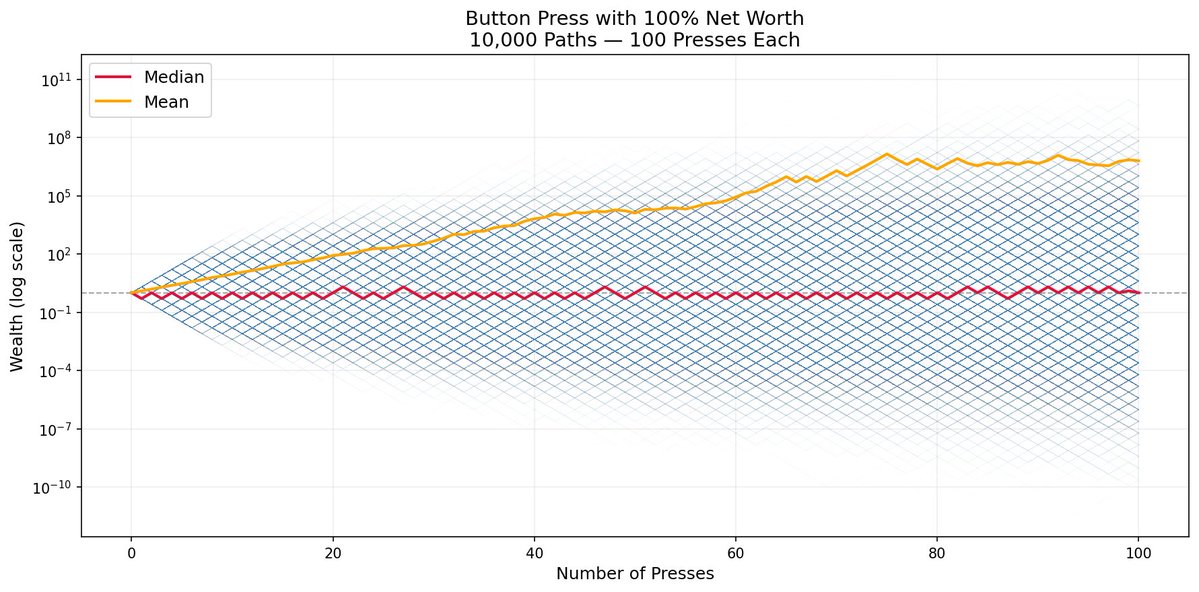
At first glance, pressing the button seems like a great opportunity. Each press has a 50% chance to double your wealth and a 50% chance to halve it (EV = 1.25x). Mathematically, this implies infinite presses should lead to infinite wealth. It becomes an infinite random walk where every positive outcome occurs with certainty. Awesome. In theory.
However, a game can offer a seemingly generous +25% average return on each press, yet most participants can still lose money because of the nature of multiplicative betting. The mean (average) wealth can explode to extremely large amounts with the median (the wealth of the typical participant) and the majority of players losing money.
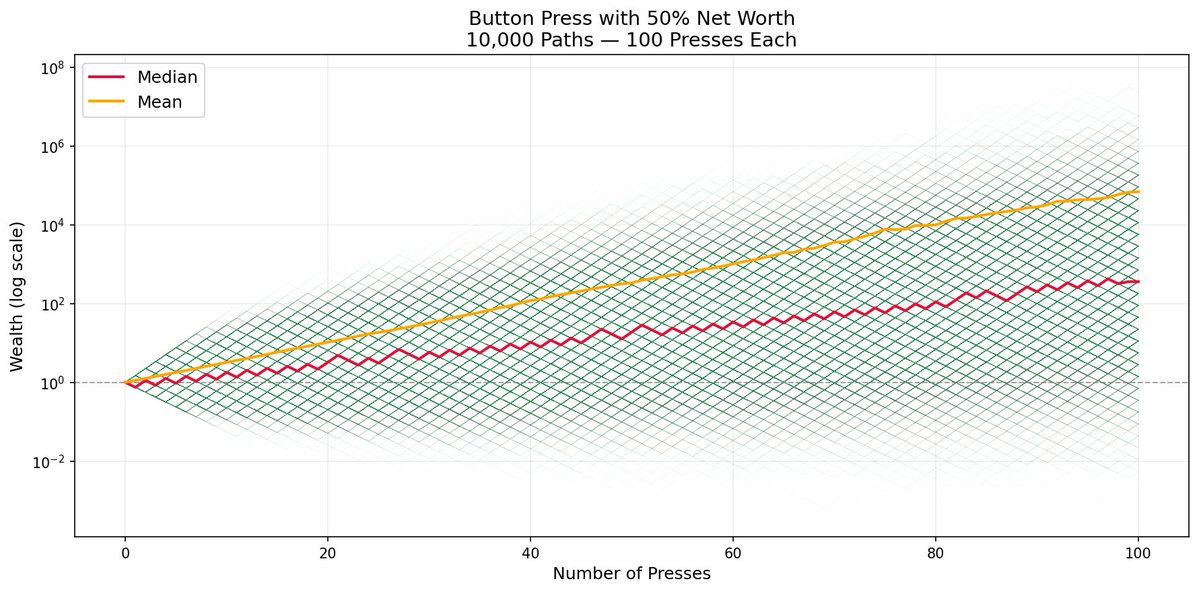
In this game, wealth compounds multiplicatively, not additively. The average outcome is wildly profitable. The typical outcome is stagnation or loss. The majority of players go to zero, on a series of highly +EV trades. The problem is in how much you bet each time. Position sizing transforms this risky gamble into a sustainable strategy. Let's say you do 50% instead of 100%. It instantly becomes a great strategy.
In any high-volatility, positive-EV scenario, the path to long-term profitability for the majority is careful position sizing. Survival is a prerequisite for realizing your edge. “Just survive” is not simply feel-good advice but actually useful.
64 trades to zero. not from bad trades. just fees.
that's a $500 port on pumpswap. trading 10% per round trip. breaking even every single time. half your money gone by trade 31. the rest follows.
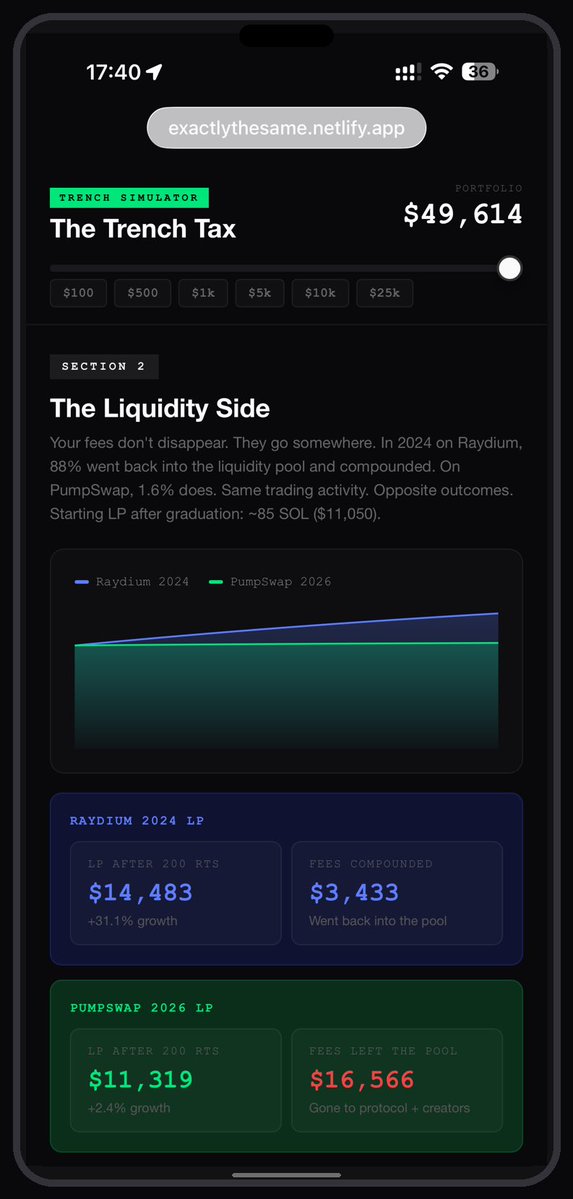
@Pumpfun's co-founder says the fees are "exactly the same" as 2024. in 2024, 88% of fees went back to the LP. today, 1.6% does. his own docs say so.
thank you for all the feedback and DMs on the article. since we're degens and it's easier to understand complex things visually, i cooked something for you.
simulator (try your own port size): https://t.co/JsNGOujQC9
and here, the full article again: