I have decided to work through all of the previous @quantnetwork AMA's and format them similarly ! This will take a lot of work - but I believe they are a great source of information. This thread will contain all of the AMA summary PDFs! $QNT 🤙 Share the good word.
OK, let's make this simple.
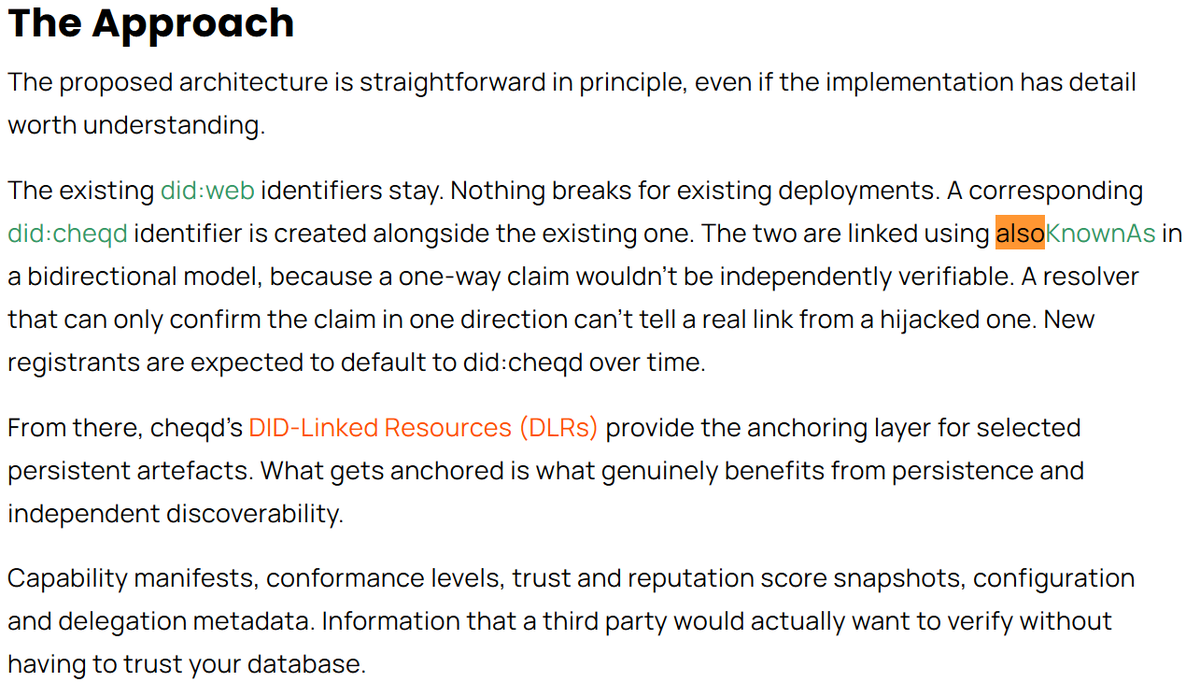
Current = DID:WEB......
Coming = DID:CHEQD......
Coming = DID:CHEQD artefacts
Artefacts aka = #DLR - DID(:CHEQD) Linked Resources
NEW DID = $2.00 operation
NEW DLR = $0.20 operation
@cheqd_io built a pricing oracle for live conversion of $CHEQ used for settlement of these operations.
So, $CHEQ @ $0.002~ means ;
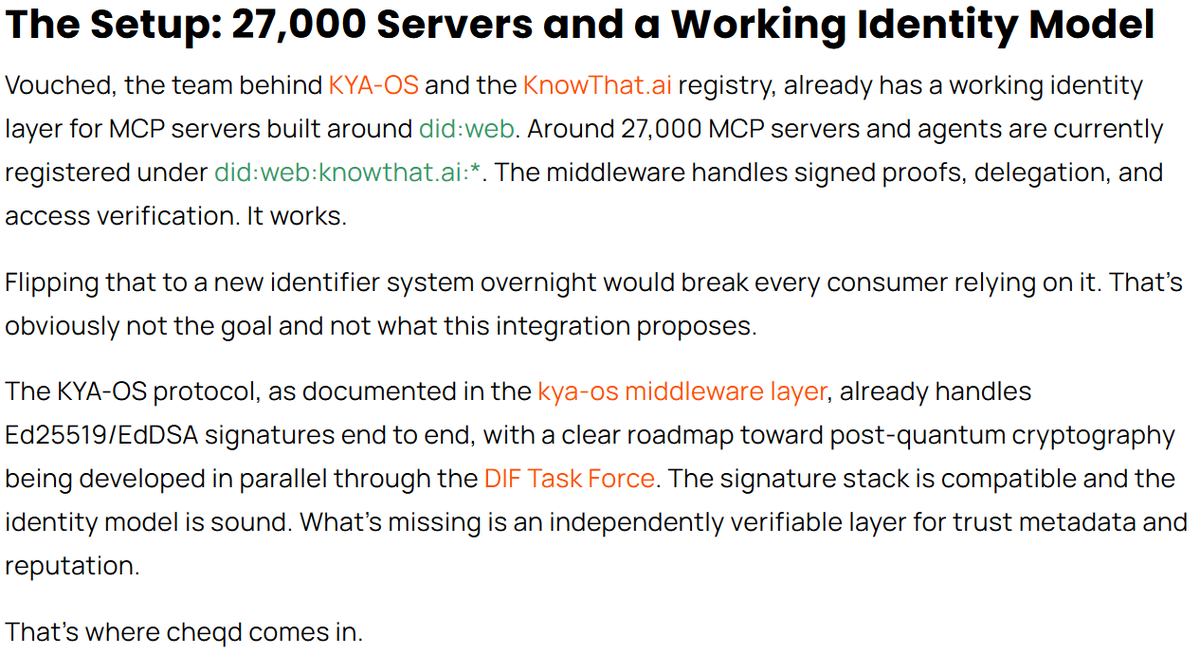
27,000 NEW DIDS = $2.00 / $0.002 = 1,000 cheq PER DID
27,000 x 1,000 = 27,000,000 tokens ; or 2%~ of supply and 99% burn rates.
You can find the link in the comments.
Vouched donated MCP-I to the Decentralised Identity Foundations #DIF
That MCP-I, is now KYA-OS.
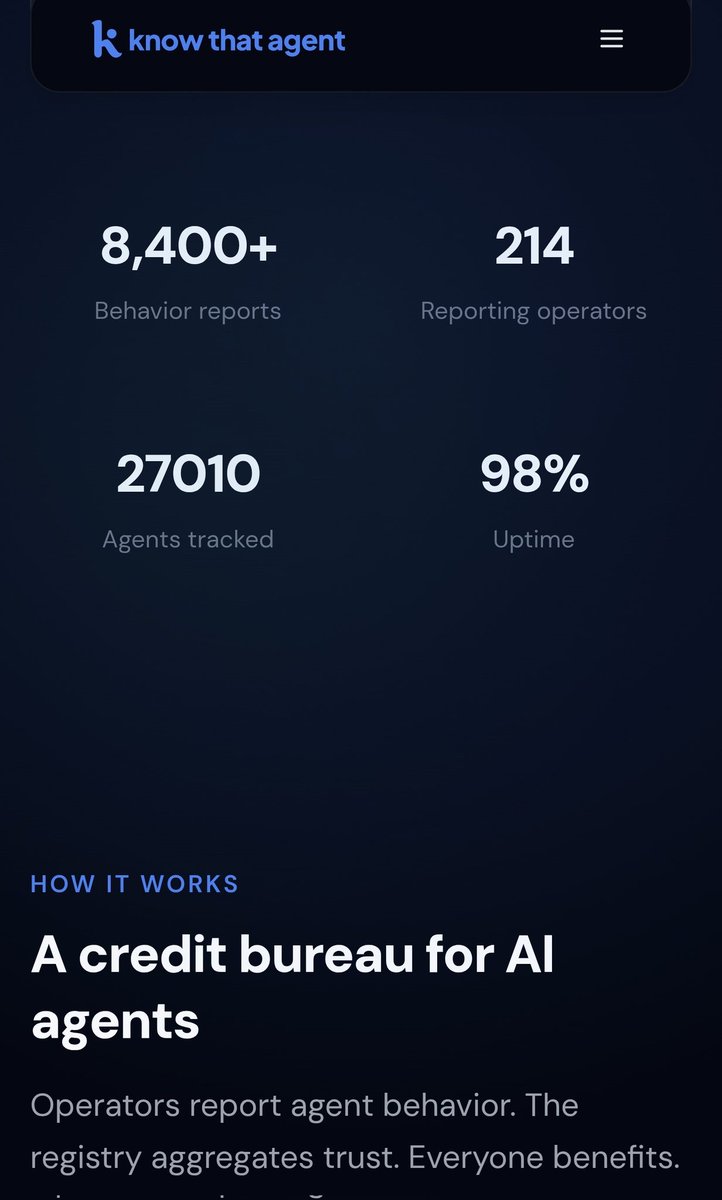
https://t.co/McSZPQcKNf is an implementation of this code.
We are approaching a world where 27,000 agents would not even make up a rounding error.
Also, AI agents / Autonomous agents are not confound to maturity of 18 years or so like an adult.
They can be spun up at will. 🧠
8b humans with 10 agents = ?
cheqd and @VouchedID are building trust in AI agents.
A decentralised, verifiable, and independently auditable trust layer for AI agents, anchored to open standards.
Read more: https://t.co/cUan5EbGYZ
Have you ran the maths of this small scale amount of AI agents needed DID:CHEQD identifiers?
Have you ran the numbers for reports/audits as operations on @cheqd_io network?
Do you know that there's a price oracle for operation costs converted into $cheq used?
Eg, a DID write $2.00 @ token price $0.002 is 1000 cheq alone.
There will be billions of AI agents in the future, and beyond.
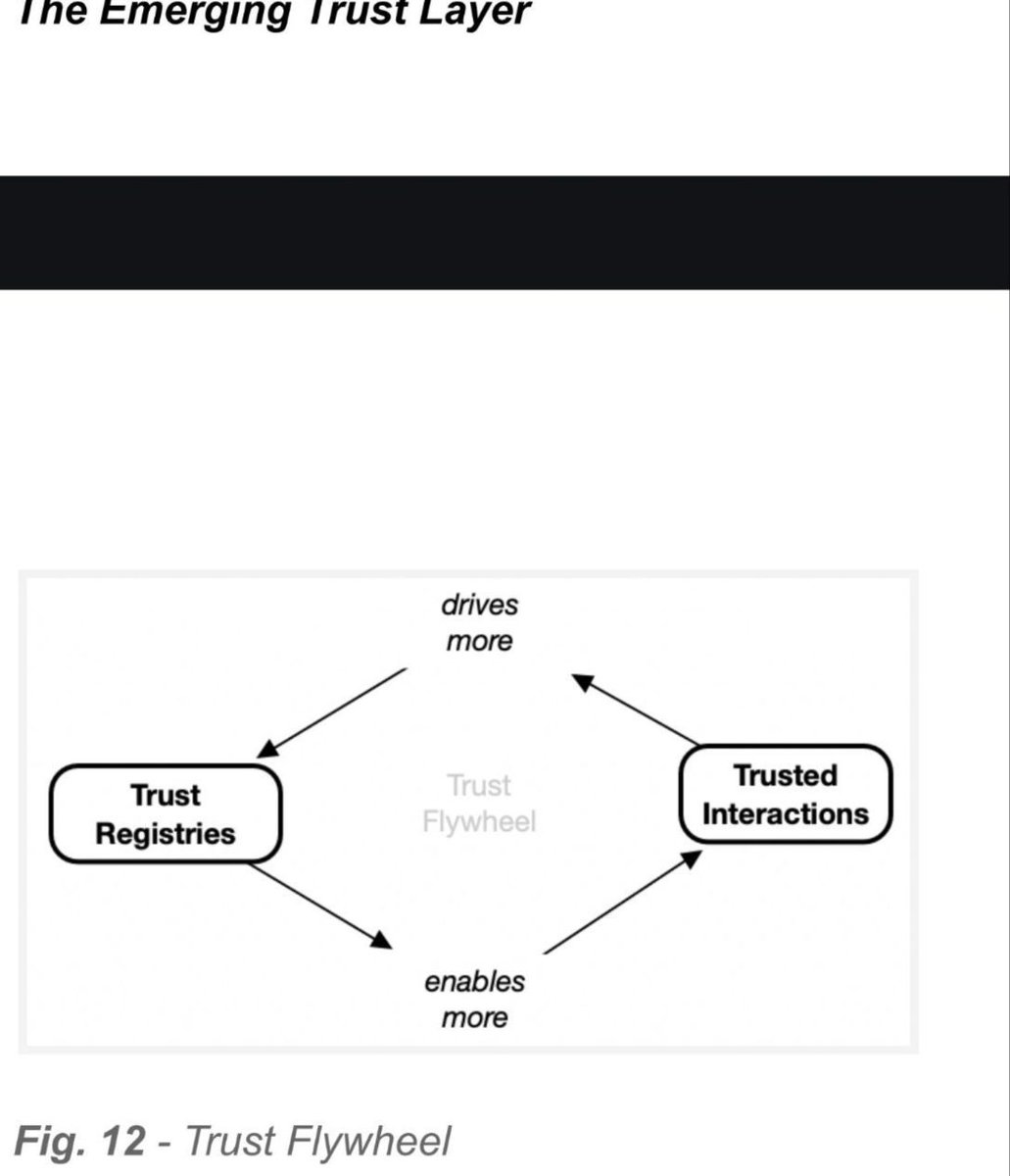
More trusted interactions, demands more teust registries.
Cheqd is a trust registry, its infrastructure.
It is a immutable, persistent and transparent cryptographically verifiable data registry.
We’re excited to partner with @VouchedID.
Vouched KYA now integrates the cheqd network, adding cryptographic agent identities, verifiable credentials and tamper-proof audit trails, without vendor lock-in.
Know more: https://t.co/anX0p1DXJt
Yesterday, @fraser_again spoke at the 'Building trust in digital supply chains with organisational identity' event hosted by @DigiCatapult.
Proud to be part of a small but strong group helping shape the future of trust and organisational identity in the UK.
Most people still think digital #identity and #SSI are niche.
I think they are potentially becoming foundational infrastructure for the AI era.
Because once #AI agents start operating autonomously across commerce, finance, healthcare, logistics and the internet itself, trust becomes the bottleneck.
Agents need:
🟠 cryptographic identity
🟠 verifiable permissions
🟠 trusted registries
🟠 decentralized key management
🟠 interoperable trust rails
And increasingly, governments, enterprises and cybersecurity agencies are all pointing in the same direction.
If it proves true that decentralized trust becomes a core internet primitive, then the upside scenarios for infrastructure providers like @cheqd_io - $CHEQ stop looking crazy very quickly.
That is the bet.
I wrote a deeper thesis below on why I think the “Internet of Trust” could become one of the biggest infrastructure narratives of the next decade:
The France digital identity breach exposing data from millions of citizens is exactly why the next generation of identity infrastructure matters.
The old model:
→ giant centralized databases
→ single points of failure
→ institutions storing everything
→ trust based on “just trust us”
In the #AI era, this becomes unsustainable.
Deepfakes, synthetic identities, automated phishing, and AI-driven fraud are scaling exponentially.
This is why I’m increasingly interested in infrastructure like @cheqd_io - $CHEQ.
Not as “another crypto project”, but as part of a future trust layer for the internet:
🟠 verifiable credentials
🟠 decentralized trust registries
🟠 issuer verification
🟠 cryptographic trust chains
🟠 portable identity
Europe is already moving toward EUDI/eIDAS wallets and interoperable digital identity frameworks.
The next step is making identity and trust:
→ verifiable
→ interoperable
→ privacy-preserving
→ not dependent on massive centralized honeypots
AI is forcing the world to rethink trust infrastructure faster than most people realize.
We are heading into insane times with #AI.
AI agents will increasingly act on behalf of humans, companies, and institutions handling data, payments, healthcare, workflows, and decisions.
But there’s a massive problem emerging:
How do you verify:
🟠 who is real?
🟠 what data is trusted?
🟠 which agent is authorized?
🟠 who issued the information?
🟠 what actions are allowed?
Current systems are already hitting the ceiling.
Deepfakes break camera-based KYC.
Centralized authentication models were never designed for autonomous AI systems.
At the same time, Europe is quietly building the next identity layer with eIDAS 2.0 and the EUDI Wallet framework.
This is much bigger than most people realize.
We are moving toward an Internet of Trust:
➡️ verifiable identity
➡️ reusable credentials
➡️ programmable permissions
➡️ trusted agents acting on behalf of users
And this is where infrastructure like $CHEQ @cheqd_io becomes extremely interesting.
Trust registries, decentralized identity, verifiable credentials, issuer verification, these systems solve problems AI will massively amplify over the next decade.
Most people still look at this as “just identity”.
I think it becomes a foundational infrastructure layer for the AI era.
And infrastructure investments at the beginning of paradigm shifts historically have the biggest asymmetrical upside.
We’re pleased to announce that cheqd is now integrated into the @Talao_io wallet, one of Europe’s leading Self-Sovereign Identity wallets.
https://t.co/dZNpnOxJjK
Verifiable credentials are gaining recognition as a reliable mechanism for AI systems that must consume authenticated information and execute dynamic tasks.
$CHEQ
Spoke to a fintech founder deploying AI agents this week. Turns out organisational dysfunction doesn't die with the agentic revolution.
Agents are being sold as the end of human inefficiency. No ego, no politics, just execution.
Gartner predicts 40% of agentic AI projects will be abandoned by 2027.
Not because the models weren't good enough. Not because the use cases were wrong. Because the agents couldn't be trusted with anything consequential.
Deepfakes are now being used to bypass identity verification systems.
Security teams are warning that AI-generated identities are passing basic checks.
In some cases, attackers are:
• generating synthetic faces
• producing fake ID documents
• creating full digital personas.
We built an MCP-enabled Agentic Trust solution that gives AI agents cryptographically verifiable identities and permissions.
Developers can now build apps where agents manage their own DIDs and Verifiable Credentials, backed by our Trust Graph.
https://t.co/UdvhB6YvOs
I've been building on the assumption that agent governance would be driven by the usual high-risk suspects: finance, insurance, healthcare. Regulated industries with clear liability exposure, existing compliance infrastructure, and boards who already lose sleep over audit trails.
Everyone is talking about decentralizing identity.
But no one is asking the more important question:
Who decides what is trusted?
If anyone can issue a Verifiable Credential…
→ who verifies the issuer?
Decentralization doesn’t remove trust. it redefines where trust lives.
We’re moving from:
→ central authorities
to:
→ verifiable trust registries + reputation layers
This is where things get interesting.
I believe networks like @cheqd_io - $CHEQ will play a key role:
Not by controlling identity, but by enabling trusted issuance + verifiable provenance at scale
Because in the end:
Identity is useless without trust in who issued it.
📰 Gartner predicts more than 1,000 legal claims against enterprises for AI agent harms by the end of 2026.
Insufficient guardrails. Inadequate oversight. No audit trail.
Here's the uncomfortable truth about AI accountability. 🧵
Bots already account for almost 50% of internet traffic.
Bad bots: roughly a third of all traffic online.
Now add AI agents, autonomous, credentialled, acting on behalf of real people.
How do you tell the difference? 🧵
📰 @NIST just launched an AI Agent Standards Initiative.
The US government is building the rulebook for agentic AI and identity is at the centre of it. 🧵