1. LLMs are just stochastic parrots.
2. Fine, articulate parrots. Still just predicting the next word.
3. They can’t even multiply.
4. Fine, they can multiply. Try olympiad math.
5. Fine, they can compete. Try winning gold.
6. Fine, gold. Someone already knew the answers.
7. Fine, an open problem. Try a Millennium Prize Problem.
8. Fine, but it wasn’t Riemann.
9. Fine, Riemann. but did it understand the proof?
10…
Me: Claude, be Reviewer 2:
Claude: here’s why your paper sucks
Me: Claude, that stuff is all wrong. What are you doing?
Claude: you told me to be Reviewer 2.
I have come to the conclusion, over the last year, that the conventional university degree is obsolete. We have tools that can prove hard theorems and write thousands of lines of assembly in seconds. When Claude can produce something quite close to a PhD thesis in less than an hour, what are we even doing?
It does not matter whether you are at MIT or a third-rate college. Your conventional take-home assignments are done. That is settled.
My instinct is that we need to raise the bar massively. A degree should conclude with work at the level of a 1995 PhD. That is doable in four years. Everything else should be short, doable in four months. We used to look down at people not doing a 'full degree' but if you need four years, with AI, what are you doing? Then move people as far as you can into actual jobs, where they can be supported by AI.
I predict we will slowly converge on something resembling my model where education is rapid. The advantage will go to the engineer who trained briefly in the basics, then quickly moved into practical projects with AI assistance, instead of spending a decade writing a PhD thesis that nobody will want to read. Going to MIT is still likely a good deal. You do not need to spend ten years there.
In short, AI ought to be a career accelerator. It should help young people be ready sooner, and get older people recycled in no time.
MIT just released a report on the subject. MIT is famous for brutal homework. The report makes clear that those take-home assignments are under siege, and that much of the evaluation is moving back into the room: oral exams, in-class work, live discussion.
https://t.co/wUEIj9mXTM
My takeaway:
1. You need to be able to change course and program content quickly. Most universities spent the last few decades adding layers of management and more committees. That machine is ill-suited to sudden change. Most universities will fail badly. They will look increasingly out-of-place.
2. Bring the focus back to live, in-person teaching. Oral exams. Then you can go all-in with AI, based on your discussions with other people. Relationships still come first. You cannot get anywhere alone.
3. Stop trying to AI-proof the current model. That only delays the inevitable and leaves you behind.
I like it. Not many schools could come up with such a report.
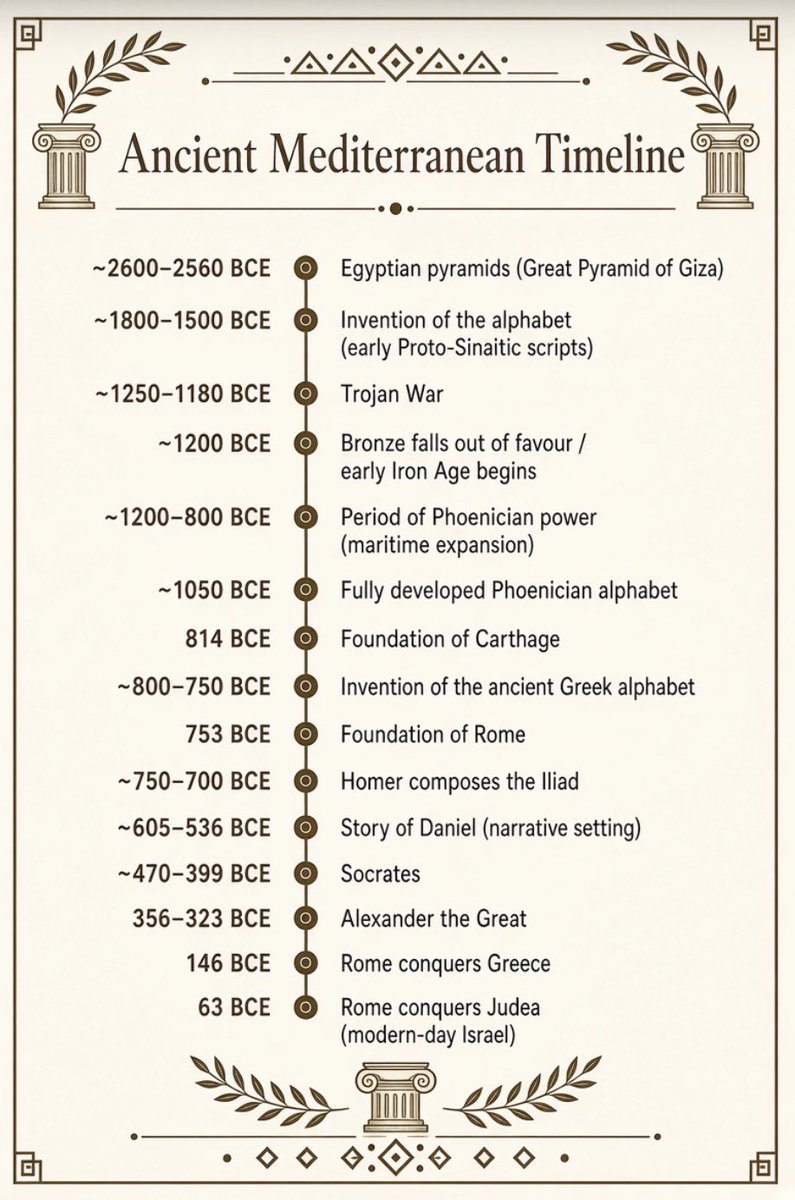
For centuries, barely anything happened. For people in Homer’s era there was no such thing as progress. They had good reasons to believe the past was more advanced.
From 1876 to 1963, despite two highly destructive wars, we saw the greatest period of scientific and technological progress. We discovered the atom and its nucleus, quantum mechanics, relativity, and we invented computers. In 1950 Turing could already see that something like ChatGPT was inevitable.
Since then, if we exclude computing, progress has been relatively modest. Cataract surgery. The Moon in 1969 and again in 1972. Knee replacement. In-vitro babies. Lithium batteries. Viagra. The Human Genome Project. Yamanaka factors. Senolytics. CRISPR. Virgin Galactic and SpaceX.
Did I forget anything major outside computing?
Computers and software improved massively. Everything else, far less so.
I have written about this contrast for years: the 1876–1963 era versus today. We have 100 or 1,000 times more scientists, engineers and government programs, yet progress outside computing remains slow.
The usual reply arrives immediately: it was easier then. The world is more complicated now. We cannot move as we once did.
This is a Homeric view. There were giants in the past: Einstein, the Wright brothers, Turing. Such men are no longer possible. We must fill the forms and toe the line. Researchers have become bards, retelling how we used to invent things in a glorious and dangerous past.
My story would be bleak if not for a recent turnaround.
We spent decades in the world of James Bond. The highest ambition was to be a civil servant who kept uncontrolled science and technology in check. Multiple forces have shifted. Few still want to be James Bond. We may still dislike the Russians that James Bond was trained to fight, but we now fight with AI and drones. The stuffy Cambridge mathematician no longer commands the same automatic respect when a sharp kid with Claude can outperform him without regard for the modern academic rituals (diversity and inclusion, social justice, post-modernist's 2+2 is 5).
Will we soon cure most diseases? Not with AI alone. But AI may help change the culture enough that we reverse biological aging within the next decade.
Nah, I think he's wrong.
I agree that most of the AI-science startups will be bankrupt in a few years, esp those banking on new discoveries in material science. I say this because I know someone who works on selling material science data to companies and you know what, they literally don't buy it, they're not interested. They do their own material testing in house and that's that.
I don't know much about chemistry but Simon is probably right about this not being a great business plan either.
And all these AI companies that cater to academia will go bankrupt because there's no money to make from that.
However, the current AI systems are ideally suited to exploit the unused potential in the already existing literature. There must be thousands of discoveries that lie in connecting the dots, which no one has made because no human can have an overview over the existing scientific publications.
This covers everything from new mathematical theorems from combining already known ones to off-label use of drugs to the application of computational methods in fields that have never heard of them.
So, yes, we will totally see an AI-driven science boom in the next few years, together with an incredible amount of slop and, hopefully, eventually a significant change to the academic system.
(Also, @simonmaechling is totally worth a follo!)
https://t.co/6sDqB4jAWc
Penrose's argument, in a nutshell, is that since humans can understand Goedel's theorem, consciousness is uncomputable and physics incomplete. I've always found it quite charming, the idea that understanding Goedel's theorem is an indicator for consciousness, seeing how few people actually understand Goedel's theorem.
In any case, the argument from Goedel's theorem is why, I believe, Penrose thinks that the measurement process in quantum mechanics is relevant for human consciousness. Because it's the only place in the foundations where you can fumble in some new physics that is plausibly relevant in the human brain. Hence the story with the microtubules. And if you believe that, then AI can't be conscious because it's algorithmic. Though presumably a quantum computer could be conscious, if it emuluates the quantum process that is supposedly relevant for consciousness.
(Penrose's model for wavefunction collapse by gravity is totally computable and actually does not fit that narrative.)
Also, I believe Penrose's argument from Goedel's theorem to be technically wrong. It is possible to algorithmically understand (and even prove) Goedel's theorem without violating Goedel's theorem because the theorem itself is a meta-statement about the Goedel sentence(s) and not the sentence itself. In some sense, Penrose's argument is wrong for the same reason Goedel's theorem exists in the first place, that you can make meta-statements about statements. In fact there have been computer-generated symbolic proofs of Goedel's theorem long before the AI boom.
It's not that I have an obsession with Penrose in particular, it just so happens that my interests have a big overlap with his. I have an interview with Penrose in my 2022 book "Existential Physics" on these and related problems.
https://t.co/PB8d8Vidkq
Keeping up with @arxiv is impossible. 500+ preprints a day across dozens of fields.
@KurateOrg scores papers on 16 dimensions (impact, novelty, rigor, surprise, translational...) so you can spot what's worth reading at a glance. Sort, filter & sign up for the weekly newsletter.
A few people have asked about the Anthropic Hawk and AES cryptanalysis results. The top-level answer is: It’s very impressive. Three immediate comments on the actual results, old-school thread below.
hello there the jacobian conjecture is false thanx to my close friend akhil for asking about it and my other close friend fable for working during the world cup final
((1+xy)^3 z + y^2 (1+xy) (4+3xy), y + 3 x (1+xy)^2 z + 3 x y^2 (4+3xy), 2 x - 3 x^2 y - x^3 z): \C^3\to \C^3, has jacobian determinant -2, and sends (0, 0, -1/4), (1, -3/2, 13/2), and (-1, 3/2, 13/2) to (-1/4, 0, 0)
📢 Major Update: eprint 2025/227
➕ New more efficient and *provable* algorithm
⚡ Solves Code Equivalence given 2 codeword pairs
📉 LESS bit-security ↓ 24 bits
Jane Goodall was one of a few people to earn a PhD without an undergraduate degree.
It was thought that her lack of formal academic training would allow her to remain unbiased by traditional thought and study the chimps with an open mind.
It worked. ❤️
Jannik Sinner is a Wimbledon champion 🇮🇹
The world No.1 defeats Carlos Alcaraz 4-6, 6-4, 6-4, 6-4 to win the 2025 Gentlemen's Singles Trophy 🏆
#Wimbledon
Does astrology work? We tested the ability of 152 astrologers to see if they could demonstrate genuine astrological skill.
Here is how the study was designed and what we found (including a result that really surprised me):
🧵
.
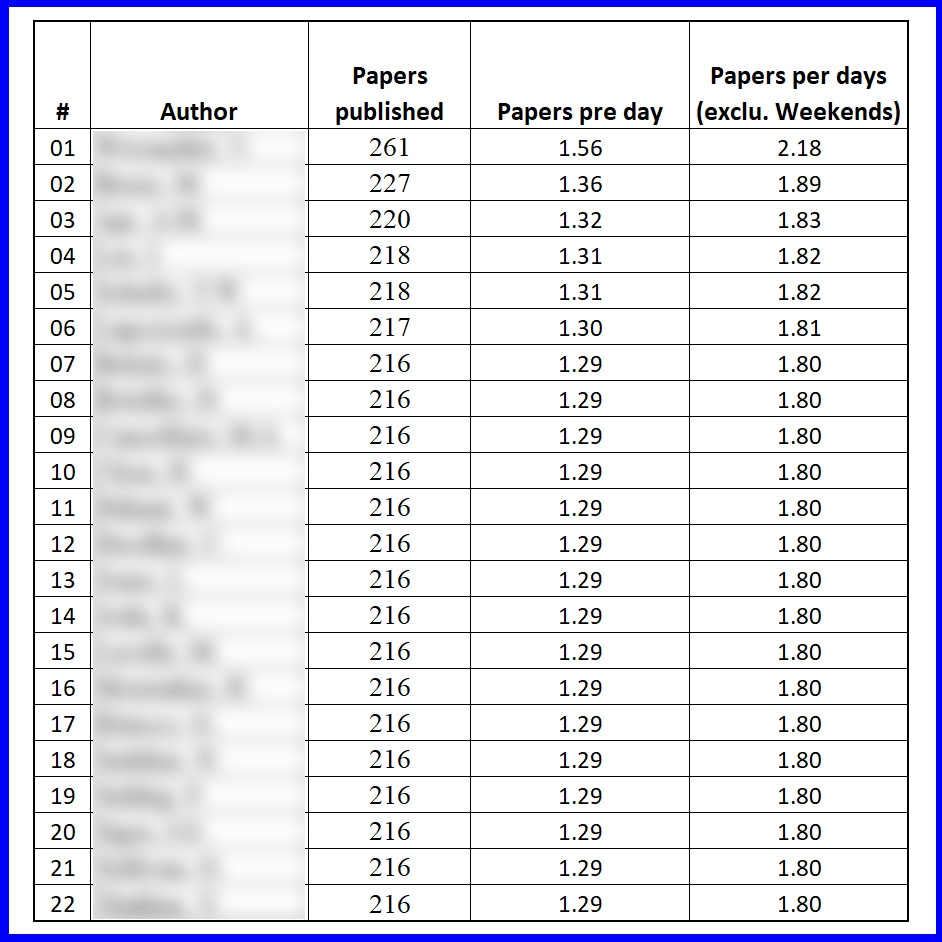
22 people have published more than 200 papers in 2024 (so far, we still have another six months to go)
We have been doing some research on another project and saw something that we found interesting. We'd be interested to know what you think.
In 2024, 22 authors (according to @Scopus) have published over 200 papers. The table below shows the details (we decided not to show author names at this time).
The author who has published the most papers has authored 261 papers (as at 15 Jun 2024) meaning that he/she has published 1.56 papers every day this year (and counting).
If we exclude weekends (everybody has to rest, right?), then they have published 2.18 papers every day.
Serious question: Is it possible for anybody to contribute in a meaningful way (at least to warrant being at author) when they are publishing a paper every day?