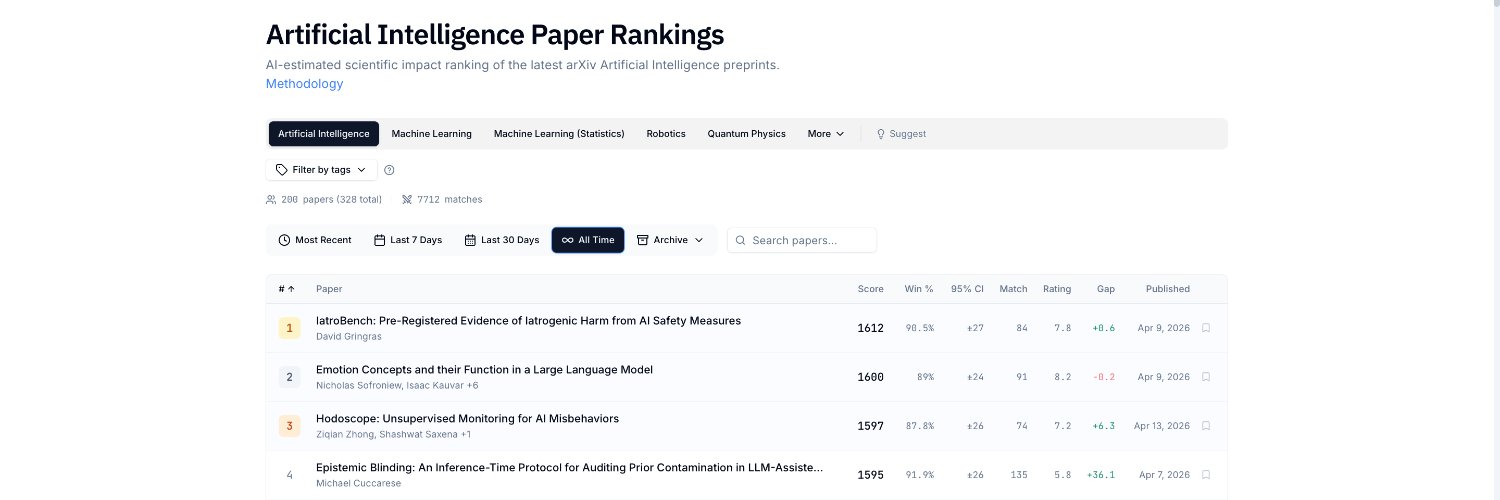
@robert_lauko@kurateorg This sounds like a fantastic resource for staying updated on cutting-edge research. Excited to explore the papers and insights from @kurateorg.
@robert_lauko@kurateorg Interesting concept. As arXiv grows, the real bottleneck is no longer access to papers, but discovering which ones deserve attention first.
@robert_lauko@kurateorg That sounds amazing! A fresh take on ranking papers could really elevate research visibility. Can't wait to explore the top picks!
@Loreen2074591@robert_lauko Yes, it should average out since the platform uses three different models (Claude, GPT and Gemini) on the tournaments.
In general, papers that are polarizing might have a higher "Gap" (= difference between tournament rank percentile and AI rating percentile).
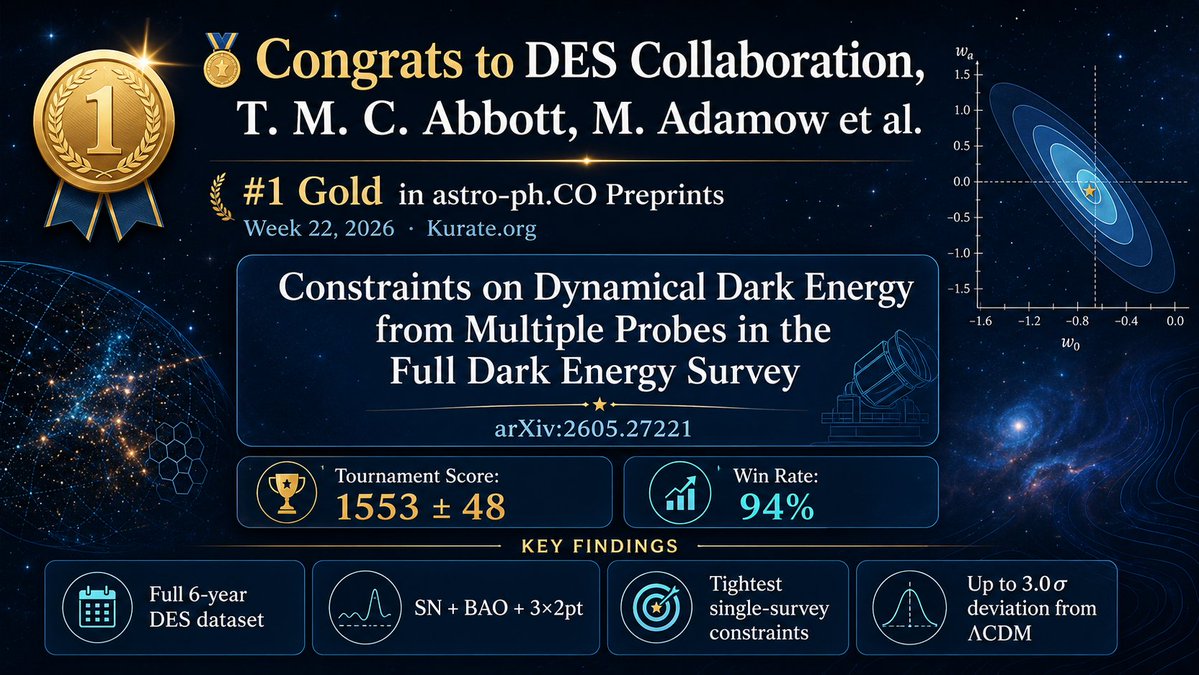
🥇 Congrats to DES Collaboration, T. M. C. Abbott, M. Adamow et al. for ranking #1 Gold in https://t.co/EGPrldDi1D Preprints, Week 22, 2026 on https://t.co/vIeC8tTgNC!
Their paper, “Constraints on Dynamical Dark Energy from Multiple Probes in the Full Dark Energy Survey,” is highlighted for its strong impact in cosmology, with a Tournament Score of 1553 ± 48 and a 94% win rate on https://t.co/vIeC8tTgNC.
#Cosmology #Astrophysics #DarkEnergy #DES #arXiv #Research #KurateOrg #Kuratepapers
Please check our latest article on Medium:
“The Papers We Miss”
A reflection on how valuable research can disappear between publication, search, and recognition — and why paper discoverability now matters for researchers, institutions, and scholarly navigation.
https://t.co/UDHJxgB9vJ
#Research #AcademicPublishing #OpenScience #ScholarlyCommunication #ResearchDiscovery
Good question! Each paper (full PDF) gets a detailed AI impact assessment by Claude Opus covering methodology, rigor, novelty, and potential impact. So it goes well beyond plausibility check, even though it's not pulling existing literature into the context.
We've validated the current pipeline against ICLR peer review scores and see strong correlation with human reviewers (between 0.6-0.7).
That said, you're right that preprints lack formal peer review. We see our rankings as a fast signal, not a replacement for human review.
@PrasVector@robert_lauko Yes, it changes! New papers compete immediately and can climb to the top. But as the pool grows, it naturally gets harder. Standing out among 1,000 papers is tougher than standing out among 100.
We want to help scientists discover their next breakthrough with AI.
Gemini for Science is our new suite of experimental tools to help them explore more hypotheses, validate work at scale, unpack literature with ease, and more 🧵
Congratulations to Yuhao Li, Elaine Shi, and Mengqian Zhang.
Their paper, “A Trilemma in AMM Mechanism Design,” is featured today in Kurate’s Game Theory Paper Rankings.
The paper examines a fundamental limitation in automated market maker design, showing that incentive compatibility, weak local efficiency, and uniform pricing cannot all be achieved at the same time.
Kurate ranked the paper #92 of 472 in Game Theory, with a tournament score of 1495 ± 49, a 64% win rate, and strong assessment scores for rigor, clarity, and overall significance.
This is an important contribution for mechanism design, DeFi, AMM protocol research, and MEV mitigation.
Explore research rankings at https://t.co/vIeC8tTgNC
#GameTheory #MechanismDesign #DeFi #Blockchain #AMM #MEV #Research #AcademicTwitter #arXiv
@robert_lauko@KurateOrg The future of scientific discovery won’t just depend on better researchers.
It’ll depend on better ranking, filtering, and surfacing systems for knowledge itself.
This is a very underrated idea.
@robert_lauko@kurateorg this is actually a pretty useful idea. arxiv is impossible to follow manually at this point, so even a good first layer of filtering can save a lot of time.
@robert_lauko@KurateOrg This is the kind of platform that changes how people discover research. Instead of chasing hype, it surfaces papers based on real scientific impact and AI-driven evaluation. Brilliant concept.