Enterprise payroll is expanding across chains. ZBCN stays connected to the activity across them.
On @Solana, payroll fees are paid in ZBCN. On other chains like @StellarOrg, the fees generated go toward ZBCN buybacks.
@simonb_ldn breaks down how it works. 👇
When Phase 2 goes live, the single supported asset is $FXRP, backed by XRP via FXRP on @FlareNetworks.
When you stake $stXRP, your capital backs cover in existing program vaults, and you accrue a share of protocol emissions plus potential emission boosts! 👇
GREAT NEWS: RFK Jr. says America now has a CURE for sickle cell anemia and he's working with Medicaid and Medicare and the private insurers to help patients access it.
FOR $XRP TRADERS ONLY!!!
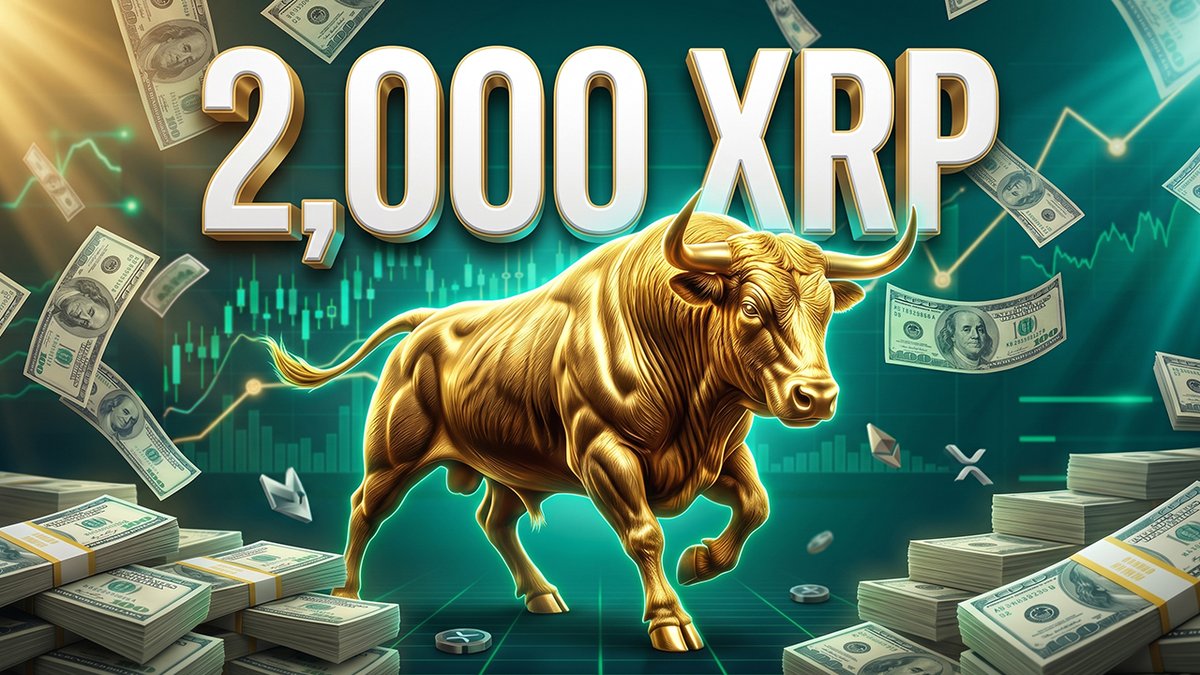
WHO WANTS TO WIN 2000 XRP???
IF INTERESTED LIKE, REPOST & COMMENT "XRP"
ONCE DONE I'LL SEND DM WITH INFO TO FOLLOWERS ONLY!!!!
🚨 CLARITY ACT INSIGHT 🚨
This is not normal pressure.
The White House is throwing serious weight behind the CLARITY Act before the August recess, with Scott Bessent, Patrick Witt, and Cynthia Lummis all pushing the bill forward.
The Council of Economic Advisers even released a report undercutting one of the banks’ biggest arguments around stablecoin yield and deposit flight.
That is not casual support.
That is the government’s economic machine lining up behind crypto regulation.
But Washington still has one wall left.
60 Senate votes.
And roughly 7 Democrats still need to move.
That is what makes this moment so important for $XRP and $XLM holders.
The strongest regulatory push crypto has ever seen is now meeting the hardest wall in politics.
So the real question is simple:
Who blinks first?
The pressure or the holdouts?
This is the blueprint institutions have been waiting for.
Permissioned lending. Native compliance. Open-source. On the $XRP Ledger.
Not a workaround built directly into the protocol. 🏦
XRP is no longer just an “alternative to SWIFT.”
It’s become a neutral, high-performance public settlement layer that institutions are actually plugging into as they reduce their reliance on the slow, expensive legacy correspondent banking system.
That’s what’s really going on.
Florida officials are ramping up anti-human trafficking efforts ahead of the 2026 FIFA World Cup
Attorney General @JamesUthmeierFL says prosecutions are up more than 50%, convictions have risen nearly 40%, and authorities have arrested more than 1,700 child predators
https://t.co/AEOmooRwZB
🇺🇸 SENATE EMERGENCY PUSH FOR CLARITY ACT
Senate leadership is holding emergency meetings this week to try and save the Clarity Act before the clock runs out.
CLARITY will finally give the US the crypto rulebook its been waiting for.
Did you know the last time $XRP shook everyone out, it delivered a 554x run in just a few months?
It's happening again. And this time it's bigger.
Back in Q4 2016, XRP got crushed down to $0.0054. Brutal. Holders panicked and sold. Then it exploded to $3.
That's a 55,455% gain. A 554x move for the people who held through the fear.
But here's what makes today completely different. In 2016, that run was pure speculation. Hype with almost no real-world use behind it.
Now? We're watching the full-scale adoption of the XRP Ledger unfold globally.
Mastercard settling on it. J
PMorgan and DTCC building on it.
RLUSD scaling across 40+ chains.
Tokenized assets crossing billions.
Banks across Europe, Asia, and Latin America plugging in.
So think bigger. The last 554x happened on a promise. This cycle is happening on actual infrastructure being adopted by real institutions.
The red candles are designed to shake you out before that gets priced in.
I'm not selling. I know what I hold.
Most people use AI like a slot machine.
One prompt. One answer. Then they blame the model when the work comes back shallow.
That is not how edge works.
A Stanford professor said AI writing gets way better when you stop asking one big question and start asking dozens, like a journalist.
That hit me because this is exactly how I think about crypto research.
One chart is not diligence.
One signal is not alpha.
One prompt is not a system.
The edge comes from the second, third, and tenth question. Who owns it? Who is selling? Where is liquidity? What breaks the thesis? What would prove me wrong?
AI rewards better operators, not lazier ones.