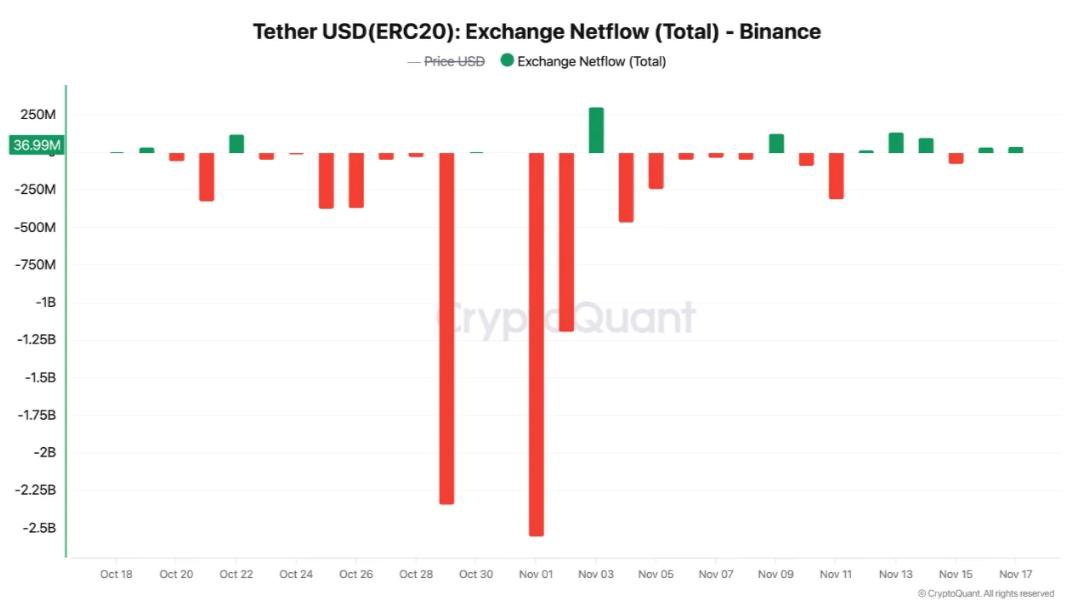
1/3 🧵 Binance Netflows: From Heavy Outflows to Normalisation
The outflows were real. But what happened afterward is equally important.
According to CryptoQuant, 29 October recorded one of Binance's largest Bitcoin outflow days.
Here's what followed:
📊 Bitcoin Netflows
• 29 Oct: -22.5K BTC
• 3 Nov: +5.2K BTC
• 9 Nov: +4K BTC
• 11 Nov: +2.7K BTC
• Latest reading: +118 BTC, near flat.
Withdrawals reopened on 1 November, and Binance netflows moved toward normal levels within days.
The USDT (ERC20) netflow chart provides additional context on stablecoin movements.
My takeaway: One day of heavy outflows doesn't tell the whole story. The following flows matter too.
Source: CryptoQuant.
Explore CryptoQuant's public charts and verify the Binance netflows yourself.
#Binance #CryptoQuant #CryptoMarket #Bitcoin #BTC #OnChainData
Digital asset prices are subject to high market risk and volatility. Not financial advice. Products and services mentioned may not be available in your region.
💳 Recntly I checked my Binance Card usage history, and it got me thinking: why keep crypto only for trading when it can also be useful for everyday spending?
That's one thing I find interesting about the Binance Card. It connects your crypto wallet with everyday payments, while this November brings some extra crypto cashback opportunities.
And there are offers for both new and existing cardholders. Let's break them down. 👇
🟡 1. New Binance Card users
Ordering a Binance Card during the campaign can qualify you for 50% cashback on your first eligible purchase, capped at 5 USDC.
For example, spend $10 on an eligible purchase and you could receive 5 USDC back.
This offer is limited to the first 80,000 eligible users who have not made a card transaction before 17 November.
🟡 2. Existing cardholders
Already using your Binance Card?
Spend more than $50 during the campaign and you can qualify for 5 USDC cashback.
This offer is limited to the first 10,000 users.
🟡 3. Black Friday Cashback Booster
There's also an extra 6% cashback on the portion of eligible spending above $1,000 during the campaign.
The reward is capped at 20 USDC per user, with a total reward pool of 250,000 USDC, available on a first-come, first-served basis.
For example, if eligible spending reaches $1,200, the amount above $1,000 is $200. Six percent of that is 12 USDC.
A useful detail: cash withdrawals, financial institution payments, government payments and gambling transactions don't count towards this booster.
⚠️ A few important things to remember:
• Total November cashback is capped at 100 USDC per user, including the regular monthly cashback programme.
• Rewards are limited, so not every eligible participant is guaranteed to receive cashback.
• You must complete identity verification, live in an eligible market and have received the campaign notification.
• Availability and eligibility depend on your market and the official Terms & Conditions.
For anyone exploring Binance Pakistan, crypto in Pakistan or ways to spend crypto instead of only trading it, the Binance Card is worth understanding.
My takeaway? The interesting part isn't simply earning cashback. It's seeing how a crypto wallet can become useful in everyday life, provided you understand the limits and use it responsibly.
📌 Campaign period: 17 November – 1 December 2026 (UTC)
Explore the official campaign and full Terms & Conditions:
https://t.co/koDLyYBOuD
Have you tried paying for everyday purchases with crypto, or do you still prefer keeping it mainly for trading? 👇
#Binance #BinanceCard #CryptoCashback #BlackFriday #CryptoCard #SpendCrypto #USDC #PayWithCrypto
Disclaimer: Offers are subject to eligibility, regional availability, reward limits and official Terms & Conditions. Rewards are not guaranteed. Digital asset prices are volatile. Not financial advice. Products and services may not be available in every region.
@nyra_one I like this shift from simply holding and trading crypto to making it useful in everyday life. Cashback is a nice bonus, but real-world utility is what makes crypto adoption more meaningful. 💳💛
@MirxBinance A good reminder for every crypto user. We focus so much on opportunities and market movements that we sometimes forget the importance of protecting what we already have. 🔒
@MadeehaAmjad117 Exactly! Strong platform safeguards and responsible user habits must work together. Security is a shared responsibility, not blind trust.
@MadeehaAmjad117 Exactly! Strong platform safeguards and responsible user habits must work together. Security is a shared responsibility, not blind trust.
6/7
🚨 Stay alert to crypto scams. Binance will never ask you to move funds to a "safe wallet" or share your 2FA codes.
Platform protection and personal responsibility go together.
Thread 1/3
1/3 🧵 🔐 Imagine waking up one morning, opening your crypto account and discovering that someone has been trying to access it.
Your first thought would probably be: Where are my funds? Is my account protected? What if someone gets access before I even notice?
This is exactly why I've started thinking about crypto security differently.
We spend so much time learning how to find opportunities in crypto, but we don't always spend enough time understanding how to protect what we already have.
And honestly, protecting a crypto account is much more than setting a password and hoping for the best.
Let's look at what happens behind the scenes and what we can do on our side.
1. Think of Binance security like an airport with multiple checkpoints.
When you enter an airport, there isn't just one security guard checking everything.
There are different layers. Identity checks, baggage screening, restricted areas and additional inspections when something looks unusual.
Crypto security works on a similar principle.
A strong security system shouldn't depend on one password, one private key or one security check.
Binance uses several layers of protection across its wallet infrastructure and account operations.
For example, most user funds are held in cold storage, which means offline wallets rather than wallets continuously connected to the internet.
A smaller amount stays in hot wallets to support normal withdrawal operations.
Moving funds also involves multiple approvals through multi-signature and MPC mechanisms.
There are additional operational safeguards, including withdrawal rate limits and manual reviews of large outflows.
Why does this matter?
Imagine someone manages to compromise one key. That shouldn't automatically mean they can move funds from a system that requires multiple authorized approvals.
It's the difference between having one key to an entire building and requiring several independent keys to access its most important rooms.
No system is completely risk-free, but multiple independent controls can reduce the impact of a single failure.
2. SAFU has a history worth understanding.
Many people recognize the word SAFU, but not everyone knows where it came from.
Binance established the Secure Asset Fund for Users in 2018 as an emergency reserve for extreme situations.
Think of it as an emergency fund rather than an everyday security feature.
Just as a household keeps savings for unexpected emergencies, SAFU exists to provide an additional financial protection mechanism for eligible platform-level incidents.
The distinction is important.
SAFU is not a personal insurance policy against every possible crypto loss.
If someone tricks you into revealing your 2FA code, sends you a fake support link or convinces you to transfer your assets to a scammer, you shouldn't assume SAFU will automatically reimburse you.
That's why understanding its actual purpose matters just as much as knowing its name.
3. Proof of Reserves: Transparency should come with verification.
Here's something I particularly appreciate about the idea behind Proof of Reserves.
In crypto, we often hear people say, "Trust the platform."
But shouldn't users also have a way to verify important claims independently?
That's where Proof of Reserves comes in.
Binance publishes reserve information that allows users to check whether their assets are included in the reported liabilities and whether the corresponding reserves cover those liabilities.
Two technologies make this possible:
🔹 Merkle Trees
Imagine a huge spreadsheet containing information about thousands or millions of accounts.
Instead of exposing everyone's individual information, a Merkle Tree organizes the data into a cryptographic structure and produces a single summary called a Merkle Root.
This allows an individual user to verify that their account was included in the published data.