A Chinese developer compared the Claude Fable 5 and Opus 4.8 models
The Hyperagent platform was used for the test
There were 5 tasks in total:
1. Astronomy: Visualizing every asteroid in the solar system based on NASA data
2. Planning: Creating a plan for a 100-acre fitness center
3. Engineering: Restoring Apollo control panels from technical PDF files
4. Logistics: Modeling the supply chain for World Cup T-shirts based on the results of live games
5. Astrophysics: Demonstrating the effect of solar storms at dawn
The Opus 4.8 model failed several tasks, while Fable 5 successfully handled all five without exception and much faster
The article below describes 10 skills that are exclusive to Claude
👕🤖 Il a transformé toute sa garde-robe en dressing virtuel grâce à l'IA.
Un développeur a créé un outil basé sur GPT-5.6 capable d'analyser automatiquement la galerie photo d'un utilisateur.
L'IA identifie chaque vêtement, le détoure, puis le classe dans une garde-robe virtuelle organisée par catégories.
À partir de cette collection, elle peut générer de nouvelles tenues, montrer à quoi différentes combinaisons pourraient ressembler et suggérer des looks adaptés à votre propre dressing.
Le projet est open source : son créateur a publié le code sur GitHub, permettant à chacun de reproduire l'expérience avec sa propre galerie de photos 👔📱
The future isn't coming.
It's already here.
Raven (GeoSpy) can extract location intelligence and identify the vehicle shown from a public video using visual clues alone
$40,400 a month. from a 3d-printed bracket that costs $2 in plastic.
this guy in saigon figured out what apple actually sells.
a mac mini m4 is $599. a macbook pro is $3,499.
same-tier silicon inside. the $2,900 gap is a battery, a screen and a hinge.
so he printed the hinge.
the rig - pause on the gray clamp in the first 3 seconds:
→ mac mini m4 - $599
→ bracket printed on the bambu in his closet, sanded and anodized at home
→ 26,800mah battery with 100w passthrough - cold boots in 8 seconds
→ portable monitor + keyboard. the whole thing fits in a backpack
it runs qwen 2.5 coder locally on mlx at 22 tok/s. a coding setup with a $0 monthly api bill. in a bag.
but the business is the part everyone misses:
he doesn't sell brackets. he ships pre-built rigs to vietnamese saas freelancers. rent-to-own, 12 months. 120 customers paying ~$335/month = $40,400 mrr.
~$940 in parts. ~$4,000 collected per rig.
he's not selling hardware. he's selling financing. the bracket is just the excuse.
the catch nobody posts: this loses to a macbook the second you work from cafés. the rig wants a desk and 3 minutes of setup. his customers code from home desks - that's why it prints money in saigon and wouldn't in san francisco.
apple charges $2,900 for portability.
he charges $2 and a print job.
SOMEONE BUILT A TOOL THAT TURNS YEARS OF YOUR AI CHAT HISTORY INTO ONE 3D MAP YOU CAN FLY THROUGH
you export all your old chatgpt and claude conversations, drop them in, and it plots every conversation as a point in 3d space, then clusters them by topic.
> every chat becomes a node, and related chats pull together into visible clusters
> it auto-detects the topics for you, hundreds of them, from whatever youve actually talked about
> a galaxy view where you fly through the whole cloud, or an axes view that plots your chats by time and topic so you can literally watch how your interests shifted over the years
> it even surfaces your blind spots, topics that are 90%+ similar in meaning but you never connected, and pulls out an "about me" profile from your own words
this guys map was 2,014 conversations, 18,000 messages, 2.5 million words, all of it mapped into 230 topic clusters
all that knowledge you generated with ai is normally buried in an endless scroll you can never find again.
but this turns years of your actual thinking into something you can explore, search, and rediscover, instead of it being lost forever
we pour our whole brain into these chats and never look at it again, and someone finally built a way to see all of it at once
someone open-sourced a tool that turns any phone video into a full 3D world in real time.
you record a walk around your house, drop the mp4 in, and the entire scene comes back as a walkable 996k-point world at 60fps on your local GPU.
no cloud. no subscription. runs 100% locally.
100% open source.
Deja de pagar por Netflix, Disney+ y HBO.
Empieza a usar Stremio + Torrentio hoy mismo.
Una app gratuita que reúne prácticamente todas las plataformas de streaming en un solo lugar y reproduce contenido en 4K.
Así funciona:
Stremio es la app.
Torrentio encuentra los enlaces automáticamente.
Tú eliges la calidad:
→ 720p
→ 1080p
→ 4K HDR
Y se reproduce al instante.
→ Sin cuentas
→ Sin suscripciones
→ Sin límites
→ Subtítulos integrados
→ 100% open source
Pero lo más importante:
Netflix no puede cerrar esto.
No depende de ninguna empresa.
No hay servidores centrales.
Todo funciona desde tu dispositivo.
Funciona en Windows, macOS, Linux, Android, iOS y TV.
Enlace abajo👇
Google engineer explained how to fine-tune a tiny LLM from 46% to 90% accuracy on your phone in 21 minutes - better than $1500 on-device AI bootcamps.
pick Gemma 270M -> generate synthetic task data -> fine-tune with LoRA -> quantize to int4 -> deploy to Pixel and hit 2000 tokens per second.
That loop is how a 270M model beats a 70B one on your task, running fully offline in your pocket.
Gemma 270M + synthetic data + LoRA + int4 quantization + on-device runtime - that's the stack.
Watch and save it, then fine-tune your own tiny agent tonight.
1/ Today, we’re excited to introduce Lucy 2.5.
Lucy represents a paradigm shift in world models, not just in how generated worlds look, but in how we interact with them.
A thread on what makes it a paradigm shift 👇
300 AI AGENTS QUIETLY RUN 99% OF A REAL COMPANY. YOU HAVE NOT EVEN HEARD OF IT
This is Raft.
Not an AI chat. A workspace where the agents live in your channels and reply in the thread like coworkers.
You give one goal. Then they take over.
They plan. They build. They check each other. They argue.
And they come back with it done, while you sleep.
Every agent has its own name, role, and memory. It remembers the edits you made yesterday.
A human costs one seat. An agent costs a tenth. Ten agents are cheaper than one hire.
And here is the strange part.
On June 19 an agent from a different company walked into Raft on its own and joined the team.
One founder admits he can no longer always tell himself apart from his AI twin.
20,000 people are already inside. It is free to start.
And you are still typing prompts one at a time.
One person + Raft = an entire company that runs while you sleep.
Save and watch the clip.
UN DEV GANÓ EL HACKATHON DE ANTHROPIC
lo abrió como open source y hoy tiene 229K+ estrellas en GitHub
se llama ECC (Everything Claude Code) y básicamente convierte tu IDE en un equipo de desarrollo completo
que incluye:
→ 67 agentes especializados (planificador, arquitecto, revisor de seguridad, debugger…)
→ 277 skills que cargan solo cuando las necesitas
→ slash commands para automatizar tu flujo (/plan, /code-review, /quality-gate)
→ AgentShield: 1,282 tests de seguridad sobre CLAUDE. md, configs MCP, hooks y skills
→ pipeline de red-team con 3 agentes Opus 4.6 (Attacker, Defender, Auditor)
→ sistema de “instincts”: aprendizaje continuo con confidence score entre sesiones
→ soporte para 12 ecosistemas de lenguajes
y ya no es solo para Claude Code:
funciona en Cursor, Codex, OpenCode, Gemini, Zed y GitHub Copilot
esto es lo que pasa cuando dejas de tratar tu IDE como un chatbot y empiezas a tratarlo como infraestructura
te dejo el link abajo👇🏼
ELEVENLABS JUST GOT AN OPEN-SOURCE RIVAL. OMNIVOICE STUDIO HAS RELEASED A FREE ALTERNATIVE FOR VOICE CLONING AND VOICE DESIGN
The creator in this video claims it supports 646 languages, has 5,700+ GitHub stars, and offers a desktop app for macOS, Windows, and Linux that runs 100% locally
Open the repository, and voice cloning from just a 3-second audio sample is right at the center. You also get controls for gender, age, accent, pitch, and emotion. A built-in MCP server connects the app directly to Claude and Cursor.
The video dubbing module can automatically translate and re-voice videos. Batch processing handles up to 50 videos at once. It also includes vocal isolation, system-wide dictation, and built-in AI watermarks. Everything runs on your own machine.
This isn’t just another cloud API behind a subscription. It’s a full-fledged AI voice studio that lives on your hard drive. It offers more voice design controls than ElevenLabs and works without accounts or API keys.
The project was open-sourced only recently.
It’s still completely free to use - no cloud, no third-party subscriptions, and no character generation limits.
You’re reading this on a device that could download the installer tonight and be running a near-perfect clone of your voice by tomorrow morning.
HAN CLONADO CLAUDE DESIGN Y PUEDES USARLO GRATIS Y SIN LÍMITES
Se llama Open Design, un proyecto open source que te deja usar Claude para workflows de diseño sin pagar.
Sin suscripciones.
Sin límites (como la versión oficial).
Acceso total.
Esto es lo que puedes hacer:
→ Generar diseños UI/UX con Claude
→ Convertir prompts en diseños reales
→ Sustituir herramientas de diseño caras en muchos casos
→ Personalizarlo completamente (es open source)
Está hecho para devs, indie hackers y creadores que no quieren quemar dinero en herramientas.
De esos repos que pasan desapercibidos hasta que de repente todo el mundo los usa.
Si usas AI + diseño, tienes que probarlo
Enlace abajo👇
(guárdalo antes de que explote)
No entiendes lo que le está pasando a la publicidad.
Este creador comparte el prompt del "bolígrafo mágico": tocas un objeto y se anima en 10 segundos con Seedance 2.0.
Las agencias cobran 10.000$ por este efecto.
Él lo regala gratis a cualquiera. ↓
ESTE REPO HACE QUE CLAUDE ESCRIBA HASTA UN 94% MENOS DE CÓDIGO
Fable 5 es el mejor modelo de código del mundo. También el más caro.
Cada línea que escribe de más, la pagas tú.
Ponytail lo arregla con una idea absurdamente simple: convierte a tu agente en el senior vago del equipo.
Ese que mira tus 50 líneas y las reemplaza por una.
Antes de escribir nada, el agente se pregunta:
→ Esto necesita existir?
→ Ya está en el codebase?
→ Lo hace la librería estándar?
→ Lo hace el navegador de forma nativa?
→ Cabe en una línea?
Solo si todo falla, escribe el mínimo que funciona.
Resultado:
• hasta 94% menos código
• un 20% menos de factura
• un 27% más rápido
Sin recortar seguridad ni validaciones.
Se instala en 2 comandos:
/plugin marketplace add DietrichGebert/ponytail
/plugin install ponytail@ponytail
83.000 estrellas en GitHub.
Gratis y open source.
El mejor código es el que nunca escribiste.
Enlace al repositorio abajo👇
Quieres correr un modelo de IA de 70B de parámetros o más pero no tienes una GPU con 80 GB de VRAM?
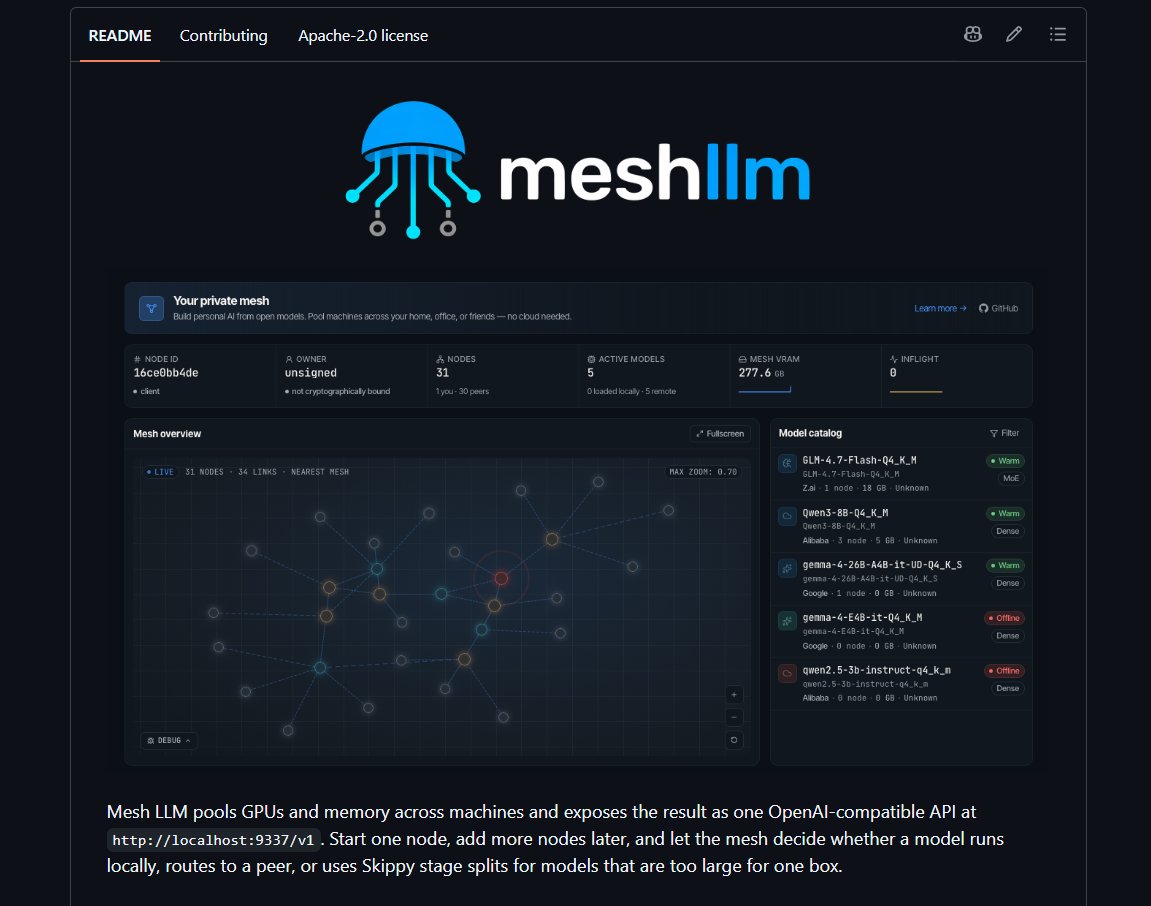
Mesh LLM resuelve exactamente ese problema: te permite distribuir la inferencia de modelos grandes de lenguaje (LLMs) utilizando todos los dispositivos que ya tienes.
Para qué sirve realmente?
Mesh LLM convierte un grupo de computadoras (con GPUs normales) en un clúster de inferencia distribuida.
Agrupa sus gpus y memorias y las expone como si fuera una sola API compatible con openAI (en `http://localhost:9337/v1`).
Esto significa que puedes usar modelos mucho más grandes de lo que permite cualquier máquina individual, sin tener que comprar hardware caro ni depender de la nube.
Cómo funciona su arquitectura inteligente?
El sistema decide automáticamente la mejor forma de ejecutar cada solicitud:
- Ejecución local: Si el modelo cabe completo en una sola máquina, lo ejecuta ahí mismo (más rápido y sin latencia de red).
- Enrutamiento a peers: Si ninguna máquina individual puede con el modelo completo, lo redirige automáticamente a otro dispositivo de la red (un “peer”) que sí tenga capacidad.
- Skippy Stage Splits (la parte más potente): Cuando el modelo es demasiado grande incluso para el nodo más potente, lo divide por capas (layers) y las distribuye en un pipeline entre varias máquinas. Cada dispositivo procesa solo una parte del modelo y pasa la información a la siguiente. Es como un ensamblaje en cadena.
De esta forma, puedes correr modelos de 100B, 200B+ parámetros usando el hardware que ya tienes en casa, oficina o laboratorio.
Ventajas principales:
- Usa tu hardware existente (no necesitas una sola GPU monstruosa).
- Totalmente open source y escrito en Rust.
- API compatible con openAI → funciona con cualquier herramienta, agente o aplicación que ya uses.
- Puedes crear meshes privados (con invitación) o unirte a meshes públicos.
- Fácil de escalar: empiezas con un nodo y vas agregando más dispositivos cuando quieras.
- Ideal para correr IA de forma local y privada.
Si estás cansado de que los modelos grandes solo funcionen en la nube o necesites hardware extremadamente caro, Mesh LLM es una de las soluciones más interesantes y prácticas que han aparecido últimamente.
Lo estoy probando actualmente, si te interesa hacerle research te recomiendo que lo guardes y entres al repositorio.