Cardano SPO · CRICH 🇰🇷
Min fee 170 ADA · 0% margin
Bare-metal BP · relays in EU & US
Digital asset strategy in finance
NightForce member · #Cardano#Midnight
CRICH is live on Cardano mainnet.
Bare-metal block producer with ECC memory.
Relays on two continents, EU and US.
Cold keys kept offline.
Fixed fee 170 ADA (the protocol minimum), 0% margin.
About 600K ADA of operator stake delegated.
First blocks possible from epoch 665 (Oct 31, 21:45 UTC).
Pool ID
pool1ezmnjmu9fw36ftprczhwhvqd60syaclpp74keu0yj7rty7r3dna
@jjtoconnor@realfi_co Good to see a Cardano asset in that top 10. How much of the 11.66% comes from the private-credit book versus the Treasury and money-market sleeve? The mix tells holders how durable that yield is.
Charles is building a new programming language for Cardano.
What would actually change for you as an ADA holder? Here's the full picture, from what you'd tap to what happens behind the screen.
First, what it is (and isn't)
• A language, not an app. You'll never use it directly, the same way you never "use HTML". You use websites built with it.
• Developers will write Cardano apps in it, like they use Aiken or Plutus today.
• Not AI "type in English, get code." It's built around two ideas: intents and zero-knowledge proofs.
• No name, code or release date yet. Charles says it runs on Cardano as it is today. No hard fork needed.
Who does what
• The language: the rulebook. "This ADA can only leave if the user gets at least 2,000 X within 10 minutes."
• Apps: wallets and DEXs (Lace, Eternl, VESPR, Minswap...) could build new screens with it.
• Solvers: independent operators who compete to fill your order.
• You: you keep using the app you already use.
Example 1: swapping ADA for a token
Today
1. Open a DEX like Minswap, pick the pair.
2. Set slippage and sign.
3. Your order waits for that DEX's batcher.
4. If the price moves past your slippage, it isn't filled. You cancel and retry.
With intents
1. Open the same wallet or DEX, once it adds intent-based swaps.
2. Fill in three fields: what you give (1,000 ADA), the minimum you want (2,000 X), how long the offer stays open (10 min).
3. Tap Swap. Your wallet signs that order, not one fixed route.
4. Solvers compete to fill it from any liquidity on Cardano. The best one sends you the tokens.
5. If nobody fills it in time, it expires and you keep your ADA.
You decide the outcome. The app finds the route.
Example 2: proving things without exposing yourself
Today
To use a KYC'd or region-restricted service, you upload your ID to each app. And once your wallet is linked to you, anyone can read your full history.
With zero-knowledge proofs
1. Get verified once. Your wallet stores the credential.
2. When an app asks "are you eligible?", tap Prove.
3. The app sees only the answer, like "verified, not in a restricted country" or "holds 10,000+ ADA". Not your name, balance or wallet.
Isn't this already a thing elsewhere?
Partly. That's what makes it interesting.
• Ethereum: intent swaps like UniswapX and CoW Swap are widely used, but as add-ons. ZK apps use separate languages (like Noir on Aztec).
• Solana: can verify the same type of proof (Groth16), but intents and privacy are built app by app in Rust.
• Anoma: built around intents and privacy with its own language (Juvix). Live on Ethereum via an adapter since Nov 2025, still little usage.
• Midnight: has its own privacy language, Compact, for the Midnight chain.
• ADA already swaps through NEAR Intents (since Sept 2025), but on NEAR's network, not inside Cardano apps.
What's different: one language for both ideas, native to Cardano's main chain, using features Cardano already has. And Cardano's transaction model already works on "only if these conditions are met". That's basically what an intent is.
What holders could see
• Swaps that work like limit orders across all of Cardano.
• One signature for multi-step actions, like swap then stake or lend.
• Compliant products (RWA, institutional DeFi) without handing over your wallet history.
• Airdrop and governance eligibility checks that don't expose who you are.
None of this is live yet. The point is the direction: the chain already supports it, the language gives builders the tools, and the apps you already use are where you'd see it.
@ItsDave_ADA Looks solid. One question on attribution: do you group holdings by stake credential or payment credential? Franken addresses make those two different people, so who holds it and who can move it can diverge.
Asked Charles whether his new language needs new ledger rules.
Answer: no. The last hard fork already gave Cardano what it needs.
My read: the bottleneck is no longer the chain. It's tooling and execution cost.
@CryptoRichBlog@tdedgx@rvcas Everything works on Cardano as of today. The last hard fork gave us everything we needed. I tested some of the ideas when I wrote a groth16 verifier back when secondfi got hacked
@IOHK_Charles@tdedgx@rvcas Clear, thanks. So the constraint is execution cost, not capability. Will the language aggregate Groth16 proofs, or is it one verification per transaction?
@Midnight_kor 좋은 지표네요. 그런데 ZK증명으로 에이전트가 본인이 에이전트인 사실만 스스로 밝히지 않는 한 집계를 어케 하죠 -_- 결국 '밝히기로 한 에이전트'만 세는 최소치가 될 텐데, 스스로 밝힐 이유는 어떻게 만드실 계획이 있으실지 궁금합니당. (가르침 부탁드림)
@JTelpner Good to see you writing again, Joel. "Who should make those decisions" is exactly what Cardano's on-chain governance tests in practice. Does faster rule-making strengthen legitimacy, or does legitimacy need some slowness built in?
@IOHK_Charles@tdedgx@rvcas Plutus V3 already ships BLS12-381 builtins, so Groth16 verification is possible on-chain today. Does the new language compile to UPLC like Aiken, or does intent settlement need new ledger rules?
@Cointelegraph@yoniassia@itsciaranlyons On America falling behind: eToro pulled ADA from US users in 2021 without any ruling, then relisted it in 2025. What changed, the law or the risk appetite?
@IntersectMBO A first worth noting. Was the 115K unspent because the work came in under budget, or because milestones weren't delivered? Those are two very different receipts.
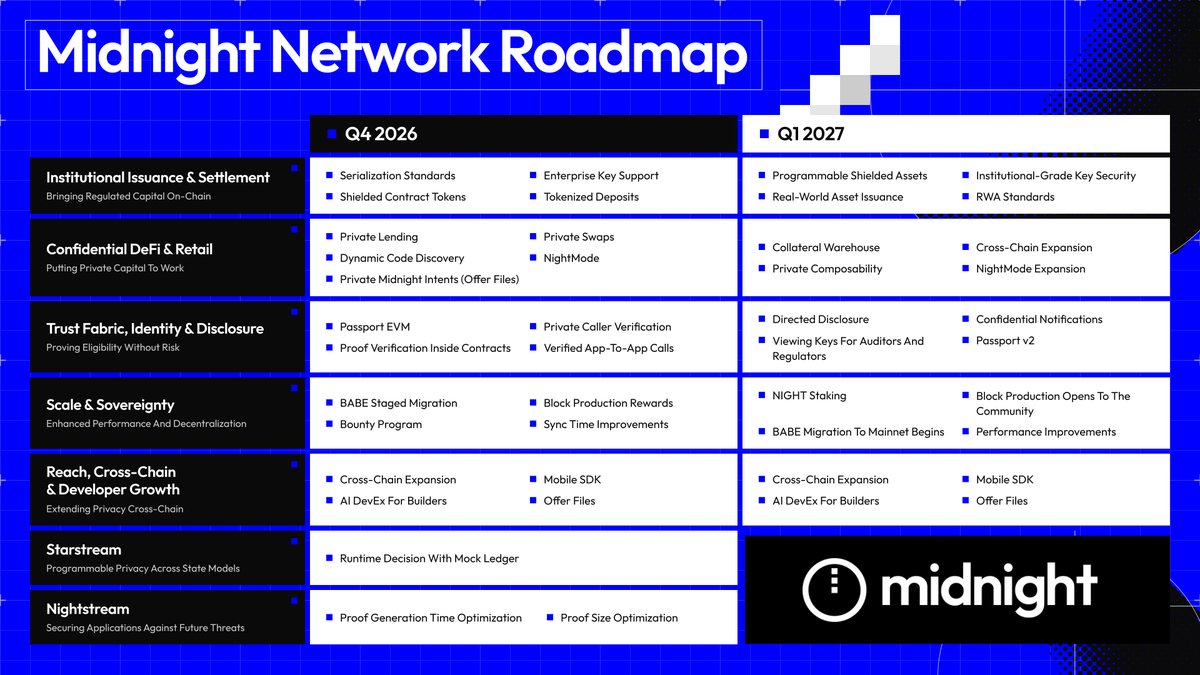
Midnight plans to open block production to Cardano stake pools in Q1 2027.
For delegators, the interesting part: it's the ADA delegation that counts. You don't need to hold NIGHT.
I plan to register CRICH the day it opens. No promises on NIGHT amounts until the rules are published.
What does it take to make privacy practical onchain?
The Midnight roadmap breaks it down across 7 areas of work, from confidential finance and digital identity to cross-chain development and next-generation proving infrastructure.
Here's a deeper dive 🧵👇
https://t.co/rr20pzkLv0
CRICH is live on Cardano mainnet.
Bare-metal block producer with ECC memory.
Relays on two continents, EU and US.
Cold keys kept offline.
Fixed fee 170 ADA (the protocol minimum), 0% margin.
About 600K ADA of operator stake delegated.
First blocks possible from epoch 665 (Oct 31, 21:45 UTC).
Pool ID
pool1ezmnjmu9fw36ftprczhwhvqd60syaclpp74keu0yj7rty7r3dna
지난 3월 SEC가 ADA를 비롯 디지털자산을 상품으로 분류한다는 '해석'을 내놓았는데, 8월에 공식적 법효력을 갖는 규칙안을 제정하겠다며 초안을 발표했습니당. SEC는 10.20일까지 의견접수를 받고 이를 반영하여 내년에 공표할 예정인 듯한데요, 근데 그 초안에는 어떤 코인이 상품이다. 라는 기준은 없고, 각주로 "지난 3월 해석 참조" 이런 식으로만 들어가있던게 다였어서, 이번에 스텔라, 헤데라, 앱토스, 아발란체, 카르다노, 체인링크 6개 재단이 함께 공동의견서를 제출했다 합니다. (해석서를 그대로 규칙제정 본문에 넣어달라)
PS 재단이 왠일이지. ㅎㅎ
.@chainlink is proud to partner with @hedera, @Aptos, @AvaLabs, and @StellarOrg in urging the SEC to codify its digital commodity framework.
Builders need lasting certainty. Codifying this progress would be a meaningful step toward keeping America the home of digital asset innovation.
H/t @jackson_mueller for leading this effort 🫡
이말이 갖는 의미가 이미 판세가 넘어왔다고 봅니다. ㅎㅎ
이런 말까지 했는데, "의견 들어봤더니 내가 맞아"라고 하기 더 어려워진거죠. 둘러 표현한겁니당.
톡방에서 누차 말씀드려왔습니다. 우리는 행정기관 관료의 입장을 생각해야하고 휘둘리지말자고. 장담할 순없지만 느낌상 그렇습니다.
Midnight 🤝 @dynamic_xyz, a @FireblocksHQ company
Dynamic has integrated Midnight across its non-custodial wallet infrastructure, making it easier to access Midnight apps through embedded wallets created with email or social login.
With “Login with Midnight” and support for external Midnight wallets, users can go from an email address to a shielded transaction without installing additional software.
And this is for the wider ecosystem, not just @midnightfdn projects. Teams already using Dynamic across EVM, Solana, Bitcoin, Stellar, Sui, TON and Aleo can add Midnight through their existing integration. Dynamic will maintain support as the network evolves, with documentation, tooling and implementation guides for builders.
Midnight is the first privacy-preserving blockchain supported by Dynamic, and early-stage projects can access Dynamic free for up to 10,000 monthly active users. 👏
Easier ways to build.
Fewer barriers to access.
Privacy built into the experience.