I think there will be Curve Wars 2.0. But not as a repeat of 2021.
Same game. Much higher stakes.
The first Curve Wars were framed as a yield farming meta. That was the surface. What actually happened, a war over who controls stablecoin liquidity and routing. That dynamic never went away. It just got quieter while the underlying infrastructure kept growing.
Now it’s back, for a reason.
Stablecoins are no longer a DeFi primitive. They’re becoming the foundation of onchain financial infrastructure. Settlement volume hit $33T in 2025, surpassing Visa and Mastercard combined. The FX market moves $9.6T daily, and onchain stablecoins are being positioned as a direct alternative. This is real. This is now.
Several structural shifts are accelerating this:
• Stablecoin supply keeps scaling globally, increasing the demand for deep, reliable liquidity
• Onchain FX is emerging, where stablecoin-to-stablecoin swaps become a core market function, not a side feature
• New monetary designs like $crvUSD and $frxUSD are live, integrating liquidity management directly into issuance mechanics
• Protocol treasuries and DAOs are treating liquidity positioning as a strategic balance sheet decision
• Crosschain ecosystems demand coordinated liquidity, not fragmented isolated pools
• DeFi is maturing from yield extraction toward settlement infrastructure, collateral mobility, and capital efficiency
The bottleneck is clear: deep, capital-efficient, reliable stablecoin liquidity.
@CurveFinance is still the most important coordination layer for this problem. Not because of hype. Because of design. AMMs built specifically for low-slippage stable swaps, a gauge system directing emissions toward strategic pools, veCRV locking long-term incentives, and years of deep integration with every major stablecoin issuer that matters.
2,209 new pools launched on Curve in 2025 alone. The machine is not slowing down.
Around Curve, a control layer has already fully formed,
• @ConvexFinance controls roughly 49% of all veCRV supply as of May 2026, meaning protocol-level influence over Curve emissions now runs almost entirely through CVX
• @FraxFinance has deployed $frxUSD into active PegKeeper pools on Curve, with the frxUSD PegKeeper reaching a monthly ATH near $200M in volume and already adopted as default stablecoin by 17 protocols. As today, Frax and @Tangent_fi’s USG/frxUSD pre deposit pool crossed $2,5M TVL through an recent $500k deployment by a well known market maker
• $crvUSD transforms Curve from a liquidity venue into a monetary system, where lending and liquidity are intertwined by design
• Stablecoin issuers actively compete for gauge weight, pool depth, and peg stability as a market share strategy
• Bridging and crosschain protocols coordinate around where liquidity sits and where it routes
What changes this time is not the mechanism. It’s the motivation.
2021 was mercenary capital chasing APY. Retail farming emissions. The meta shifted every week.
What’s emerging now is different. Protocols are optimizing for:
• Stablecoin market share and routing dominance
• Liquidity depth that doesn’t evaporate after incentives dry up
• Settlement-grade infrastructure and collateral mobility
• Treasury-level capital deployment with multi-year time horizons
Control over Curve liquidity is increasingly equivalent to control over how onchain dollars move. That’s a fundamentally different and more important layer than yield. It’s also less visible, which is why it’s easy to underestimate.
Markets tend to dismiss old narratives once the hype cycle ends. But when the underlying function becomes critical infrastructure, the mechanisms don’t disappear. They re-emerge as the operating system nobody talks about but everyone depends on.
Curve Wars were about extracting value from emissions.
Curve Wars 2.0 are about controlling the rails of onchain liquidity.
$1 in ve tokens such as $CRV, $YB, $PENDLE, $AERO pays x3-x7 than owning average buybacks
Even more: $UNI & $AAVE buybacks are >order of magnitude more expensive than any ve yield
Comparison: ve tokens vs. buybacks👇
Stillcore Capital @stillcorecap is proud to release our STATE OF TAO: January 2026 Report.
It is aimed primarily at people who know nothing about Bittensor.
It explains, in simple-speak, what Bittensor $TAO is and how it works, and then characterizes where the ecosystem is at today.
Hope you enjoy it!
Download PDF:
https://t.co/DSoFzVQyUL
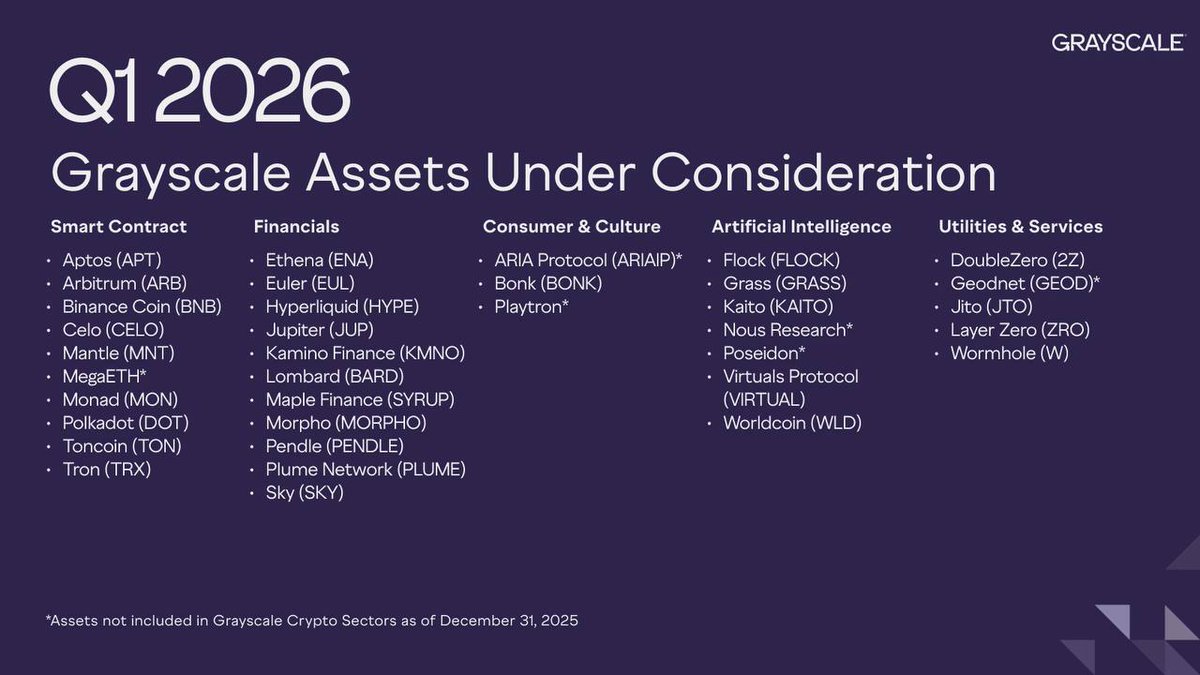
🚨 NEW: Grayscale updated its watchlist, adding BONK, ARIA Protocol, and Playtron as assets under consideration, while BAT, MANA, and DOGE remain in its product suite.
For the first time, institutions can move between BTC + USDCx, all on Bitcoin rails, without compromising on compliance.
That's the power of Stacks + @Circle xReserve.
“Ethereum was not created to make finance efficient or apps convenient. It was created to set people free”
This was an important - and controversial - line from the Trustless Manifesto ( https://t.co/QAvZfiNxpe ), and it is worth revisiting it and better understanding what it means.
“efficient” and “convenient” have the connotation of improving the average case, in situations where it’s already pretty good. Efficiency is about telling the world's best engineers to put their souls into reducing latency from 473 ms to 368ms, or increasing yields from 4.5% APY to 5.3% APY. Convenience is about people making one click instead of three, and reducing signup times from 1 min to 20 sec.
These things can be good to do. But we must do them under the understanding that we will never be as good at this game as the Silicon Valley corporate players. And so the primary underlying game that Ethereum plays must be a different game. What is the game? Resilience.
Resilience is the game where it’s not about 4.5% APY vs 5.3% APY - rather, it’s about minimizing the chance that you get -100% APY.
Resilience is the game where if you become politically unpopular and get deplatformed, or if a the developers of your application go bankrupt or disappear, or if Cloudflare goes down, or if an internet cyberwar breaks out, your 2000ms latency continues to be 2000ms.
Resilience is the game where anyone, anywhere in the world will be able to access the network and be a first-class participant.
Resilience is sovereignty. Not sovereignty in the sense of lobbying to become a UN member state and shaking hands at Davos in two weeks, but sovereignty in the sense that people talk about "digital sovereignty" or "food sovereignty" - aggressively reducing your vulnerabilities to external dependencies that can be taken away from you on a whim. This is the sense in which the world computer can be sovereign, and in doing so make its users also sovereign.
This baseline is what enables interdependence as equals, and not as vassals of corporate overlords thousands of kilometers away.
This is the game that Ethereum is suited to win, and it delivers a type of value that, in our increasingly unstable world, a lot of people are going to need.
The fundamental DNA of web2 consumer tech is not suited to resilience. The fundamental DNA of _finance_ often spends considerable effort on resilience, but it is a very partial form of resilience, good at solving for some types of risks but not others.
Blockspace is abundant. Decentralized, permissionless and resilient blockspace is not. Ethereum must first and foremost be decentralized, permissionless and resilient block space - and then make that abundant.
Pomp and I are back with the first episode of 2026.
2025 was dominated by AI and in the final two weeks saw a major acceleration.
We break it all down, preview what’s next for AI this year, and how BTC fits into the macro picture.
https://t.co/F1gzkl3eSJ
FX is finally coming to Curve.
The first pilot CHF<->USD liquidity pool is live on Ethereum, powered by $ZCHF from @frankencoinzchf and crvUSD, alongside some juicy CRV emissions (up to 100% APR currently).
Built on FXSwap, Curve's newest algorithm engineered for extremely efficient, deep liquidity on low-volatility assets - perfect for onchain foreign exchange.
https://t.co/Hv2pOF8c4l
1/ Most onchain lending systems liquidate you instantly the moment your collateral dips below a price.
One sharp candle and your entire position is gone. No time to react. No time to adjust.
Llamalend works differently.
https://t.co/tjMPiVScWm
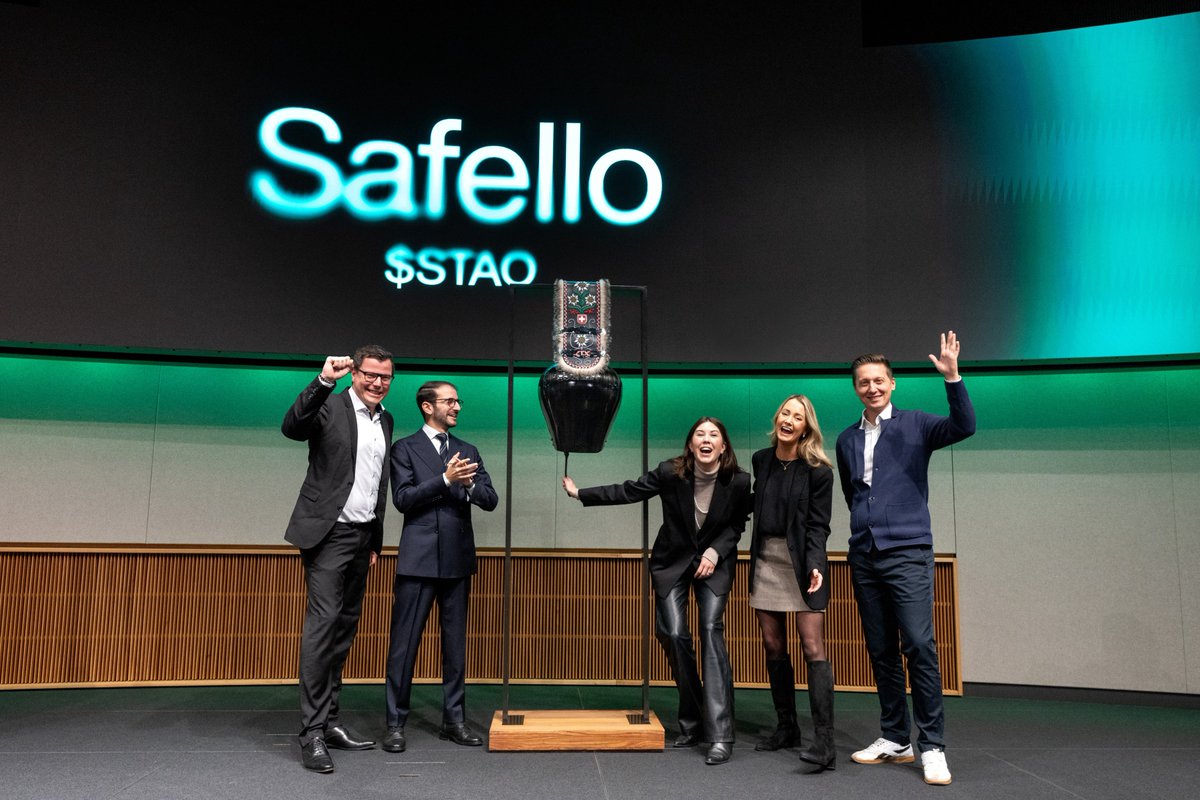
Safello's staked TAO ETP is now listed on SIX Swiss Exchange in Zurich 🚀
Europe now gets regulated access to Bittensor's $TAO via our physically backed, staked #ETP issued by @DDA_GmbH.
Safello Bittensor Staked TAO ETP (#STAO) trades in $USD and reinvests staking rewards ✨
Curious about what this Bittensor $TAO thing is all about?
Take some time this weekend to watch The Incentive Layer, a new documentary by @evert_scott
https://t.co/YdCtsrblU8
WTF is a doodle?
A brand of the future, @doodles doesn't just do one thing, it bobs and weaves through culture.
From their famous IRL events to partnerships, apparel, memes, music, animation, awards, and the legend himself @burnttoast, the doodles are everywhere that matters.