Yesterday was a pretty special day for me.
I finally hatched my Rally NFT, and I was lucky enough to get this beautiful bird. I honestly didn't expect to get one like this, so it made the moment even more exciting.
Whenever I receive something meaningful from a community I'm part of, I like to create artwork around it. So I spent some time making this illustration featuring my new Rally companion alongside Mochi from @GenLayer. It may be a simple piece, but it represents the beginning of another journey for me.
I'll definitely be staking this NFT and holding onto it. It's more than just a collectible to me. It reminds me that being active in communities, joining events, creating art and contributing consistently can lead to memorable moments like this.
Looking forward to seeing how the Rally ecosystem grows from here, and I'm excited to be part of the journey from the beginning.
Adventure begins today.
What did everyone else hatch? I'd love to see your Rally companions!
@RallyOnChain × @GenLayer
One thing that caught my attention this week was seeing PrismaX represented at Stanford's Robotics × Physical AI Founder-Investor Summit. Events like this are more than just networking opportunities they're where founders, researchers, investors and builders come together to discuss the real challenges of bringing Physical AI into everyday life.
The panel focused on one of the biggest questions in the industry today: How do you move from a working prototype to a product that people actually use?
Building a great demo is one thing, but creating something reliable, scalable, and valuable in the real world is a completely different challenge. That's where strategy, execution and community feedback become just as important as the technology itself.
What stood out to me is that @PrismaXai wasn't just attending the event it was part of the conversation. Sharing the stage with leaders from robotics and AI companies, while discussing go-to-market strategies, deployment and real-world adoption, shows that the project is engaging with the broader Physical AI ecosystem rather than staying inside its own bubble.
Another highlight was the incredible mix of people at the summit. Founders pitched their ideas, investors explored new opportunities, researchers shared the latest developments, and industry experts exchanged perspectives on where Physical AI is heading next. It's encouraging to see these conversations happening because innovation grows much faster when different parts of the ecosystem work together.
In my opinion, this is exactly the type of exposure that benefits a project in the long run. Instead of focusing only on announcements, PrismaX is participating in discussions that shape the future of robotics and AI. Learning from experienced founders, collaborating with researchers and exchanging ideas with industry leaders creates a stronger foundation for sustainable growth.
The future of Physical AI won't be defined by the most impressive prototype it will be defined by products that solve real problems and can be deployed at scale. Seeing PrismaX involved in conversations around deployment, commercialization and adoption makes me even more interested in following its journey.
A big thank you to CNPYNetwork and IntelliPro Pitch for organizing the summit, and to Robert Zhang and all the panelists for sharing valuable insights. Looking forward to seeing how these conversations translate into real-world innovation.
Know more about PrismaX
Join Discord : https://t.co/v8PUkTAyCw
Every great builder starts by learning.
Today, Mochi isn't reading just another book.
It's opening the pages of Internet Court.
Not for answers...
But for better questions.
How do we build trust between humans and AI agents?
How should autonomous agents represent our intentions?
What kind of permissions should they have?
How do we create systems that are transparent, verifiable, and fair?
These aren't problems we'll solve overnight, but every Internet Court discussion feels like another chapter toward that future.
What I enjoy most isn't that every question has an answer.
It's that every conversation challenges the way I think about AI, Web3, identity, governance, and the infrastructure we'll need as autonomous agents become part of everyday life.
Knowledge compounds.
Every livestream...
Every debate...
Every perspective...
Another page added to the book.
Maybe that's how the future is written not by one person, but by a community willing to question, learn and build together.
Today's lesson: Stay curious. The future belongs to those who never stop learning.
@GenLayer@courtofinternet
I've been thinking about one idea from the latest Internet Court discussion.
Everyone talks about making AI agents smarter.
But maybe intelligence isn't the biggest challenge anymore.
The real challenge is control.
If an AI agent is going to act on your behalf, where do you draw the line?
Would you trust it to swap tokens while you're asleep?
Would you let it renew subscriptions automatically?
Could it negotiate the best price for something you want to buy?
What if it accidentally spends more than you expected?
That's why the discussion around delegated permissions feels so important.
Instead of asking users to trust an AI with everything, we can define exactly what it's allowed to do.
Not unlimited access.
Not zero access.
Just the right amount of permission for a specific task.
To me, that's how Agentic Commerce becomes practical instead of risky.
I think the next generation of wallets won't simply store assets.
They'll become control centers where users decide what their AI agents can do, when they can do it, and under what conditions.
That shift feels much bigger than adding another feature.
It changes the relationship between humans, AI, and digital ownership.
@courtofinternet always leaves me with more questions than answers, and honestly, I think that's the best kind of discussion.
How much authority would you give your AI agent today?
@GenLayer
New milestone unlocked in GenLayer Synapse!
Happy to share that I've earned the Synapse role in the GenLayer community!
Every role represents more than just a badge it reflects consistency, participation, and the time spent learning alongside an amazing community. Since I started exploring @GenLayer , I've been diving deeper into the ecosystem through the Portal, GenLayer Studio, community events, quizzes, POAPs and creating content to better understand what the project is building.
Receiving the Synapse role motivates me to keep contributing and stay active. There is still so much to learn about Intelligent Contracts, AI-powered consensus, and the future GenLayer is working toward, and I'm excited to continue that journey.
A big thank you to the GenLayer team and everyone in the community for making it such a welcoming place to learn, build, and grow together.
This is another milestone, but definitely not the destination. More learning, more contributions and more community involvement are ahead.
Onward to the next role!
It's always motivating to see dedicated community members move forward in the PrismaX progression system. Congratulations on earning the Assistive role! 🎉
Every role in @PrismaXai represents more than just a badge. It reflects consistent participation, valuable contributions and a willingness to learn about the future of Physical AI. Progress like this doesn't happen overnight it comes from showing up, engaging with the community, and supporting the project's vision over time.
In my opinion, PrismaX has one of the more meaningful community progression systems because it encourages long-term involvement instead of short-term activity. Advancing through the roles feels like earning trust within the ecosystem rather than simply collecting titles. That's something I genuinely appreciate.
Seeing more members reach new milestones is a positive sign that the community is growing stronger. Every contribution whether it's creating educational content, joining discussions, validating data or helping others plays a part in building the ecosystem.
Congratulations once again on reaching Assistive! Wishing you the best as you continue your journey toward Proactive and beyond. Looking forward to seeing even more contributions in the PrismaX community.
@MaxC16134
Not every moment in Web3 has to be about charts, transactions, or shipping the next feature.
Sometimes the strongest progress happens when you step away for a while.
That's the feeling I wanted to capture with this little piece of art.
Mochi is sitting under a tree, backpack beside it, eyes closed, enjoying the breeze. It isn't doing nothing it is recharging. Every builder, contributor, artist, developer, moderator and community member needs moments like this.
I've spent months creating art, joining quizzes, participating in discussions, learning from the community and trying to contribute wherever I can. One thing I've realized is that creativity doesn't come from forcing ideas. It comes from curiosity, patience and giving yourself room to think.
Nature has always been one of the best reminders of that. Trees don't rush to grow. Flowers don't bloom overnight. Yet, with time and consistency, they become something beautiful.
I think building @GenLayer feels similar.
Every discussion, every Internet Court session, every Genfren Quiz, every AMA, every community contribution and every piece of feedback is like planting another seed. Alone they may seem small, but together they're helping grow something much bigger than any one of us.
So today, instead of rushing, Mochi chose to rest.
Not because the journey is over...
But because tomorrow there will be more to build, more to learn, and more adventures waiting.
Sometimes slowing down isn't falling behind.
It's preparing for the next leap forward.
What's your favorite place to clear your mind when you need fresh ideas? 🌳💜
@RuzgarFlns
Meow details are here!
🗓 July 15
⏰17:00 UTC
🎟 Supply: 2,222
🌊Launchpad: OpenSea
Set your reminder, See you at mint
Last chance to secure a whitelist spot
Submit your wallet:
https://t.co/1S0HMVNlcL
success = community
help us summon more believers and spread the message. follow your fellow cats. more of us, louder we purr
light a candle, join the cult: https://t.co/PzHlitFE0t
new cult. new order. new success. tomorrow. =^.^=
GenFrenzy Quiz is happening today!
Time to put your @GenLayer knowledge to the test and learn something new alongside the community.
Join the GenFrenzy Quiz hosted by @xtrabee and @Moriarty it's always a fun way to explore the ecosystem, challenge yourself, and connect with fellow builders.
🕜 Time: 1:30 UTC
Whether you're just starting your GenLayer journey or you've been following the project for a while, every quiz is a chance to discover something new and improve your understanding.
I'll definitely be joining. Looking forward to seeing everyone there and wishing the best of luck to all participants!
Every time I learn more about PrismaX, I become more interested in the direction it's taking. Most conversations about AI focus on software that understands text or generates images, but @PrismaXai is solving a different challenge helping AI understand and interact with the physical world. For robots, reading information isn't enough. They need to experience movement, objects, and real environments to improve, and that starts with high-quality real-world data.
What I like about PrismaX is that it doesn't just talk about the future of robotics; it's building the foundation that future depends on. From collecting robot demonstrations to validating data quality, every part of the ecosystem contributes to creating better datasets for smarter AI models. It's a practical approach that connects technology with real-world applications instead of just theory.
In my opinion, projects like PrismaX deserve more attention because they're addressing a problem that many people overlook. We often celebrate breakthroughs in AI models, but we rarely think about the quality of the data those models are trained on. Better data leads to better decisions, safer robots and more capable AI systems. That's why I believe data quality will become one of the most valuable parts of the Physical AI ecosystem.
I'm excited to keep following PrismaX's journey and learn more as the project grows. We're still in the early stages of Physical AI, and it's interesting to watch a project that's building the infrastructure needed to make intelligent robotics more practical for the future.
Better data. Better robots. Better future.
Robots don't improve because they collect more data. They improve because they learn from better data.
Every robot demonstration is a potential lesson, but not every lesson deserves to become part of an AI model.
A task can be completed successfully while still teaching the wrong habits hesitant movements, inefficient paths, unnecessary adjustments, or unsafe object handling. If those examples make it into the training set, the robot doesn't just remember them it repeats them.
This is where validation becomes one of the most valuable stages in the entire data pipeline.
Validation isn't simply asking "Did the robot finish the task?" It's asking whether the behavior represents the standard we want future robots to follow.
A strong validation process examines questions such as:
• Did the robot accomplish the intended objective?
• Were its actions deliberate, stable and efficient?
• Was every interaction with the environment accurate and safe?
• Is this demonstration valuable enough to improve future models?
Quality becomes even more reliable when multiple human reviewers independently evaluate the same demonstration. Agreement across reviewers creates a stronger signal, reducing bias and filtering out demonstrations that don't meet the required standard.
In robotics, the real advantage isn't collecting millions of recordings.
It's building a dataset where every accepted example has earned its place.
Reliable data leads to reliable models.
And reliable models are what ultimately make Physical AI capable of operating in the real world.
@PrismaXai@vivianrobotics
Yesterday was a pretty special day for me.
I finally hatched my Rally NFT, and I was lucky enough to get this beautiful bird. I honestly didn't expect to get one like this, so it made the moment even more exciting.
Whenever I receive something meaningful from a community I'm part of, I like to create artwork around it. So I spent some time making this illustration featuring my new Rally companion alongside Mochi from @GenLayer. It may be a simple piece, but it represents the beginning of another journey for me.
I'll definitely be staking this NFT and holding onto it. It's more than just a collectible to me. It reminds me that being active in communities, joining events, creating art and contributing consistently can lead to memorable moments like this.
Looking forward to seeing how the Rally ecosystem grows from here, and I'm excited to be part of the journey from the beginning.
Adventure begins today.
What did everyone else hatch? I'd love to see your Rally companions!
@RallyOnChain × @GenLayer
Robots don't improve because they collect more data. They improve because they learn from better data.
Every robot demonstration is a potential lesson, but not every lesson deserves to become part of an AI model.
A task can be completed successfully while still teaching the wrong habits hesitant movements, inefficient paths, unnecessary adjustments, or unsafe object handling. If those examples make it into the training set, the robot doesn't just remember them it repeats them.
This is where validation becomes one of the most valuable stages in the entire data pipeline.
Validation isn't simply asking "Did the robot finish the task?" It's asking whether the behavior represents the standard we want future robots to follow.
A strong validation process examines questions such as:
• Did the robot accomplish the intended objective?
• Were its actions deliberate, stable and efficient?
• Was every interaction with the environment accurate and safe?
• Is this demonstration valuable enough to improve future models?
Quality becomes even more reliable when multiple human reviewers independently evaluate the same demonstration. Agreement across reviewers creates a stronger signal, reducing bias and filtering out demonstrations that don't meet the required standard.
In robotics, the real advantage isn't collecting millions of recordings.
It's building a dataset where every accepted example has earned its place.
Reliable data leads to reliable models.
And reliable models are what ultimately make Physical AI capable of operating in the real world.
@PrismaXai@vivianrobotics
A little late, but I still wanted to celebrate this. 🇺🇸🤖
I really liked how PrismaX gave the fleet a patriotic touch with today's red, white and blue setup. It's a small detail, but it makes the robots feel a little more connected to the community behind them.
One thing I've come to appreciate about PrismaX is that it isn't just about showcasing robots it's about giving people the chance to interact with them through live teleoperation and contribute to the future of Physical AI.
Every live-control session helps generate valuable real-world data, allowing robots to learn from real interactions instead of relying only on simulations.
That's what makes this project exciting to me. Every session, no matter how small, helps build toward smarter and more capable robots.
Even though I'm a bit late posting this, I still wanted to wish everyone who celebrated a Happy 4th of July!
Here's to more learning, more innovation and more progress in Physical AI.
@PrismaXai@vivianrobotics
A little late, but I still wanted to celebrate this. 🇺🇸🤖
I really liked how PrismaX gave the fleet a patriotic touch with today's red, white and blue setup. It's a small detail, but it makes the robots feel a little more connected to the community behind them.
One thing I've come to appreciate about PrismaX is that it isn't just about showcasing robots it's about giving people the chance to interact with them through live teleoperation and contribute to the future of Physical AI.
Every live-control session helps generate valuable real-world data, allowing robots to learn from real interactions instead of relying only on simulations.
That's what makes this project exciting to me. Every session, no matter how small, helps build toward smarter and more capable robots.
Even though I'm a bit late posting this, I still wanted to wish everyone who celebrated a Happy 4th of July!
Here's to more learning, more innovation and more progress in Physical AI.
@PrismaXai@vivianrobotics
PrismaX × Galxe: Building the Foundation for Physical AI
The collaboration between @PrismaXai and @Galxe isn't just another campaign it's an opportunity for the community to participate in something much bigger.
The First 100 Validators initiative represents the beginning of community-driven data quality standards for robotics and Physical AI.
We often talk about powerful AI models and advanced robots, but one thing is becoming increasingly clear: better models start with better data.
Physical AI is different from traditional AI.
Language models learn from text and digital content, but robots need real-world experiences. They need demonstrations, movements, interactions, and high-quality training examples that reflect how tasks are actually performed in the physical world.
That's why validation matters.
Human judgment can identify things that automated systems still struggle with:
Was the task completed naturally?
Were the robot movements smooth and intentional?
Is this demonstration valuable enough to train future models?
Does this data improve diversity and learning quality?
The people answering these questions are helping build the future intelligence of robotics systems.
Personally, this is one of the reasons why I find PrismaX interesting.
The project isn't only talking about Physical AI—it's creating the infrastructure that supports it. From operators collecting demonstrations to validators maintaining quality standards, every participant contributes to a larger ecosystem designed for real-world AI applications.
The partnership with Galxe also brings more opportunities for community members to get involved through quests, rewards, and recognition.
$2,500 Prize Pool
Up to 35,000 Prisma Points
A chance to become one of The First 100 Validators
But beyond the rewards, I think the real value is being part of the early foundation.
The first people helping establish data standards today could influence how robotics datasets are evaluated tomorrow.
The future of AI won't only exist on screens.
It will move.
It will interact with the physical world.
It will assist humans in everyday tasks.
And all of that begins with quality data and communities willing to help build the next generation of intelligent systems.
Excited to see how The First 100 journey unfolds and wishing everyone participating the best of luck!
Join the campaign and become part of the future of Physical AI.
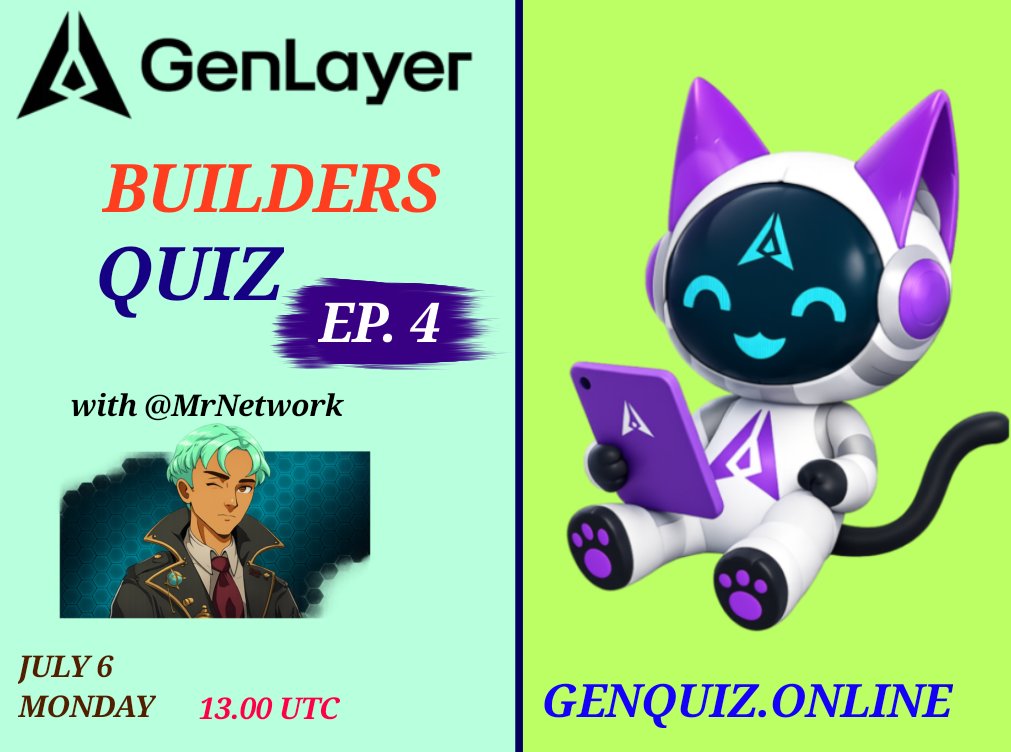
Builders Quiz Ep. 4 is almost here!
Time to put your GenLayer knowledge to the test and compete with fellow builders.
📅 Monday, July 6
⏰ 13:00 UTC
🎙️ Hosted by @encrypt_wizard
Quiz code will be shared in the GenLayer Discord (games-hub) before the event starts.
https://t.co/VrK93Yg4dZ
Whether you're just getting started or have been exploring the ecosystem for a while, it's a great chance to learn something new, challenge yourself, and earn XP.
I'll be there see you at the quiz!
@GenLayer
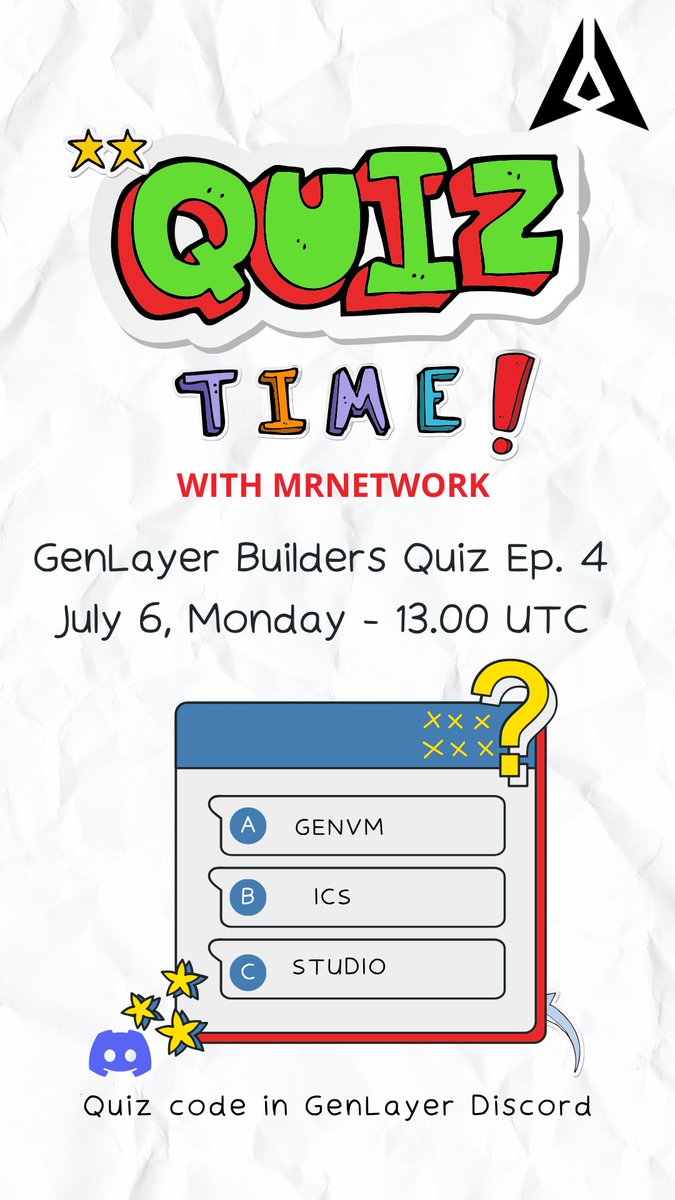
GenLayer Builders, it’s quiz time once again! 🔥
join me, for Episode 4 this Monday, July 6 at 13:00 UTC;
test your knowledge, compete with fellow builders, and stand a chance to win XPs
the quiz code will be shared in the @GenLayer discord (games-hub channel), before the quiz starts
quiz venue: https://t.co/EHt2c6Dz3L
will you be there?👀
A fun collaboration deserves a fun piece of artwork
Ever since I saw the collaboration between @GenLayer and @RallyOnChain , I wanted to create something simple that represents both communities. Instead of making a complex design, I imagined Mochi and the Rally mascot doing what every excited community member would do before a big event... taking a selfie together.
To me, this artwork represents more than just two mascots. It represents two communities coming together to build, create, and celebrate new ideas in Web3. Small moments like these are what make collaborations feel alive.
With the Rally NFT Mint getting closer, the excitement is definitely building. If you've been following Rally or GenLayer, this is an event you won't want to miss.
Mint Reminder
• Date: July 7
• Time: 16:00 UTC
• Total Supply: 3,000 NFTs
This artwork is my small way of celebrating the partnership and the upcoming mint. Wishing the best to both communities, and I can't wait to see everyone on mint day!
Rally is dropping its NFT collection on @opensea on July 7.
We are very proud to see this project growing so fast. All of you already know Wingston well. Time to mint him.
PrismaX × Galxe: Building the Foundation for Physical AI
The collaboration between @PrismaXai and @Galxe isn't just another campaign it's an opportunity for the community to participate in something much bigger.
The First 100 Validators initiative represents the beginning of community-driven data quality standards for robotics and Physical AI.
We often talk about powerful AI models and advanced robots, but one thing is becoming increasingly clear: better models start with better data.
Physical AI is different from traditional AI.
Language models learn from text and digital content, but robots need real-world experiences. They need demonstrations, movements, interactions, and high-quality training examples that reflect how tasks are actually performed in the physical world.
That's why validation matters.
Human judgment can identify things that automated systems still struggle with:
Was the task completed naturally?
Were the robot movements smooth and intentional?
Is this demonstration valuable enough to train future models?
Does this data improve diversity and learning quality?
The people answering these questions are helping build the future intelligence of robotics systems.
Personally, this is one of the reasons why I find PrismaX interesting.
The project isn't only talking about Physical AI—it's creating the infrastructure that supports it. From operators collecting demonstrations to validators maintaining quality standards, every participant contributes to a larger ecosystem designed for real-world AI applications.
The partnership with Galxe also brings more opportunities for community members to get involved through quests, rewards, and recognition.
$2,500 Prize Pool
Up to 35,000 Prisma Points
A chance to become one of The First 100 Validators
But beyond the rewards, I think the real value is being part of the early foundation.
The first people helping establish data standards today could influence how robotics datasets are evaluated tomorrow.
The future of AI won't only exist on screens.
It will move.
It will interact with the physical world.
It will assist humans in everyday tasks.
And all of that begins with quality data and communities willing to help build the next generation of intelligent systems.
Excited to see how The First 100 journey unfolds and wishing everyone participating the best of luck!
Join the campaign and become part of the future of Physical AI.
The First 100 Validators journey has officially begun!
PrismaX has partnered with Galxe to launch one of the most exciting community campaigns so far:
$2,500 Prize Pool
Up to 35,000 Prisma Points
A chance to become one of The First 100 Data Quality Validators
And honestly, I think this is much bigger than just rewards.
For me, this represents the beginning of community-driven standards for Physical AI.
Everyone talks about building smarter robots, but very few people talk about what actually makes intelligent robots possible in the first place: high-quality training data.
The reality is simple.
No matter how powerful the hardware becomes or how advanced AI models get, they can only learn from the data we give them.
Bad data creates bad habits.
Great data creates better intelligence.
That's why I find the validator system so interesting.
Validators aren't simply clicking buttons or completing random tasks. They're helping decide which robot demonstrations are truly valuable for training future AI systems.
They're asking questions like:
Was the task completed correctly?
Were the robot movements smooth and natural?
Would this be good behavior for an AI model to learn from?
Does this data add diversity instead of repeating existing patterns?
These human judgments are things that algorithms alone still struggle to understand.
And that's why people remain an essential part of the AI development process.
What I love about PrismaX is that the community isn't sitting on the sidelines watching innovation happen.
The community is becoming part of the infrastructure itself.
Operators generate data.
Validators maintain quality.
Companies train better models.
Those better models eventually lead to smarter robots that can work in the real world.
It's a complete ecosystem, and every participant contributes to making Physical AI stronger.
The First 100 isn't just a title.
It's an opportunity to help establish the first community standards for robotics data quality and to be part of something that could grow much larger in the years ahead.
My personal view is that the future of AI won't be limited to conversations on screens.
AI will move.
AI will interact.
AI will perform physical tasks.
AI will work alongside humans.
But for that future to become reality, we need massive amounts of reliable, high-quality, real-world data.
Projects that focus on solving that challenge are incredibly important and that's one reason why I'm following PrismaX so closely.
Good models start with good data.
Good data starts with people.
And the first generation of validators is helping build that foundation today.
Good luck to everyone competing for The First 100!