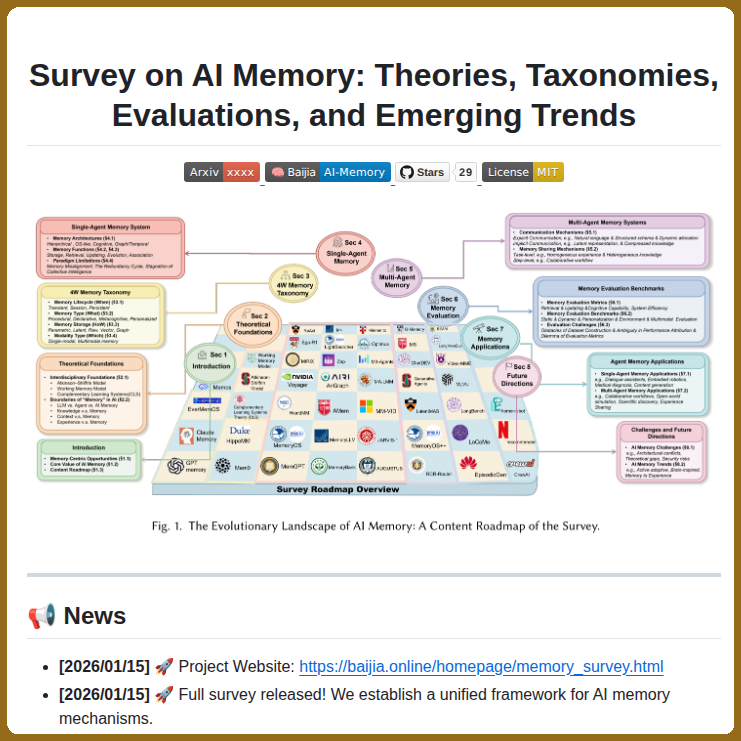
Anthropic just dropped a 13-page PDF on Agent Memory - 5 layers that cut token cost 90% and make your agent actually learn:
here's the 5-layer memory architecture:
layer 1 → working memory - the context window. everything the agent sees right now. when it fills up, old context dies. most agents stop here and wonder why they're broken
layer 2 → episodic memory - what happened. full interaction logs with timestamps. the agent recalls that the deploy failed Tuesday at 3am because the migration script had a typo
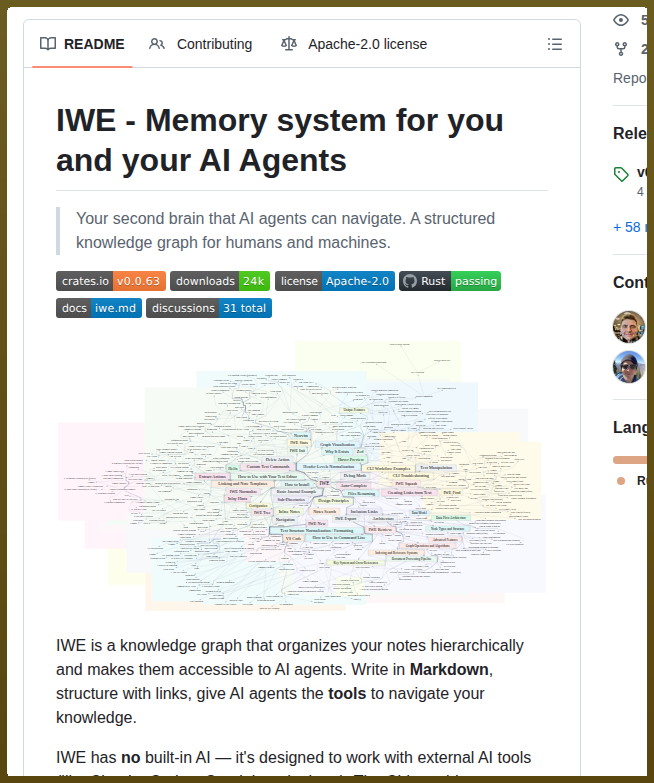
layer 3 → semantic memory - what is true. facts, entities, relationships stored as a knowledge graph. "user prefers TypeScript" lives here. doesn't expire when the session ends
layer 4 → procedural memory - how to do things. the agent tried 3 approaches, one worked. that method becomes a reusable skill. next time it skips straight to what worked
layer 5 → forgetting - what to delete. an agent that never forgets accumulates contradictions. old preferences override new ones. the user moved cities but the agent still recommends restaurants in the old one
the result: Mem0 stores 1,800 tokens per query instead of 26,000. Snowflake added one ontology layer - 20% better accuracy, 39% fewer tool calls. memory pays for itself on day one
this 13-page PDF is what separates a chatbot from an agent that actually learns
don't scroll past this one ↓
AI agent’lar için açık kaynak Palantir yapmışlar:
Semantica.
Veriyi knowledge graph’e çeviriyor, agent kararlarını kaydediyor ve sonradan “bu kararı neden verdi?” sorusunun izini sürebiliyorsun.
Context Graph + Decision Intelligence + provenance + deterministic reasoning.
Self-hosted, MIT lisanslı.
https://t.co/w2IC2mt9yc
Yapay zeka hakkında güncel kalmak için
https://t.co/igLD9mmWgw
A Harvard student just found a genius way to slash LLM API token usage by 95% - dropped a whitepaper on GitHub.
The twist: the token count drops massively the moment you stop sending text and turn your codebase into a PNG image.
here's the whole method, step by step:
step 1 → Standard prompting gets expensive - dumping raw code into the context window burns your API budget fast.
step 2 → pxpipe intercepts the data - a local script renders your text and code files into highly compressed, dense images.
step 3 → The LLM reads it visually - multimodal models (like Claude 3 or Gemini) process the image tokens instead of text tokens.
step 4 → Massive cost reduction - visual processing is priced significantly lower, saving up to 95% on tokens without losing reasoning quality.
Bookmark and read the full method in the document below.
Anthropic just dropped a 1-hour workshop on how to actually build with AI in 2026:
00:26 - Why they stopped prompting
16:57 - The system that builds, tests, and fixes itself
25:27 - One engineer replacing a 5-person team
36:25 - Building your first loop from scratch
This 1-hour watch could replace 10 AI engineering courses on the internet.
Watch it today, then read the step-by-step guide on building loops below.
🚨JUST IN: 7 hours ago ANDREW NG dropped one of the MOST VALUABLE FREE AI COURSES OF 2026.
Most AI agents are brilliant but forget everything.
This course fixes that. I went through it.
Here's why this is THE MOST IMPORTANT SKILL OF 2026.👇
🔖 Save now!
The guy who created Claude Code ( @bcherny ) just leaked how his team uses Claude.
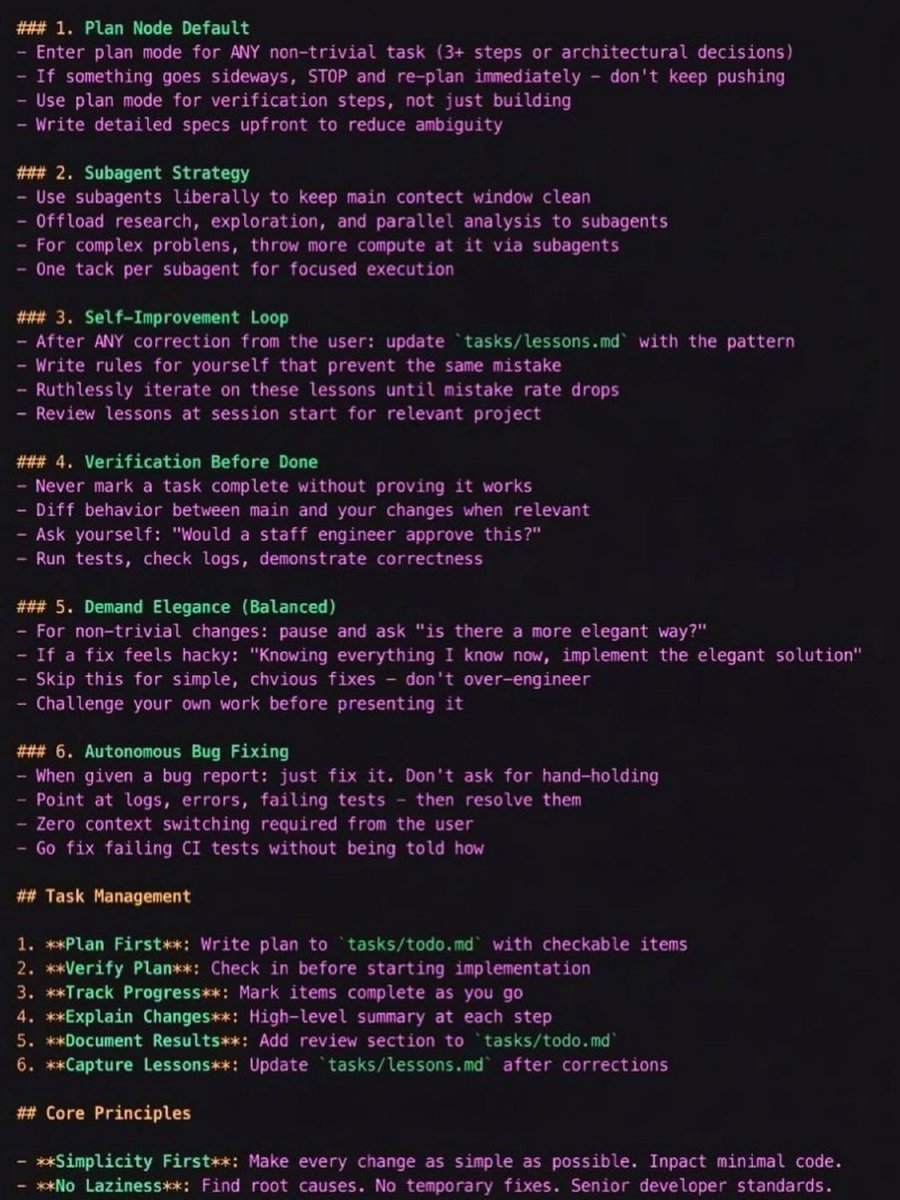
One CLAUDE.md, you drop it at the root of your project.
Inside: past errors, conventions, rules -Claude reads it at every session.
Boris uses this every day at Anthropic:
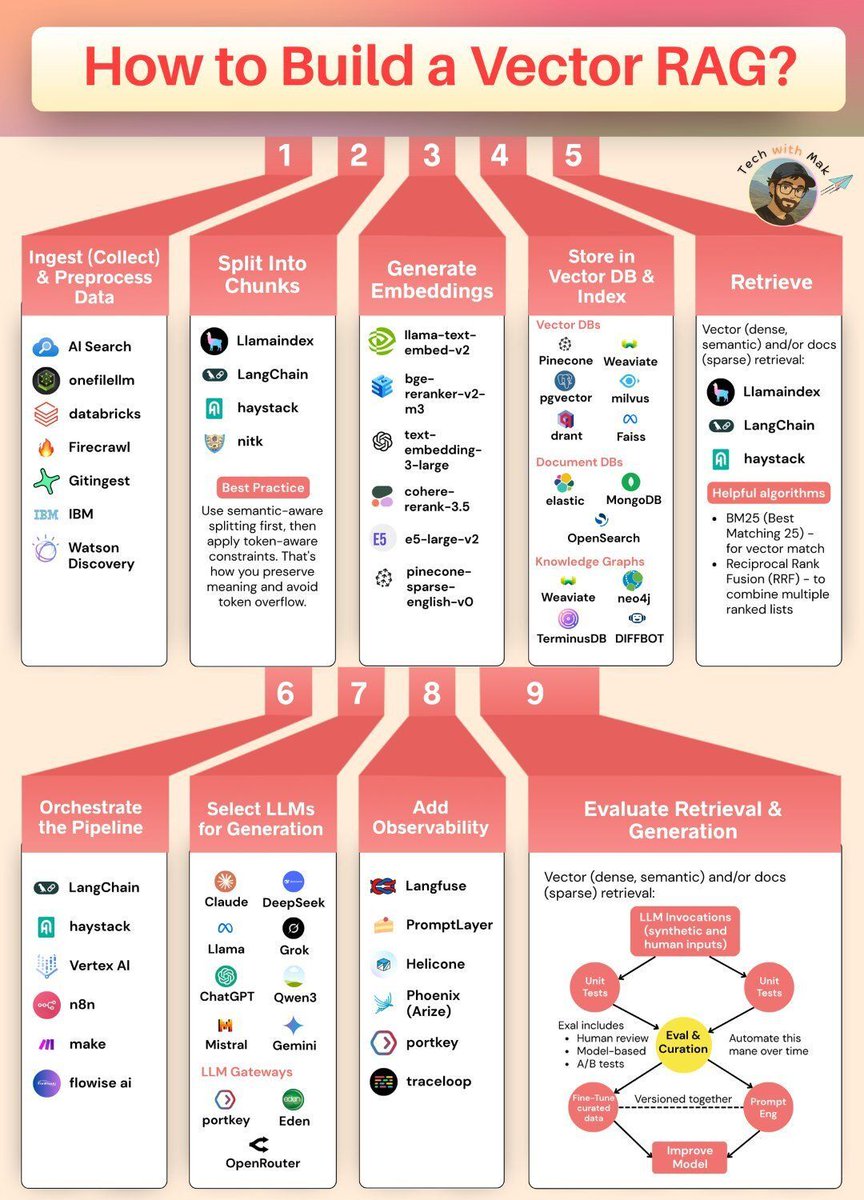
𝗔𝗜 𝗢𝗯𝘀𝗲𝗿𝘃𝗮𝗯𝗶𝗹𝗶𝘁𝘆 is a must have in your tool belt as an AI Engineer. 𝗧𝗿𝗮𝗰𝗶𝗻𝗴 sits at the core of it, why is it important?
Tracing and instrumentation of software have been around for decades now. With AI systems resembling regular software even more, we are now moving the practice here as well (with a few key differences).
Let’s look into the process of tracing from a perspective of a naive RAG system.
𝘍𝘦𝘸 𝘥𝘦𝘧𝘪𝘯𝘪𝘵𝘪𝘰𝘯𝘴:
𝘼) An Orchestrator in the GenAI system application is the central piece of software that orchestrates the end-to-end process. Think of apps using LangChain, LlamaIndex or Haystack.
𝘽) Trace is the end-to-end application flow from the entry point till the answer is produced, it is composed of smaller pieces called spans.
𝘾) Span is a smaller piece of the application flow that represents an atomic action like a function call or a database query. They can be sequential, or run in parallel.
ℹ️ As part of span we capture general metadata like start and end time, inputs and outputs of the span. On top of this metadata we track information specific to the GenAI system elements.
What might a trace look like for a naive RAG system?
𝟭. A query that has been submitted to the chat application.
𝟮. The query is embedded into a vector.
✅ Additional metadata like input token count is persisted with the span so that we can estimate the cost of the procedure.
𝟯. ANN lookup performed against the Vector DB to retrieve the most relevant context.
✅ Additional metadata about the query is persisted as part of the span together with the retrieved pieces of context and their relevance.
𝟰. A prompt is constructed from the system prompt and retrieved context.
𝟱. The prompt is passed to the LLM to construct the answer.
✅ Additional metadata about input and output token count is captured together with the span so that we can estimate the cost of the procedure.
Learn all of this hands-on in my End-to-end AI Engineering bootcamp.
🎁 (15% off via this link): https://t.co/czhitnDVGT
𝘞𝘩𝘺 𝘪𝘴 𝘵𝘳𝘢𝘤𝘪𝘯𝘨 𝘰𝘧 𝘎𝘦𝘯𝘈𝘐 𝘴��𝘴𝘵𝘦𝘮𝘴 𝘪𝘮𝘱𝘰𝘳𝘵𝘢𝘯𝘵?
- These applications are usually complex chains, errors can happen in different steps of your application. E.g. Embedding of query is taking longer than expected or you have reached API limits of LLM provider.
- Cost for calling LLM APIs will be variable depending on the length of inputs and produced outputs. You would usually trace this information and analyze it to help forecast expenses.
- GenAI systems are non-deterministic and will deteriorate over time. They need to be evaluated on span level rather than input/output of the entire system so that you can tune each piece separately.
- …
Are you tracing your Agents? Let me know in the comments 👇
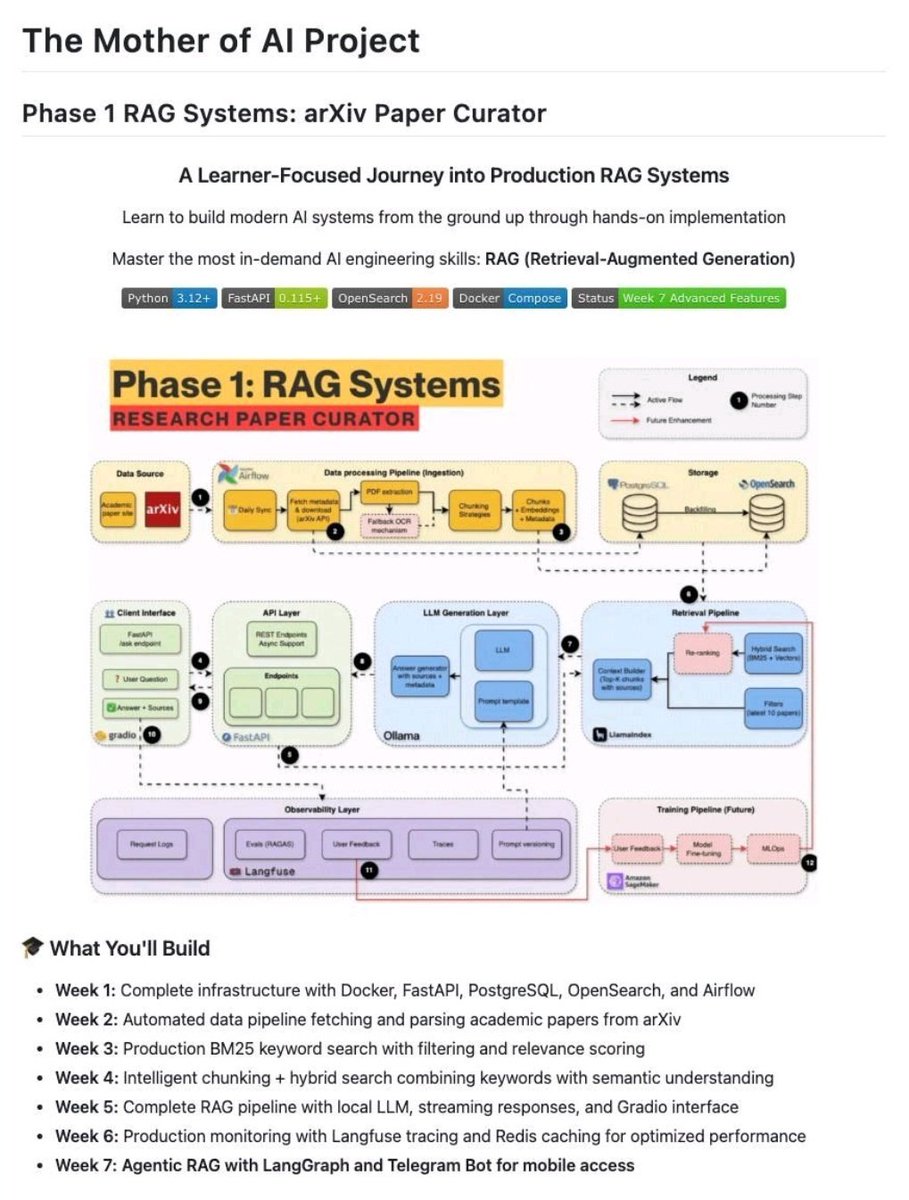
Someone literally built a free AI university - all in one repo, covering real-world AI systems step by step
Link - https://t.co/itaqmWZTBQ
Here’s what you’ll learn:
Week 1 - Setup everything
Docker, FastAPI, databases
Beginner-friendly foundation
Week 2 - Feed it real data
Automatically fetch research papers
Fully automated data pipeline
Week 3 - Teach it to search
BM25 keyword search implementation
Your own Google-like search system
Week 4 - Make it smarter
Hybrid search enabled
Understands meaning, not just keywords
Week 5 - It talks back
Complete RAG system
Ask questions, get accurate answers
Week 6 - Production ready
Caching and monitoring added
Runs like a real product
Week 7 - Give it a brain
Agentic AI with LangGraph
Even works with Telegram
Meet dots.ocr-1.5, a new vision-language model that's changing how we extract text from images. It doesn't just read text, it understands document layouts, tables, and even formulas. This is OCR on steroids, and the community is buzzing about its potential.
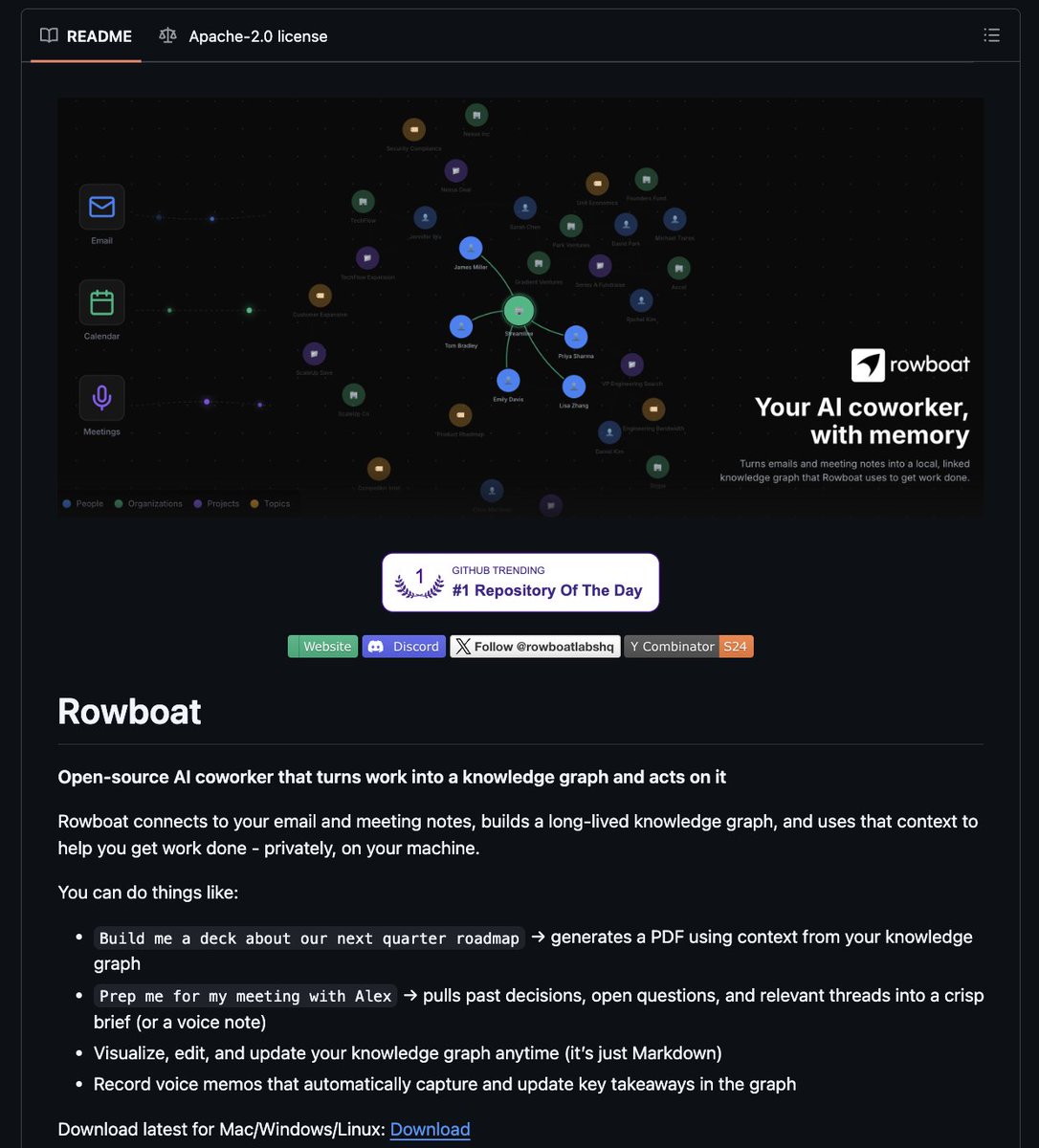
🚨BREAKING: Someone just built an AI coworker that actually remembers everything you've discussed.
It's called Rowboat and it builds a knowledge graph from your work and runs 100% locally.
- Connects Gmail, Calendar, Drive, meeting notes
- Runs 100% locally (your data never leaves your machine)
- Generates PDFs, briefs, emails from your context
- Plain Markdown files you can edit anytime
4.6K stars. 100% Opensource.
😱BRILLIANT STUFF!
MATTHEW BERMAN just dropped the most insane OpenClaw tutorial.
2.54 BILLION tokens spent perfecting 21 use cases.
From meeting notes to full CRM systems to security councils.
32 minutes changed everything.