We're rolling out new pricing for the Mastra platform!
We've updated our Free plan and added a $25 plan to make it easier and cheaper for everyone to get their agents live and into production.
More details in the blog post: https://t.co/92wmVfRb49
Every AI chat is built for one human
So I put an AI in a group chat with 3 people. It knows who's away, who can't do Mondays, and who gets to make the call
Multiplayer agents, built with @mastra 👇
What happens after you find an agent failure?
On Thursday, we'll show you what should happen - turn failed traces into datasets, compare changes with experiments and scorers, and automate regression evals
Join us as we build this eval loop live!
https://t.co/yrLILoQsAQ
I'm now building an "improvements" feature into all of my personal vibecoded applications: a freeform text input that's hooked up to an agent that yolo implements whatever is submitted.
It's an interesting experience -- the activation energy barrier to sanding any rough edge or implementing any new feature becomes extremely low. Someone else who uses one of the applications I created has already implemented 150 improvements over the course of a few days. This pattern feels like a new kind of tool -- liquid software? -- and every application that doesn't have this feature now has a slightly rigid and anachronistic flavor. Why can't I just tell it how I want it to be different?
Now, it's not obvious to me how this pattern can or should scale. Does it become unmaintainable after a while? (Maybe model intelligence improvement outstrips my feature appetite such that it's fine?) How does collaborative software work in this model? Can software designed this way be secure and reliable?
Whatever the larger questions about broader deployment, it definitely works great in a personal context. It reminds me a little of the visions of Lisp/Lisp machines, Smalltalk, and HyperCard -- systems that the user can take control of and modify. Those visions never quite worked, though: the vast majority of software today is not end-user modifiable in any useful way. So, while this "liquid" affordance is a very small touch, the way it changes one's relation to the software feels a bit transgressive and empowering in a Lickliderian and Engelbartian way.
Fair play! This is one of the coolest little demos I've seen lately. Just spent half an hour poking around my favourite spots in London. Very charming.
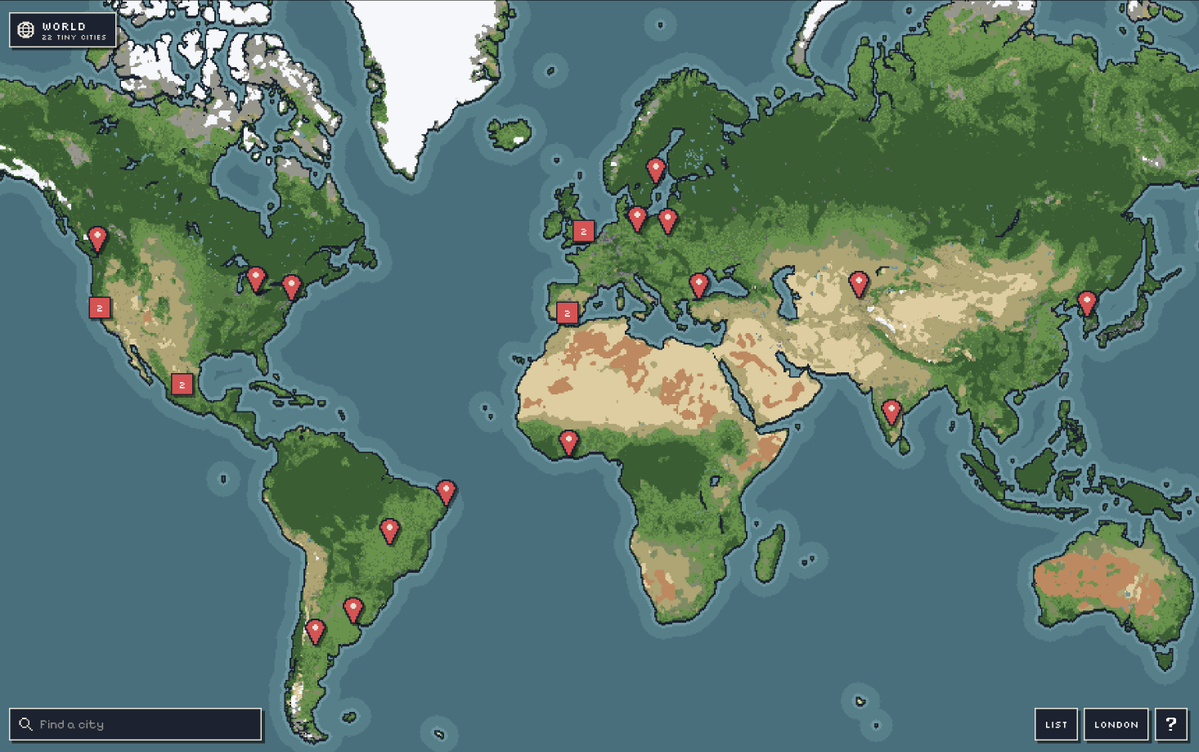
introducing https://t.co/NdaN3oeDhY
after https://t.co/427WVkl8io & https://t.co/UHEsK4oFRm went viral, dozens people did same maps for their cities. i put all of them in one place
from tashkent to goiânia check how similar but different they are!
Slack isn't going anywhere soon.
The agent experience isn't great right now, and progress feels slow. But it's not enough to build a better mousetrap. Slack is too hard to leave. Your message history and connections live there, and the network effects are huge.
If something does dethrone Slack, it'll be less distracting, help you deal with fewer messages less often, and feel agent native.
If it happens, it'll take a while. And it'll come from a player that already has distribution -
like Linear or Notion 😉
prediction: for the first time ever, slack will see major competition
it will happen in the next few months
by end of 2027, majority of modern silicon valley companies will be using something else
Every vector database has its own SDK, query syntax, and filter rules.
Over the last six months we've added seven: same 𝚌𝚛𝚎𝚊𝚝𝚎𝙸𝚗𝚍𝚎𝚡, 𝚞𝚙𝚜𝚎𝚛𝚝, 𝚚𝚞𝚎𝚛𝚢, and 𝚏𝚒𝚕𝚝𝚎𝚛 on Weaviate, Couchbase, OpenSearch, Turbopuffer, etc
Swap stores w/o rewriting your code:
We're making the Mastra Observability dashboard best-in-class
And everything in it works headless too
So you can ask your coding agent to inspect traces and aggregates, and even fix things - potentially automatically 👀