Over the last few months, we’ve noticed a shift towards a new paradigm for agents: instead of assigning tasks, you assign metrics or outcomes. A Devin Bot owns such an outcome and pursues it for days or weeks - leading a team of agents towards it.
It was clear this would become the next paradigm but it wasn’t clear what the right interface for it would be. As a company we like to take the time & iterate until we get it right. We noticed we had hit gold once Bots started spreading internally, including on the research team where researchers have organically switched their day-to-day work to it. In our latest sprint, it has allowed us to achieve substantial research acceleration & compress weeks into days.
Big shoutout to the Poke team (@marvinvonhagen@felixms@samyok@maxiloh1) who played a big part in this launch (and of course many others!). Bots brings the best parts of Devin & Poke together. While it’s optimized for software engineering, it’s also a great personal chief of staff and hopefully more to come on that front too.
I've migrated 100% of my work to Devin Bots over the past few weeks, the experience has been nothing short of mind-blowing and delightful, it's something I look forward to using more every day (and has completely changed the way I approach agent orchestration)
Here are some of the ways I'm using Devin Bots:
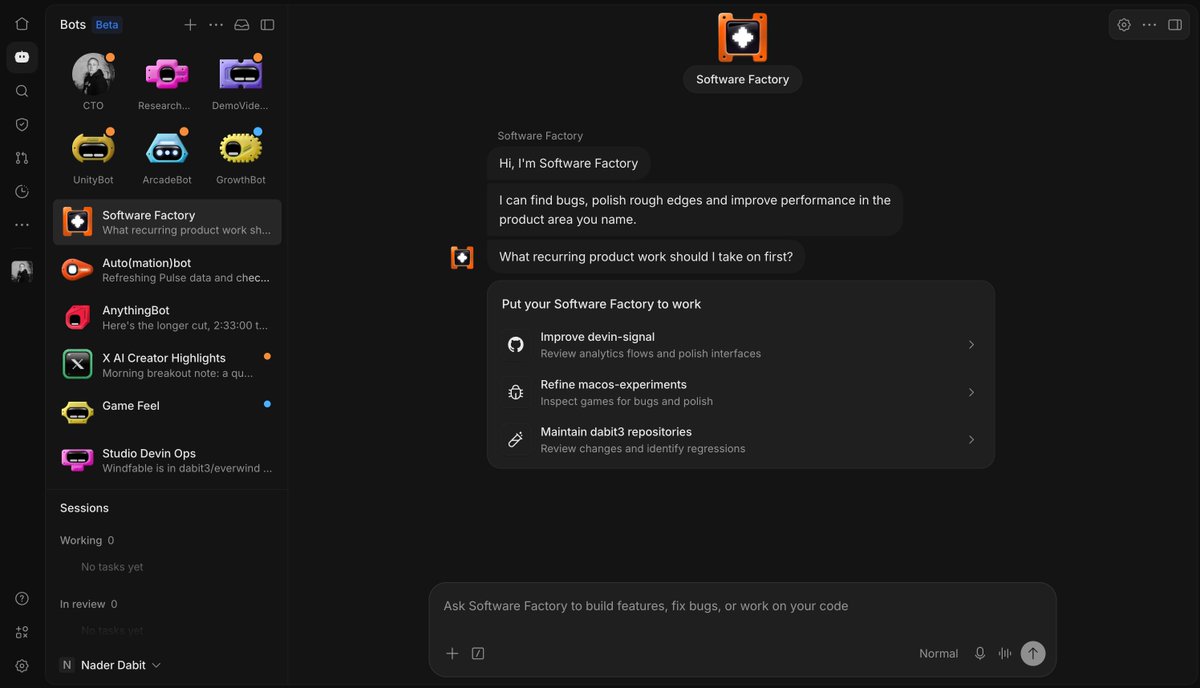
CTO - my go-to, has access to all of my sessions, all repos, etc.. I shoot off a lot of one-off tasks to my CTO, get status updates from other Bots and sessions. I also have him connect to iMessage so I can text him anything any time (VIP) which allows me to talk to *all of my bots* via SMS
Auto(mation)Bot - manages a bunch of automations I have for personal and internal dashboards and reports that poll data from various places, gives me ideas and advice on how to improve, gives me performance reports and advice on how to reduce latency, be more efficient etc...
DevCommunityBot - helps manage our ambassador program, transfers data between various spreadsheets, notion, etc.. and creates mini-apps and other data visualization to help me understand our strengths / weaknesses and gives me advice and ideas for what we should do to improve, what's working / not working, and what's working for other people that we're not doing
Poke - Poke is my non-engineering and personal assistant, I also have it doing research and any general task I don't want in my CTO feed
DevRelBot - this is still a work in progress, but essentially it is doing documentation improvements, tutorials, videos, content research, and general ideation. The videos are probably the most interesting thing here because Devin has its own Computer (macOS, Windows, and Linux), its own Devin account, its own GitHub account, its own Linear account, etc.. as well as an ElevenLabs API key and a few other API keys so it can boot up a browser, sign in to Devin, and record the actual real UI. I have it looking at our changelog and creating either concise demo videos or in-depth tutorials. Videos it has created: https://t.co/UJng20Lqv1, and https://t.co/8xImEaBrr8 are examples (if you're wondering, no that's not my voice, that's a voice clone using @ElevenLabs!)
Finally gaming (a big platform focus for our team @cognition going forward) - @xujennyc has set me up with a suite of gaming Bots that let me run a small game studio for Windfable (photo attached), our Unity RPG for the iPhone Duo! SuperJenny leads ~10 Bots and rolls all requests into a main inbox. Every Bot gets its own macOS + Xcode + Unity so it has the option to build the game for iOS + play it on a Duo. They test literally everything, including Duo specific stuff like "folded as a phone" and "unfolded as a wide tablet". Every change comes back with before and after screenshots side by side of the game and a video of the gameplay! Overnight they catch bugs nobody reported and come back with the fix already tested. It's actually insane how good and easy Unity development has been using Devin + macOS VMs.
If you've made it this far, thank you! I want to shout out the entire @cognition team that I feel so incredibly fortunate to work with. The amount of care, thought, and effort that has gone into this is nothing short of mind-blowing. I feel extremely honored to work around such an incredible group of people everyday 🙏. We have a lot of amazing new things coming soon as well.
"This is like a weather app, and the weather is me."
Here’s how @bryan_johnson uses Devin Bots to ingest billions of data points into one synthesis of how he’s doing.
Your Devin Bots collaborate with each other to get things done: QA Bot finds a bug and hands it to your Developer Bot to fix. You can follow along in Slack, group chats, text, or phone call.
Devin Bots go beyond personal agents to focus on professional software engineering. With its cloud computer, Devin Bot handles every step from planning, to code review, and automated testing. The decisions that need you show up in one place.
In 2015, I built an AI that detects early cancer.
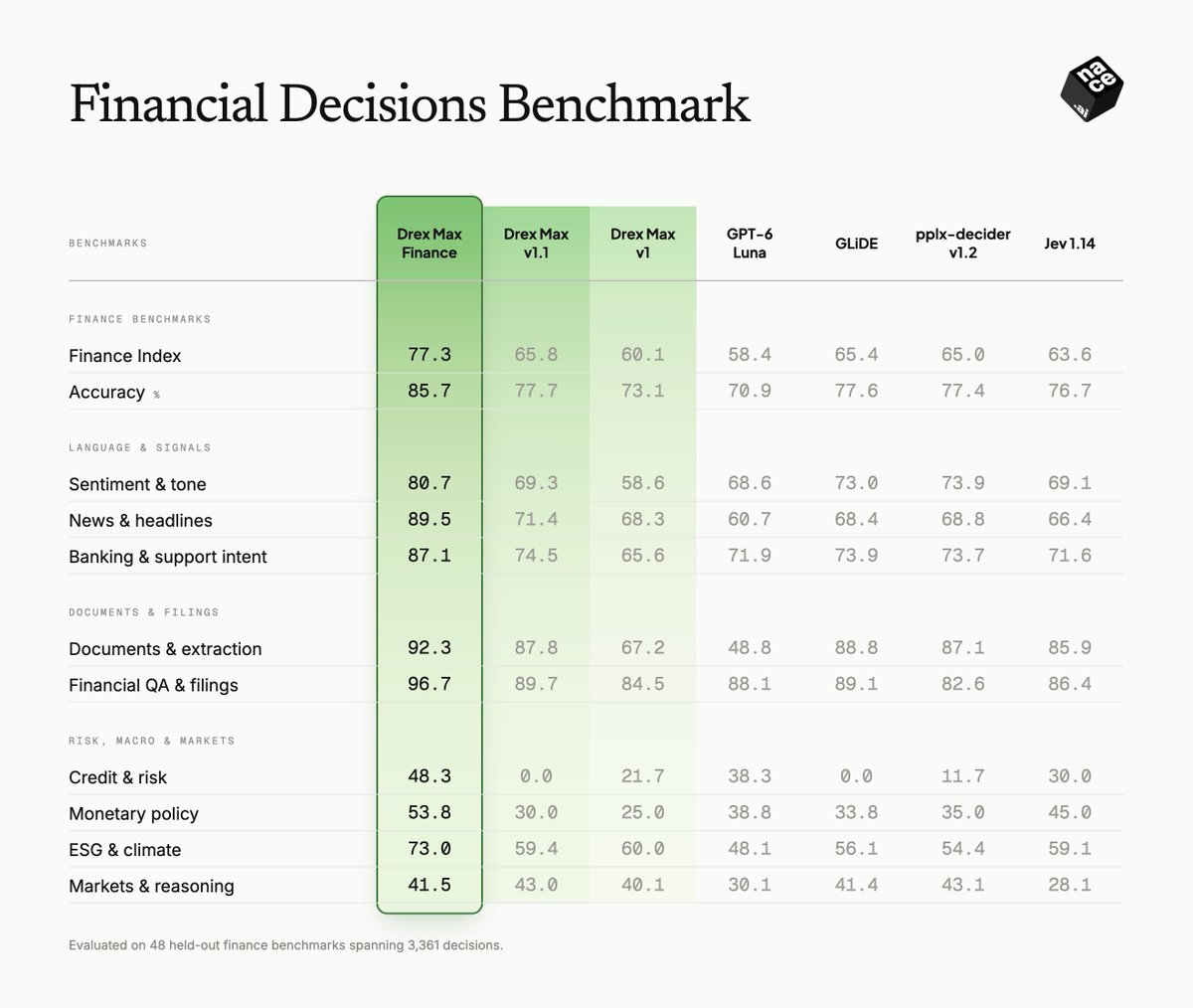
Today, we’re introducing ARC by Rayline: the world’s first unified model for routing AI.
> 97.5% of Opus 5.5 quality
> Up to 1/10th of the cost
> Fully open-source
It picks the right model and the right amount of thinking for every step of your agent’s work.
Try it here and read our technical report below:
https://t.co/P7LCZwhMuQ
🚨 جوجل تضرب سوق الذكاء الاصطناعي في مقتل وتكسر الأسعار رسمياً! 🤯🔥
إطلاق نموذج Gemini Decision 1 الخارق للمشتركين والمطورين عبر الـ API.. والقوة لا تكمن فقط في أدائه، بل في سعره الخيالي!
🔹 المواصفات المرعبة:
▪️ السعر: $0.10 فقط لكل 1 مليون توكن! (بدون أي تكاليف خفية)
▪️ يدعم بشكل أصلي (Native): الصور، الصوت، الفيديو، وملفات PDF!
▪️ نافذة سياق عملاقة: 256K context window!
▪️ دعم لمعالجة 1K سؤال دفعة واحدة.
💡 التجربة مجانية بالكامل الآن على Google AI Studio!
المنافسون في مأزق حقيقي.. من يستطيع الصمود أمام نموذج خارق بهذا السعر؟ 🎯🧵👇
We've shipped a lot of features to Devin and Devin Desktop, let's dive in to 20 things you might not know Devin can do.
Starting with Local Hands: Devin Cloud can run commands on your machine.
Gostei dessa alternativa para acessar o WhatsApp pelo servidor dos bots, sem precisar de interface.
https://t.co/DQDDMiXsUN
Assim da pra plugar o Whats, e os agentes ver e controlar por lá. Sem precisar do MCP, vai direto no CLI.
Esse é uma modificação mantida pelo @steipete
Users can now auto-connect plugins when they log in to Claude, with MCP servers that accept Claude as a trusted issuer.
If you’re building plugins for Claude, add support so users get started faster and stay connected without re-authorizing.
An Anthropic engineer just broke down how to build autonomous agents with Claude, from basic agentic loops to managed agents that learn from past runs:
• 00:00 - Build your first agent using the Messages API and tool calls
• 01:20 - Use the Claude Agent SDK for tools, filesystems, and sandboxes
• 02:40 - Deploy Claude Managed Agents with secure infrastructure
• 04:00 - Manage credentials, sessions, and observability
• 06:00 - Give agents persistent memory across different runs
• 08:00 - Use Dreaming to extract lessons and improve future performance
• 10:00 - Build agents that become more effective through repeated work
the key insight: an agent should not start from zero every time.
Give Claude a computer, persistent sessions, and memory. Let it review previous runs, identify patterns, and carry those lessons into future tasks.
This is the shift from building agents that execute instructions to building systems that improve through experience.
Watch and bookmark this one if you're serious about building AI agents.
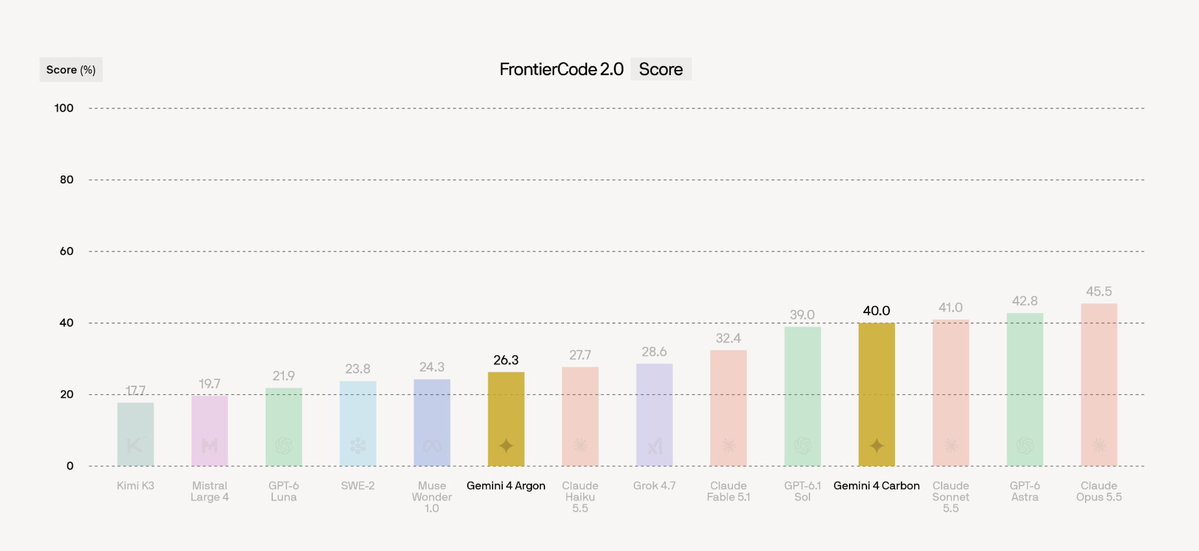
We've evaluated Gemini 4 Carbon and Gemini 4 Argon on FrontierCode 2.0, our coding benchmark that measure's a model's ability to go beyond the spec.
Gemini 4 Carbon scores near SOTA with a score of 40% and a cost of $4.04 per task, behind Claude Opus 5.5, GPT-6 Astra, and Claude Sonnet 5.5.
Gemini 4 Argon scores 26.3% with a cost of $6.41 per task, ahead of Muse Wonder 1.0, but behind Claude Haiku 5.5 and Grok 4.7.
See the leaderboard with full scores: https://t.co/PPHwljDuaN
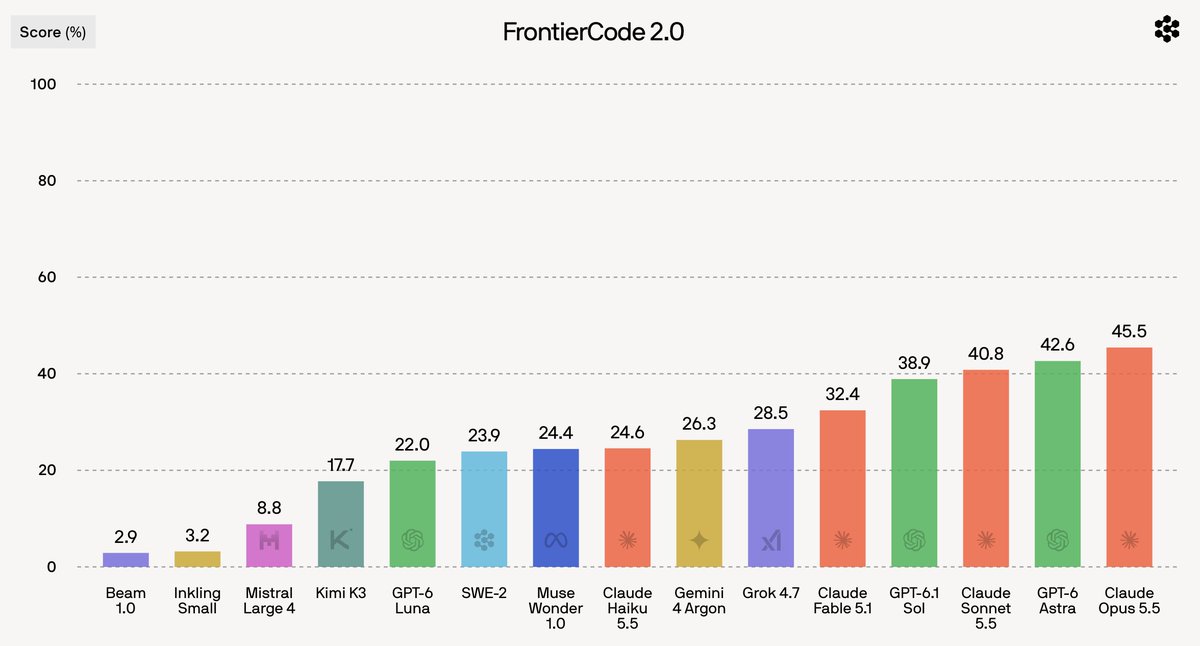
Introducing FrontierCode 2.0: our new coding benchmark that measures a model’s ability to go beyond the spec.
Most coding evals measure a model’s ability to write code that meets a spec. With FrontierCode 1.0, we asked a new question: would you actually merge the PR?
FrontierCode 2.0 is comprised of more diverse tasks, featuring larger scopes and higher mergeability standards. We are now asking: not only would you merge this PR, but should you?
One key feature of FrontierCode 2.0 is underspecified prompts. Rather than including every engineering decision, prompts are deliberately ambiguous, giving the models room to demonstrate their judgment.
The result is a benchmark that is far from saturated, with the top model scoring just 45%.