"Investing in crypto is like a box of chocolates, you never know what you're gonna get,unless insiders got it first."
#NFTs, #Metaverse, #Crypto, #Web3
If the #Crypto market does begin to sniff out a large liquidity expansion it will begin to reprice it a lot faster than 2020
The playbook is now known
If the market starts rising for no reason; that is the reason
@TheCryptoDog Being a parent is hard, it‘s not for everyone. Tough, you at least had parents compared to other children. Respect to you, but also your parents who decided to have you whether intentionally or unintentionally. Without them you won‘t be born neither be who you are today.
Maybe an unpopular opinion: a cryptocurrency that solves the trilemma doesn't need to convince everyone it solved it (right away or at all). The true properties it has achieved will showcase themselves in time, through challenges and dynamics as the economy evolves over it.
@Washigorira The blockchain trilemma was already solved in November 2021 by the Kaspa currency. It launched fairly, with no pre-mine and no pre-sale, and it uses proof-of-work. The founder of Kaspa is also one of the engineers behind Ethereum — what a coincidence.
Kaspa's Stock-to-Flow Ratio Just Surpassed That of Silver
At approximately midnight Eastern Standard Time on December 4, 2025, Kaspa’s stock-to-flow (S2F) ratio quietly crossed a historic milestone: it surpassed that of silver.
While a commodity’s S2F ratio does not directly determine its market capitalization, since many other factors influence fiat price action, if KAS were valued at the same aggregate level as the world’s above-ground silver, its price would be roughly $122 per KAS.
If one believes Kaspa to be the most advanced form of money ever devised, offering a ledger superior to silver or any other monetary commodity, then on what basis should we assume its market cap could never exceed silver’s?
Unlike gold and silver, Bitcoin and Kaspa are digital commodity monies that, for the first time in history, provide ledgers where the stock-to-flow ratio can be precisely measured and independently verified by anyone. In contrast, gold and silver rely on trust-based systems and remain vulnerable to coordination failures and information asymmetries.
In this respect, Bitcoin and Kaspa represent superior ledger technologies. They resolve the Byzantine Generals Problem, ensuring consensus without centralized trust.
By the end of this decade, Kaspa’s S2F ratio will exceed that of both gold and Bitcoin.
In his recent talk, @hashdag articulated a comprehensive vision for Kaspa that goes beyond throughput metrics. He moved past technical specifications to define a core thesis: How Kaspa becomes true "Internet Money."
Currently, most blockchains operate as isolated mathematical silos, decoupled from off-chain reality. Here is a technical breakdown of the talk's key points.
1/ Breaking the Isolation: Internal Validity vs. External Reality
Current blockchains optimize strictly for internal cryptographic correctness but lack awareness of external context. Yonatan argues that to function as genuine Internet Money, the protocol must interact trustlessly with real-world events. For instance, upon significant market news (e.g., equity index changes), the chain must be capable of ingesting and reacting to that data immediately.
2/ The Latency Constraint of Nakamoto Consensus
Consider a high-velocity financial event (e.g., MicroStrategy’s inclusion in an index) that impacts asset valuation instantly. On Bitcoin, achieving probabilistic finality for a reactive transaction takes ~60 minutes. In the context of high-frequency internet finance, this latency is prohibitive. Kaspa aims to compress consensus and state reaction times to the moment the event occurs—effectively, a single Internet Round Trip Time (RTT).
3/ 100 BPS as a Statistical Security Parameter
High block rates are not merely for throughput; they provide statistical certainty.
Think of it as majority sampling:
• 10 samples (blocks) per second leaves a non-negligible margin for minority variance or manipulation.
• 100 samples (blocks) per second drives the probability of sampling the honest majority to ~100%.
High BPS enables rapid convergence, making the system resistant to tampering through granular, high-frequency sampling.
4/ High-Definition PoW: The Technical Moat
While PoS is often touted as the modern standard, Yonatan asserts that only Proof-of-Work (PoW) allows for the unforgeable, granular sampling of the honest majority in real-time without susceptibility to manipulation. This capability—High-Definition PoW—is a unique technical moat of the DAG structure that other consensus mechanisms cannot natively replicate.
5/ Future Utility: Native L1 Atomicity & Logic Execution
This architecture transforms miners into decentralized attestors of external state. It enables conditional transaction execution ("If Event A, then Action B") with zero-latency atomicity directly on Layer 1. This eliminates reliance on centralized exchanges or asynchronous bridges, allowing for instantaneous, trustless financial reactions.
6/ MEV Auctions for Execution Safety
To prevent miners from front-running transactions based on privileged knowledge of external events, the system proposes embedding MEV auctions. This mechanism ensures fair transaction sequencing via open bidding, protecting user intent and delegated strategies from exploitation by the consensus layer.
7/ Conclusion: The Nervous System of Value
Kaspa is not merely architecting a "faster Bitcoin." It is designing a reactive settlement layer—a nervous system—capable of synchronizing with physical reality and executing financial logic instantly. This defines the thesis of "Real-Time Decentralization" (RTD), the prerequisite for a true Internet of Value.
$KAS #Kaspa #Layer1 #PoW #DeFi #BlockchainArchitecture #MEV
I was scrolling down a Bitcoin forum when I noticed a post about this new coin claiming to solve blockchain. After it popped up two more times, I had to see what the deal was.
The claims were so big, they forced me to DoMyOwnResearch, one that started two years ago and continues to this day with growing momentum.
I started with (finally) understanding Bitcoin, why it must be slow to be secure, step by step I learned about GHOSTDAG all the way to understanding the basic ideas of DAGKNIGHT - The thing is complex and my understanding is partial, but man… what a beautiful moment that was!
Some solutions are... solutions. But some rare ones are THE solution. Not an incremental improvement, not a patch - DAGKNIGHT is of this rare kind, more of a fundamental truth than a new invention.
During my software dev career, I got paid to build products for companies. Open source projects always excited me but I stood from afar. Until today =]
Kaspa was just too mind blowing, over the last month I decided to step in and work on something I deeply believe in. After a lot of help from the developer community, and @michaelsuttonil in particular, I made my first contribution to an open source project!
Kaspa is intriguing. It's research, math, cryptography, and hardcore software engineering. But it's also community. I mostly stay away from social media, but this time it's different. Contributing great, but contributing to the community in Kaspa's case matters just as much.
In the near future I aim to translate some of the concepts behind the tech, share thoughts & ideas, and hopefully inspire others to jump in as well.
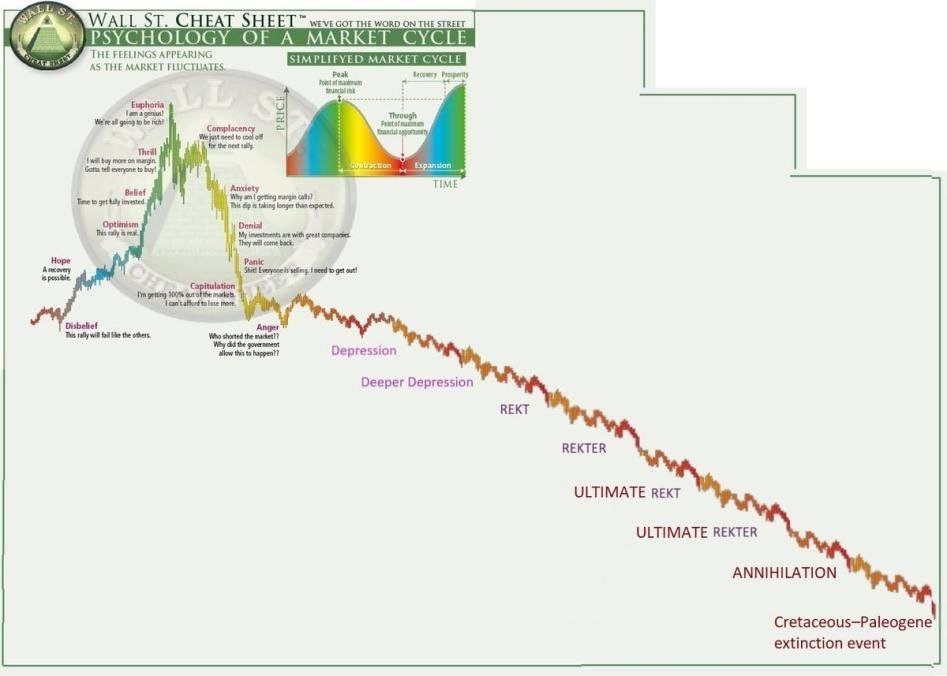
It’s astonishing that with one asset ($BTC) you can control most of the time the entire market (crypto).
Institutions don’t like it!
Some cracks are being seen in crypto already.
Let that sink in what it means for legit projects.
#Bitcoin#Altcoins





![manyfest_'s tweet photo. I was scrolling down a Bitcoin forum when I noticed a post about this new coin claiming to solve blockchain. After it popped up two more times, I had to see what the deal was.
The claims were so big, they forced me to DoMyOwnResearch, one that started two years ago and continues to this day with growing momentum.
I started with (finally) understanding Bitcoin, why it must be slow to be secure, step by step I learned about GHOSTDAG all the way to understanding the basic ideas of DAGKNIGHT - The thing is complex and my understanding is partial, but man… what a beautiful moment that was!
Some solutions are... solutions. But some rare ones are THE solution. Not an incremental improvement, not a patch - DAGKNIGHT is of this rare kind, more of a fundamental truth than a new invention.
During my software dev career, I got paid to build products for companies. Open source projects always excited me but I stood from afar. Until today =]
Kaspa was just too mind blowing, over the last month I decided to step in and work on something I deeply believe in. After a lot of help from the developer community, and @michaelsuttonil in particular, I made my first contribution to an open source project!
Kaspa is intriguing. It's research, math, cryptography, and hardcore software engineering. But it's also community. I mostly stay away from social media, but this time it's different. Contributing great, but contributing to the community in Kaspa's case matters just as much.
In the near future I aim to translate some of the concepts behind the tech, share thoughts & ideas, and hopefully inspire others to jump in as well.](https://pbs.twimg.com/media/G6tnYyjW0AADEYM.png)





