Listing Zebec Network (ZBCN) mulai diperdagangkan di INDODAX pada Kamis, 9 Juli 2026 pukul 14.00 WIB.
Bagaimana sebenarnya ZBCN itu? Baca selengkapnya https://t.co/FawmgP42Zz
Jangan lupa lakukan riset sebelum berinvestasi #AsetMasaDepan ya
#INDODAX#AsetMasaDepan
Hold, spend, and move digital pounds natively on Zebec.
As we expand our footprint in the UK, users can now make real-time GBP transfers and spend natively with their Zebec Cards, with tGBP support on Zebec Enterprise to follow.
👇 Read more: https://t.co/9Gj72iXaws
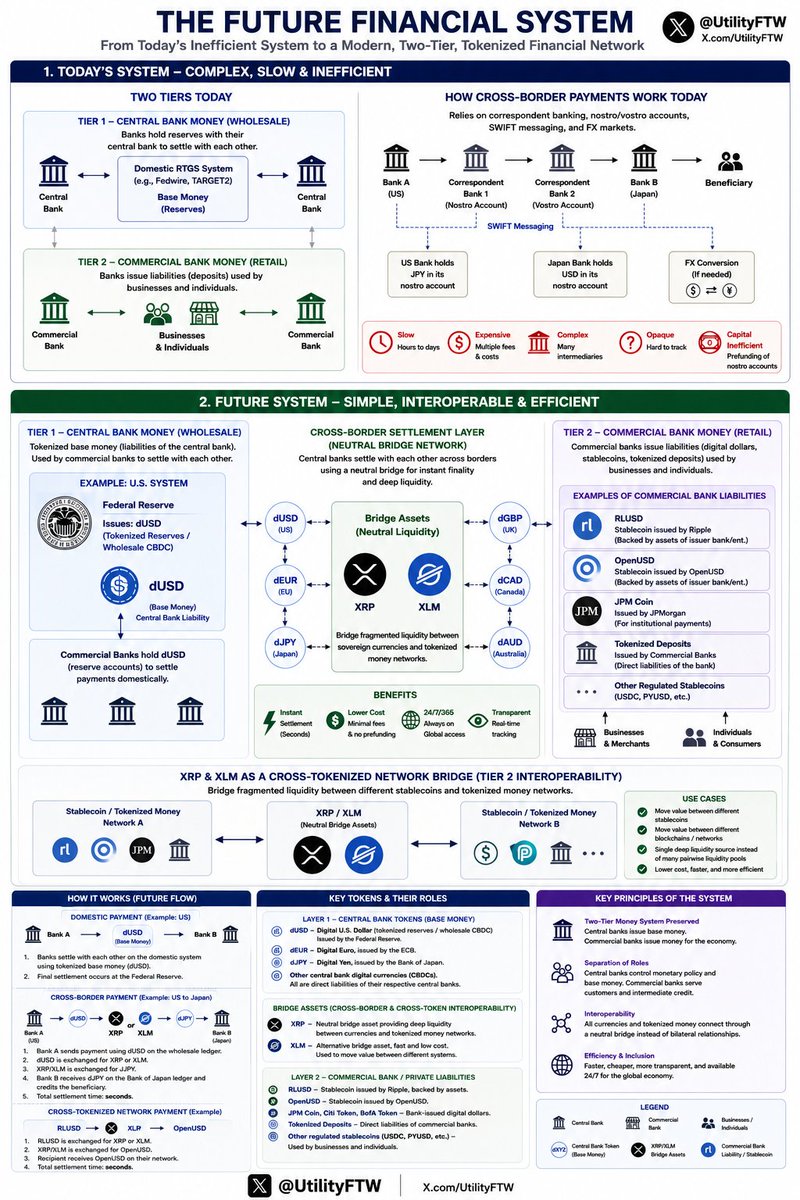
🔥MY CURRENT HYPOTHESIS ON THE STRUCTURE OF THE FUTURE MONETARY SYSTEM 🔥
Stablecoins are just the opening act...
XRP and XLM's ULTIMATE USECASE 🚀🌙
The biggest takeaway from this should be in understanding it's a 2-tier system today, and it will remain a 2-tier system when it is fully digitized.
Central Banks (Layer 1) issue base money as a wholesale liability, which acts as an asset on Commercial Banks balance sheets.
Commercial Banks (Layer 2) then use that wholesale asset to issue liabilities (IOUs) to their customers. This forms 2 distinct USD layers...
Layer 1 is real money, used for interbank settlement in a domestic setting along with being part of a cross-border settlement infrastructure.
Layer 2 is a pegged IOU stablecoins, used for transfers between industry, institutions, customers and consumers.
ALL stablecoins issued today, be it USDT, USDC, RLUSD, OpenUSD or JPM Coin, are only liabilities of Commercial Banks and are only used on the 2nd layer.
In the future, Layer 1 sovereign funds will be settled between nations using a neutral bridge asset #XRP and #XLM.
But Layer 2 can also utilize the same neutral bridge asset when moving value between different stablecoin networks.
The moon 🌙 shots will come when Central Banks start announcing where they will be building their balance sheets and wholesale ledgers... Grown men will weep. I hope ours will be tears of joy.
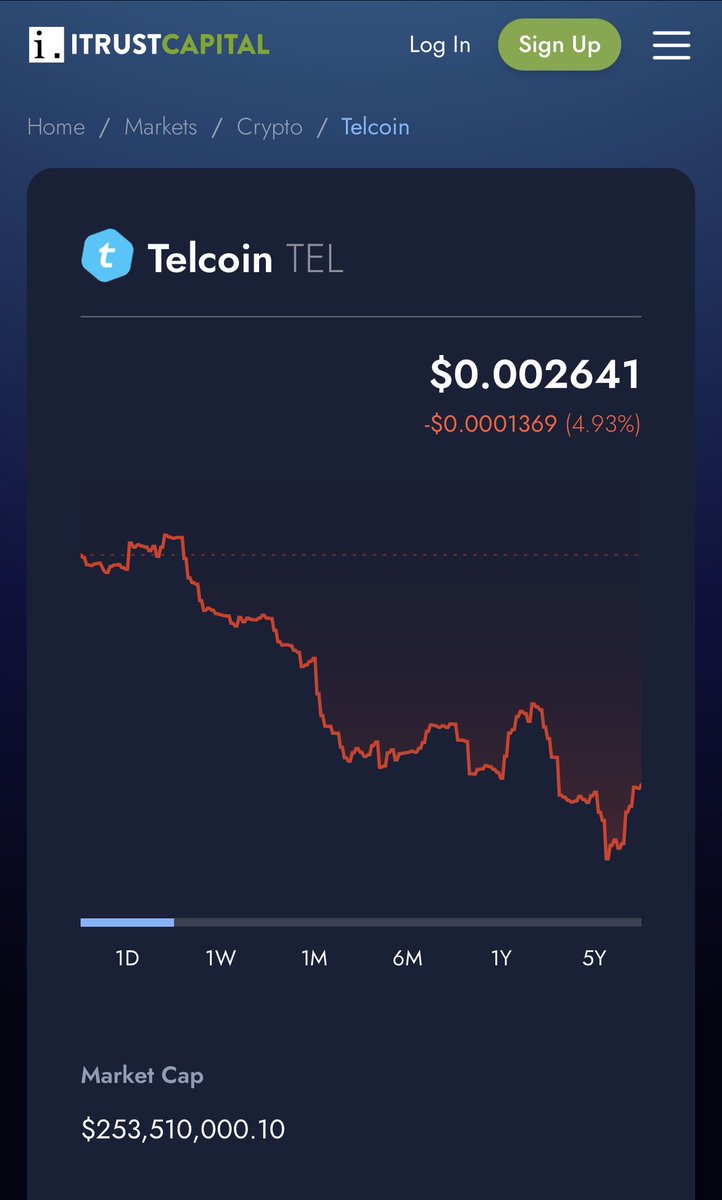
$Telcoin V5 is finally LIVE 🚀
eUSD bank accounts are now available to U.S. residents, with USD deposits converting 1:1 into eUSD Digital Cash.
Spend, send, and use funds on-chain - banking, self-custody, and DeFi all in one wallet.
$LOAN Credit Card
$XMD Debit Card
"Layer 1 and 2 #Spending"
*The How, Why & What it looks like*
You hold XMD.
You swipe the card.
The system checks the best accepted settlement route.
Behind the curtain, XMD converts into USDC, PYUSD, USDP, RLUSD, or fiat.
Merchant gets paid like normal.
I have been thinking about the moving parts of #Metallicus and some this concept may involve pieces already beyond public awareness and in play.
Marshall Hayner has signaled the larger card concept: a Metal Pay card integrated with XMD, powered by $LOAN Protocol, running on $XPR Network, secured by $Metal Blockchain, and connected to credit unions and banks for access on and off the blockchain.
This experimentation isn't to step on that road. This is a thought-exercise detour: an XMD-first debit version or routing layer that could add to the Metal Pay card system.
A credit card extends spending power. A debit card spends existing value. Marshall has pointed out that financial instrument purchases on credit cards can be treated as cash advances, with rates varying by provider. A debit card avoids that by debiting directly from an account balance.
That makes an XMD debit card concept viable: users are not borrowing. They are spending a stable digital balance.
XMD is the best ecosystem stable asset for staying inside Metal X and XPR Network while parking value. XMD is a reserve-backed stablecoin index treasury from Metallicus. The treasury contains USDC, PYUSD, and USDP, and allows minting or redeeming basket stablecoins 1:1 for Metal Dollar. Metal X also describes XMD as the primary stablecoin on Metal X, used for trading against available assets. That makes XMD strong dry powder.
The basket design spreads stablecoin exposure instead of relying on one coin. $USDC, $PYUSD, and $USDP each represent one route. $RLUSD could become another major route when supported. XMD lets the user hold one ecosystem stable asset while the backend manages multiple settlement paths.
Most payment users will not want to choose between USDC liquidity, PYUSD routes, USDP compliance paths, RLUSD corridors, or fiat conversion.
The card experience could be simple: hold XMD, spend normally, let the system route. One transaction may settle through USDC. Another may route through PYUSD. Another may use USDP. Another could use RLUSD. If the card network needs fiat, the system converts to fiat.
The merchant experience stays normal. The user experience stays simple. The backend becomes the new future normal. This benefits Metallicus in concrete ways: XMD becomes spendable treasury money, Metal Pay and Metal X gain volume, TDBN gains partner-bank utility, and credit unions get a modern account experience where members hold digital dollars, spend anywhere, and settle through compliant routes.
XMD could become the universal stable balance inside Metallicus. Instead of choosing which stablecoin to hold, users hold XMD and let the system route.
The hard parts are clear: regulation, liquidity, redemption, and taxes.
Card programs need banking partners, KYC, AML controls, risk controls, disclosures, and card-network approval. Automatic switching only works because pools are deep enough. XMD will remain cleanly redeemable into supported basket assets. Stablecoin spending can also create tax reporting requirements.
Marshall’s card concept could become the main access layer 1 payments between Metal Pay, XMD, LOAN, XPR Network, Metal Blockchain, banks, and credit unions. An XMD-first debit version could become the stable spending layer 2 within that system. One card concept creates access. The other refines how value routes.
Together, they point toward the same outcome: XMD becomes a treasury interface for everyday money.
Hold XMD.
Spend normally.
Route intelligently.
Settle compliantly.
Keep the user experience simple.
Users spend like normal people while the treasury works quietly behind the curtain.
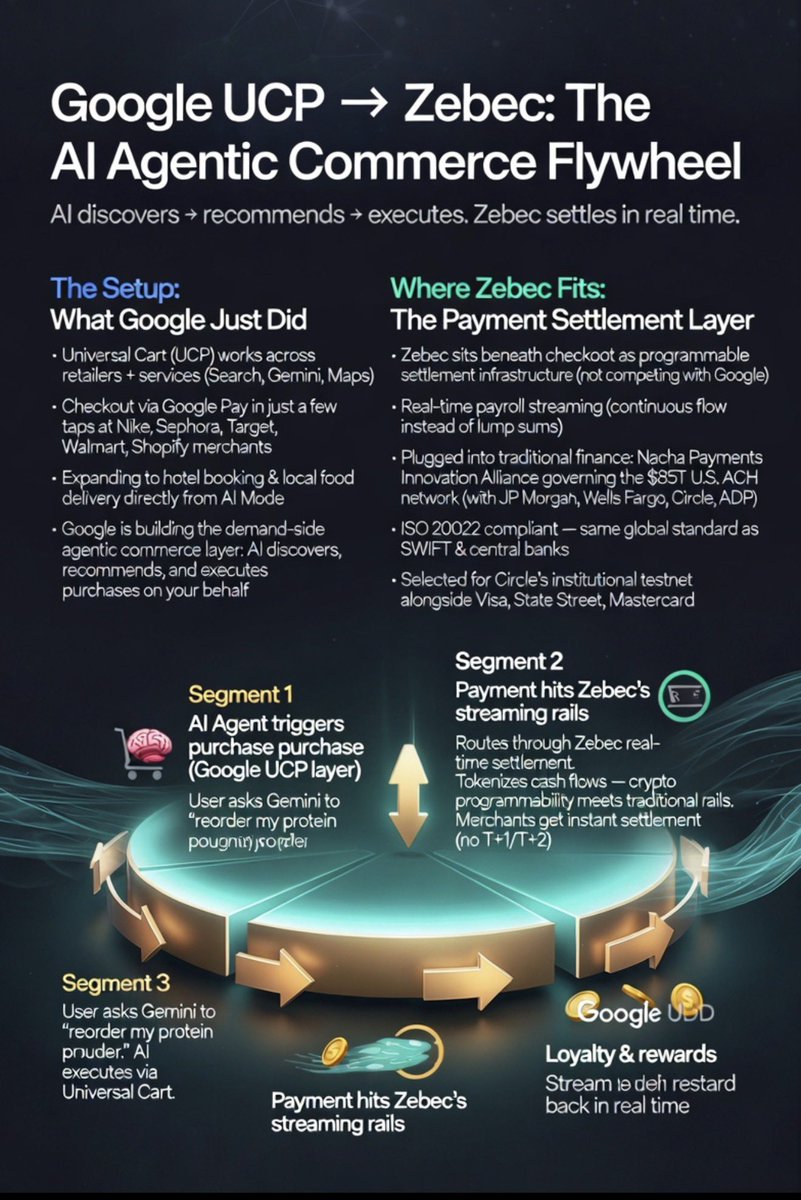
🚨 @Google JUST LIT THE FUSE FOR AGENTIC COMMERCE AND @Zebec_HQ MAY BE THE PAYMENT RAILS BENEATH IT 🚨
Most people are focused on Google’s new Universal Cart Platform (UCP).
They’re missing the MUCH bigger story.
🧵👇
1/ Google is building the demand-side AI commerce layer.
With UCP, users can:
• Discover products through Search/Gemini/Maps
• Add items across merchants into one cart
• Checkout in a few taps with Google Pay
Nike. Walmart. Target. Sephora. Shopify merchants.
And it’s expanding into:
• hotel bookings
• local food delivery
• AI-powered purchasing directly from conversations
This is AGENTIC COMMERCE.
AI doesn’t just recommend anymore.
It EXECUTES purchases for you.
2/ But there’s a major problem:
Google controls discovery + checkout…
…but settlement still runs through legacy rails.
That means:
• delayed merchant payouts
• batch processing
• fragmented loyalty systems
• T+1/T+2 settlement delays
• zero real-time cash flow programmability
AI commerce is moving at machine speed.
Traditional finance still moves in batches.
That’s the bottleneck.
3/ This is where Zebec becomes incredibly interesting.
$ZBCN isn’t competing with Google.
It sits UNDER the checkout experience as programmable settlement infrastructure.
Google handles:
→ discovery
→ recommendation
→ execution
Zebec handles:
→ real-time settlement
→ streaming money movement
→ programmable rewards
→ instant liquidity
4/ Imagine the flow:
You tell Gemini:
“Reorder my protein powder.”
AI executes the transaction through Google UCP instantly.
Instead of waiting days for settlement…
Zebec rails stream funds in real time.
Merchant receives liquidity immediately.
No legacy banking lag.
5/ Now the flywheel starts.
Google UCP already supports loyalty integrations.
But traditional rewards systems are static and delayed.
Zebec changes that.
Cashback and rewards could stream back continuously in real time:
• instantly usable
• immediately spendable
• dynamically programmable
AI commerce becomes a closed-loop liquidity engine.
Google’s latest AI developments highlight a growing shift: AI is evolving beyond assistants into operational workflows.
As agents operate across commerce and subscriptions, infrastructure for real-time creator payouts and subscription payments via stablecoin streaming becomes increasingly important.
$ZBCN ETF in the works? What’s @FalconXGlobal have to do with it? Great video by @CryptoStarRail on this below! 👇 Also, Falconx acquired @21shares in October 22025
https://t.co/aozX2U44zt